Best Things to Do in Bruges, Belgium: The Definitive Guide
Bruges (Brugge) is a UNESCO World Heritage city in northwest Belgium packed with medieval architecture, Flemish masterpieces, canal tours, and craft beer culture. This guide covers the best things to do in Bruges, with real prices, seasonal tips, and honest takes on what's worth your time.
Plan and book this trip
Tools from our partner Travelpayouts help you compare flights and hotels. If you book through them, we may earn a commission at no extra cost to you.
Flights
Hotels map
TL;DR
- Bruges (Dutch: Brugge) is a UNESCO World Heritage city of around 120,000 residents in West Flanders, Belgium, with most major sights within easy walking distance of the Markt.
- Top priorities: climb the Belfort (€16, 366 steps), take a canal boat tour (€15 adults, guaranteed March–October), and spend a morning at the Groeningemuseum for Flemish Primitive masterpieces.
- The historic centre is compact enough to cover on foot in a day, but two days lets you explore properly without rushing.
- Avoid weekends in July and August if crowds are a concern. Late spring (May–June) and early autumn (September–October) offer the best balance of weather and visitor numbers. See the full best time to visit Bruges guide for detail.
- Bruges is not a village. It has world-class art museums, a medieval brewery still operating inside city walls, and one of Europe's best-preserved Gothic city centres.
The Landmarks Every Visitor Should See
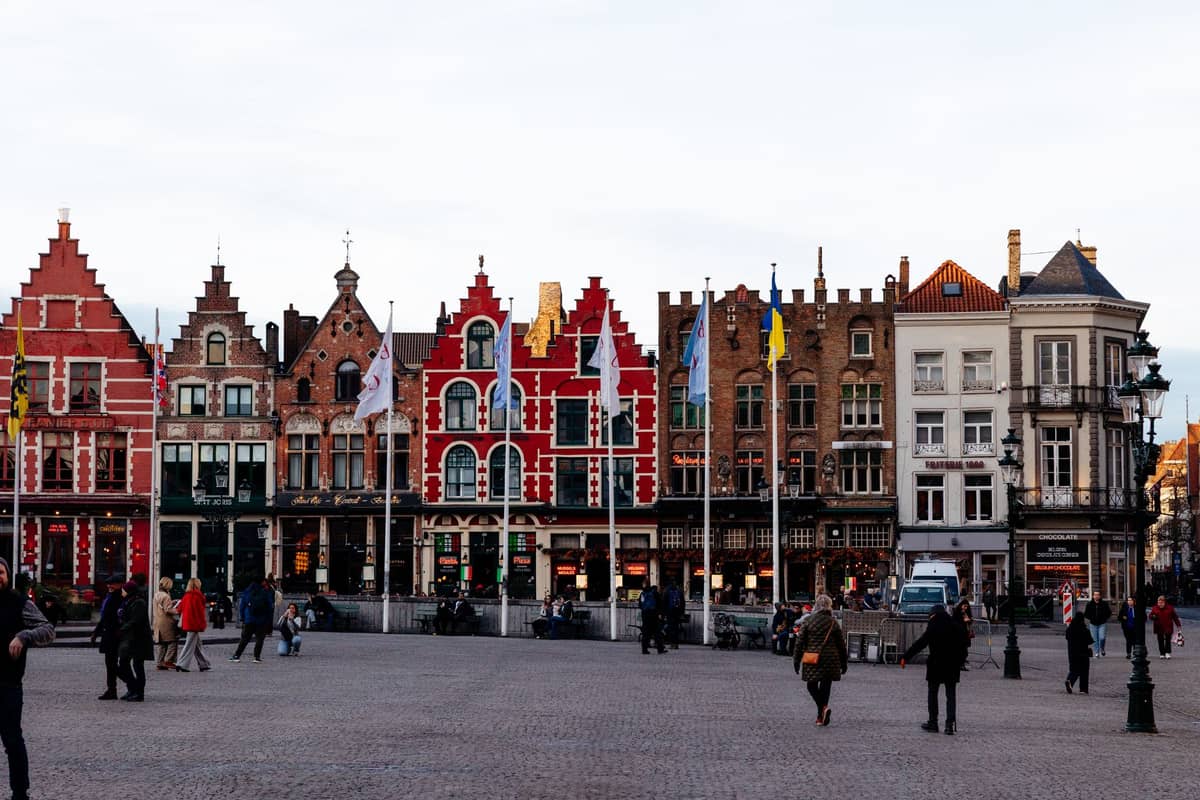
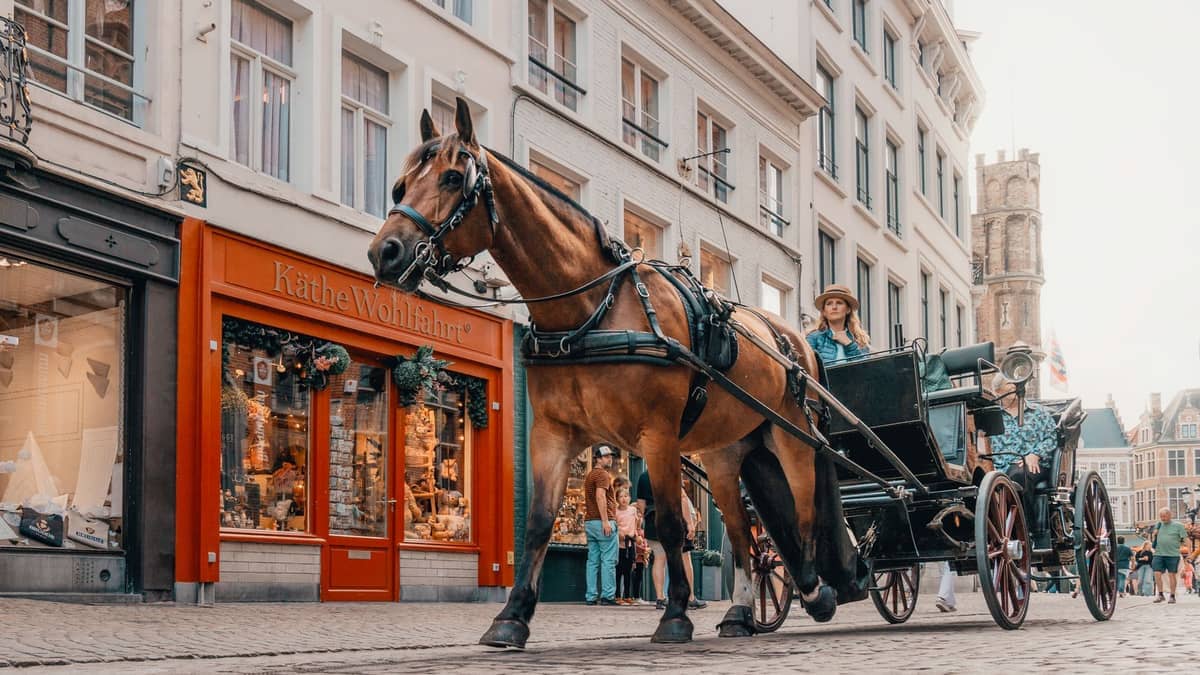
Start at the Markt, the central market square that has been the commercial heart of Bruges since the 10th century. The square is photogenic at any hour, but early morning (before 9:00) offers the cleanest views before tour groups and horse-drawn carriages arrive. Flanking it to the east is the Burg Square, a more intimate space containing the Gothic Stadhuis (City Hall) and the Basilica of the Holy Blood, one of the most significant religious sites in Flanders.
The Belfort van Brugge (Belfry of Bruges) rises 83 metres above the Markt and is the defining silhouette of the city. Tickets cost €16 in summer and on weekends and public holidays, €15 on winter weekdays. The 366-step climb is narrow and steep, and the top platform has limited space, so expect to queue during peak periods. The carillon mechanism near the top is worth pausing for. Visitors under 7 enter free. Book online through Musea Brugge to skip the ticket desk.
💡 Local tip
The Belfort queue moves fastest right at opening time (typically 09:00 in summer and 10:00 on most winter weekdays, with earlier Saturday openings). Arriving 10 minutes before doors open on a weekday avoids the worst of it. The top platform holds only a handful of people at once, so even a short wait at the bottom can mean a quiet summit.
The Basilica of the Holy Blood on the Burg houses a venerated relic and occupies two stacked chapels of contrasting styles: the lower Romanesque chapel (12th century) and the upper late-Gothic chapel. Entry to the basilica itself is free, though the treasury museum charges a small admission. It is compact and can be seen in 20–30 minutes. On Friday afternoons during the Veneration period, the relic is displayed for the public, drawing longer queues than usual.
Canal Boat Tours and the Waterfront
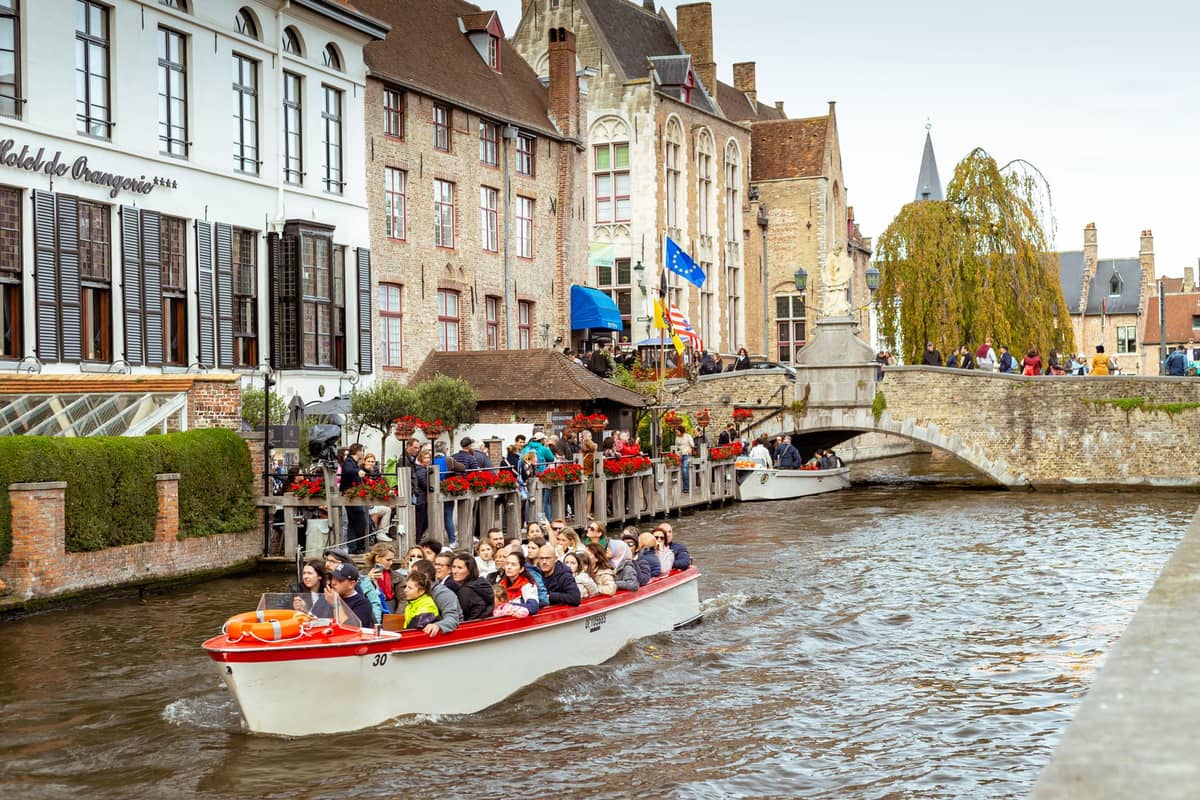
Taking a canal boat tour is one of the most popular things to do in Bruges Belgium, and for good reason: the city's medieval skyline looks entirely different from water level. Boats depart from five landing stages near the Rozenhoedkaai and Dijver canal. Tours run approximately 30 minutes and cover the central canal network. Adult tickets are around €15, children aged 4–11 around €9, and under 4s travel free. Boat tours are guaranteed from March through October: daily, 10:00–18:00, with the last departure 30 minutes before closing.
Outside March–October, boat tours operate on a conditional basis depending on weather and demand. If you are visiting in November or February, check locally on the day rather than planning around it. Weekend queues in summer can stretch to 45 minutes or more at the Rozenhoedkaai landing. The Nieuwe Gentweg and Katelijnestraat landings tend to have slightly shorter waits.
⚠️ What to skip
Canal boats do not run 24 hours or year-round. Winter visitors (November–February) should not count on boat tours as a reliable activity. Check the official Visit Bruges website or ask at your accommodation before heading to the quay.
For a self-guided alternative, walking the canal-side streets is free and often more rewarding than the boat at peak times. The stretch from the Rozenhoedkaai south toward the Minnewater (Lake of Love) passes the Arentshof garden, the Bonifaciusbrug footbridge, and the outer edge of the Begijnhof, all within a 20-minute walk. This route is consistently one of the most photographed in the city for good reason. Our Bruges canal tours guide covers every departure point and what each tour covers.
Art Museums and Cultural Attractions
Bruges has a museum density that surprises first-time visitors. The Groeningemuseum at Dijver 12 is the anchor: it holds the finest collection of Flemish Primitive painting outside a major national institution, including Jan van Eyck's Madonna with Canon van der Paele and Hans Memling's Moreel Triptych. Standard tickets are €15 (€13 for under-26s, €7 for under-18s, free for under-13s). Hours shift seasonally: 10:00–18:00 from 1 April to early November, 09:30–17:00 in winter, closed Mondays. Allow at least 90 minutes.
Next door, the Gruuthusemuseum occupies a 15th-century nobleman's palace and covers decorative arts, tapestries, and the daily life of medieval Bruges. It connects directly to the Church of Our Lady (Onze-Lieve-Vrouwekerk), which houses Michelangelo's Madonna and Child, one of the few Michelangelo sculptures outside Italy. The sculpture is modest in size but extraordinary in context: it was purchased by a Bruges merchant in 1504 and has been here since. Admission to the church's art section is charged separately.
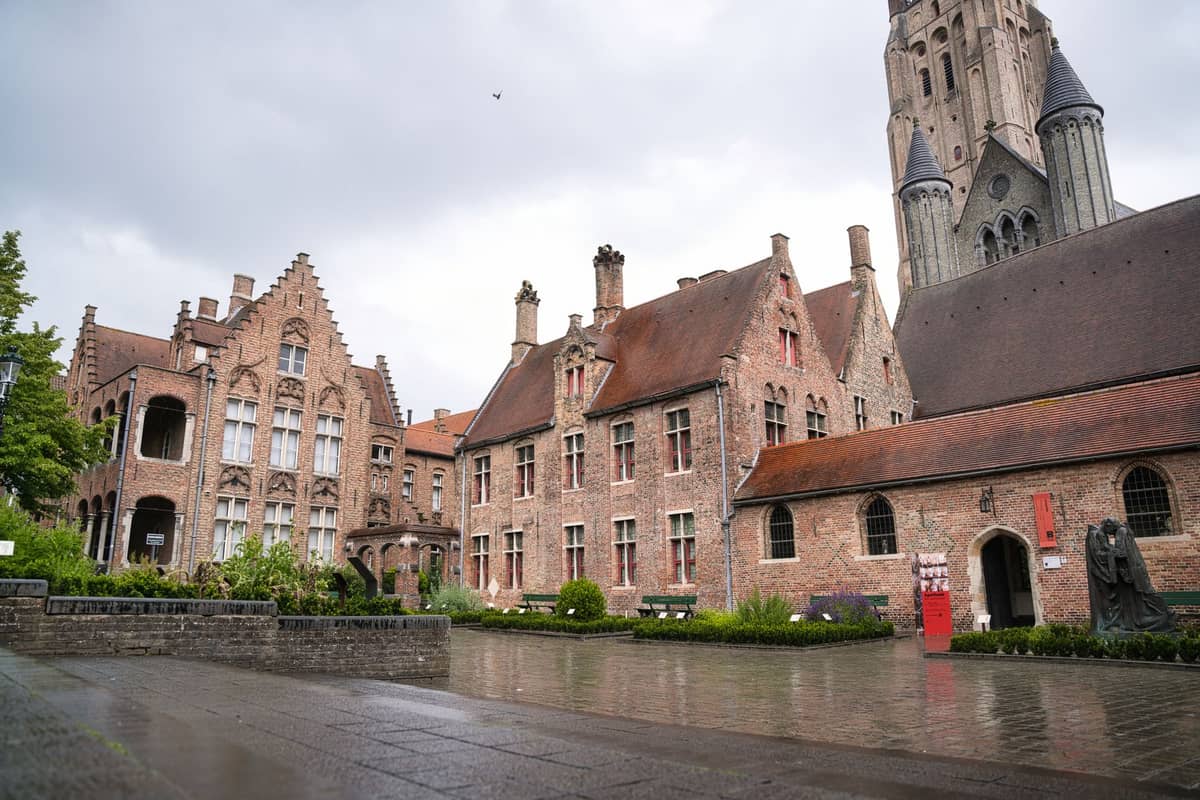
For Flemish art with more depth and context, Memling in Sint-Jan at the former Sint-Janshospitaal is one of the most atmospheric museum experiences in the city. Hans Memling's altarpieces are displayed in the original medieval hospital wards where they were commissioned. It rewards slow looking. Our guide to Flemish art in Bruges covers the full picture of what's available and how to prioritise your time across the collections.
- Groeningemuseum The city's premier art museum. Flemish Primitive paintings from Van Eyck to Memling, plus Belgian art up to the 20th century. Dijver 12. €15 standard. Closed Mondays.
- Memling in Sint-Jan Hans Memling altarpieces displayed in a functioning medieval hospital. Mariastraat 38. One of the most affecting museum visits in Bruges.
- Gruuthusemuseum Decorative arts and medieval daily life in a 15th-century palace. Directly connected to the Church of Our Lady.
- Historium Immersive experience recreating 15th-century Bruges on the Markt. Good for first-time visitors and families. More theatrical than scholarly.
- Choco-Story Bruges Popular chocolate museum near the Burg. Informative and well-organised, with a demonstration at the end. Worth it if chocolate is your focus.
Beer, Food, and the De Halve Maan Brewery
The De Halve Maan brewery (The Half Moon) on Walplein is the only family brewery still operating inside the historic walls of Bruges. Founded in 1856, it produces Bruges Zot and Straffe Hendrik ales. Guided tours run regularly (check current times on their website), include a tasting, and finish on the rooftop with views over the canal district. It is one of the most popular things to do in Brugge and books up fast on summer weekends. Pre-booking is strongly advised.
Belgian beer culture in Bruges extends well beyond one brewery. The city has a strong selection of brown cafes (traditional Belgian pubs) where local ales are served properly, at cellar temperature, in their correct glass. For a deeper look at what to drink and where, the Bruges beer guide covers the full landscape. On the food side, Flemish stew (stoofvlees), moules-frites, and local waffles are staples, but quality varies enormously by location. Our guide to what to eat in Bruges separates the worthwhile from the tourist-trap versions.
✨ Pro tip
The Frietmuseum on Vlamingstraat 33 is a legitimate museum dedicated to Belgian fries and their history. It sounds gimmicky, but it is well-researched and genuinely interesting. Admission is around €11 for adults. Combined tickets with other Musea Brugge sites are available.
The Begijnhof, Minnewater, and the Quieter South
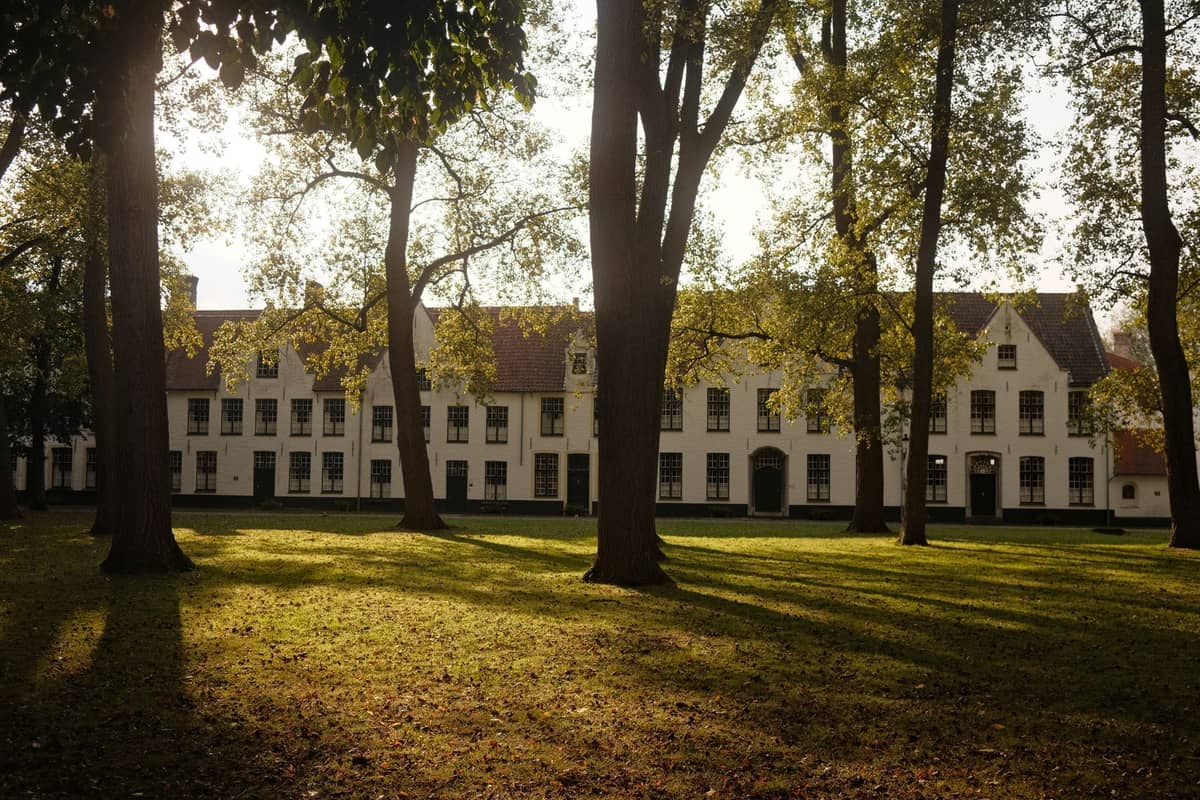
The Begijnhof is a walled religious community dating from the 13th century, now occupied by Benedictine nuns. The whitewashed courtyard and canal-side setting are among the most peaceful spots in the centre. Entry to the outer court is free and open daily. The small museum inside the Begijnhuisje charges a modest entry fee. It is popular but absorbs crowds well because of its size. Visit on a weekday morning for the best atmosphere.
A short walk from the Begijnhof, the Minnewater is a lake formed by a medieval sluice system, surrounded by a park that is particularly pleasant in spring when the trees are in bloom. It connects to the Minnewater and Begijnhof quarter, which rewards slower exploration. The windmills along the Kruisvest ramparts to the northeast are another undervisited area: four restored mills line the earthwork ramparts, and the walk along the top offers views across the city's roofline without a single souvenir shop in sight.
Practical Information: Getting There, Getting Around, and Timing
Bruges sits in northwest Belgium, roughly 100 km west of Brussels. The fastest and most practical way to arrive from Brussels is by direct train from Brussels-Midi (Brussel-Zuid), with journey times of around 55–63 minutes and standard second-class fares around €16.20 one way (April 2026 baseline; check SNCB/NMBS for current fares). Trains run frequently throughout the day. From Brussels Airport (BRU), factor in an additional connection and approximately 1.5 hours total travel time.
Once in Bruges, almost everything is walkable. The historic centre is compact, with the Markt to the Begijnhof measuring under 1.5 km. City buses run under the De Lijn network (single ticket around €3), but most visitors rarely need them for the main sights. Cycling is excellent and well-suited to the flat terrain. The cycling in Bruges guide covers rental options and the best routes. For a full orientation on logistics, the getting to and around Bruges guide has everything you need.
- Bruges uses the Euro (EUR). ATMs are widely available in the centre.
- Tap water is safe to drink throughout the city.
- Emergency number: 112 (police, ambulance, fire). Country calling code: +32.
- Belgium uses Type E plugs at 230V/50Hz. UK and US travellers need an adapter.
- Most museum and church sites require modest, covered attire. This is rarely enforced but worth respecting.
- English is widely spoken in hotels, restaurants, and tourist sites. The official local language is Dutch (Flemish dialect).
- Belgium is Schengen Area. EU/EEA nationals need only a passport or ID card. Most non-EU visitors from countries including the US, Canada, and Australia can enter visa-free for up to 90 days.
For budget planning, Bruges is not cheap by Belgian standards, but it is manageable with the right approach. The Bruges on a budget guide lists free attractions, reduced admission options, and where to eat without paying tourist-square prices. If you are deciding how many days to allocate, the 2-day Bruges itinerary is the most efficient structure for covering the major sights without feeling rushed.
FAQ
How many days do you need in Bruges?
Two full days is the practical minimum to cover the main sights comfortably: the Markt, Belfort, canal tour, Groeningemuseum, Begijnhof, and a brewery visit. One day is possible if you are disciplined with your time, but you will feel rushed. Three days allows you to explore quieter neighbourhoods, visit the Sint-Anna quarter, and take a day trip.
Is Bruges worth visiting for just a day trip?
Yes, but with caveats. Day trips from Brussels are common and easy by train (under 65 minutes). The problem is that Bruges is at its most crowded between 11:00 and 17:00, exactly when day-trippers are present. If you arrive early (before 09:30) and leave after 18:00, you get the best of both worlds. Staying overnight gives you the city largely to yourself in the evening and early morning.
What is the best time of year to visit Bruges?
Late May through June offers the best combination of mild weather (around 17–19°C), longer daylight hours, and crowds that are present but not overwhelming. July and August are warmer but significantly more crowded, especially on weekends. September and October are excellent for photography and atmosphere. December brings the Christmas market, which is popular but draws large crowds on weekends.
Do you need to book Bruges attractions in advance?
The Belfort and Groeningemuseum can be booked online through Musea Brugge, which is recommended in summer to avoid ticket desk queues. The De Halve Maan brewery tour books up quickly on summer weekends and should be reserved in advance. Canal boat tours do not take advance bookings; you pay on the day at the quay. The Begijnhof outer court is free and always accessible.
Is Bruges expensive compared to other Belgian cities?
Bruges is priced at a slight premium compared to Ghent or Antwerp for food and drink in the tourist-heavy centre, because the concentration of visitors around the Markt supports higher prices. Museum entry is comparable to other European heritage cities. Moving one or two streets away from the main squares typically halves the price of a meal or a coffee without sacrificing quality.