Best Time to Visit Bruges: A Season-by-Season Guide
Bruges (Brugge) rewards visitors in every season, but timing your trip well makes a real difference. This guide breaks down weather, crowds, prices, and key events month by month so you can decide when to go based on what actually matters to you.
Plan and book this trip
Tools from our partner Travelpayouts help you compare flights and hotels. If you book through them, we may earn a commission at no extra cost to you.
Flights
Hotels map
TL;DR
- Spring (April–May) and early autumn (September–October) offer the best balance of mild weather, manageable crowds, and full access to attractions. For most visitors, these are the optimal windows.
- Summer (June–August) delivers the warmest days (18–23°C) and longest daylight, but also the highest hotel prices and the densest tourist traffic in the historic centre.
- Winter (December–February) is cold and damp but far from dead: the Christmas market on the Markt and light installations during Winter Glow draw significant crowds in December, while January and February offer genuine quiet.
- If visiting Belgium more broadly, the best time to visit Belgium overlaps with Bruges: late spring and early autumn give you pleasant weather across Bruges, Ghent, and Antwerp without the summer peak.
- Key events to plan around: the Procession of the Holy Blood (Ascension Day, May), the Bruges Beer Festival (September), and the Christmas Market (late November to early January). See our full overview of things to do in Bruges for year-round ideas.
Understanding Bruges' Climate
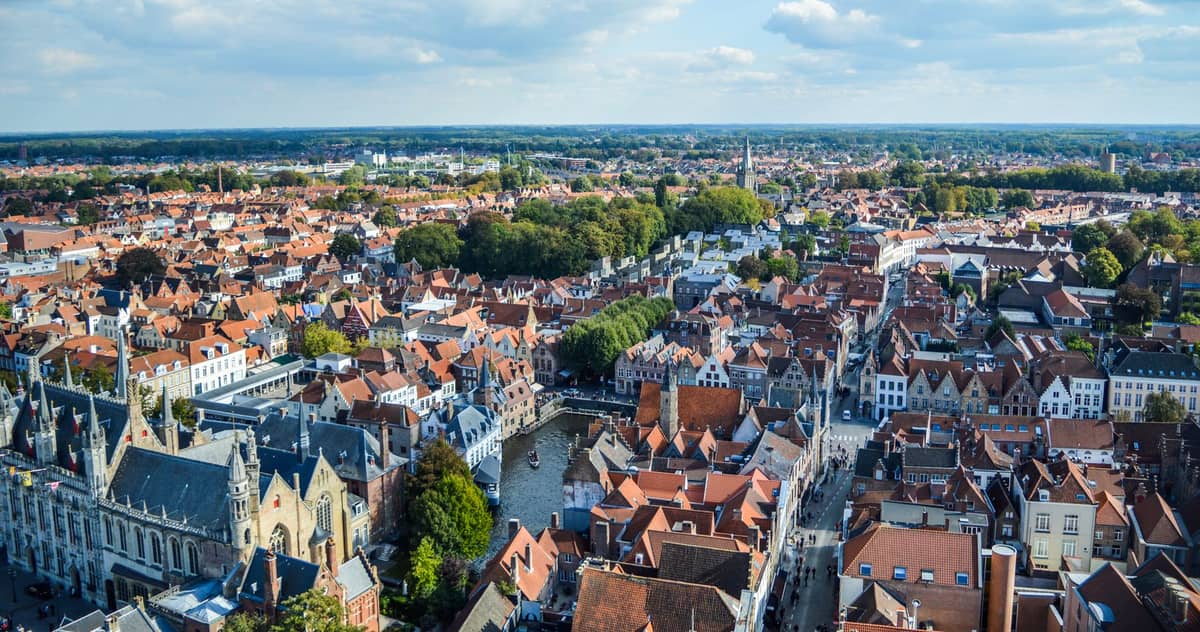
Bruges sits in northwest Belgium at roughly 2 metres above sea level, just 30 kilometres from the North Sea coast. That proximity shapes its temperate maritime climate: temperatures stay moderate year-round, rarely hitting extremes in either direction. Annual average temperature hovers around 10.3°C. Rain is distributed fairly evenly across the calendar, with around 731 mm falling over approximately 143 days per year. There is no true dry season, so packing a compact rain jacket is sensible regardless of when you travel.
Seasonal temperature ranges give you the clearest picture for planning. Seasonal temperature ranges give you the clearest picture for planning. Winter (December–February) averages 4–6°C, with daytime highs often sitting around 6°C in January. Spring (March–May) climbs from 7–13°C up toward 15°C. Summer (June–August) reaches 17–19°C, occasionally spiking higher during heat waves. Autumn (September–November) drops from around 16°C back down toward 8°C. November is one of the wettest months, averaging around 74 mm of rainfall, so it occupies a firm spot at the bottom of the rankings for most travellers. so it occupies a firm spot at the bottom of the rankings for most travellers.
💡 Local tip
Bruges' climate data refers specifically to Bruges, Belgium (Brugge), in West Flanders. There is a separate commune called Bruges in southwest France with entirely different climate statistics. Always verify you're using Belgian data when researching weather.
Spring (March–May): The Sweet Spot for Most Visitors
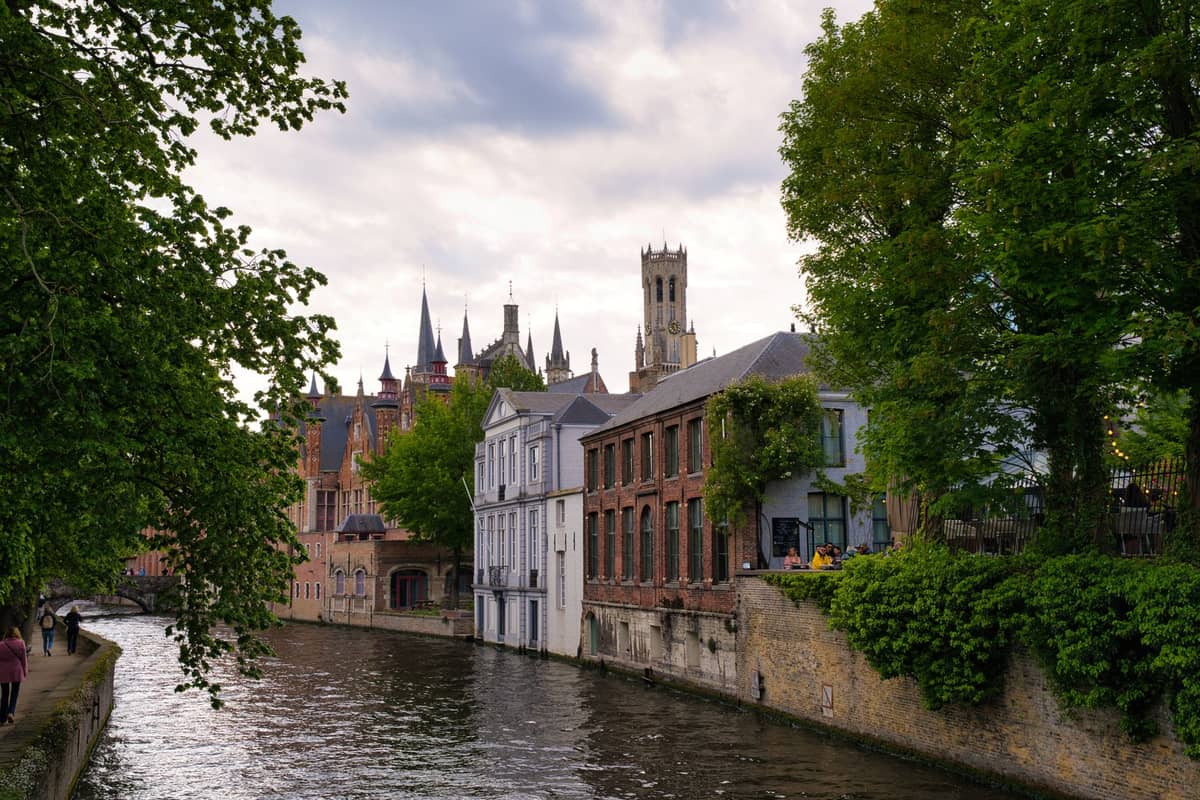
Late spring is the period most frequently recommended for first-time visitors, and the reasoning is straightforward. Temperatures in May average around 12–15°C during the day, the canal-side trees are in full leaf, and the city's famous rooftop views have a softness to the light that summer's harsh midday sun removes. Rainy days run to about 10–12 per month in spring, but showers tend to be short rather than sustained. A morning of drizzle at the Rozenhoedkaai often clears into a bright afternoon.
The standout event of spring is the Procession of the Holy Blood on Ascension Day in May. This UNESCO-recognised procession draws tens of thousands of spectators to the streets around the Burg and Markt, with participants in medieval costume. It is genuinely spectacular, but it also means street closures, packed accommodation, and sharply higher prices for that specific weekend. Book at least two months ahead if you want to attend, or plan your visit for the weeks immediately before or after.
March and early April are quieter and cheaper, with temperatures that can still feel sharp in the morning. If you are comfortable with a coat and the occasional grey day, March offers real value: hotels are at off-season rates, the main museums have shorter queues, and the Begijnhof feels genuinely peaceful rather than photogenic in a staged way.
Summer (June–August): Warm, Long, and Very Crowded
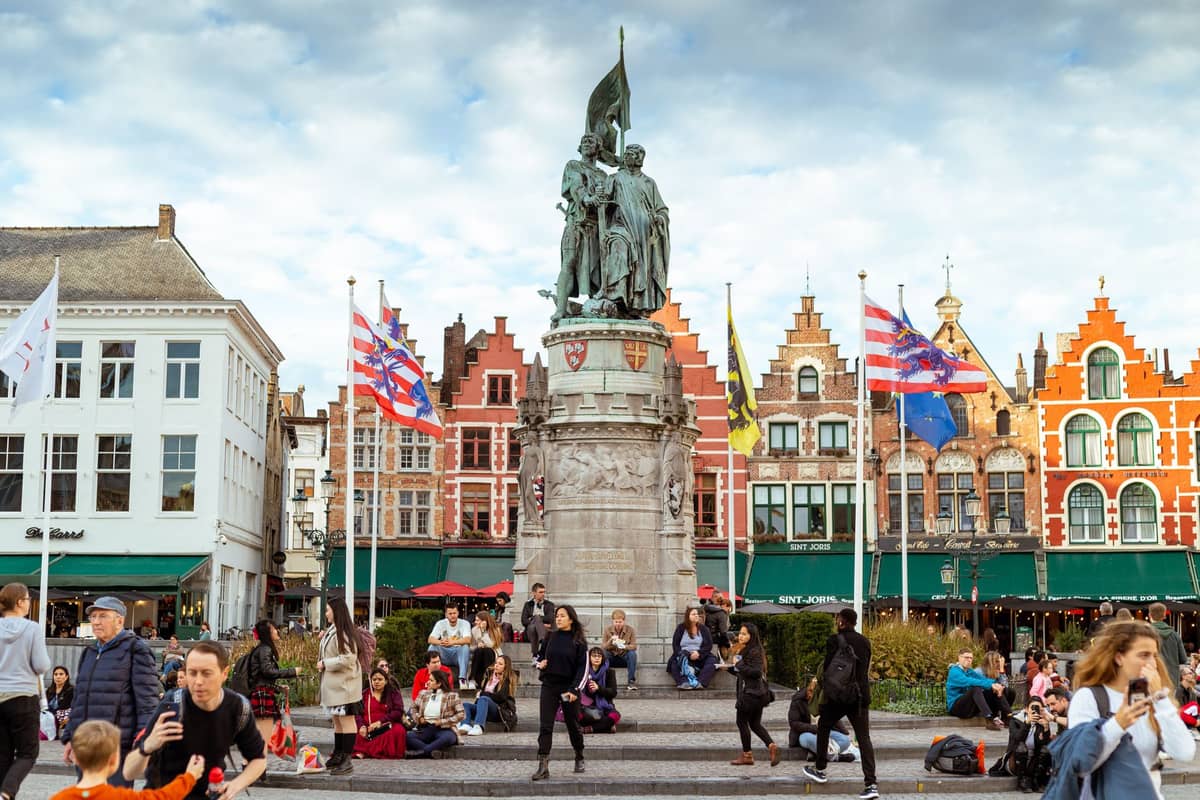
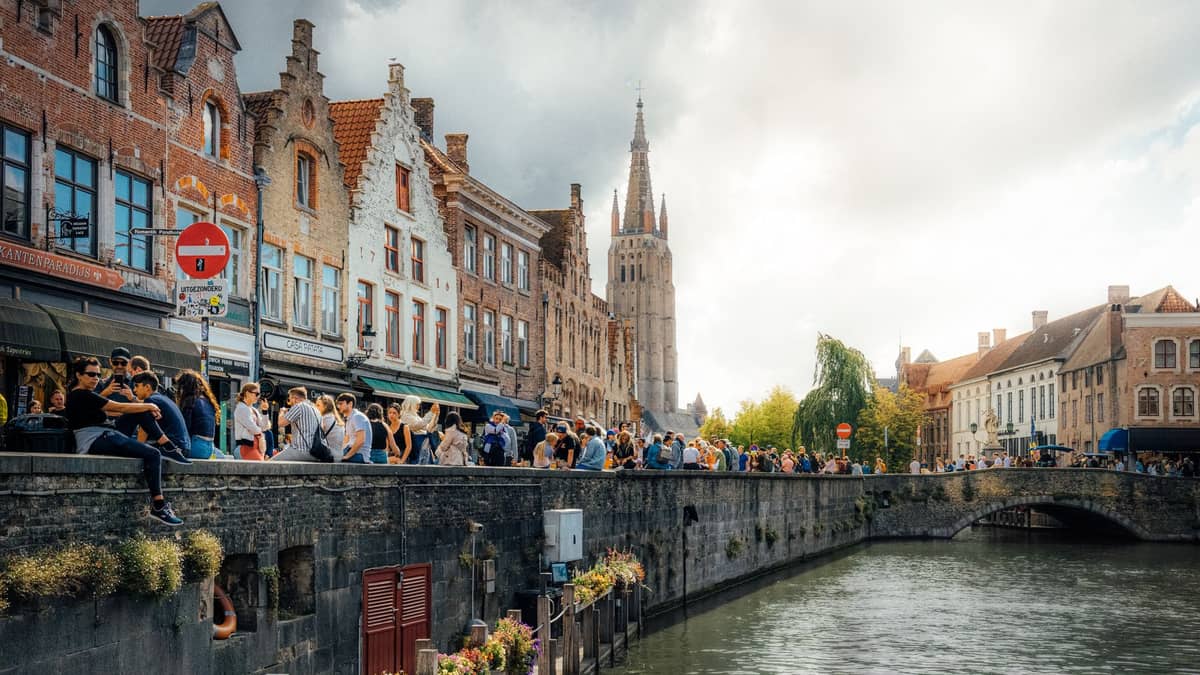
Summer is peak season in Bruges, and the city's compact historic centre shows it. The area around the Markt, the Burg, and the Rozenhoedkaai can feel genuinely congested from mid-June through August, particularly on weekends when day-trippers from Brussels, Ghent, and across the Channel arrive in volume. Canal boat queues at the main jetties near the Dijver can stretch to 40–60 minutes on a busy Saturday afternoon.
That said, summer has real advantages. Daylight extends until around 10 pm, so the golden-hour light over the canals lasts well into the evening. Outdoor terraces at cafés and restaurants are fully operational. The canal boat tours run at full frequency. Temperatures of 18–23°C are ideal for walking the city's historic streets on foot. If you travel during a weekday and stay at least two nights to catch the city early in the morning before day-trippers arrive, summer Bruges is still worth the effort.
⚠️ What to skip
Hotel rates in Bruges peak sharply in July and August. Book at least 8–12 weeks in advance for the historic centre. Arriving on a Friday or Saturday without a reservation in summer is a genuine risk. If flexibility is limited, aim for a Sunday–Thursday stay and avoid the busiest weekend periods.
- Early morning advantage The area around the Rozenhoedkaai and the Burg is almost empty before 8:30 am even in July. Set an alarm and walk the canals before the tour groups arrive.
- Avoid peak weekend afternoons Saturday afternoons from mid-June to mid-August bring the highest crowd density. Museums, canal boats, and chocolate shops all see their longest queues between noon and 4 pm.
- Weekday vs weekend pricing Some hotels charge 20–30% more on Friday and Saturday nights. A midweek trip in June or early July can combine good weather with noticeably lower rates.
Autumn (September–October): The Underrated Window
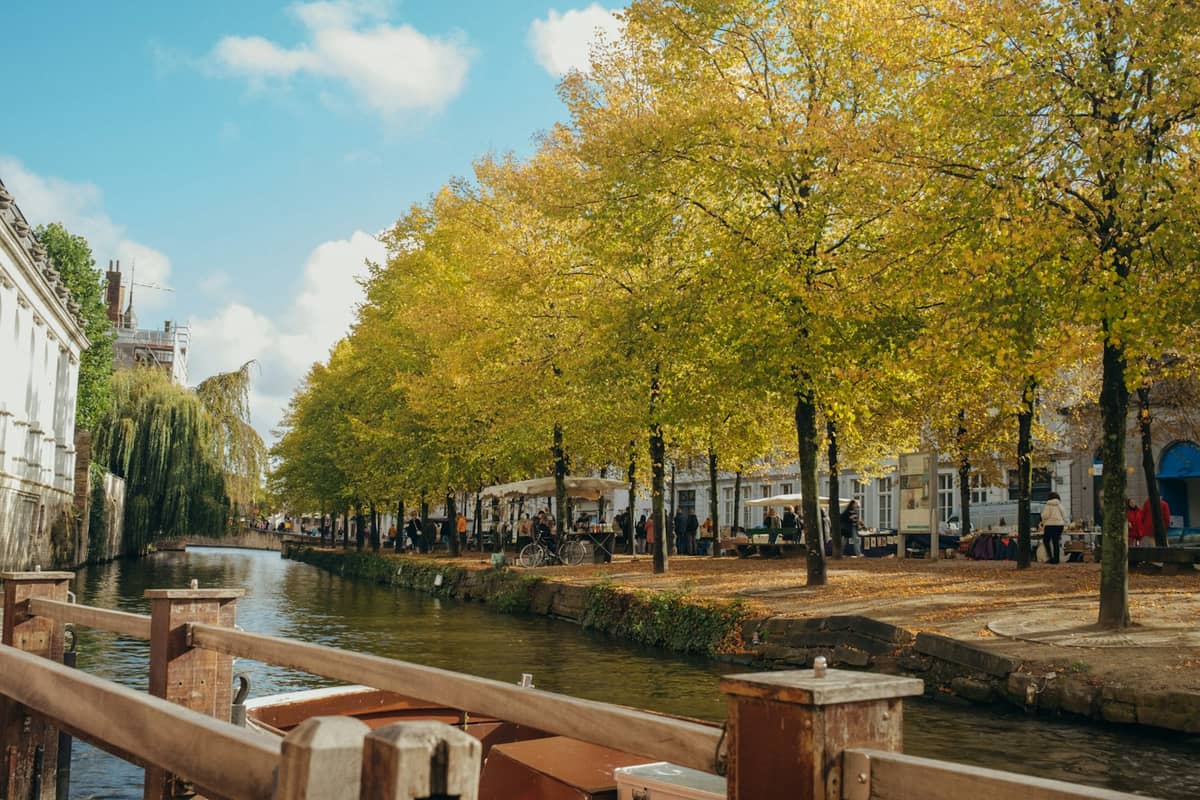
September and October deserve more credit than they typically get. The summer crowds thin out noticeably after the first week of September, but the weather holds reasonably well: average temperatures of 14–17°C in September and 10–14°C in October, with around 12–13 rainy days per month. The canals reflect the first hints of autumn colour from the lime and plane trees, and the light takes on the same warm quality you see in Flemish panel paintings.
The Bruges Beer Festival typically takes place in mid-September at the Bruges Meeting and Convention Centre, drawing significant beer tourism to the city. Check the official Visit Bruges calendar for confirmed 2026 dates. The festival adds visitor numbers for that specific weekend but does not affect the rest of the month. For those interested in the city's brewing heritage, this also makes September an ideal time to visit the De Halve Maan Brewery, which stays busy year-round but is less chaotic in autumn than in peak summer.
October is arguably the most underrated month of the year in Bruges. Hotel rates drop, the main attractions remain fully open, and the city's Gothic architecture looks particularly striking under overcast autumn skies. The Groeningemuseum and Memling in Sint-Jan rarely have queues. If rain puts you indoors, Bruges has enough world-class museum content to fill multiple days comfortably.
Winter (November–February): Cold, Quiet, and Christmas
November is the toughest sell. It is the wettest month of the year, averaging around 74 mm of rainfall, with temperatures dropping from 10°C at the start of the month toward 5°C by its end. with temperatures dropping from 10°C at the start of the month toward 5°C by its end. Daylight is limited to around 8–9 hours. Outdoor sightseeing is uncomfortable for extended periods, and the canal tours reduce to off-season schedules. If your primary goal is walking the city and enjoying its outdoor spaces, November is best avoided.
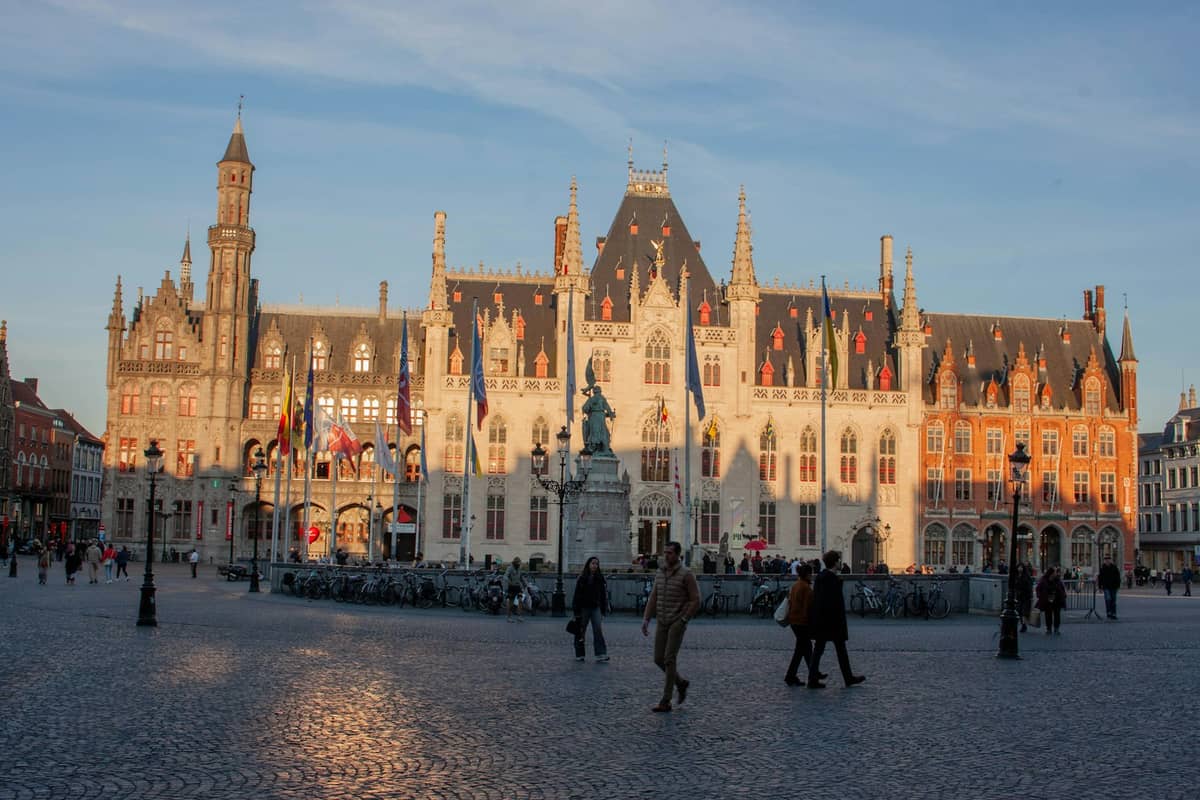
December is a different story entirely. The Winter Glow festival brings a large Christmas market to the Markt and Simon Stevinplein, along with light installations and an outdoor ice rink. The city becomes genuinely festive in a way that photographs cannot fully convey, and the Gothic architecture of the Markt and the Belfort looks extraordinary lit up against a dark winter sky. The trade-off is crowds: December weekends are among the busiest of the year, and hotel prices spike again. Plan to visit in the evenings when the light installations are at their best and the atmosphere is warmest. For a detailed breakdown of the event, see our guide to the Bruges Christmas market.
January and February are the quietest months in Bruges by a significant margin. Temperatures average 3–6°C, and the city's tourist infrastructure scales back, though all major museums and churches remain open with standard hours. If you want to experience Bruges at its most local and unhurried, this is when to go. Hotel rates are at their lowest. The complete guide to Bruges in winter covers what to expect in detail.
✨ Pro tip
Bruges in January is not as bleak as its reputation suggests. The historic centre is quiet, the museums are uncrowded, and the Belgian comfort food (stoofvlees, waterzooi, hot chocolate in a proper tearoom) makes far more sense in cold weather. If crowds are your primary concern, mid-January to mid-February is the lowest-pressure window of the entire year.
Key Events Calendar: Plan Around These Dates
- Procession of the Holy Blood (May, Ascension Day) The city's most important annual event. A UNESCO-recognised religious procession through the historic streets, attended by tens of thousands. Expect road closures, packed accommodation, and elevated prices that weekend. Book far in advance or visit the week before.
- Bruges Beer Festival (mid-September) Typically held over one weekend at the Bruges Meeting and Convention Centre. In 2026, the 18th edition is scheduled for 12–13 September. Adds a busy weekend to an otherwise quieter autumn month.
- Winter Glow / Christmas Market (late November to early January) Markets on the Markt and Simon Stevinplein, ice skating, and light installations across the centre. December weekends are among the busiest of the year. The market typically runs from late November through early January; verify exact 2026–2027 dates on the official Visit Bruges portal.
- School holiday periods Belgian and Dutch school holidays, particularly in late July and August, significantly boost family visitor numbers. UK summer holidays (late July–August) also increase British day-tripper traffic via Eurostar connections.
Practical Planning: Getting There and Getting Around
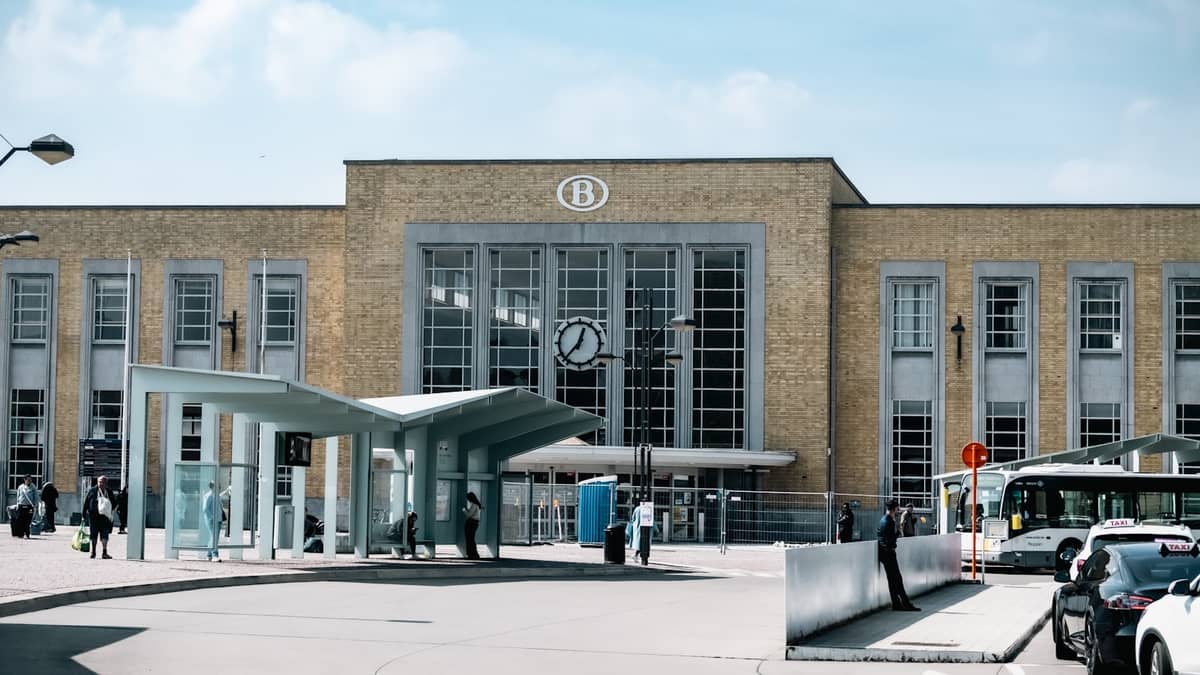
Bruges is well connected by rail via Belgian Railways (NMBS/SNCB). From Brussels Airport (BRU, approximately 100 km away), Bruges is well connected by rail via Belgian Railways (NMBS/SNCB). From Brussels Airport (BRU, approximately 100 km away), a train journey with one change takes around 1 hour 26 minutes, with second-class fares typically in the range of €20–€30 one way, though these change periodically and should be verified before booking. From Ostend-Bruges Airport (OST, approximately 30 km away), a bus or taxi to Ostend's train station followed by a short rail journey keeps total travel time under an hour., with second-class fares typically in the range of €20–€30 one way, though these change periodically and should be verified before booking. From Ostend-Bruges Airport (OST, approximately 30 km away), a bus or taxi to Ostend's train station followed by a short rail journey keeps total travel time under an hour.
Within Bruges, the historic centre is compact enough to cover almost entirely on foot. City buses (operated by De Lijn) connect outlying boroughs and the train station to the centre, City buses (operated by De Lijn) connect outlying boroughs and the train station to the centre, with single tickets around €3. Cycling is also a serious option: Bruges has an established cycling culture and relatively flat terrain. Cycling is also a serious option: Bruges has an established cycling culture and relatively flat terrain. Our guide to cycling in Bruges covers routes and rental logistics in detail. For budgeting overall, the Bruges on a budget guide breaks down where to save and where it is worth spending.
ℹ️ Good to know
Belgium is part of the Schengen Area. EU and EEA nationals enter visa-free with a valid ID or passport. Nationals of the US, Canada, Australia, Japan, and many other countries can visit visa-free for up to 90 days in any 180-day period. Other nationalities require a Schengen visa. Always check the Belgian Ministry of Foreign Affairs or official EU sources for the most current entry requirements before travel.
FAQ
What is the best time to visit Bruges to avoid crowds?
For the least crowded experience, visit in late September, October, or mid-January through February. October offers a good compromise: mild temperatures, full museum access, and significantly fewer visitors than summer. January and February are the quietest months overall but come with cold, short days.
Is Bruges worth visiting in winter?
Yes, with caveats. December is festive but crowded due to the Christmas market. November is the wettest month and least rewarding for outdoor sightseeing. January and February are genuinely quiet, cheap, and manageable if you are comfortable with cold weather and limited daylight. The museums, breweries, and chocolate shops are all operating normally.
What is the weather like in Bruges in April?
April in Bruges averages around 8–13°C, with a mix of sun and showers. Rain is possible on 10–12 days during the month, but prolonged downpours are uncommon. It is a good time to visit: spring flowers along the canals, fewer crowds than May, and most attractions running at full capacity.
When is the Bruges Christmas market?
The Christmas market and Winter Glow festival currently run from 20 November 2026 through 14 February 2027, with the main market stalls on the Markt and Simon Stevinplein. Exact dates for the 2026–2027 edition should be confirmed via the official Visit Bruges website before you book travel. Exact dates for the 2026–2027 edition should be confirmed via the official Visit Bruges website before you book travel.
How does the best time to visit Belgium compare to the best time for Bruges specifically?
They align closely. The best time to visit Belgium for pleasant weather and manageable crowds is generally late spring (April–June) and early autumn (September–October), which maps directly onto the recommendation for Bruges. If you are combining Bruges with Ghent, Antwerp, or Brussels, these windows work well for the whole trip.