Exarchia is Athens' most politically charged neighborhood, a dense urban grid wedged between Lycabettus Hill and Pedion tou Areos park, where radical bookshops share streets with rembetiko tavernas, student cafés, and one of the world's great archaeology museums. It rewards curious travelers who come without fixed expectations and leave with a clearer sense of what contemporary Athens is actually wrestling with.
Exarchia sits at the ideological edge of Athens, a neighborhood where graffiti-covered walls debate politics in real time, Saturday markets overflow onto the pavement, and the National Archaeological Museum anchors one end of a street scene that feels nothing like the postcard version of Greece. It is unpolished, self-aware, and unlike anywhere else in the city.
Orientation
Exarchia occupies a compact triangle in central Athens, roughly bounded by Patission Street (also called 28is Oktovriou) to the west, Alexandras Avenue to the north, and the slopes of Lycabettus Hill to the east. The neighbourhood edges against Kolonaki on its southeastern side, a contrast that could hardly be more pronounced: move three blocks downhill from Exarchia and the anarchist murals give way to designer boutiques and marble-clad apartment lobbies.
Exarchia Square, known locally as Plateia Exarcheion, sits at the geographic and social heart of the neighbourhood at the intersection of Themistokleous and Mesologiou streets. From the square, the street grid fans out in a mostly regular pattern, which makes navigating on foot straightforward once you have your bearings. Kallidromiou Street runs roughly east to west a few blocks north of the square and functions as the neighbourhood's main commercial artery, lined with food stalls, small shops, and the site of the popular Saturday farmers market.
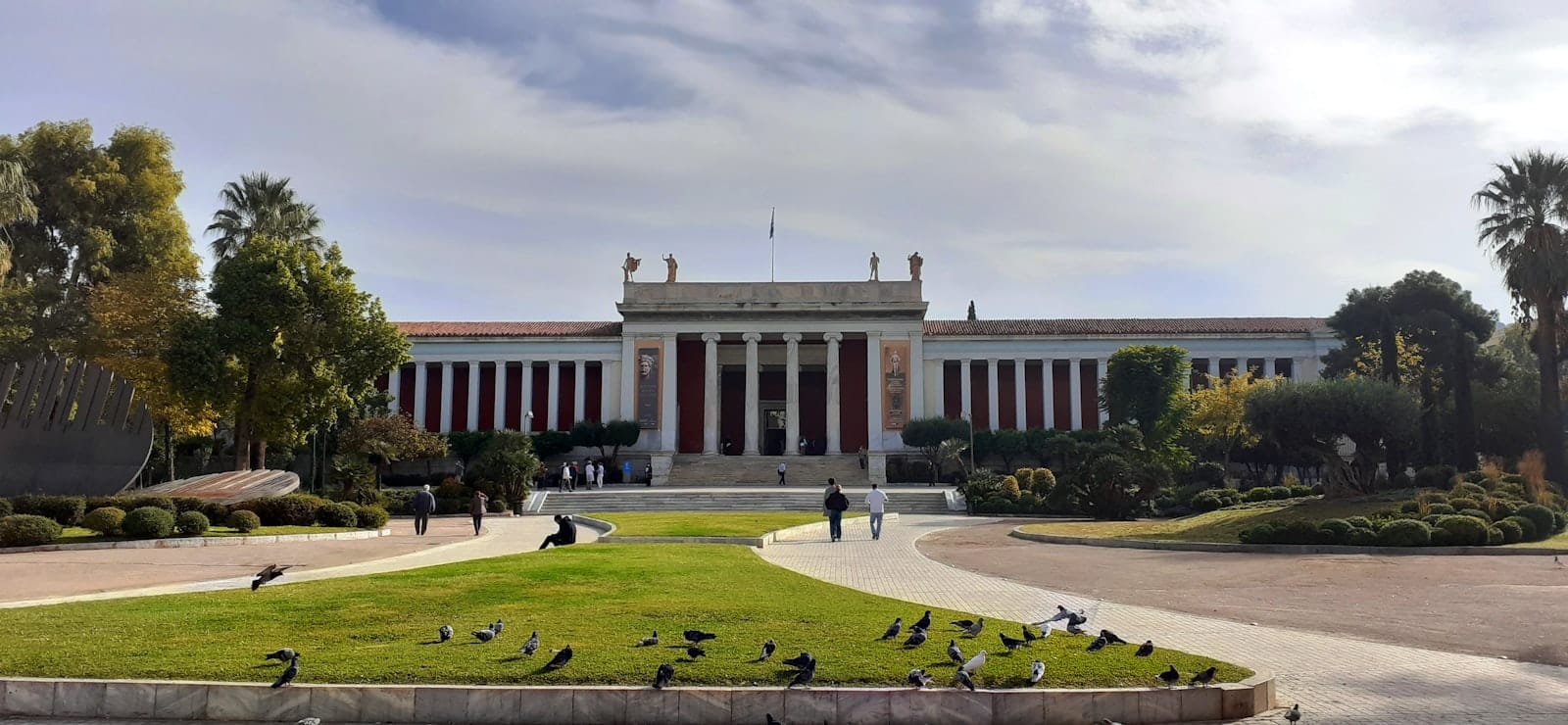
To the northwest, Exarchia blends into the area around the National Archaeological Museum on Patission Street, one of the most important museums in the world and technically within the neighbourhood's boundaries. Pedion tou Areos, Athens' largest central park, stretches along the northern edge. The Polytechnic University (Polytechneion) occupies a prominent block along Patission, anchoring the neighbourhood's identity as much as any café or square.
Character & Atmosphere
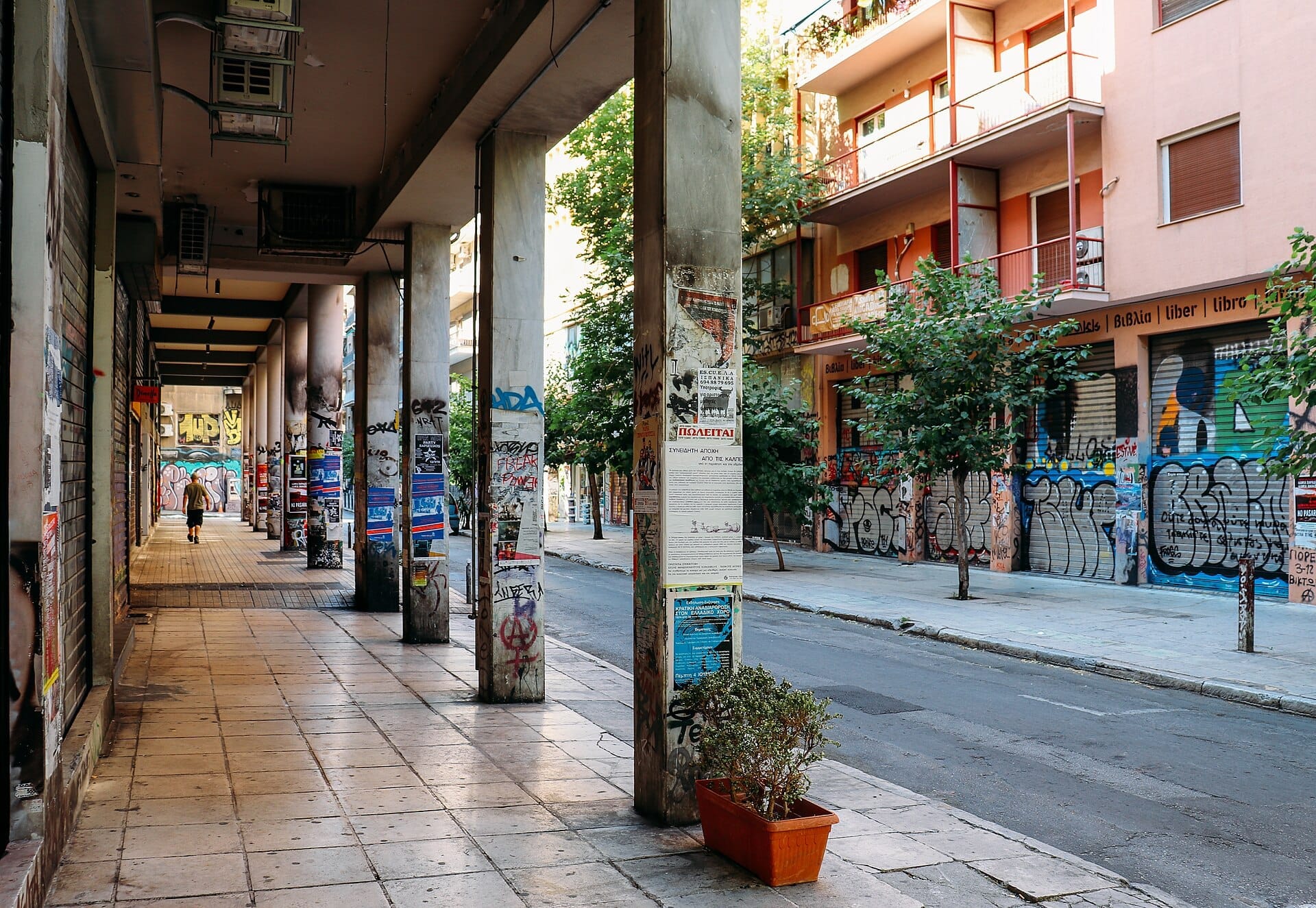
Exarchia feels different from the moment you step into it. The walls are thick with stencilled slogans, layered murals, and torn posters for benefit concerts and political meetings. Shutters on closed shops carry more art than most galleries. There is nothing decorative about it: this is a neighbourhood that has been using public space as a bulletin board for decades, and the accumulation of that habit gives every street a sense of ongoing conversation.
Mornings in Exarchia are quieter than the reputation suggests. The kafeneia around the square start filling after nine with students nursing freddo espressos over books and laptops. On Saturday mornings, Kallidromiou Street transforms completely: the farmers market takes over the road, and the smell of fresh herbs, grilled corn, and bread from nearby bakeries carries down the block. Vendors sell vegetables, olives, honey, and dried legumes alongside second-hand books and vinyl records. It is genuinely local in a way that few Athenian markets still manage to be.
Afternoons in summer can feel subdued, the heat pooling in the flat streets, but the self-managed park near the square stays shaded and active: children playing, residents reading, occasional film screenings projected against a wall at dusk. This park was created in 2009 when local residents occupied and converted an abandoned car park into a community space, and it has operated continuously since, serving meals to homeless residents and hosting cultural events on an ad hoc basis.
By ten at night, the square and the bars along Valtetsiou and Emmanouil Benaki streets are loud and packed. Exarchia has always been a drinking neighbourhood: cheap beer, outdoor tables, and the kind of long conversations that start with music and end with politics. The crowd skews young but not exclusively so. Older intellectuals, artists, and long-time residents mix with university students and the international visitors who have read about the neighbourhood and come to see for themselves.
ℹ️ Good to know
Exarchia's reputation as an 'anarchist quarter' is real but sometimes overstated in international coverage. On most evenings it functions as a lively, slightly rough-edged urban neighbourhood. The political character is genuine, but visitors spending an evening at a taverna or browsing a bookshop will not feel out of place.
What to See & Do
The single most significant cultural institution in Exarchia is the National Archaeological Museum on Patission Street. Its collection spans prehistoric Greece through the Roman period and includes the Antikythera Mechanism, the Mask of Agamemnon, and thousands of sculptures, bronzes, and ceramics. Block out at least three hours; two to four hours is common and still leaves things unseen. The museum sits on Patission Street, accessible by foot from anywhere in Exarchia in under ten minutes.
The National Technical University of Athens, or Polytechneion, on Patission Street is a significant historical site in its own right. Its main neoclassical building was the site of the 1973 student uprising against the military junta, an event that became a turning point in modern Greek history and is commemorated every November 17th. The campus is generally open to walk through and the gates and facade are worth seeing even if you do not go inside.
Exarchia Square itself is worth sitting in for an hour, especially in the early evening. It is not a manicured public space: the benches are worn, the kiosk sells cigarettes and cold drinks, and the surrounding café terraces spill out unevenly onto the pavement. Political groups sometimes set up information stalls. It functions less as a tourist attraction and more as a neighbourhood living room, which is precisely what makes it interesting.
The self-managed community park a short walk from the square, converted from a former car park, operates as a genuine social experiment. It is open to visitors who are respectful of its purpose. On certain evenings it hosts open-air film screenings and discussions; checking community notice boards or asking at local cafés is the most reliable way to find out what is on.
National Archaeological Museum: one of Greece's great collections, on Patission Street
Polytechneion (National Technical University): historically significant neoclassical campus, site of the 1973 uprising
Exarchia Square (Plateia Exarcheion): the neighbourhood's social centre, best visited in the evening
Kallidromiou Street Saturday market: fresh produce, second-hand books, vinyl, and street food
Self-managed community park: neighbourhood institution with cultural programming
Bookshops and publishing houses: Exarchia has a higher density of independent bookshops than almost any other neighbourhood in Athens
Street art: the neighbourhood functions as an open-air gallery of political and artistic murals
Eating & Drinking
Exarchia is not a neighbourhood of fine dining, and that is a deliberate feature rather than a gap. The food scene runs on volume, value, and local loyalty. There are dozens of small tavernas serving reliable Greek staples: moussaka, gemista, grilled meats, and seasonal vegetables cooked simply. Prices are noticeably lower here than in Kolonaki or Plaka, and portions tend to be generous. Rembetiko tavernas, some of which host live music on weekend evenings, are part of the neighbourhood's food-and-drink culture in a way that has largely disappeared from more tourist-facing areas of Athens.
The café culture around Exarchia Square and along Valtetsiou Street is strong. Freddo espresso and freddo cappuccino are the standard orders in warmer months; Greek coffee (ellinikos kafes) is still served in the older kafeneia that cater to long-term residents. Most cafés are open from mid-morning until well past midnight, and it is normal to nurse a single coffee for two hours without anyone suggesting you move on.
Bars along Emmanouil Benaki and the streets surrounding the square tend to be informal, with outdoor seating and music that shifts between Greek rock, rebetiko, and whatever the owner happens to put on. Craft beer has arrived in Exarchia, but it coexists with cheap draught lager rather than replacing it. There are no cocktail bars in the Kolonaki sense: the drinks are simple and the point is the company.
The Saturday market on Kallidromiou is a good place to eat as well as shop. Street food vendors sell koulouri, chestnuts depending on the season, and grilled corn in summer. Nearby bakeries open early and draw queues for tiropita, spanakopita, and other pastries. If you are in Exarchia on a Saturday morning, building breakfast around the market is the obvious move.
💡 Local tip
The tavernas on and around Kallidromiou Street, particularly the older ones without English menus in the window, tend to offer the most reliable combination of quality and price. Look for places where the daily specials are written on a chalkboard inside rather than on a laminated tourist menu outside.
Getting There & Around
Exarchia has no metro station of its own, which is one reason it has been slower to gentrify than surrounding neighbourhoods. The closest metro stations are Omonia (Line 1 and Line 2) to the southwest and Victoria (Line 1) to the north, both roughly a ten to fifteen minute walk from Exarchia Square. The walk from Omonia along Patission Street passes directly in front of the Polytechneion and the National Archaeological Museum before reaching the neighbourhood proper.
From Monastiraki or Syntagma, Exarchia is walkable in twenty to twenty-five minutes through the city centre. The route from Syntagma runs north through Kolonaki, which means a short uphill stretch before descending toward Exarchia Square. The route from Monastiraki is flatter, following Athinas Street north to Omonia and then cutting east.
Multiple bus routes run along Patission Street and Alexandras Avenue, connecting Exarchia to Omonia, the city centre, and the northern suburbs. Athens trolleybuses also serve Patission Street, making the stretch between Omonia and the National Archaeological Museum one of the more reliably served corridors for surface transit in central Athens.
Within the neighbourhood, everything is walkable. Exarchia's grid is compact enough that the square, Kallidromiou Street, the National Archaeological Museum, and the Polytechneion can all be visited on foot within a single unhurried morning. Taxis and ride-hailing apps (Beat is widely used in Athens) can reach the square easily; delivery vehicles and occasional road blockages during protests mean that drivers sometimes take slightly longer routes.
⚠️ What to skip
On the evening of November 17th each year, the area around the Polytechneion becomes the focal point for the annual march commemorating the 1973 uprising. Streets are blocked, police presence is heavy, and public transport is disrupted. If your visit falls on this date, plan accordingly.
Where to Stay
Exarchia is not a conventional base for first-time visitors to Athens. There are guesthouses, boutique hotels, and short-term rental apartments in the neighbourhood, and they are generally cheaper than comparable options in Kolonaki or Plaka. The trade-off is noise, particularly around the square on weekend nights, and the need to feel comfortable in an area where the street scene can be unpredictable.
Travelers who want to be within walking distance of the ancient sites and mainstream tourist infrastructure are better served by staying in Plaka, Monastiraki, or Koukaki. Exarchia makes more sense as a base for people who plan to spend significant time at the National Archaeological Museum, who want to experience a less curated version of the city, or who are specifically interested in the neighbourhood's cultural and political character.
The streets closest to the National Archaeological Museum and toward the northern edge of the neighbourhood near Pedion tou Areos tend to be quieter than the streets around the square. If you do choose to stay in Exarchia, accommodation on those quieter streets will involve less night noise. Avoid ground-floor rooms facing Exarchia Square itself if light sleep matters to you.
For a broader overview of accommodation options across Athens by neighbourhood type, the where to stay in Athens guide covers the tradeoffs in detail.
Safety & Honest Assessment
Exarchia has a reputation that sometimes precedes it unfairly and sometimes understates real considerations. For the average traveler visiting during the day or spending an evening at a bar or taverna, the neighbourhood is no more threatening than many European city districts with a politically active character. Petty crime exists, as it does across central Athens, but Exarchia is not a place where tourists are systematically targeted.
The genuine risks are situational. Protests can erupt with little warning around Exarchia Square and the streets leading toward the Polytechneion. Some demonstrations remain entirely peaceful; others escalate into confrontations between protesters and riot police, with tear gas and occasional property damage. The pattern is unpredictable enough that it is worth checking local news before visiting if you are planning to be in the area on politically significant dates or during periods of social tension.
Migrant and refugee squats operate in several buildings in the neighbourhood. These are community spaces serving a real social function; they are not sources of risk to visitors who treat them with basic respect. Far-right groups have targeted some of these spaces in the past, and there have been incidents of conflict related to this. These are episodes in a larger political situation in Athens rather than risks that bear directly on tourist visits.
For general guidance on navigating Athens safely, including practical advice on areas to be aware of, the Athens safety tips guide is worth reading before you arrive.
⚠️ What to skip
If you encounter a protest or demonstration forming around Exarchia Square, leave the immediate area calmly and avoid filming or engaging with participants on either side. Tear gas can affect people at a distance from the main confrontation.
Nearby Neighborhoods Worth Combining
Kolonaki is immediately to the southeast, reached in a ten-minute walk uphill from Exarchia Square. The contrast is extreme and instructive: Kolonaki's designer cafés and gallery-lined streets feel like a different city. Combining both in a single afternoon walk gives a better sense of Athens' social geography than staying in either alone.
To the southwest, the archaeological zone around Ancient Agora and the neighborhoods of Monastiraki and Psyrri are reachable in twenty to twenty-five minutes on foot. Psyrri in particular shares some of Exarchia's rough-edged, creative character without as much political charge, making it a useful comparison point.
The Mount Lycabettus viewpoint is accessible from the eastern edge of Exarchia, either on foot up the hill or via the funicular from Kolonaki. The walk up through the pine forest takes around thirty minutes and offers increasingly good views over the city as you climb.
TL;DR
Exarchia is Athens' most politically and culturally distinct neighbourhood: radical bookshops, rembetiko tavernas, vivid street art, and genuine community institutions coexist on a compact grid between Lycabettus and Pedion tou Areos park.
The National Archaeological Museum, one of the world's great archaeology collections, is located on the neighbourhood's western boundary and is reason enough alone to spend time in the area.
The Saturday market on Kallidromiou Street is one of the most authentic market experiences in central Athens, worth timing a visit around if possible.
Exarchia is best suited to travelers comfortable with urban roughness, interested in contemporary Greek society, and willing to engage with a neighbourhood that does not perform for tourists.
Safety requires situational awareness: protests can escalate without warning, but day-to-day the neighbourhood is navigable and rewarding for visitors who come with open expectations and basic street sense.
Three full days is the right amount of time to cover Athens at a comfortable pace, from the Acropolis and its world-class museum to the ancient Agora, Monastiraki, Kolonaki, and beyond. This guide breaks it all down day by day, with booking tips, honest crowd warnings, and the practical details most itineraries skip.
Twenty-four hours in Athens is enough to cover the Acropolis, the Acropolis Museum, the historic neighborhoods of Plaka and Monastiraki, and a spectacular sunset viewpoint. This itinerary is built around realistic walking distances, smart timing, and clear guidance on what to skip when time is short.
Athens holds one of the densest concentrations of ancient history on earth. This guide covers the city's major archaeological sites and museums, from the Acropolis and Ancient Agora to lesser-known gems like Kerameikos, with practical tips on tickets, timing, and what to expect at each.
Athens is one of the best cities in Europe to eat well without spending much. This guide covers the essential dishes, where to find them, realistic prices for 2026, and how to avoid the tourist traps that line the most photographed streets in the city.
Athens rewards those who wander beyond the obvious. From a Cycladic island village clinging to the Acropolis rock to a thermal lake on the coast, these are the experiences that make the city feel like yours. This guide covers the lesser-known sites, quiet hills, and local haunts that most visitors walk straight past.
Summer in Athens means intense heat, peak crowds, and some of the longest days in Europe. This guide breaks down what each month actually looks like, how to handle the heat, and how to get the most out of your visit in June, July, or August.
Athens nightlife runs on its own schedule, with dinners starting at 10pm and clubs peaking between 3 and 5am. This guide covers every major district, the best bars and clubs, what things cost, how to dress, and how to navigate the city after dark like a local.
Athens is one of Europe's most affordable capitals, with free archaeological sites, cheap street food, and an excellent public transport network. This guide breaks down exactly what things cost, when to go for the best deals, and how to stretch every euro without missing anything important.
Athens is generally a safe city for tourists, but petty theft, taxi scams, and a few neighborhood considerations are worth knowing before you arrive. This guide covers the real risks, the overhyped ones, and exactly how to stay out of trouble.
Athens rewards shoppers who know where to look. This guide breaks down the city's best markets, shopping streets, and neighborhoods by type, with practical advice on timing, pricing, and what's actually worth buying versus what to skip.
Athens is one of Europe's most walkable capitals, with millennia of history packed into a compact city center. This guide covers the best guided walking tours, self-guided routes, practical logistics, and clear advice on timing, pricing, and what to avoid.
Athens is far more family-friendly than most travelers expect. From interactive museum programs and funicular rides to free outdoor ceremonies and canal kayaking, this guide covers the best activities for children of all ages, honest pricing breakdowns, and practical logistics for navigating Athens with kids.
Athens holds one of the densest concentrations of world-class museums anywhere in Europe. This guide covers every major collection, from the Acropolis Museum's Parthenon sculptures to the Benaki's sweep of Greek history, with practical advice on what to prioritise and when to go.
Athens rewards visitors year-round, but the experience changes dramatically by season. This guide breaks down every month by weather, crowd levels, and cost so you can plan around what actually matters to you.
Athens rewards those who look up, and out. The city's hills, ancient rock outcrops, rooftop bars, and clifftop temples frame the Parthenon, the Saronic Gulf, and the sprawling Attic basin from every angle. This guide covers the best viewpoints in Athens, from completely free hilltop climbs to spectacular paid experiences.
Athens sits at the center of one of Europe's richest regions for day tripping. Within a few hours you can stand at the Oracle of Delphi, swim off a car-free Saronic island, or walk through a Bronze Age citadel. This guide covers the best day trips from Athens, organized by type and travel time.
Athens is one of Europe's most rewarding cities on a tight budget. From ancient hilltop views and marble stadiums to flea markets and ceremonial guards, this guide covers the best free experiences in the Greek capital, plus the specific days when even major paid sites open their gates for nothing.
Athens has one of the most affordable and well-connected urban transport networks in Southern Europe. This guide covers everything from metro fares and airport express buses to taxi flat rates, tram routes, and the ticketing mistakes that catch most first-time visitors off guard.
Athens rewards visitors who go beyond the obvious. This guide covers the best things to do in Athens Greece, from ancient sites and world-class museums to rooftop bars, coastal escapes, and neighborhood walks, with practical advice on tickets, timing, and what to skip.
Choosing where to stay in Athens shapes your entire trip. This guide breaks down every major neighbourhood by walkability, noise level, price range, and proximity to the sights that matter, so you can book with confidence rather than guesswork.