National Archaeological Museum Athens: The Complete Visitor Guide
The National Archaeological Museum in Athens holds one of the most important collections of ancient Greek artifacts on earth. Opened in 1889 in the Exarchia district, it spans roughly 8,000 square meters of galleries and draws visitors who leave having fundamentally changed how they picture the ancient world.
Quick Facts
- Location
- 44 Patision Street, Exarchia, Athens 10682
- Getting There
- Omonia (Line 2, Red Line) or Victoria (Line 1, Green Line) — about 10 minutes on foot from either
- Time Needed
- 2.5 to 4 hours for a thorough visit; serious antiquity enthusiasts often spend a full day
- Cost
- €12 standard entry (verify current pricing before visiting; reduced rates apply for certain groups)
- Best for
- Ancient history lovers, archaeology students, travelers who want depth over spectacle
- Official website
- www.namuseum.gr/en
Why This Museum Earns Its Place at the Top of Any Athens Itinerary
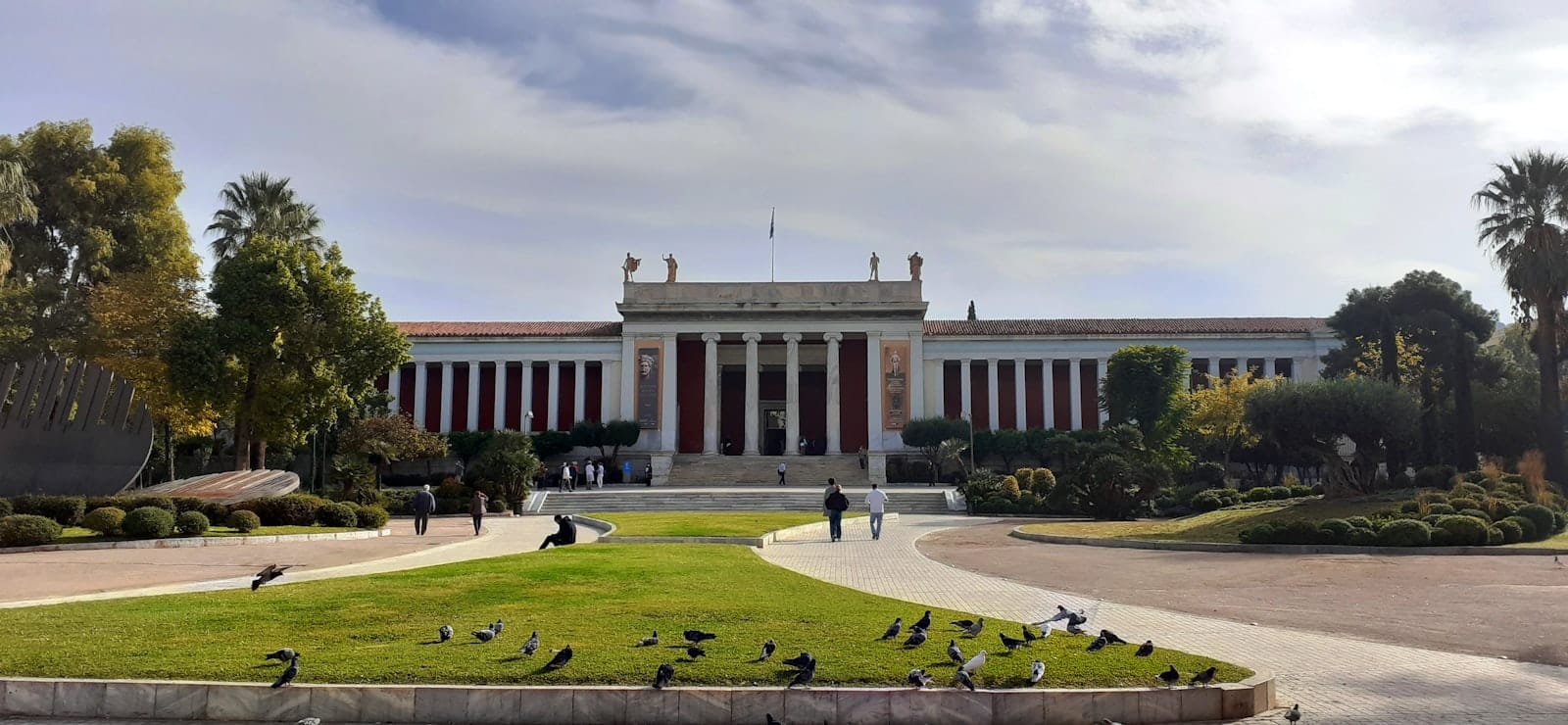
The National Archaeological Museum is not simply Athens's best museum — it is one of the most consequential archaeology collections anywhere in the world. Founded in 1866 and housed in a neoclassical building completed in 1889, it gathers treasures from across the entire Greek world: prehistoric Cycladic figurines, gold death masks from Mycenae, bronze statues recovered from the sea floor, and painted mummy portraits from Roman-era Egypt. No single building in Greece contains more accumulated evidence of human civilization across four millennia.What makes it different from the famous sites like the Acropolis is intimacy. You can stand within arm's length of artifacts that shaped the foundations of Western art, science, and politics. The Mask of Agamemnon — a beaten gold funeral mask dating to around 1550 BCE, discovered by Heinrich Schliemann at Mycenae — sits behind glass in Room 4, quiet and extraordinary. No queues form specifically for it. Most people drift past before registering what they're looking at.
If you are working through Athens's ancient sites, this museum belongs early in your trip rather than at the end. Visiting before the Acropolis or the Agora gives you mental scaffolding: you understand what the pottery looked like, how the bronzes were cast, what the votive offerings meant. The ruins make more sense after the museum gives them context.
💡 Local tip
Tuesday hours differ from the rest of the week. During the extended summer season (typically from 9 May through 9 November), the museum opens at 13:00 on Tuesdays rather than 08:00. Plan around this if Tuesday is your only available day.
Opening Hours and Getting There
The museum operates on two seasonal schedules. During the extended summer season (typically 9 May through 9 November), it opens Wednesday through Monday from 08:00 to 20:00, with Tuesday hours running 13:00 to 20:00. During the winter season (1 November to 31 March), hours contract to 08:30 to 15:30 on most days. Always verify the current schedule on the official website before visiting, as hours are subject to change around public holidays.
The museum sits on Patision Street (also called 28th of October Street) in the Exarchia district of central Athens. Two metro stations provide straightforward access: Omonia on Line 2 (Red Line) to the south, and Victoria on Line 1 (Green Line) to the north. Both are roughly a 10-minute walk. From Omonia, walk north along Patision; the neoclassical facade with its Ionic columns is hard to miss. From Victoria, walk south. Buses also serve the area along Patision. If you are arriving from the Syntagma or Monastiraki area on foot, allow around 25 to 30 minutes for a direct walk north.
If you are combining the museum with other nearby attractions, the Exarchia neighborhood surrounding it offers inexpensive cafes ideal for a pre-visit coffee or post-visit lunch. The area has a distinctly local character compared to the more tourist-saturated streets near the Acropolis.
Tickets & tours
Hand-picked options from our booking partner. Prices are indicative; availability and final rates are confirmed when you complete your booking.
Athens National Archaeological Museum e-ticket and audio tour
From 22 €Instant confirmationDelphi Archaeological Museum E-ticket and Audio Tour
From 12 €Instant confirmationEntrance ticket to Delphi archaeological site and museum
From 26 €Instant confirmationDelphi archaeological site with virtual reality from Athens
From 37 €Instant confirmationFree cancellation
What You Will Actually See: The Collections
The museum's permanent collection spans more than 11,000 objects across exhibition areas covering approximately 8,000 square meters. That number sounds abstract until you are two hours in and realize you have covered less than half the ground floor. The collections are organized thematically and chronologically across numbered rooms, and the layout rewards a systematic approach.
Prehistoric and Mycenaean Collections
The prehistoric halls are where the museum announces its ambition immediately. The Cycladic collection presents figurines carved from Aegean marble dating from roughly 3200 to 2000 BCE — lean, abstract human forms that feel startlingly modern, like something Brancusi might have made. Several rooms away, the Mycenaean collection in Room 4 contains the shaft grave finds from Schliemann's 1876 excavations: gold jewelry, bronze weapons, decorated ceramics, and that famous funeral mask. The gold catches the gallery lighting in a way that makes its age feel impossible. These objects are from a civilization that preceded classical Athens by more than a thousand years.
Sculpture Galleries
The sculpture collection traces the development of Greek statuary from the rigid Archaic kouroi of the 7th century BCE through the Classical refinement of the 5th and 4th centuries and into the expressive Hellenistic period. The kouroi are worth slowing down for: life-sized or larger marble figures of young men, arms at their sides, one foot slightly forward. The form seems formulaic until you notice how the carving evolved across decades, the anatomy becoming gradually more accurate, the expressions less mask-like. The Artemision Bronze, a larger-than-life-size figure of either Zeus or Poseidon raising his right arm to throw (scholars still disagree on which), is one of the finest surviving Greek bronzes. It was found in the sea off Cape Artemision in the 1920s. The scale and movement of it stops most visitors cold.
Bronze Collection and Vase Collection
The bronze collection includes pieces recovered from shipwrecks, sanctuaries, and private estates, ranging from small votive offerings to the Jockey of Artemision — a boy rider on a galloping horse, both figures frozen mid-motion, the horse's legs fully extended, cast in bronze around 150 BCE. It is technically and artistically extraordinary. The vase collection, organized across several rooms, documents the full arc of Greek pottery from Geometric-period geometric decoration through red-figure and black-figure techniques. These are working objects, not just art: amphorae for wine and oil, kraters for mixing drinks at symposia, lekythoi for funerary rites. The painted narratives on their surfaces are effectively illustrated mythology.
Egyptian Collection
A less-expected wing holds a substantial Egyptian collection, including Fayum mummy portraits from Roman-era Egypt (roughly 1st to 3rd century CE) — painted panels placed over the faces of mummified individuals. The portraits are rendered with enough realism that the individuals feel immediately present. This collection is often overlooked by visitors rushing toward the Greek antiquities, which makes it quieter and more contemplative than most of the ground floor.
How the Experience Changes by Time of Day
Opening time is the most comfortable window for visitors who want to move through galleries without navigating group tours. Between 08:00 and 09:30, the rooms are largely quiet, the light through the clerestory windows in some halls is at its softest, and you can spend five or ten minutes with a single object without anyone crowding your line of sight. By 10:30, organized school groups and tour buses begin arriving. The Mycenaean hall in particular gets loud and dense around midday.
Late afternoon on weekdays, particularly after 17:00 during the summer season, sees a significant drop in visitor numbers. This is an underused window. The galleries are cooler than midday, the light has shifted, and the museum's cafe and bookshop are less crowded. Photography in low-crowd conditions is also considerably more rewarding — you can compose a frame without strangers in it.
ℹ️ Good to know
Summer temperatures in Athens regularly exceed 35°C. The museum is air-conditioned and makes an ideal midday refuge during July and August when outdoor sites become punishing. Plan outdoor visits to the Acropolis for early morning, and use the museum as your afternoon slot.
Practical Walkthrough: What to Prioritize
The museum cannot be done justice in under two hours, but if time is genuinely limited, a focused route through the must-see rooms is possible. Start with the Mycenaean collection (Room 4), move through the Cycladic figurines, then spend time with the bronze galleries including the Artemision Bronze and the Jockey. If you have a third hour, the Egyptian portraits and the vase collection are both worth unhurried attention.
Wear comfortable shoes. The floors are stone and marble throughout, and even a selective visit covers several kilometers of walking. The museum shop near the entrance sells well-produced catalogs and reproduction prints; the quality is noticeably higher than most museum shops, and the archaeology section includes several academic titles not easily found elsewhere.
Photography without flash is permitted throughout the permanent collection. The museum prohibits tripods in the galleries. If you are visiting Athens on a tight schedule, the Athens 1-day itinerary pairs this museum logically with the Acropolis and the ancient Agora for a single-day sweep of the city's core archaeology.
Who This Museum Is For — and Who Might Find It Frustrating
Visitors who arrive with some prior knowledge of ancient Greek history — even just a couple of hours of background reading — will get dramatically more from this museum than those who arrive cold. The labeling is informative but not always translated into evocative context for non-specialists. If you are bringing children, the Athens with kids guide has practical notes on navigating large museums with younger visitors; the prehistoric and bronze sections tend to hold children's attention better than the vase rooms.
Travelers looking primarily for dramatic views, outdoor experiences, or Instagram-optimized locations will find the museum less satisfying than the Acropolis hill or Lycabettus. This is a place for sustained looking, not quick visual hits. It also demands mental energy; several visitors underestimate how tiring four millennia of human civilization can be to process in one go. If your schedule is already full, skipping it in favor of the Acropolis Museum is a defensible choice — but the two institutions are genuinely complementary, not substitutes for each other.
⚠️ What to skip
Large bags and backpacks must be left in the cloakroom at the entrance. The cloakroom is free. Arrive a few minutes early if you are visiting with a group, as the check-in process can add time during peak hours.
Combining the Museum with the Surrounding Area
The museum sits at the edge of Exarchia, one of Athens's most characteristically Athenian neighborhoods. After your visit, the streets immediately to the east of Patision offer a very different texture from the tourist-facing districts near the Acropolis: small bookshops, independent record stores, unpretentious tavernas, and squares where locals actually sit. It is worth thirty minutes of wandering before heading back toward Syntagma or Monastiraki. For a broader orientation to the city's archaeology, the Acropolis Museum in the Makrygianni district makes the most logical full-day pairing — the National Archaeological Museum covers the breadth of Greek antiquity, while the Acropolis Museum focuses specifically on the Parthenon and its sculptures.
Insider Tips
- Tuesday afternoons are counterintuitively good: the museum opens late (13:00) which means the general public assumes it is a slow day and avoids it, but by 15:00 it is notably quieter than a typical Monday or Wednesday.
- The Fayum mummy portraits in the Egyptian wing are among the most emotionally striking objects in the building, yet most visitors walk past them quickly. Spend time here — the faces are painted with enough individuality that they feel like portraits of specific people, not types.
- The museum's bookshop carries high-quality academic and illustrated catalogs that are cheaper here than in airport shops or online. If you buy one catalog, choose the bronze collection or the Mycenaean gold — both are superbly photographed.
- If you want a closer look at specific pieces without crowds, ask at the information desk about quieter viewing times for particular galleries. Staff are generally knowledgeable and willing to give informal guidance.
- The garden courtyard between the building wings is often overlooked. It contains several large sculptural pieces in a shaded outdoor space and is a genuine respite during summer visits — far cooler than the street outside and rarely busy.
Who Is National Archaeological Museum For?
- Ancient history and archaeology enthusiasts who want the definitive survey of Greek material culture in a single building
- Travelers visiting the Acropolis who want full context for what they are seeing on the hill
- Museum-going couples or solo travelers who appreciate sustained, unhurried looking
- Summer visitors seeking a quality air-conditioned afternoon activity during peak heat hours
- Students or researchers with an interest in classical studies, bronze casting, or prehistoric Aegean culture