Acropolis Museum: What to Expect, See, and Know Before You Go
Built directly over an archaeological excavation in Athens' Makrigianni district, the Acropolis Museum opened in 2009 and now houses the defining sculptural record of ancient Athens. It is one of the most thoughtfully designed museum buildings in Europe, and the collection inside is extraordinary by any standard.
Quick Facts
- Location
- Dionysiou Areopagitou 15, Makrigianni (Koukaki area), Athens 117 42
- Getting There
- Akropoli station, Metro Line 2 (Red Line) – 2-minute walk
- Time Needed
- 2 to 3 hours for a thorough visit; 90 minutes if focused
- Cost
- General admission €20; reduced €10. Verify current pricing at the official site before visiting.
- Best for
- History enthusiasts, architecture lovers, families with older children, first-time visitors to Athens
- Official website
- www.theacropolismuseum.gr/en
What the Acropolis Museum Actually Is
The Acropolis Museum, or Μουσείο Ακρόπολης in Greek, is the permanent home for thousands of objects recovered from the Acropolis of Athens and its surrounding slopes. The building itself opened in 2009, replacing a small, overcrowded predecessor that had stood on the archaeological site since the 1870s. The new museum was designed by Swiss-American architect Bernard Tschumi in collaboration with Greek architect Michalis Photiadis, and the structure is as much a part of the experience as the artifacts inside.
The collection spans from the Archaic period through the Roman era, with the Parthenon Gallery on the top floor serving as the museum's visual and intellectual centerpiece. The building holds over 4,000 objects, though not all are on permanent display. What makes the Acropolis Museum distinct from other world-class archaeology museums is its specific focus: everything here came from a single site, which gives the collection unusual coherence and depth.
ℹ️ Good to know
The museum sits directly above an active archaeological excavation. Sections of the glass floor on the ground level let you look down at the ancient Athenian neighborhood beneath the building, dating primarily to the Late Roman and Early Byzantine periods.
The Building: Architecture Worth Paying Attention To
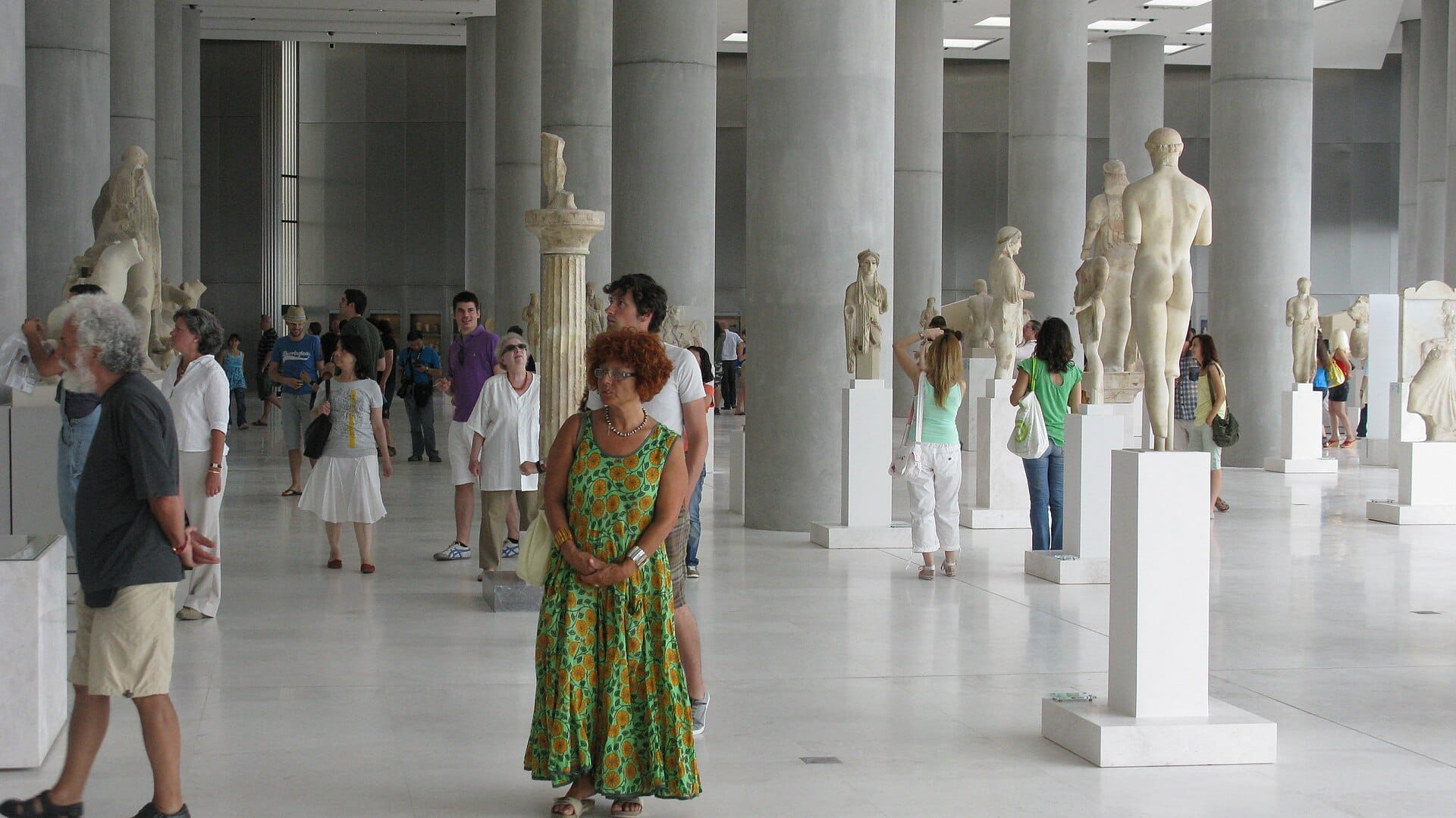
Before you reach a single artifact, the building itself rewards observation. The ground floor is elevated on concrete pillars to avoid disturbing the excavation below, and the structure is oriented at a slight angle to the surrounding street grid so the top-floor Parthenon Gallery aligns precisely with the Parthenon itself, visible through floor-to-ceiling glass on all sides. On a clear day, you can stand among the Parthenon frieze casts and look directly up the hill at the temple they came from.
The use of natural light throughout the building is deliberate and significant. The Parthenon Gallery in particular fills with changing light across the day, which means the marble surfaces read differently depending on when you visit. Morning light from the east hits the eastern frieze panels more directly; afternoon shifts the effect toward the western sections. This is not accidental design.
The glass floor panels on the entrance level, covering approximately 1,000 square meters, reveal the excavated neighborhood beneath. The excavation exposed streets, drainage channels, pottery workshops, and domestic buildings from late antiquity. Signs in the floor interpret what you are looking at, and it is worth spending five minutes here before heading upstairs, both to orient yourself and to appreciate the depth of history the museum is literally built on.
Tickets & tours
Hand-picked options from our booking partner. Prices are indicative; availability and final rates are confirmed when you complete your booking.
Guided tour of the Acropolis, Parthenon and Museum in Athens
From 50 €Instant confirmationFree cancellationAthens full-day tour with Acropolis and Cape Sounion
From 92 €Instant confirmationFree cancellationGuided tour of the Acropolis and Parthenon in Athens
From 34 €Instant confirmationFree cancellationAcropolis and museum tickets with three audio tours
From 80 €Instant confirmation
Floor by Floor: What You Will See
Ground Floor: The Slopes of the Acropolis
The ground floor displays finds from the sanctuaries on the slopes of the Acropolis rock, including the Sanctuary of Asclepius and the Sanctuary of Dionysus. Objects here range from Archaic period figurines and relief carvings to votive offerings. The material is dense but well-labeled, and this floor tends to be less crowded than the Parthenon Gallery above.
First Floor: The Archaic Acropolis
The first floor is where many visitors have their first genuine moment of surprise. The Archaic gallery holds a sequence of korai (statues of young women) and kouroi (young men) from the 6th century BCE, several of which retain traces of original paint. The Moschophoros, a marble figure of a man carrying a calf on his shoulders dating to around 570 BCE, is one of the most quietly powerful objects in the room. The famous Kore statues here display the archaic smile, the slightly upturned expression that appears across this period of Greek sculpture, and seeing multiple examples side by side makes the convention legible in a way no textbook photograph conveys.
Also on this floor are the sculptural fragments from the earlier temples that preceded the Parthenon, including the Hekatompedon pediment with its limestone Typhon figure and finely worked animals. These older pieces are crucial context for understanding how the Acropolis developed before the Classical period.
Top Floor: The Parthenon Gallery
The Parthenon Gallery is structured as a scaled rectangle matching the exact dimensions of the Parthenon cella. The frieze, metopes, and pediment sculptures are displayed in sequence around the room, with original pieces from Athens interspersed with high-quality plaster casts of the sections currently held in London's British Museum. The casts are clearly distinguished from the originals, and this presentation is explicitly part of the museum's ongoing argument for the return of the Elgin Marbles. Whether or not you have a view on that debate, the visual effect of the partial frieze is striking: the originals show the actual texture of Pentelic marble, while the casts render the missing sections in flat white, making the absences visible.
Allow yourself time here. The frieze alone, which originally ran 160 meters around the exterior of the Parthenon depicting the Panathenaic procession, repays slow looking. Individual figures reveal details that are easy to miss from a distance: the veining on horses' necks, the different fabric textures on the draped figures, the spatial relationship between overlapping bodies. Pick a section and stay with it for ten minutes rather than walking the full circuit quickly.
Opening Hours and Admission
Hours follow a seasonal pattern that changes between summer and winter; consult the museum’s official "Plan your visit" page for the current daily opening times before you go. Last entry is typically 30 minutes before closing.
The museum is closed on certain public holidays and operates with reduced hours on others, including major dates around Christmas, New Year, and Orthodox Easter; check the official site for the latest holiday schedule and special opening times.
⚠️ What to skip
Hours and admission prices are subject to change. Verify current information at theacropolismuseum.gr before your visit, particularly around Greek public holidays, which follow the Orthodox calendar and shift annually.
General admission is €20, with a reduced rate of €10 available to specific eligible groups as listed on the official site. The museum participates in periodic free admission days; check the official site for the current schedule. There is no additional charge to view the excavation beneath the building.
When to Go and How Crowds Behave
Mid-morning arrivals between 10:00 and 12:00 are the most congested periods, especially on days when large cruise groups are visiting the Acropolis hill and routing through the museum afterward. The Parthenon Gallery in particular becomes noticeably crowded during these hours, and the combination of people and natural light through the glass can make photography more difficult.
The most comfortable visit windows are opening time (9:00), which gives roughly 45 minutes of relative calm before group tours arrive, or late afternoon from around 16:00 onward. Friday evenings under the extended 22:00 closing are an option worth considering in summer: crowds thin significantly after 19:00, the light fading through the Parthenon Gallery glass takes on a different quality, and the restaurant upstairs has outdoor views toward the illuminated Acropolis.
In July and August, even the air-conditioned museum can feel warm near the glass-heavy top floor on the hottest afternoons. Carry water. The museum has a cafe on the ground floor and a restaurant on the upper level, both of which are usable without an additional ticket.
💡 Local tip
If you plan to visit both the Acropolis Museum and the Acropolis hill on the same day, visit the museum first. Understanding the sculptural context before standing in front of the Parthenon makes the site itself significantly more legible.
Getting There and Accessibility
The museum is at Dionysiou Areopagitou 15, on the pedestrianized street that runs along the southern base of the Acropolis. The Akropoli metro station on Line 2 (Red Line) is approximately a 2-minute walk from the main entrance. The station exit deposits you directly onto Dionysiou Areopagitou, and the museum is visible from the exit.
For visitors combining multiple sites, the pedestrianized Dionysiou Areopagitou street connects the museum area westward toward the Ancient Agora and the Temple of Hephaestus through Thisio, making it straightforward to link several sites on foot without significant road crossings.
The museum is fully accessible. Elevators serve all floors, ramps connect the entrance level to the excavation viewing area, and the glass floor panels over the excavation are navigable by wheelchair. Tactile exhibits are available for visually impaired visitors. Pushchairs and strollers are permitted throughout.
Photography, the Museum Shop, and Practical Details
Personal photography without flash is permitted throughout the museum, including in the Parthenon Gallery. The light quality for photography varies significantly by floor and time of day. The ground floor and first floor have more controlled lighting and tend to produce cleaner results. The top floor is more challenging: the natural light through the glass creates strong contrasts depending on the angle, and reflections on the display cases can be difficult to manage. A polarizing filter helps if you are shooting with a dedicated camera.
The museum shop near the entrance carries a good range of reproductions, publications, and exhibition catalogues. The scholarly catalogue for the permanent collection is available in English and Greek and is among the better museum publications in Athens for anyone who wants deeper context on specific objects. It is reasonably priced relative to comparable museum publications in Western Europe.
The museum sits in the Koukaki and Makrigianni area, a neighborhood worth exploring in its own right. Koukaki has a concentration of low-key cafes and restaurants that are generally less expensive and less crowded than those in Plaka immediately to the north. Post-museum lunch or coffee is easy to find within a five-minute walk.
Honest Assessment: Is It Worth It?
The Acropolis Museum is worth the time and the admission fee for almost any visitor to Athens. It is not a browsing museum where you wander and hope to be surprised; it is a museum with a clear argument and a defined collection, and engaging with it on those terms produces a more satisfying experience. Visitors who spend most of their time on the ground floor and skip the Parthenon Gallery are shortchanging themselves. Visitors who rush through the Parthenon Gallery without reading any of the interpretive panels will struggle to understand what they are looking at.
The museum is less suited to visitors with very young children, primarily because the scale and density of the collection makes sustained engagement difficult for children under about eight. Families with younger children may find the open spaces and outdoor sites on the Acropolis hill itself more manageable.
For context on how the Acropolis Museum fits into a broader Athens itinerary, the Athens ancient sites guide covers the logical sequence for visiting the city's major archaeological locations. If you are working with limited time, the Athens 1-day itinerary addresses how to combine the museum with the Acropolis hill itself efficiently.
Insider Tips
- Book tickets online in advance during peak season (June through August). The ticket queue on-site can add 30 to 45 minutes to your visit, while online ticket holders use a separate, faster entry lane.
- The glass floor panels over the excavation are easy to miss if you walk straight to the galleries. Spend a few minutes at ground level before heading upstairs; the street plan of the ancient neighborhood beneath is genuinely interesting and orients you to the depth of history the building sits on.
- Friday evening visits under the 22:00 closing time offer the most peaceful experience of the Parthenon Gallery in summer. After 19:00, the crowds thin noticeably and the changing light through the gallery glass is worth experiencing on its own terms.
- The reduced ticket price applies to specific groups including students, seniors, and others. Check the current eligibility list on the official site before assuming you qualify; the categories are more specific than many visitors expect.
- If you are interested in the Elgin Marbles debate, the museum provides a clear visual argument for repatriation without being polemical about it. Reading the frieze interpretation panels alongside the casts and originals is the most direct way to understand the scale of what is currently missing.
Who Is Acropolis Museum For?
- First-time visitors to Athens who want the essential context for understanding the Acropolis
- History and archaeology enthusiasts with a specific interest in Classical Greek sculpture
- Architecture and design-focused travelers interested in how the building itself engages with its setting
- Visitors planning to spend a full morning or afternoon on the Acropolis hill and wanting proper preparation
- Travelers visiting in summer who need a substantial indoor, air-conditioned attraction during the hottest part of the day
Nearby Attractions
Other things to see while in Koukaki & Makrygianni:
- National Museum of Contemporary Art (EMST)
The National Museum of Contemporary Art Athens (EMST) anchors the Koukaki neighborhood inside a dramatically refurbished 1960s brewery. With a permanent collection spanning Greek and international art from the 1960s to today, it is the country's most significant institution for contemporary work and a genuinely rewarding stop beyond the ancient sites.