Temple of Hephaestus: Athens' Most Complete Ancient Temple
Standing on Kolonos Agoraios hill inside the Ancient Agora, the Temple of Hephaestus is the most intact Doric temple to survive from ancient Greece. Built between roughly 449 and 415 BCE, it outlasted centuries of conversion, conquest, and neglect to stand nearly whole today. This guide covers what you'll actually see, how to time your visit, and what the guidebooks tend to leave out.
Quick Facts
- Location
- Kolonos Agoraios hill, Ancient Agora of Athens, Monastiraki
- Getting There
- Monastiraki Metro Station (Lines 1 and 3), approx. 5-minute walk
- Time Needed
- 45–90 minutes for the full Ancient Agora site
- Cost
- Included in the Ancient Agora admission ticket (verify current price before visiting)
- Best for
- Ancient history, architecture, photography, quiet morning exploration
What You're Looking At
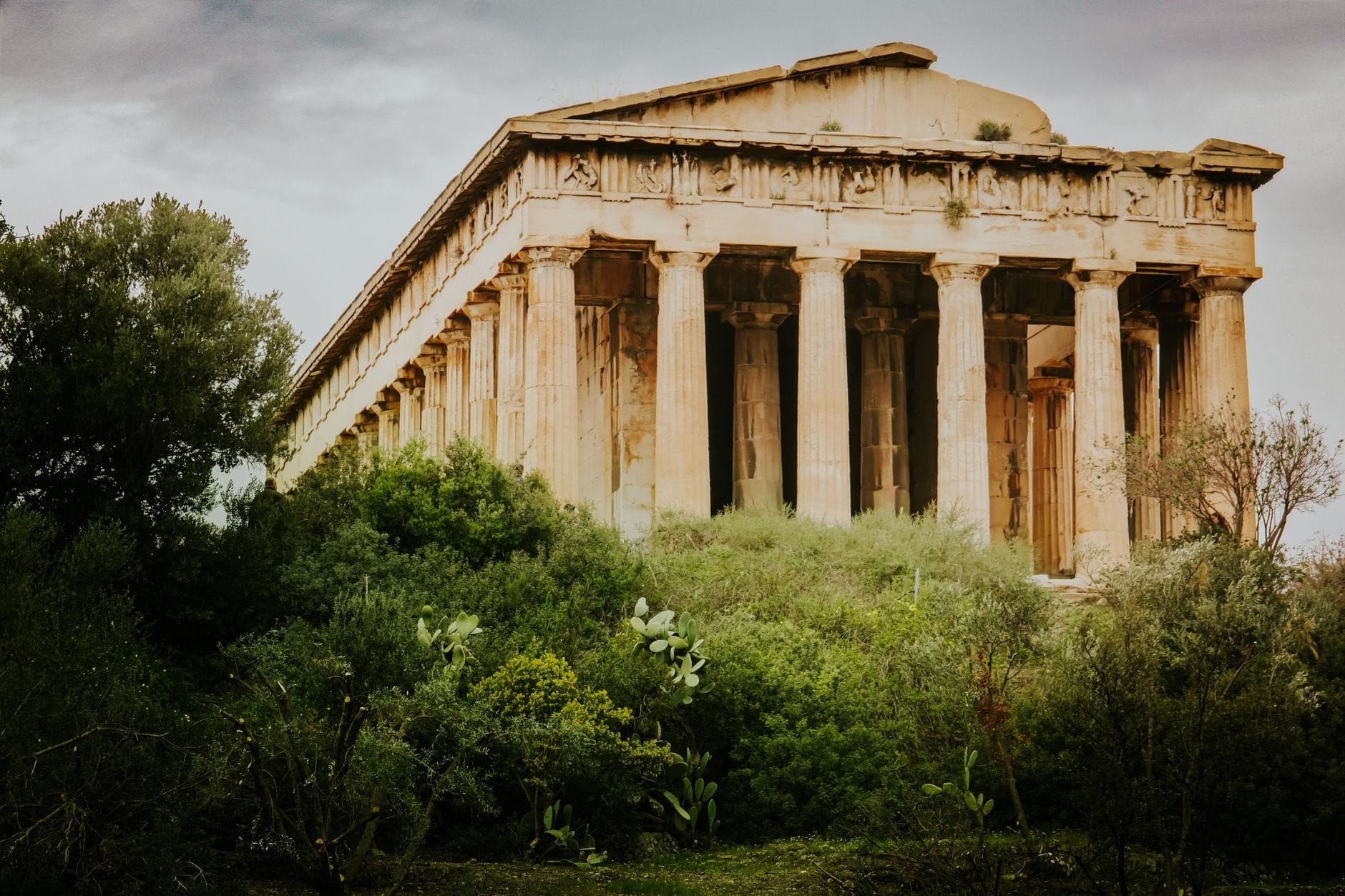
The Temple of Hephaestus, known formally as the Hephaisteion and historically misnamed the Theseion or Theseum, is a Doric peripteral temple dedicated to Hephaestus, god of fire and metalworking, and to Athena Ergane, patron of crafts. It was built during the Classical period, with construction generally dated between approximately 449 and 415 BCE, making it a near-contemporary of the Parthenon on the Acropolis. Its dimensions, roughly 13.7 metres wide by 31.7 metres long, are modest by Parthenon standards, but that modesty is part of why it survived.
The temple's preservation is exceptional by any measure. Both its colonnades of 34 Doric columns stand intact, the roof structure is substantially complete, and much of the sculptural frieze remains readable. For visitors arriving from more fragmentary sites, the sheer completeness of the structure can take a moment to register. This is not a ruin in the conventional sense. You are looking at a nearly whole ancient building.
ℹ️ Good to know
The Temple of Hephaestus is accessed through the Ancient Agora archaeological site, not as a standalone attraction. The site has seasonal opening hours that change by month. Confirm current hours and ticket prices on the official Hellenic Ministry of Culture website before you go.
The Setting: Kolonos Agoraios and the Ancient Agora
The temple sits on Kolonos Agoraios, a low hill on the western edge of the Ancient Agora of Athens. This placement was deliberate. From the temple's eastern steps, a priest or worshipper would have had a direct sightline across the Agora's open square to the Stoa of Attalos on the far side. The Agora was Athens' civic and commercial heart, and the temple watched over it from a slight elevation. That spatial relationship still reads clearly today.
The Ancient Agora site itself is large and requires more than a quick pass-through. Alongside the Hephaisteion, the grounds contain the reconstructed Stoa of Attalos (now housing the Agora Museum), the remains of the Metroon, the Altar of the Twelve Gods, and several other structures in varying states of preservation. Arriving with enough time to walk the site properly, rather than sprinting to the temple and leaving, pays dividends.
The hill itself is planted with pomegranate, myrtle, and laurel, species introduced in the 1950s during the American School of Classical Studies excavations to approximate the ancient landscape. In spring these bloom quietly. In summer they provide patches of shade on a hill that catches full sun for most of the day.
Tickets & tours
Hand-picked options from our booking partner. Prices are indicative; availability and final rates are confirmed when you complete your booking.
Guided tour of the Acropolis, Parthenon and Museum in Athens
From 50 €Instant confirmationFree cancellationAthens: Temple of Olympian Zeus E-ticket with audio tour on your phone
From 10 €Instant confirmationAthens full-day tour with Acropolis and Cape Sounion
From 92 €Instant confirmationFree cancellationAthens National Archaeological Museum e-ticket and audio tour
From 22 €Instant confirmation
Architectural Details Worth Slowing Down For
From a distance, the Hephaisteion reads as a textbook example of the Doric order: sturdy columns with no bases, plain capitals, and a triglyphs-and-metopes frieze running around the exterior. Move closer and the picture becomes more interesting. The eastern frieze above the entrance porch shows scenes from the labors of Heracles, carved in high relief. The frieze on the north and south sides of the interior (the so-called continuous Ionic frieze) depicts the battle of the Lapiths and Centaurs. The quality of the carving, even weathered as it is, shows skilled hands at work.
Visitors are not permitted inside the cella itself, but through the columns you can see the brick walls added during the temple's long tenure as a Christian church, a conversion that probably began in the 7th century CE. The church dedication was to Saint George. It is this conversion, combined with the temple's solid original construction, that accounts for its survival while temples elsewhere were quarried for building material or simply collapsed. The last religious service here was held in 1834, when the newly established Greek state declared Athens its capital and the building became an archaeological site.
Look at the column drums carefully. You can trace repair work from multiple eras: ancient patching in Pentelic marble, later Byzantine interventions, and 20th-century conservation fills. The temple is not frozen in 415 BCE. It is a layered object with two and a half millennia of accumulated decisions embedded in it.
Visiting by Time of Day
Morning, particularly in the first hour after the site opens, is measurably better for the Hephaisteion than any other time. The low eastern sun hits the columns from the side, throwing their fluting into sharp relief. The Agora site is quiet. You can stand on the eastern steps and look across the whole archaeological zone without another person in your sightline, which is the closest approximation available to how the space once felt.
By late morning, tour groups begin arriving from the Acropolis area. The Hephaisteion is a natural second stop on the standard ancient Athens circuit, and by 11am on most days you will be sharing the hill with several groups at once. This is manageable but changes the character of the experience.
Late afternoon, in the hour before closing, brings a different quality of light. The western sun illuminates the rear of the temple and the hill's vegetation glows. Crowds thin again. If you are combining the Agora with a visit to the Acropolis or the Acropolis Museum, do the Agora early in the day and the museum later, rather than the reverse.
💡 Local tip
Summer afternoons on Kolonos Agoraios are hot, exposed, and uncomfortable. Carry water, wear a hat, and apply sunscreen before entering. There is no shade on the approach to the temple itself, and temperatures on the hill regularly exceed 35°C in July and August.
Photography
The Hephaisteion is one of the more photogenic structures in Athens because it photographs as a complete building rather than a fragment. The classic composition is from the northeast corner, which captures both the long colonnade and the shorter end facade with the Acropolis visible on the hill behind. This shot works best in the morning when the light is on the eastern face and the Acropolis catches soft illumination rather than harsh midday glare.
For detail photography, the frieze blocks on the eastern porch reward a telephoto or close approach, though you cannot touch or enter the temple. The texture of the Pentelic marble, pitted and cream-colored after 2,400 years of weathering, reads well in overcast light. On cloudy days in spring or autumn, the columns glow against a grey sky in a way that flat summer light does not produce.
Getting There and Practical Notes
The most direct approach is from Monastiraki Metro Station, served by Line 1 (Green) and Line 3 (Blue). From the station, walk south along Adrianou Street for approximately 400 metres to the Ancient Agora entrance. The walk takes around five minutes on flat ground. Alternatively, the site can be entered from the Dionysiou Areopagitou pedestrian street on the southern side, which is convenient if you are coming directly from the Acropolis area.
The Ancient Agora is also a straightforward walk from Psyrri or Thisio, and the surrounding streets make for easy combination with a broader exploration of the area. The Monastiraki Flea Market is minutes away to the north, and Hadrian's Library borders the Agora site to the northeast.
The terrain inside the Ancient Agora is uneven, with gravel paths, exposed ancient paving, and some slopes. Sturdy footwear is strongly recommended. The path to the Hephaisteion involves a gentle but definite uphill climb over rough ground. Accessibility for wheelchair users or visitors with significant mobility limitations is limited; confirm current conditions directly with the site before visiting.
⚠️ What to skip
There is no dedicated ticket office at the Hephaisteion itself. Purchase your ticket at the Ancient Agora site entrance on Adrianou Street or at the southern entrance near Dionysiou Areopagitou. Admission prices and site hours are subject to seasonal change and should be verified before your visit.
Context: Where This Fits in Athens' Ancient Sites
Visitors who have already seen the Acropolis and the Acropolis Museum sometimes approach the Hephaisteion as a secondary stop, something to tick off while passing through Monastiraki. This underestimates it. The Parthenon is more famous and more dramatic in scale, but you cannot stand next to the Parthenon's columns or read the site without a large crowd. The Hephaisteion allows a closer, quieter encounter with 5th-century BCE architecture. For visitors interested in the structural and decorative logic of Greek temple building, the Hephaisteion is the better teaching object.
The temple also sits inside an active archaeological landscape. The Ancient Agora excavations, ongoing since the 1930s under the American School of Classical Studies at Athens, continue to produce new findings. The site is not static. The National Archaeological Museum holds much of what has been excavated here, and visiting both in sequence gives a richer picture of what civic Athens actually looked like in antiquity.
One honest note: the Hephaisteion is sometimes described in travel writing with a kind of breathless superlative that sets up unrealistic expectations for first-time visitors. It is not a spectacle in the Colosseum sense. It is a medium-scale temple that rewards close looking and some background knowledge. Visitors who arrive wanting scale and grandeur may find the Acropolis more satisfying. Visitors who want texture, detail, and the feeling of genuine proximity to antiquity will find the Hephaisteion gives them something the Acropolis hilltop cannot.
Insider Tips
- The site opens early, and arriving at or very close to opening time on weekdays gives you a realistic chance of having the Hephaisteion almost to yourself for 20 to 30 minutes. Weekend mornings fill faster.
- The Agora Museum inside the reconstructed Stoa of Attalos is included in the same ticket and is frequently skipped by visitors in a hurry. It contains bronze objects, pottery, and everyday items from the Agora excavations that make the surrounding site legible in a way that standing among ruins alone does not.
- The northeast corner of the Hephaisteion, where the long colonnade meets the short end facade, frames the Acropolis in the background. This is the best angle for photography and is also simply the most pleasant place to stand and look. Most visitors cluster at the eastern front steps; the northeast approach is quieter.
- If you are visiting in spring (April to May), the pomegranate and myrtle planted on the hill will be flowering. The combination of ancient stone and low flowering shrubs is one of the more distinctive sensory details of the site and is absent in summer when the vegetation is dry and brown.
- The Hephaisteion is dedicated in part to Athena Ergane, the aspect of Athena who governed crafts and skilled labor. The location was deliberate: metalworking workshops, ergasteria, operated in the area around the Agora's western edge for centuries. The temple's hill was not chosen for drama but for proximity to the people it served.
Who Is Temple of Hephaestus For?
- Architecture and classical history enthusiasts who want a close reading of Doric temple construction
- Photographers seeking a complete ancient structure with good morning light and Acropolis backdrop
- Visitors who find the Acropolis too crowded and want a quieter, more intimate ancient site
- Travelers building a full-day ancient Athens itinerary combining multiple archaeological sites
- Anyone with a particular interest in the transition from pagan temple to Byzantine church and the layers of history that produced
Nearby Attractions
Other things to see while in Monastiraki:
- Ancient Agora of Athens
The Ancient Agora of Athens was the civic, commercial, and philosophical center of the ancient city for over a thousand years. Today, its open archaeological site combines sweeping ruins, one of the best-preserved Greek temples in existence, and a world-class on-site museum — all within easy walking distance of Monastiraki Square.
- Athens Central Market (Varvakios Agora)
Open since 1884, the Athens Central Market — officially the Varvakios Agora — is where Athenian chefs, home cooks, and curious travelers collide under a 19th-century iron-and-glass roof. It is raw, fragrant, occasionally confronting, and entirely genuine. This is what a food market looks like before it becomes a tourist attraction.
- Hadrian's Library
Built by Emperor Hadrian in 132 AD, the Library of Hadrian is one of Athens' most underappreciated ancient sites. A short walk from Monastiraki Square, it offers a rare, close encounter with Roman imperial architecture layered over centuries of Greek and Byzantine history.
- Monastiraki Flea Market
Sprawling across the cobbled lanes around Monastiraki Square, the Monastiraki Flea Market is where Athens does its most honest selling. Free to enter, chaotic by design, and best on Sunday mornings when antique dealers take over Avissinia Square.