Monastiraki Flea Market: Athens' Open-Air Bazaar Explained
Sprawling across the cobbled lanes around Monastiraki Square, the Monastiraki Flea Market is where Athens does its most honest selling. Free to enter, chaotic by design, and best on Sunday mornings when antique dealers take over Avissinia Square.
Quick Facts
- Location
- Ifestou Street & Monastiraki Square, Athens 105 55 (Monastiraki neighborhood)
- Getting There
- Monastiraki Station (Metro Lines 1 & 3), exiting directly onto Monastiraki Square at the market center
- Time Needed
- 1–3 hours; add extra time on Sundays for Avissinia Square antiques
- Cost
- Free to enter; goods priced individually by vendors in EUR
- Best for
- Vintage hunters, casual browsers, street food lovers, Sunday morning explorers
What Monastiraki Flea Market Actually Is
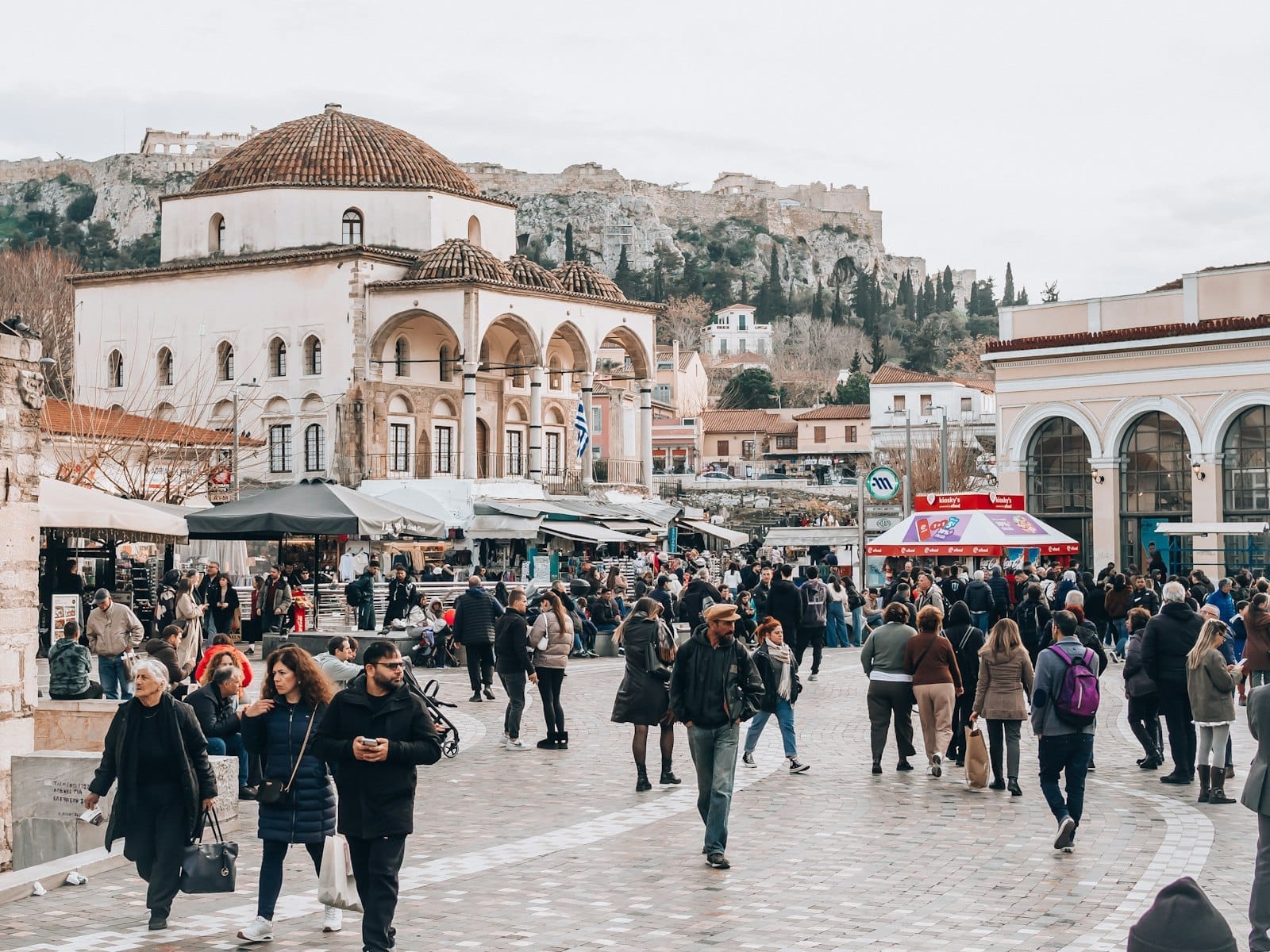
The Monastiraki Flea Market is not a single enclosed venue with gates and a closing time. It is a living neighborhood bazaar spread across several streets and alleyways converging on Monastiraki Square, in one of Athens' oldest continuously inhabited districts. The market's core runs along Ifestou Street (named after Hephaestus, the god of the forge) and branches into Pandrossou Street, Adrianou Street, and the smaller lanes threading toward Avissinia Square. The result is less a traditional market and more a commercial ecosystem: permanent shops, semi-permanent stalls, street vendors, and impromptu sellers operating simultaneously.
The neighborhood itself carries serious historical weight. Monastiraki takes its name from the small Church of the Pantanassa that sits in the square, and the area is said to have been inhabited for roughly six thousand years, placing human settlement here well before the classical period. Standing at the right corner of the square, you can see the remains of Hadrian's Library to one side and the Acropolis framing the skyline above. The market operates within an archaeological landscape that most cities would rope off and charge admission for.
ℹ️ Good to know
Monastiraki Flea Market has no official opening or closing time, no admission fee, and no single managing authority. It operates as an open neighborhood market. Individual shops typically open from mid-morning, while street vendors may arrive earlier. Sunday mornings bring the highest concentration of antique stalls around Avissinia Square.
Sunday Morning: When the Market Earns Its Reputation
From Monday through Saturday, Monastiraki is a lively shopping strip with permanent shops selling leather goods, tourist souvenirs, clothing, and household items. It is worth a walk, but nothing exceptional compared to similar bazaar districts in other Mediterranean cities. Sunday morning changes the equation entirely.
On Sundays, Avissinia Square, just a short walk west of Monastiraki Station, fills with vendors selling genuine antiques, used furniture, vintage clothing, old coins, military memorabilia, silverware, religious icons, and an enormous volume of pure clutter. The air smells of old wood and frying food from the surrounding kafeneions. The sound is a low, persistent hum of negotiation, scraping chairs, and the occasional argument over a price. Serious buyers arrive before 9:00 AM, when the best pieces are still on the ground cloth and the vendors have not yet packed the obvious stock back into their vans.
If you are in Athens on a Sunday and even mildly curious about vintage objects, architecture, or street-level urban life, this market deserves the morning. Pair it with a visit to the Ancient Agora, which sits directly adjacent and opens from 8:00 AM, allowing you to combine both without backtracking.
Tickets & tours
Hand-picked options from our booking partner. Prices are indicative; availability and final rates are confirmed when you complete your booking.
Food tour in Omonia through Psyrri and Monastiraki in Athens
From 69 €Instant confirmationFree cancellationGuided tour of the Acropolis, Parthenon and Museum in Athens
From 50 €Instant confirmationFree cancellationAthens: Temple of Olympian Zeus E-ticket with audio tour on your phone
From 10 €Instant confirmationAthens full-day tour with Acropolis and Cape Sounion
From 92 €Instant confirmationFree cancellation
How the Market Changes Through the Day
Early morning, before 9:00 AM, the lanes around Ifestou Street are relatively quiet. A few shops roll up their metal shutters, and the smell of coffee drifts from the neighborhood cafes. This is the most pleasant time to walk the market on any day of the week: the light is soft, the paving stones are still cool underfoot, and you can actually stop and look at things without being bumped by a passing crowd.
By mid-morning, particularly on weekends, the crowds thicken noticeably. Tour groups begin arriving from the nearby Acropolis circuit, street food vendors light their grills, and the narrow lanes around the market core become congested. The smells shift too: grilled corn, souvlaki from nearby stands, and the particular dusty warmth of textiles left in the sun. By early afternoon in summer, the combination of heat, crowds, and the reflective heat of Athens' stone surfaces makes extended browsing genuinely uncomfortable without water and a hat.
Late afternoon brings a second, calmer wave of visitors. Many of the more serious souvenir shops and leather goods stores stay open until early evening, and the square itself becomes a natural meeting point as the light turns golden over the Acropolis. This is the best time for photography: the warm directional light hits the facades and the Tzistarakis Mosque (an 18th-century Ottoman-era structure that anchors Monastiraki Square visually) at a flattering angle.
💡 Local tip
For the best photography of Monastiraki Square with the Acropolis in the background, position yourself on the northeast corner of the square in the late afternoon. The Tzistarakis Mosque provides a strong foreground element and the Acropolis sits cleanly in the upper frame.
What You'll Find: A Realistic Inventory
The permanent shops along Ifestou and Pandrossou Streets sell a predictable mix: leather sandals and bags, worry beads (komboloi), painted ceramics, evil-eye charms, olive wood kitchenware, reproduction ancient figurines, and printed textiles. The quality varies enormously from shop to shop, and the prices on tourist-facing items are rarely fixed, particularly if you are buying multiple pieces. A polite, low-key counter-offer on items without posted price tags is standard practice and generally expected.
Beyond the souvenir layer, the market rewards more careful looking. Several shops on and around Ifestou Street specialize in vintage tools, old electrical equipment, military surplus, and general household salvage. These shops are not primarily aimed at tourists, and the inventory reflects that: you might find a 1960s Greek army canteen, a set of copper coffee pots, or a pile of vintage postcards. Prices in these shops tend to be more fixed and considerably lower than in the tourist-facing stores.
The Sunday Avissinia Square antique section is a different category again. Genuine antique pieces do appear, including old coins, Byzantine-era religious objects, Art Deco jewelry, and pre-war furniture. However, the market also carries a substantial volume of low-quality reproduction goods presented as antiques. If you are buying anything as a serious collectible, exercise the same caution you would at any unregulated antique market anywhere in the world.
⚠️ What to skip
Greece applies strict export controls to genuine antiquities. Purchasing or attempting to export authentic ancient artifacts without proper documentation is illegal and can result in serious legal consequences. If a vendor claims an item is a genuine ancient artifact at a street-market price, treat that claim with skepticism.
Getting There and Moving Around
The Monastiraki Metro station, served by both Line 1 (Green) and Line 3 (Blue), deposits you directly into the square at the market's center. This is the most practical arrival point from most parts of Athens, and the station itself is worth a brief look: excavations during its construction exposed a section of an ancient road and drainage infrastructure, visible through glass panels on the platform level.
The market connects naturally to the surrounding neighborhood on foot. Plaka is a 5-minute walk to the east. The pedestrianized Apostolou Pavlou street leading toward Philopappos Hill begins near Thissio station, a 5-minute walk west. The Ancient Agora of Athens is immediately adjacent, and the Roman Agora is less than 200 meters from the square's northern edge.
The market streets are pedestrian-only, but the cobblestone and stone-slab surfaces are uneven in places. Wheelchairs and strollers can navigate Monastiraki Square itself without difficulty, but the narrower lanes running off it become trickier, particularly when crowded. There are no steps on the main routes between the Metro station and the square.
Eating and Drinking Around the Market
Monastiraki is one of Athens' better areas for quick, inexpensive eating. The cluster of souvlaki shops near the square, particularly on Mitropoleos Street running east toward Syntagma, serves some of the city's most-discussed street food. For a broader overview of the neighborhood's food options and what to order, the Athens food guide covers specific stops worth noting before you visit.
Several rooftop cafes and bars around Monastiraki Square offer elevated views toward the Acropolis. These tend to be priced at a significant premium over ground-floor alternatives, which is understandable given the view, but a coffee here on a clear morning is one of the more quietly spectacular things you can do in Athens without spending much. Avoid peak lunch hour (13:00 to 15:00) if you want a table without a wait.
Honest Assessment: Limitations Worth Knowing
The Monastiraki Flea Market is frequently described in travel content as a place where remarkable antique finds await the patient browser. That framing is only partially accurate. The Sunday market at Avissinia Square does contain genuine old objects, but it is not the unexploited trove it was described as in older guides. Prices on recognizable antiques have risen considerably, and vendors dealing with tourists regularly are aware of international market values. The better finds tend to go to regular local buyers who arrive early and speak Greek. If your goal is serious antiquing, the market is worth an exploratory Sunday visit, but managing expectations is important. For a clearer picture of how Monastiraki fits within Athens more broadly, the Monastiraki neighborhood guide provides useful context on what else the area offers beyond the market itself.
The market is also significantly more crowded than most guidebooks acknowledge. On summer weekend afternoons, the main lanes are genuinely difficult to move through comfortably, and the heat reflected off Athens' stone surfaces intensifies the experience. Visitors who are sensitive to crowds, heat, or high-pressure sales approaches from more persistent vendors may find the Sunday peak hours taxing.
That said, even at its most crowded, the market occupies one of the most historically layered urban spaces in Europe. The combination of the active bazaar, the surrounding ancient sites, and the Acropolis visible from almost every angle makes it a genuinely Athens-specific experience. For first-time visitors building an itinerary, the Athens one-day itinerary integrates the market with the nearby ancient sites in a logical walking sequence.
Insider Tips
- Arrive at Avissinia Square before 9:00 AM on Sundays if you want first access to the antique stalls. The vendors with the best pieces often pack up or raise prices once the tourist flow picks up after 10:30 AM.
- The shops along Ifestou Street that deal in used tools, old radios, and household salvage are rarely aimed at tourists and often have the most interesting and fairly priced inventory in the market. They are easy to walk past if you are not looking, but worth slowing down for.
- Haggling is normal for goods without a posted price, but aggressive negotiating on small-value items rarely makes a meaningful difference and can sour the interaction. A calm, direct counter-offer of 20–30% below the asking price on larger purchases is a reasonable opening.
- The rooftop bars and cafes overlooking Monastiraki Square are popular for Acropolis views, but the actual best elevated view of the square and the surrounding area is from the Acropolis itself. If you are visiting both in one day, save the rooftop for a quieter late-morning coffee.
- The Monastiraki Metro station platform contains a visible archaeological excavation section behind glass panels, showing ancient roadway and drainage infrastructure uncovered during construction. It takes two minutes to look at and most visitors walk straight past it.
Who Is Monastiraki Flea Market For?
- First-time Athens visitors wanting an immediate sense of the city's layered character without booking tickets
- Sunday morning antique and vintage hunters willing to arrive early and browse without fixed expectations
- Travelers looking to combine shopping, street food, and access to adjacent ancient sites in a single compact area
- Budget travelers: the market is free to enter, street food is inexpensive, and the surrounding archaeological views cost nothing
- Photographers interested in urban street scenes, architectural contrasts, and Acropolis backdrops at varying light
Nearby Attractions
Other things to see while in Monastiraki:
- Ancient Agora of Athens
The Ancient Agora of Athens was the civic, commercial, and philosophical center of the ancient city for over a thousand years. Today, its open archaeological site combines sweeping ruins, one of the best-preserved Greek temples in existence, and a world-class on-site museum — all within easy walking distance of Monastiraki Square.
- Athens Central Market (Varvakios Agora)
Open since 1884, the Athens Central Market — officially the Varvakios Agora — is where Athenian chefs, home cooks, and curious travelers collide under a 19th-century iron-and-glass roof. It is raw, fragrant, occasionally confronting, and entirely genuine. This is what a food market looks like before it becomes a tourist attraction.
- Hadrian's Library
Built by Emperor Hadrian in 132 AD, the Library of Hadrian is one of Athens' most underappreciated ancient sites. A short walk from Monastiraki Square, it offers a rare, close encounter with Roman imperial architecture layered over centuries of Greek and Byzantine history.
- Roman Agora
The Roman Agora of Athens is a remarkably preserved 1st-century BC commercial complex that once served as the city's main marketplace under Roman rule. Spanning roughly 111 by 104 metres in the heart of the old city, it offers a quieter and often overlooked counterpoint to the crowded Acropolis. Its crowning feature, the Gate of Athena Archegetis, remains one of the finest surviving Roman gateways in Greece.