Philopappos Hill: Athens' Quieter Summit with the Best View of the Acropolis
Standing about 147 metres above the city, Philopappos Hill is an open, free-access park in the Thisio area with panoramic views of the Acropolis, a Roman-era funerary monument at its summit, and shaded pine paths that feel a world away from the tourist crowds below. It rewards early risers and sunset chasers in equal measure.
Quick Facts
- Location
- Central Athens (accessed via Apostolou Pavlou or Dionysiou Areopagitou Street)
- Getting There
- Acropoli (Metro Line 2, ~8 min walk) or Thissio (Metro Line 1, ~10 min walk)
- Time Needed
- 1 to 2 hours, including summit walk and views
- Cost
- Free, no ticket required, open 24 hours year-round
- Best for
- Panoramic Acropolis views, quiet walks, sunset photography, history enthusiasts
What Is Philopappos Hill?
Philopappos Hill, also spelled Filopappou Hill, sits at 147 metres above sea level on the western flank of the Acropolis. It is part of a trio of historic hills in this part of Athens, alongside the Hill of the Nymphs and the Pnyx, and it offers what many visitors consider the single most satisfying vantage point in the city: a direct, unobstructed view across to the Parthenon. Unlike the Acropolis itself, there is no queue, no ticket booth, and no timed entry window. You walk in, you walk up, and the city opens up around you.
The hill falls within the Thisio neighborhood, one of the more relaxed quarters of central Athens, and it connects naturally to the pedestrianised archaeological promenade that runs along Apostolou Pavlou street. This makes Philopappos Hill an easy addition to any day that includes the Acropolis or the Ancient Agora, without adding significant time or cost.
💡 Local tip
Approach from Apostolou Pavlou Street rather than through Filopappou Park's back paths. The main route is better marked, more shaded, and gives you a cleaner walk up to the summit monument.
The Philopappos Monument: What You'll Find at the Top
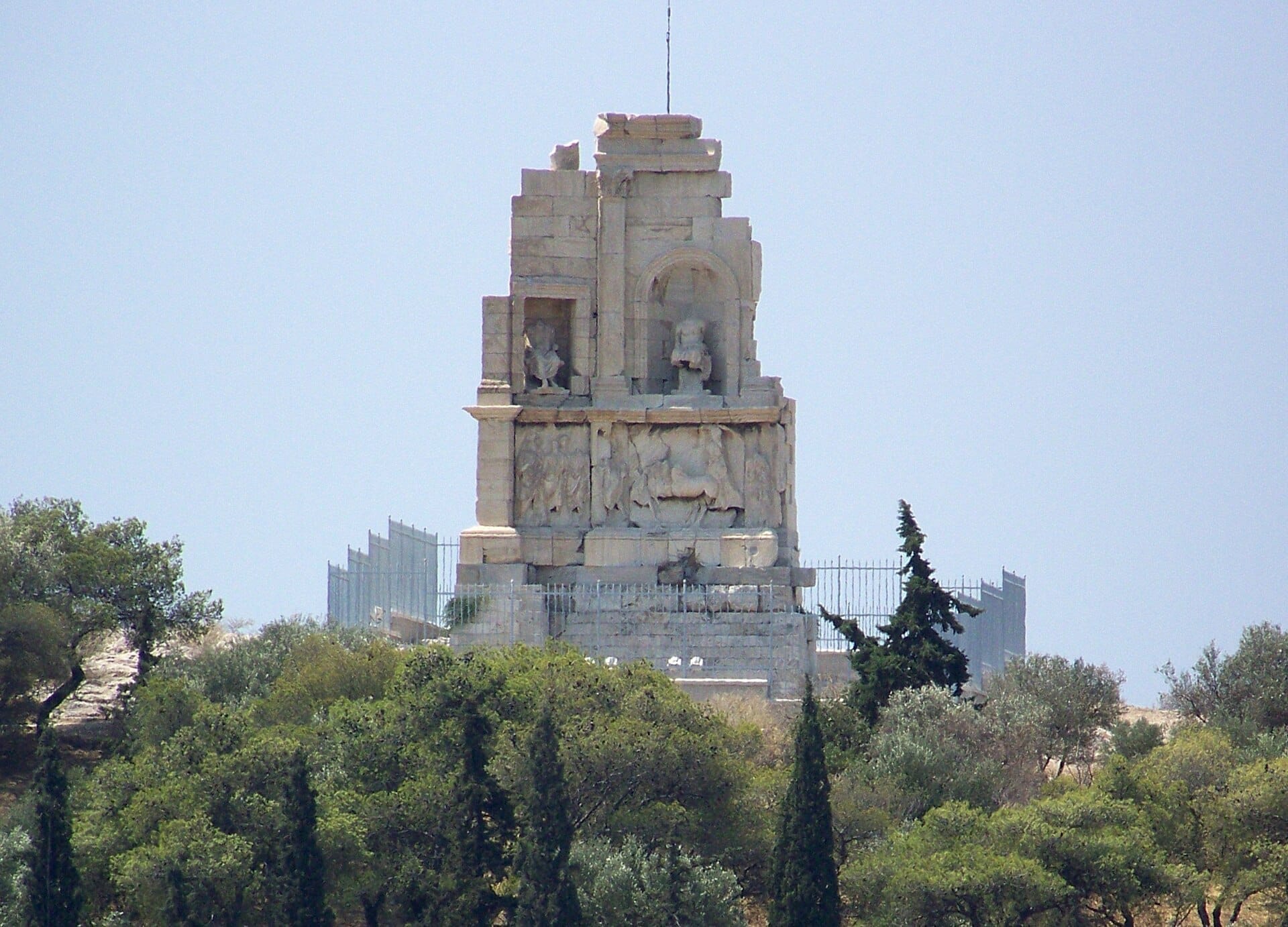
The marble structure at the summit is the Philopappos Monument, a funerary monument built in honour of Gaius Julius Antiochus Epiphanes Philopappos, a Roman senator and prince of Commagene who died in 116 AD. Philopappos was an Athenian citizen of considerable standing, and the city honoured him with this prominently placed tomb on what was then known as the Mouseion, or Hill of the Muses.
In antiquity, the Mouseion name connected the hill to the nine Muses and to the poet Musaeus, a legendary figure thought to have lived and been buried here. The hill carried that name for centuries before Philopappos' monument became its defining landmark. The monument itself originally stood about 12 metres high and featured carved relief panels depicting Philopappos in a Roman consul's procession. Much of the upper structure has eroded or collapsed over the centuries, but the remaining marble frieze and arched niches are still clearly readable on site.
The structure is fenced to protect the stonework, so you cannot touch or walk around all sides of it at close range. What you can do is stand just below it and take in the full westward sweep of Athens, from the Port of Piraeus on clear days, to the ridge of the Saronic hills beyond. On the other side, the Acropolis floats above the city rooftops at almost eye level, close enough to see the construction scaffolding on the Parthenon in detail.
Tickets & tours
Hand-picked options from our booking partner. Prices are indicative; availability and final rates are confirmed when you complete your booking.
Guided tour of the Acropolis, Parthenon and Museum in Athens
From 50 €Instant confirmationFree cancellationAthens: Temple of Olympian Zeus E-ticket with audio tour on your phone
From 10 €Instant confirmationAthens full-day tour with Acropolis and Cape Sounion
From 92 €Instant confirmationFree cancellationAthens National Archaeological Museum e-ticket and audio tour
From 22 €Instant confirmation
The Walk Up: Paths, Terrain, and What to Expect
The climb from the base to the summit takes roughly 15 to 25 minutes depending on your pace and which path you take. The terrain is a combination of wide stone-paved walkways and narrower dirt tracks with embedded limestone steps. None of it is technical, but the paths are consistently uneven. Loose gravel appears in places, and the steps near the summit can be slippery after rain. Comfortable walking shoes are important; sandals or dress shoes will make the ascent uncomfortable.
⚠️ What to skip
There are no wheelchair-accessible or step-free routes to the summit. Visitors with limited mobility will find the terrain difficult above the first level of the park. The lower path areas, however, are more level and still pleasant.
The park itself is largely shaded by Aleppo pines and cypress trees, which makes the walk considerably more bearable in summer than the exposed Acropolis paths. The smell of sun-warmed pine resin is noticeable throughout the day, particularly in the still morning air. Birds are active early in the morning, and the combination of shade, birdsong, and stone underfoot gives the lower sections of the park a genuinely peaceful character.
Several informal paths branch off the main route, and some visitors get turned around briefly. Stay on the wider, better-worn paths and keep the summit monument in sight once it becomes visible. The hill is small enough that getting seriously lost is not a real concern, but a few unnecessary extra minutes on the wrong track in summer heat is worth avoiding.
Timing Your Visit: How the Hill Changes Through the Day
Early mornings, from around 7am to 9am, are the least crowded and most atmospheric. The light comes in from the east, catching the Parthenon columns in a warm direct angle, while the hill itself is still cool and quiet. You may have the summit almost entirely to yourself. A few local joggers and dog walkers use the lower paths at this hour, but the upper areas are rarely busy.
Midday visits in summer are best avoided. Athens regularly exceeds 35°C from June through August, and while the pines provide partial shade, the summit area is fully exposed to the sun. If you are planning a summer visit, read the full context on navigating the city in heat in our guide to visiting Athens in summer before you set out.
Late afternoon is the second-best window, especially from April through October. As the sun drops toward the west and the shadows lengthen, the Acropolis is lit from the side rather than from above, and the photography conditions improve sharply. The hill becomes gradually busier from 5pm onward as both locals and tourists head up for the sunset. By 6pm in peak season, the summit area has a social atmosphere, with small groups arranged along the viewing edge. It is not the lonely hilltop you might hope for at that hour, but the shared experience of watching the sky shift over the Parthenon has its own appeal.
💡 Local tip
For sunset photography, arrive 30 to 40 minutes before actual sunset. The best angle for the Acropolis sits slightly north of the monument itself, near the natural rocky outcrop to the right as you face the hill's eastern edge.
Historical and Cultural Context
Philopappos Hill does not exist in isolation. It sits at the centre of a cluster of ancient sites that defined civic life in classical Athens. To the northeast is the Areopagus Hill, the ancient high court of Athens. Directly east rises the Acropolis. Just below the northern face of Philopappos is the Pnyx, the semicircular open-air meeting ground where Athenian citizens gathered to vote and debate during the classical period. These three hills together formed the western boundary of the ancient city's public life.
During the Ottoman period, the hill was largely ignored as a civic space, though the monument was visible from the city and used as a landmark by travellers and cartographers. It was not until the nineteenth century, after Greek independence, that systematic archaeological interest in the hill began. The Pnyx below the hill was partially excavated and studied as early as the 1930s, confirming its function as the original democratic assembly ground of Athens.
The broader pedestrian zone connecting these hills, including the path that runs past the Odeon of Herodes Atticus and continues around the southern base of the Acropolis, was developed progressively through the twentieth century and is now one of the longest car-free archaeological promenades in Europe. Philopappos Hill anchors its western end.
Practical Details: Getting There and What to Bring
The most straightforward route is from Acropoli metro station on Line 2 (the Red Line). Exit the station, walk west along Dionysiou Areopagitou Street, then turn left onto Apostolou Pavlou. The path into Filopappou Park begins on the left side of Apostolou Pavlou, marked by stone steps and an information panel. From the Thissio station on Line 1 (the Green Line), the approach is slightly longer but equally walkable, coming from the north along Apostolou Pavlou.
Bring water regardless of season. There are no kiosks or water points on the hill itself. In summer, a hat and sunscreen are not optional for the exposed upper section. The park has stone benches at several points on the lower paths, useful if you need to rest on the way down. There is no artificial lighting on most paths, so after dark the terrain becomes significantly harder to navigate; a phone torch is useful if you stay past dusk.
Philopappos Hill is free, which makes it a natural fit if you are travelling on a tight budget. For more free and low-cost options across the city, the guide to free things to do in Athens covers the full picture.
Who Should Think Twice Before Visiting
Travellers with significant mobility limitations will find the summit inaccessible. The paths are not paved uniformly, and there are no handrails for most of the climb. Visiting with very young children in pushchairs is impractical above the first level of the park, though older children who can walk on uneven ground will generally enjoy the climb.
If your main priority is a polished museum experience or air-conditioned comfort, Philopappos Hill will not satisfy that. It is an outdoor archaeological park with no facilities beyond the terrain itself. In rainy weather, the stone steps become slick and the experience loses most of its appeal. January and February are statistically the wettest months in Athens, and a wet-season visit to the summit is notably less rewarding.
Insider Tips
- The cave of Socrates, a rock-cut chamber on the northwestern slope, is often overlooked by visitors heading straight to the summit. It is thought to have been used as a prison during the classical period, though its connection to Socrates is legendary rather than verified. It takes only a few extra minutes to find on the lower paths.
- If you combine this visit with the Acropolis on the same day, do Philopappos first, in the early morning before the Acropolis opens its gates. You will see the hill at its quietest, and then walk directly to the Acropolis queue while it is still manageable.
- The view of the Parthenon from just below the Philopappos Monument is more interesting photographically than the view from the Acropolis itself, because you see the full structure in context with the city spread behind it. A zoom lens or a phone with a good optical zoom makes a significant difference here.
- Local residents use the lower paths for morning exercise. If you want a sense of the hill as a living neighbourhood space rather than a tourist site, arrive before 8am on a weekday and walk the perimeter paths rather than heading straight to the summit.
- The Pnyx assembly ground is directly accessible from the northern face of Philopappos Hill via an unmarked but clear path. It is almost always empty and gives a remarkable sense of scale for the place where Athenian democracy was literally practised. Few visitors make this short detour.
Who Is Philopappos Hill For?
- Photographers looking for the classic elevated Acropolis shot away from the crowds
- History enthusiasts interested in the Roman-era monument and classical Athenian civic landscape
- Travellers who want a meaningful outdoor experience without any entrance fee
- Early risers and sunset chasers seeking an atmospheric vantage point over the city
- Visitors who want to combine multiple ancient sites in a single self-guided walking circuit
Nearby Attractions
Other things to see while in Thisio:
- Areopagus Hill
Rising just northwest of the Acropolis, Areopagus Hill is a bare marble outcrop where Athenian aristocrats once judged homicide cases, Ares was tried by the gods, and the Apostle Paul addressed the city's intellectuals. Today it costs nothing to climb and rewards visitors with one of Athens' most unobstructed views of the Acropolis. No fence, no ticket, no tour guide required.