Odeon of Herodes Atticus: Ancient Stone, Living Stage
Built in AD 161 on the southwest slope of the Acropolis, the Odeon of Herodes Atticus is one of the best-preserved Roman theatres in the world. By day it reads as archaeology; by night, during the Athens Epidaurus Festival, it becomes one of the most atmospheric performance venues on earth.
Quick Facts
- Location
- Dionysiou Areopagitou Street, southwest slope of the Acropolis, Plaka, Athens
- Getting There
- Akropoli (Metro Line 2, Red Line) — 5-min walk along Dionysiou Areopagitou
- Time Needed
- 30–45 min for daytime exterior visit; 2–3 hours for an evening performance
- Cost
- Daytime view is from outside the Odeon (street level or Acropolis south slope paths) using an Acropolis ticket; access to the interior seating area is only with a performance ticket. Evening performance tickets are event-specific — check Athens Epidaurus Festival website for current pricing.
- Best for
- Architecture lovers, classical music and theatre fans, evening culture seekers
- Official website
- aefestival.gr/venues/odeon-of-herodes-atticus/?lang=en
What the Odeon of Herodes Atticus Actually Is
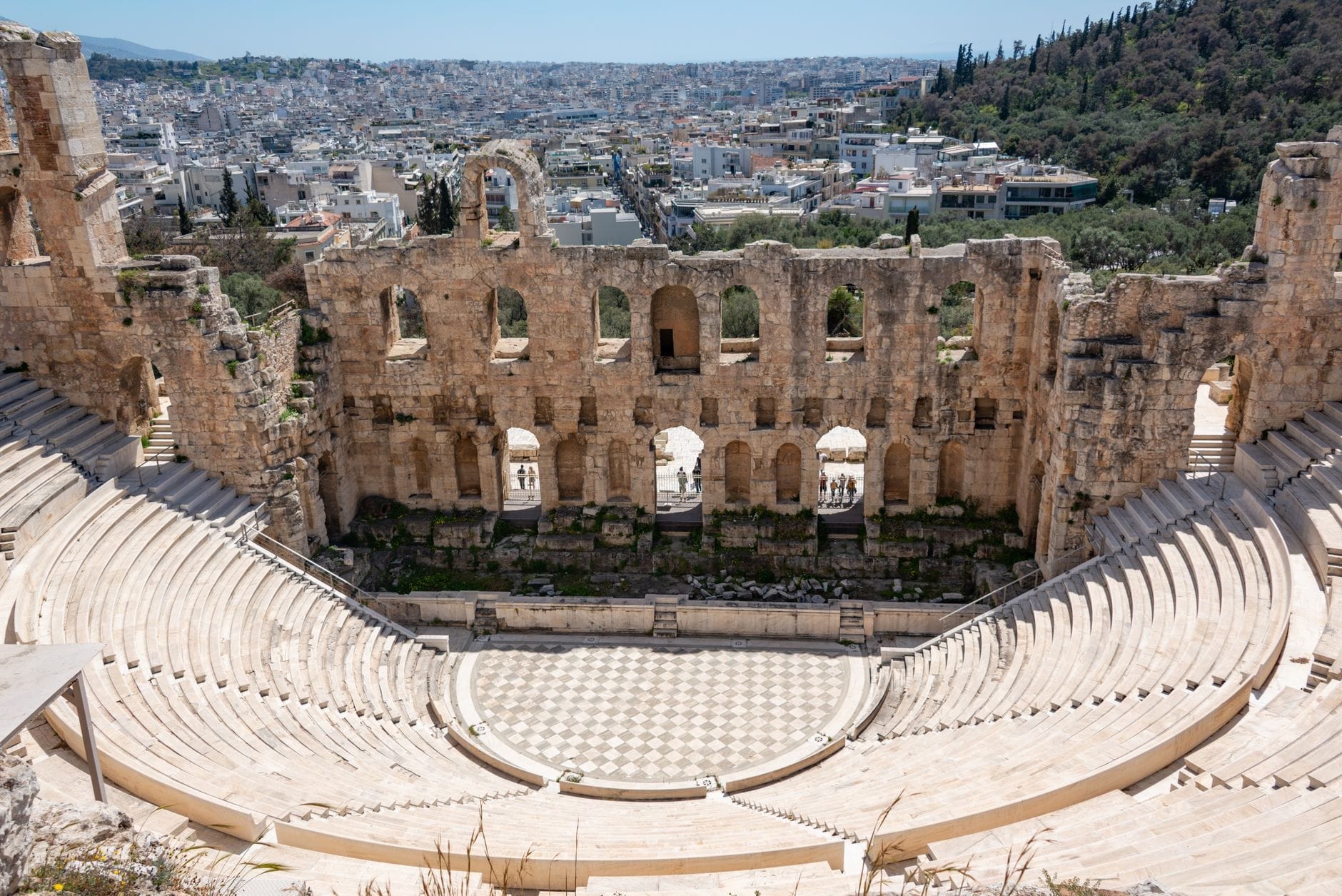
The Odeon of Herodes Atticus — also known as the Herodeion or Herod Atticus Odeon — is a stone theatre completed in AD 161 by the Athenian aristocrat and Roman senator Herodes Atticus in memory of his wife Aspasia Annia Regilla. It sits on the southwest slope of the Acropolis hill, embedded into the rock face in a way that makes it feel less constructed than excavated. The curved cavea (seating area) rises in tiers of Pentelic marble, facing a three-story Roman stage facade of arched niches.
Unlike the older Theatre of Dionysus, which sits slightly further east along the same slope, the Odeon was built in a distinctly Roman idiom: originally roofed in cedarwood, designed for acoustics, and intended for a covered, intimate program of music, oratory, and poetry. The Heruli raid of AD 267 destroyed it, and it sat as a ruin for many centuries before extensive restoration work in the mid-20th century returned it to use for performances once again.
ℹ️ Good to know
The Odeon holds roughly 5,000 spectators. Its seating tiers use both original ancient stone and restored Pentelic marble installed during the 1950s reconstruction — a distinction visible if you look closely at coloration and weathering patterns.
The Daytime Experience: Monument, Not Performance Venue
During the day, you cannot enter the Odeon's seating bowl itself — the interior is reserved for scheduled events. What you can do is view it from the walkway along Dionysiou Areopagitou Street, the broad pedestrian promenade that borders the Acropolis archaeological zone to the south. From here, the Odeon's upper arched facade looms above you, three stories of cut stone interrupted by sky. The scale is not immediately obvious from photographs; standing beneath it corrects that impression quickly.
Your Acropolis ticket grants access to the broader south slope archaeological zone, which brings you closer and at a higher angle. From the path leading up toward the Propylaea, you can look down into the cavea and read the entire spatial logic of the theatre: the orchestra floor, the stage building ruins, and the arced rows of marble climbing the hillside. Morning light, particularly between 8am and 10am, falls across the stone at a low angle that picks out the texture and shadow of each tier with unusual clarity. By midday in summer, the stone bleaches out in direct sun and the contrast is lost.
The surrounding pedestrian zone is worth understanding before you arrive. Dionysiou Areopagitou Street connects the Odeon's base to the Acropolis Museum to the east — a 10-minute walk along a flat, well-paved route. It is one of the most photographed streetscapes in Athens, and for good reason: the Acropolis dominates the skyline above while cafes and benches line the pedestrian path below.
Tickets & tours
Hand-picked options from our booking partner. Prices are indicative; availability and final rates are confirmed when you complete your booking.
Guided tour of the Acropolis, Parthenon and Museum in Athens
From 50 €Instant confirmationFree cancellationAthens: Temple of Olympian Zeus E-ticket with audio tour on your phone
From 10 €Instant confirmationAthens full-day tour with Acropolis and Cape Sounion
From 92 €Instant confirmationFree cancellationAthens National Archaeological Museum e-ticket and audio tour
From 22 €Instant confirmation
The Evening Experience: Performances Under the Acropolis
The atmosphere at a nighttime performance here is unlike almost any other concert or theatrical venue in the world. As dusk falls, the floodlighting on the Acropolis comes up behind the stage facade, and the rock of the hill itself becomes part of the set. The air in Athens during June and July is typically warm and still, and the stone seats, cool from the shadow they've been in all afternoon, provide a small reprieve from the day's heat.
The Athens Epidaurus Festival programs the Odeon through the summer season, typically running from May through October, though the exact schedule changes each year. Past performers have ranged from opera companies and symphony orchestras to dance troupes and international theatre productions. The acoustic quality — even without the ancient roof — is genuinely impressive; spoken word carries across the cavea with minimal amplification in many productions.
Tickets are sold by event, with prices varying by production and seat category. The lower tiers (sections closer to the orchestra) command premium prices; upper tiers are more affordable and, for many visitors, actually preferable for the full visual sweep they provide. The Acropolis floodlit behind the stage is most dramatic from the higher rows.
💡 Local tip
Book performance tickets well in advance through the Athens Epidaurus Festival website. Popular productions — particularly opera, major orchestras, and internationally known artists — sell out weeks or months ahead. Check aefestival.gr for the current season lineup.
Getting There and Finding Your Bearings
The most direct public transit option is Metro Line 2 (the Red Line) to Akropoli station. From the station exit, turn right and walk along Dionysiou Areopagitou Street for roughly five minutes. The Odeon's arched facade will become visible above you on the left before you reach the main entrance area. The walk is flat and straightforward.
If you're arriving from Monastiraki on foot, the pedestrian route along Dionysiou Areopagitou takes around 15–20 minutes. This is a pleasant walk in the evening, passing the Temple of Hephaestus area and the Thissio neighborhood before curving south toward the Acropolis base.
For evening performances, rideshare apps and taxis are practical given the likely warmer temperatures and the fact that you'll be arriving in smart-casual clothing. Parking nearby is extremely limited, and the streets adjacent to the venue fill up well before curtain time.
Practical Details Worth Knowing Before You Go
For daytime visits as part of the Acropolis archaeological zone, wear shoes with grip. The paths along the south slope involve uneven stone surfaces and some gradient. In summer months (June through August), temperatures regularly exceed 30°C and can reach 37–38°C; a hat, sunscreen, and water are not optional extras. There is no shade on most of the approach path to the Odeon's exterior.
For evening performances, the dress code is smart casual — most Athenian attendees take performances here seriously enough to dress accordingly, but formal attire is not required. Bring a light layer regardless of the season: even on a 30°C summer evening, a breeze picks up after midnight, and air-conditioned transport before and after the show can make a jacket worth carrying.
Photography is generally possible during daytime access. During performances, photography and sound or video recording are prohibited, and flash photography is not allowed at any time during a performance.
⚠️ What to skip
The marble seating in the Odeon has no cushions. For evening performances lasting two hours or more, a seat cushion is worth bringing — vendors sometimes sell them near the entrance, but availability is not guaranteed. Many regular Athens festivalgoers carry their own.
Accessibility
For performances, wheelchair users are granted vehicular access to the square in front of the Odeon to minimize walking distance. The venue provides 8 wheelchair spaces in section A1 (lower tier) and 13 companion or mobility-impaired seats in section A2 directly behind them. Concessions are available for wheelchair users and people with severe mobility, visual, or hearing impairments, plus one companion each. Contact the Athens Epidaurus Festival directly when booking to arrange these accommodations.
The daytime approach via Dionysiou Areopagitou Street is paved and accessible. However, the south slope paths within the archaeological zone include sections of uneven ancient stone that are not wheelchair-friendly. If mobility is a concern, viewing the Odeon's facade from street level along Dionysiou Areopagitou provides a clear view without navigating the slope.
Historical and Cultural Context
Herodes Atticus was one of the wealthiest men in the Roman Empire during the 2nd century AD, a patron whose building projects extended across Greece. The Odeon was his most personal commission, a memorial to his wife Regilla. Its placement on the Acropolis slope was deliberate: this was Athens at the height of its Roman-era cultural revival, and situating a new theatre here connected Roman patronage directly to the city's classical identity. The Theatre of Dionysus just to the east of it predates the Odeon by roughly 600 years and represents an entirely different, earlier phase of Athenian cultural life.
The Heruli invasion of AD 267 effectively ended the Odeon's ancient life. For centuries it was quarried for building material and incorporated partially into the later Byzantine-era walls of Athens. Its modern restoration, undertaken in the 1950s under the direction of Greek archaeologist Ioannis Travlos, was oriented explicitly toward returning the space to use rather than pure archaeological preservation — a choice that remains somewhat debated but has given Athens one of its most distinctive cultural institutions. For a deeper understanding of how this site fits into the broader ancient landscape, the Athens ancient sites guide provides useful context.
Insider Tips
- Upper tier seats (sections C and D) are significantly cheaper than the lower sections, and many visitors prefer them: the full view of the Acropolis lit behind the stage is more dramatic from height, and the sound carries well throughout the cavea.
- The gates along Dionysiou Areopagitou open to let ticketholders into the forecourt area about 45–60 minutes before curtain. Arriving early lets you find your seat without the crowd and gives you time to take in the space before the lights dim.
- If you want to photograph the Odeon's exterior facade at night without a performance ticket, the stretch of Dionysiou Areopagitou Street in front of the entrance is a public pedestrian zone. The floodlit arches photograph well from street level after dark.
- Evening performances in July and August can be interrupted or affected by the Meltemi, the seasonal north wind that picks up strongly on some summer evenings. For outdoor orchestral performances, this occasionally causes program adjustments. It is rare but worth being aware of.
- If a performance you want is sold out, check the Athens Epidaurus Festival site a few days before — returns and last-minute releases do appear, though not reliably.
Who Is Odeon of Herodes Atticus For?
- Architecture and history enthusiasts who want to see a Roman theatre still in functional use
- Classical music, opera, and dance audiences looking for a setting that adds genuine meaning to the program
- Evening visitors to Athens who want a culture-focused alternative to restaurant-hopping
- Photographers working at dusk or night — the Acropolis-lit backdrop is exceptional
- Travelers combining the Acropolis archaeological zone visit with a broader south-slope walk
Nearby Attractions
Other things to see while in Plaka:
- The Acropolis
The Acropolis of Athens is the defining landmark of Greece and one of the most significant ancient sites in the world. This guide covers everything from the Parthenon's construction history to crowd patterns, transit options, and what the experience actually feels like at different times of day.
- Anafiotika
Tucked onto the northeastern slope of the Acropolis, Anafiotika is a cluster of whitewashed houses built in the mid-19th century by craftsmen from the Aegean island of Anafi. Free to wander and open at all hours, it feels more like a Cycladic village than the capital of Greece.
- Theatre of Dionysus
Cut into the south slope of the Acropolis, the Theatre of Dionysus Eleuthereus is one of the oldest theatres in the world and the stage where Sophocles, Euripides, and Aristophanes first presented their plays in Athens. It is not a reconstruction or a replica — it is the original ground where dramatic art as we know it was invented.