Theatre of Dionysus Eleuthereus: Where Western Drama Was Born
Cut into the south slope of the Acropolis, the Theatre of Dionysus Eleuthereus is one of the oldest theatres in the world and the stage where Sophocles, Euripides, and Aristophanes first presented their plays in Athens. It is not a reconstruction or a replica — it is the original ground where dramatic art as we know it was invented.
Quick Facts
- Location
- South slope of the Acropolis, just above Dionysiou Areopagitou, central Athens
- Getting There
- Metro Line 2 (Red) — Acropoli Station, then 5-minute walk along Dionysiou Areopagitou
- Time Needed
- 30–60 minutes at the theatre itself; plan 3–4 hours for the full Acropolis site
- Cost
- Included in the Acropolis & Slopes ticket (€30 full / €15 reduced; verify at hhticket.gr)
- Best for
- History enthusiasts, classical literature lovers, architecture and archaeology students
- Official website
- http://odysseus.culture.gr/h/2/eh251.jsp?obj_id=10341
What You Are Standing In Front Of
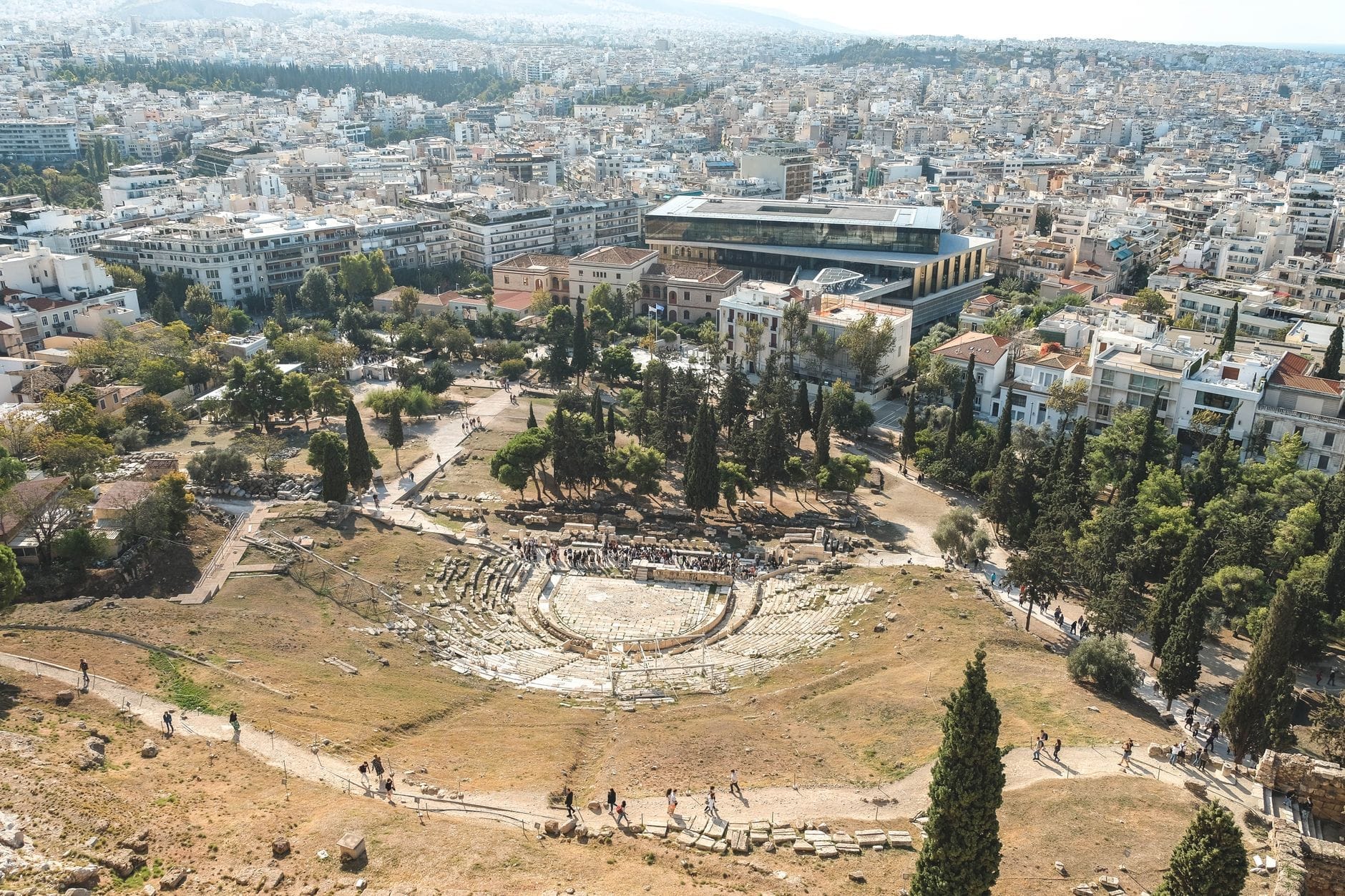
The Theatre of Dionysus Eleuthereus — Θέατρο του Διονύσου Ελευθερέως in Greek — sits on the south and eastern part of the Acropolis hill, directly below the Parthenon. It is not a later imitation or a Roman-era replacement. This is the original site where Athenian citizens gathered in the 5th century BC to watch the world premieres of works by Sophocles, Euripides, Aeschylus, and Aristophanes. Greek tragedy as a literary form was essentially invented and refined here.
Most visitors spend their energy climbing to the Parthenon and walk past the south slope without stopping properly. That is a real loss. The theatre repays careful attention. The stone seating tiers (the koilon) fan out across the hillside in a wide arc, and even in its ruined state the scale is unmistakable. At its height, the theatre could seat approximately 17,000 spectators — a number that puts Athenian democratic civic life into sharp physical perspective.
💡 Local tip
Access is via the Acropolis & Slopes ticket (€30), which covers the Theatre of Dionysus as part of the south slope archaeological area. Buy tickets online in advance during spring and summer to avoid queues at the gate on Dionysiou Areopagitou.
A Brief History: From Earthen Orchestra to Stone Monument
The site's origins go back to the 6th century BC, when the earliest performances were held in a simple earth and wood arrangement near the sanctuary of Dionysus Eleuthereus — the god of wine, fertility, and theatrical release. The word 'theatre' itself (theatron, meaning 'a place for watching') traces directly to spaces like this one. Drama was not entertainment in the modern sense; it was a civic and religious ritual, performed at the City Dionysia festival and funded in part by wealthy citizens as a public duty.
The stone theatre that visitors see today took its defining form around 350 BC, when permanent marble seating replaced the earlier wooden and earthen structures. This phase introduced the characteristic curved rows of stone seats cut into the natural hillside slope — a design that later influenced every amphitheatre in the Greek and Roman worlds. The circular orchestra at the centre, approximately 20 metres in diameter, was the performance space where the chorus moved and danced.
Significant alterations were made under Roman rule. Around AD 61, during the reign of the emperor Nero, the orchestra was rebuilt with marble paving and a low barrier was added, likely to accommodate Roman-style spectacles including animal hunts and gladiatorial contests. These changes are still visible in the paving and the front-row marble thrones, most notably the elaborately carved throne of the priest of Dionysus at the centre of the front row.
For deeper context on how this theatre relates to other ancient structures across the city, the Athens ancient sites guide provides a useful overview of the full archaeological landscape.
Tickets & tours
Hand-picked options from our booking partner. Prices are indicative; availability and final rates are confirmed when you complete your booking.
Guided tour of the Acropolis, Parthenon and Museum in Athens
From 50 €Instant confirmationFree cancellationAthens: Temple of Olympian Zeus E-ticket with audio tour on your phone
From 10 €Instant confirmationAthens full-day tour with Acropolis and Cape Sounion
From 92 €Instant confirmationFree cancellationAthens National Archaeological Museum e-ticket and audio tour
From 22 €Instant confirmation
What You Actually See on Site
Walking in from the Dionysiou Areopagitou pedestrian path, you approach the theatre from below. The first thing that registers is the smell: warm stone and dry scrub in summer, damp earth after rain in autumn. The air carries the faint mineral scent of ancient marble that is particular to Athens's hillside archaeological zones.
The seating tiers are the dominant visual element — rows of pale limestone rising in a broad curve up the slope. The front row features large marble thrones rather than ordinary seats, reserved for priests, officials, and honored citizens. The throne of the priest of Dionysus Eleuthereus is the most ornate, with carved legs and decorative reliefs. Many of these front-row seats retain their carved inscriptions identifying the positions of their original occupants.
The stage building (the skene) is fragmentary but present. You can identify the rectangular platform area and the remains of the proscenium. The orchestra circle in front is the most evocative space: standing at its edge and looking up at the tiers of seating, you get a genuine sense of the sight lines that 5th-century Athenians had when watching Oedipus Rex or The Clouds for the first time. The acoustics, even in the open air with ambient city noise, are surprisingly focused.
ℹ️ Good to know
The elaborate front-row throne at the centre of the lowest tier is the Throne of the Priest of Dionysus Eleuthereus. It is one of the best-preserved decorative elements in the theatre and worth examining closely — the carved decorations on its arms and legs are clearly visible.
Best Time to Visit and How Light Affects the Experience
The Theatre of Dionysus faces roughly south and east, which means morning light falls directly on the stone seating tiers and creates good conditions for photography. By midday in summer, the entire site is in full sun with no shade whatsoever. Temperatures on exposed stone surfaces regularly exceed 40°C in July and August, and the pale marble and limestone reflect and radiate heat intensely. If you visit in summer, arrive at or near opening time (approximately 08:00) or in the late afternoon after 17:00, and bring water.
Spring (April to early June) and autumn (September to October) offer the most comfortable conditions — daytime temperatures in the 18–25°C range, clear light, and smaller crowds than peak summer. In these seasons the hillside scrub vegetation adds texture and colour to photographs. Winter visits are viable and sometimes rewarding for solitude, though hours are reduced and rain makes the ancient stone surfaces slippery.
For a broader picture of seasonal conditions across the city, the best time to visit Athens guide covers monthly temperature ranges, crowd patterns, and festival schedules.
Getting There and Practical Logistics
The most straightforward approach is Metro Line 2 (Red Line) to Acropoli Station. From the station exit, follow the pedestrianized Dionysiou Areopagitou street westward. The south slope entrance to the Acropolis archaeological area is on your left within about five minutes of walking. The street itself is flat, shaded in parts by trees, and lined with cafes where you can stop after your visit.
If you are coming from the Plaka neighbourhood or Monastiraki, you can also approach on foot through the winding streets and reach the south slope entrance in roughly 10–15 minutes depending on your starting point. Plaka is immediately adjacent to the Acropolis and provides easy access without needing transit.
Accessibility is limited. The theatre sits on uneven, sloping ancient terrain with original stone steps and surfaces. There are no seats or benches inside the theatre area for resting. Visitors with mobility impairments should check current accessibility provisions with the Acropolis site administration before visiting, as these change periodically. The Dionysiou Areopagitou pedestrian walkway itself is flat and wheelchair-accessible.
⚠️ What to skip
Do not attempt to sit on or climb the ancient stone thrones or seating tiers. This is prohibited by site regulations and causes real damage to irreplaceable carved surfaces. Enforcement is active.
The Theatre in Context: What Surrounds It
The Theatre of Dionysus is one of several significant structures on the south slope of the Acropolis. Nearby, also on the slope, is the Stoa of Eumenes — a long colonnaded walkway from the 2nd century BC — and at the western end of the slope, the Odeon of Herodes Atticus, a later Roman-era theatre from around AD 161 that is still used for live performances today, including during the Athens Epidaurus Festival each summer.
The Odeon of Herodes Atticus is worth combining with a visit to the Theatre of Dionysus on the same day — the two structures illustrate how theatrical architecture evolved from the classical Greek model to the Roman period across roughly six centuries.
After exploring the south slope, the Acropolis Museum is a short walk away on Dionysiou Areopagitou and contains sculptures, reliefs, and artefacts from across the Acropolis site, including material related to the theatre and the Dionysus sanctuary. It is one of the best archaeological museums in Europe and makes the south slope visit considerably richer.
The Ancient Agora is another natural pairing — it was the civic centre of Athens and functioned alongside the theatre as a space where Athenian democratic and cultural life played out. The two sites together give a full picture of classical Athens at its height.
Is It Worth Visiting on Its Own?
Honestly, the Theatre of Dionysus is not a visually spectacular ruin in the way that the Parthenon or the Temple of Olympian Zeus are. Much of the stage building is fragmentary, and without context the site can read as a wide curve of worn stone seats on a hillside. Visitors who arrive without any background knowledge of its history sometimes find it underwhelming.
The experience changes considerably if you arrive knowing what happened here. This is not hyperbole: the works of Sophocles, Aeschylus, and Euripides, performed in this exact space, shaped the entire subsequent tradition of Western narrative, from Shakespearean drama to modern film structure. Standing in the orchestra knowing that Oedipus Rex had its premiere on this very ground, in front of 17,000 Athenian citizens, is a genuinely affecting experience for anyone who cares about literature, theatre, or cultural history.
Visitors who are primarily interested in visual spectacle or Instagram photography may find the Acropolis summit more satisfying. The theatre rewards engagement and a degree of preparation over casual observation.
Insider Tips
- The carved throne of the Priest of Dionysus Eleuthereus in the front row centre is the single most detailed and well-preserved artefact in the theatre. Take time to examine the relief carvings on its armrests and legs rather than viewing it only from a distance.
- The theatre is included in the Acropolis & Slopes ticket, so if you plan to visit the Acropolis summit anyway, there is no reason to skip the south slope. Budget an extra 30–45 minutes to walk through it properly rather than passing by on the path.
- For the best photographs of the seating tiers with the Parthenon visible above, position yourself at the eastern edge of the theatre area in the morning when light hits the stone directly. By midday the angle is less favourable and the glare from pale stone is intense.
- The Dionysiou Areopagitou walkway below the site has several cafes and water fountains. Stock up before entering the archaeological area — there are no refreshment facilities inside the site itself.
- If you visit during the Athens Epidaurus Festival (usually June to August), check whether any events are scheduled at the nearby Odeon of Herodes Atticus. Seeing a live performance in a functioning ancient theatre on the same day you visit the Theatre of Dionysus creates a powerful sense of continuity across two and a half millennia.
Who Is Theatre of Dionysus For?
- Classical history and ancient Greece enthusiasts who want to connect physical space to historical events
- Literature and theatre scholars, students, or anyone with a background in Greek drama
- Architecture and archaeology visitors who appreciate ruins in their original context rather than reconstructions
- Travellers combining a full Acropolis day with the south slope and Acropolis Museum
- Photographers interested in ancient stone textures, dramatic hillside settings, and views toward the Parthenon
Nearby Attractions
Other things to see while in Plaka:
- The Acropolis
The Acropolis of Athens is the defining landmark of Greece and one of the most significant ancient sites in the world. This guide covers everything from the Parthenon's construction history to crowd patterns, transit options, and what the experience actually feels like at different times of day.
- Anafiotika
Tucked onto the northeastern slope of the Acropolis, Anafiotika is a cluster of whitewashed houses built in the mid-19th century by craftsmen from the Aegean island of Anafi. Free to wander and open at all hours, it feels more like a Cycladic village than the capital of Greece.
- Odeon of Herodes Atticus
Built in AD 161 on the southwest slope of the Acropolis, the Odeon of Herodes Atticus is one of the best-preserved Roman theatres in the world. By day it reads as archaeology; by night, during the Athens Epidaurus Festival, it becomes one of the most atmospheric performance venues on earth.