Ancient Agora of Athens: Where Democracy Was Born
The Ancient Agora of Athens was the civic, commercial, and philosophical center of the ancient city for over a thousand years. Today, its open archaeological site combines sweeping ruins, one of the best-preserved Greek temples in existence, and a world-class on-site museum — all within easy walking distance of Monastiraki Square.
Quick Facts
- Location
- Adrianou 24, Monastiraki, Athens (northwest slope of the Acropolis)
- Getting There
- Metro Line 1 or 3 to Monastiraki, or Line 1 to Thiseio (both a short walk)
- Time Needed
- 1.5 to 3 hours depending on pace and interest in the museum
- Cost
- Paid admission (separate site ticket; verify current EUR rates at hhticket.gr before visiting)
- Best for
- History enthusiasts, architecture lovers, travelers who want more than the Acropolis crowd
- Official website
- http://odysseus.culture.gr/h/3/eh355.jsp?obj_id=2485
What the Ancient Agora Actually Was
The Ancient Agora of Athens is not a single building. It is a sprawling open precinct, roughly 30 acres (about 12 hectares), that functioned for centuries as the social, political, commercial, and religious center of classical Athens. From at least the 6th century BC onward, this was where Athenian citizens voted, argued philosophy, conducted trade, worshipped, and tried their legal cases. Socrates walked here. Stoic philosophy takes its name from the stoa, the covered colonnades that lined spaces like this one.
Understanding that history makes the visit dramatically richer. When you stand on the flat expanse of the site and look up at the Acropolis looming to the southeast, you are positioned exactly where Athenian democracy was practiced in the open air, not inside a building, but in public, under collective scrutiny. The Agora was the physical manifestation of the idea that civic life belongs to everyone.
If you are planning a broader sweep of Athens's ancient sites, pairing the Agora with the Acropolis and the Acropolis Museum gives a coherent narrative arc: the Agora was where everyday civic life happened; the Acropolis was where the city expressed its sacred and political power in stone.
What You Will See: A Practical Walkthrough
Entering from the Adrianou Street gate deposits you at the eastern edge of the site, facing the reconstructed Stoa of Attalos, a long two-story colonnade that now houses the Agora Museum. The original Stoa was a gift from King Attalos II of Pergamon in the 2nd century BC. The reconstruction, completed in 1956 by the American School of Classical Studies, used ancient building materials and original architectural proportions. It is not a ruin, and that distinction is worth noting: it gives you a precise sense of how grand these covered walkways actually were when intact.
The museum inside the Stoa is compact but carefully curated, displaying pottery shards, bronze ballots used in Athenian court verdicts, fragments of the inscribed law code, and personal objects recovered from excavations. Look for the ostraka, pottery sherds inscribed with names used in the process of ostracism, by which Athenians could vote to exile a citizen considered a threat to democracy. Seeing the physical objects used in that process anchors an otherwise abstract political concept.
Beyond the Stoa, the open site contains the remains of the Tholos (where the rotating committee of the Council dined and slept on duty), the Middle Stoa, the Temple of Ares, the Odeon of Agrippa, the Altar of the Twelve Gods, and several other foundations. Most are low walls and column bases, requiring some imagination. Signage is adequate but not exceptional; picking up the site map at the entrance or downloading the Ministry's materials in advance makes navigation considerably clearer.
💡 Local tip
Grab a site map at the entrance ticket booth. The open ruins are spread across uneven terrain and the signage between structures is sparse. A map turns a confusing field of stones into a legible ancient city.
Tickets & tours
Hand-picked options from our booking partner. Prices are indicative; availability and final rates are confirmed when you complete your booking.
Ancient Agora self-guided audio tour
From 12 €Instant confirmationFree cancellationAncient Agora of Athens E-Ticket and Audio Tour
From 35 €Instant confirmationAthens Roman Agora and Ancient Agora e-tickets with two self-guided audio tours
From 44 €Instant confirmationAncient Agora of Athens, Self-Guided Audiovisual Tour with 3D Models
From 9 €Instant confirmationFree cancellation
The Temple of Hephaestus: The Agora's Undisputed Highlight
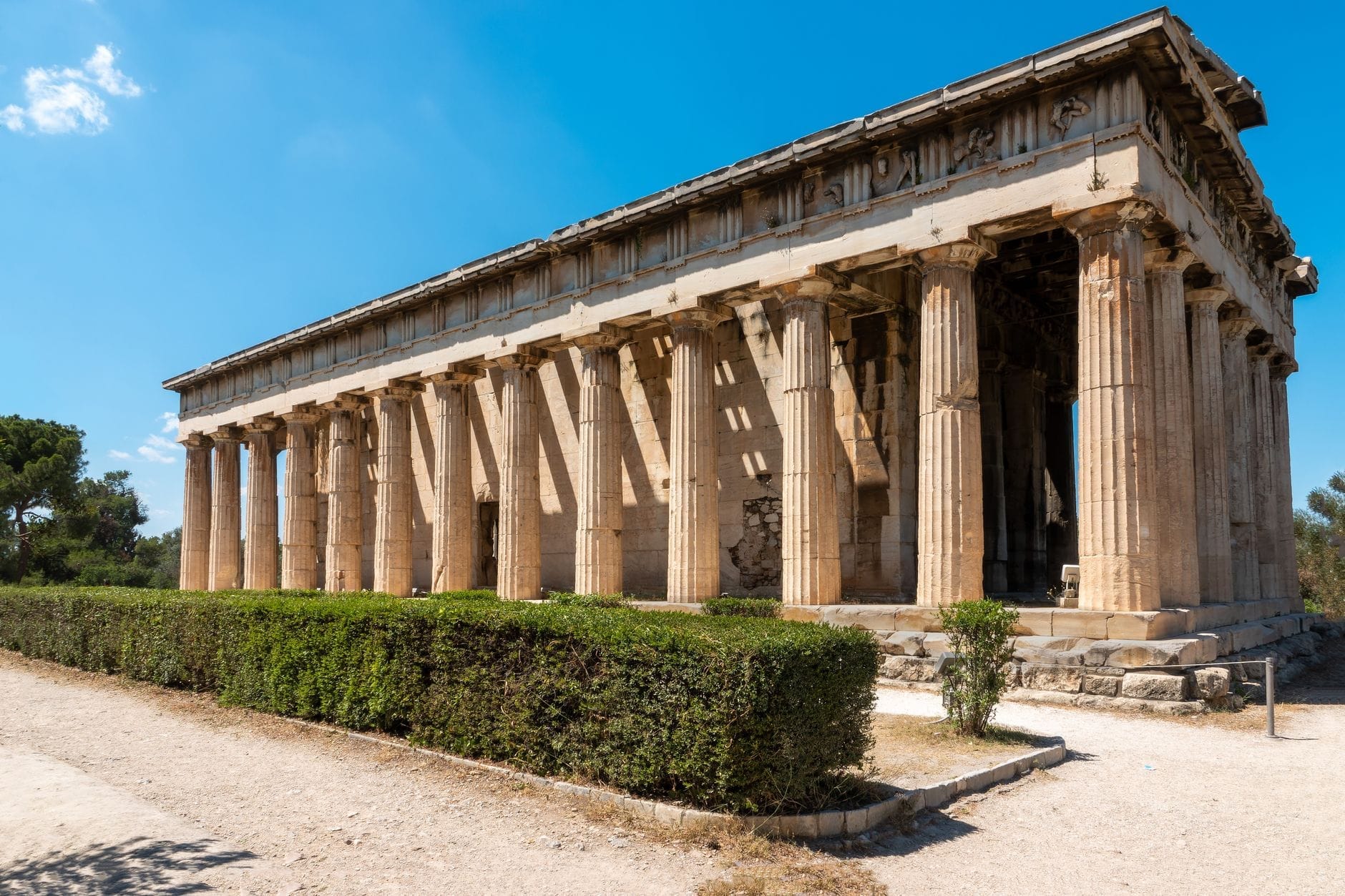
At the western edge of the site, on a low hill called the Agoraios Kolonos, stands the Temple of Hephaestus. Built between 449 and 415 BC, it is one of the best-preserved ancient Greek temples in the world, its Doric colonnade and much of its frieze surviving nearly intact. It owes its survival largely to its conversion into a Christian church, a transformation that protected the structure through the Byzantine and Ottoman periods.
The temple is dedicated to Hephaestus, god of the forge and craftsmen, and to Athena Ergane, patron of skilled workers. Its location makes sense: the surrounding area was historically occupied by metalworkers and potters, many of whose workshops have been excavated nearby. Compare this to the Temple of Hephaestus dedicated page for more detail on its architectural program and sculptural decoration.
In the late afternoon, with the sun moving toward the west, the honey-colored limestone of the temple catches warm light and the crowds from the morning have thinned. This is the best window to photograph it without tour groups in the frame and with the light working in your favor. The temple is fenced off for preservation, so you observe it from a short distance rather than walking through it, but the exterior is fully visible from multiple angles.
How the Experience Changes by Time of Day
The site opens at 08:00, and the first hour is genuinely quiet. The Athenian morning light is sharp and angled, casting long shadows across the ruins and giving the stone a clarity that midday flattens entirely. The sounds at this hour are ambient city noise from Monastiraki below, distant traffic, and occasionally the first metro trains passing on the elevated section of Line 1 along the site's western edge. It is not a silent archaeological park; Athens surrounds it.
By 10:00, guided tour groups arrive in volume and the site grows louder and more congested around the Stoa of Attalos and the Temple of Hephaestus. Midday in summer is brutal, with temperatures regularly exceeding 35°C and almost no shade across the open site. Visitors who arrive between 11:00 and 14:00 in July and August should bring water, a hat, and sunscreen, and should expect their tolerance for lingering to drop significantly.
Late afternoon, from around 16:00 onward, is a reliable sweet spot in spring and autumn. The heat drops, the tour groups thin, and the light becomes photogenic. In summer, the extended opening until 19:30 means you can arrive at 17:00 and have a relatively uncrowded final two hours. Winter hours close at 16:30, which limits the late-afternoon option but also means the site is rarely full at any point during the day.
⚠️ What to skip
In summer (June through August), avoid arriving between 11:00 and 14:00. The open site offers almost no shade, and the heat in central Athens frequently exceeds 35°C. Carry at least 500ml of water per person beyond what you think you will need.
Historical Context: Destruction, Survival, and Excavation
The Agora was not preserved in amber. It was burned by Persian forces in 480 BC and subsequently rebuilt. It was sacked by the Herulians, a Germanic people, in 267 AD, which effectively ended its function as a civic center. The Ottoman period saw residential construction directly on top of the ancient remains, and by the 19th century the area was a dense neighborhood of houses. Large-scale excavation by the American School of Classical Studies in Athens began in the 1930s, requiring the demolition of over 400 houses. That decision remains historically significant and occasionally controversial in discussions of archaeological ethics.
What visitors walk through today is the product of nearly a century of continuous excavation and scholarship. The site is still actively studied. The layers of history are genuine: traces of the Agora's various phases from the early democratic period through Roman occupation are visible in the overlapping foundations and varied masonry styles.
For visitors interested in the broader story of ancient Athens's public spaces, the Roman Agora is only a few minutes' walk from the site's eastern entrance and shows how the city's commercial center shifted during the Roman period. The two sites together form a coherent morning itinerary without requiring much transit.
Practical Information for Your Visit
The site is located at Adrianou 24 in Monastiraki. The main entrance on Adrianou Street is the most convenient for visitors arriving by metro: take Line 1 (Green) or Line 3 (Blue) to Monastiraki station and walk roughly five minutes south and west along Adrianou. Alternatively, Thiseio station on Line 1 places you at the site's secondary western entrance near the Temple of Hephaestus, which is a useful option if you want to see the temple first.
Summer opening hours run approximately 08:00 to 19:30 (last entry 19:00). Winter hours reduce to 08:00 to 16:30 (last entry 16:10), with transitional schedules in September through October. Verify current hours on the Hellenic Ministry of Culture's official Odysseus portal before your visit, as seasonal transitions are not always precisely predictable.
Admission is charged as a separate site ticket (verify current price at hhticket.gr). The Ministry discontinued the multi-site combo pass in 2025, so each archaeological site in Athens now sells its own entry. EU students and various other categories receive reduced or free admission; check current eligibility criteria on the official site.
The terrain across the open site is uneven, with gravel paths, ancient stone paving, and some inclines. Comfortable, closed-toe shoes with grip are advisable. The Stoa of Attalos museum is fully accessible on the ground floor, but portions of the open site present challenges for visitors with limited mobility. Tactile site plans and Braille brochures in both Greek and English are available at the Stoa of Attalos for visitors with visual impairments. For detailed accessibility information, contact the site administration directly.
ℹ️ Good to know
If you plan to visit multiple Ministry of Culture sites in Athens, budget for separate tickets at each location — the former multi-site combo pass was discontinued in 2025. Check hhticket.gr for current per-site pricing.
Who This Attraction Suits and Who Should Reconsider
The Ancient Agora rewards visitors who arrive with some prior knowledge of ancient Athenian history or who take time to engage with the museum before walking the open site. Without that context, the ruins outside the Stoa can feel underwhelming: foundations and partial columns do not speak for themselves the way a standing temple does. Travelers who are not engaged with ancient history and prefer immediate visual impact may find the Agora less satisfying than expected compared to, say, the Acropolis or even the Acropolis Museum.
Families with young children can visit, but the combination of heat, uneven ground, and the absence of interactive exhibits means engagement can be difficult to sustain for more than an hour. The National Archaeological Museum offers a more controlled indoor environment with more visually striking individual artifacts, which may suit younger visitors better.
For travelers building a coherent itinerary around the ancient city, the Agora sits naturally alongside a visit to the nearby Kerameikos archaeological site, which is quieter, less visited, and provides a sobering look at Athens's ancient cemetery district. Together the two sites take roughly half a day and cover aspects of ancient life that the Acropolis does not.
Insider Tips
- The western entrance near Thiseio station drops you directly below the Temple of Hephaestus. If you enter here first and walk the site east toward the Stoa, you end at the museum rather than starting there — which works better for many visitors because the artifacts make more sense after you've seen the ruins.
- The site's northern boundary runs alongside the Athens Metro Line 1 elevated track. If you are sensitive to noise, avoid sitting near that edge of the site for a prolonged break, as trains pass regularly.
- The Stoa of Attalos museum closes slightly before the open archaeological site in some periods. Confirm museum hours separately if the collection is a priority, as the last entry to the museum is sometimes earlier than the site's posted closing time.
- The small cafe immediately outside the Adrianou entrance is convenient but significantly overpriced. Walk two minutes north into Monastiraki proper and you will find better quality and lower prices for coffee and water before or after your visit.
- Free admission is offered on the first Sunday of each month from November through March, and on certain national cultural dates. Check the Ministry of Culture calendar if your visit falls in winter.
Who Is Ancient Agora of Athens For?
- History and archaeology enthusiasts who want depth beyond the Acropolis
- Architecture lovers interested in classical Greek building typologies, particularly the Doric order
- Photographers seeking early-morning or late-afternoon light on ancient stone with fewer crowds
- Travelers planning a multi-site ancient Athens day combining several archaeological ruins
- Anyone interested in the origins of democratic civic institutions and wanting a tangible connection to that history
Nearby Attractions
Other things to see while in Monastiraki:
- Athens Central Market (Varvakios Agora)
Open since 1884, the Athens Central Market — officially the Varvakios Agora — is where Athenian chefs, home cooks, and curious travelers collide under a 19th-century iron-and-glass roof. It is raw, fragrant, occasionally confronting, and entirely genuine. This is what a food market looks like before it becomes a tourist attraction.
- Hadrian's Library
Built by Emperor Hadrian in 132 AD, the Library of Hadrian is one of Athens' most underappreciated ancient sites. A short walk from Monastiraki Square, it offers a rare, close encounter with Roman imperial architecture layered over centuries of Greek and Byzantine history.
- Monastiraki Flea Market
Sprawling across the cobbled lanes around Monastiraki Square, the Monastiraki Flea Market is where Athens does its most honest selling. Free to enter, chaotic by design, and best on Sunday mornings when antique dealers take over Avissinia Square.
- Roman Agora
The Roman Agora of Athens is a remarkably preserved 1st-century BC commercial complex that once served as the city's main marketplace under Roman rule. Spanning roughly 111 by 104 metres in the heart of the old city, it offers a quieter and often overlooked counterpoint to the crowded Acropolis. Its crowning feature, the Gate of Athena Archegetis, remains one of the finest surviving Roman gateways in Greece.