Kerameikos Archaeological Site: Athens' Ancient Cemetery Beyond the Crowds
Once the potters' quarter of classical Athens and later its most important necropolis, Kerameikos Archaeological Site preserves over two millennia of funerary monuments, ancient city gates, and sacred roads in a remarkably quiet corner of the city. For travelers who want depth without the queues, it is one of Athens' most rewarding ancient sites.
Quick Facts
- Location
- 148 Ermou Street, Athens 10553, Kerameikos neighborhood, northwest of the Ancient Agora
- Getting There
- Metro Line 3 (Blue) – Monastiraki station, approx. 10-min walk west along Ermou St.
- Time Needed
- Closed for renovation works since May 2025 (verify reopening at efaathculture.gr). When open: 1.5 to 2.5 hours for site and museum
- Cost
- Full €10, Reduced €5. Free on select dates including first Sundays of Nov–Mar. Tickets also at hhticket.gr (verify before visiting)
- Best for
- Ancient history lovers, archaeology enthusiasts, quiet morning walks, travelers avoiding Acropolis crowds
- Official website
- http://odysseus.culture.gr/h/3/eh355.jsp?obj_id=2392
What Kerameikos Actually Is
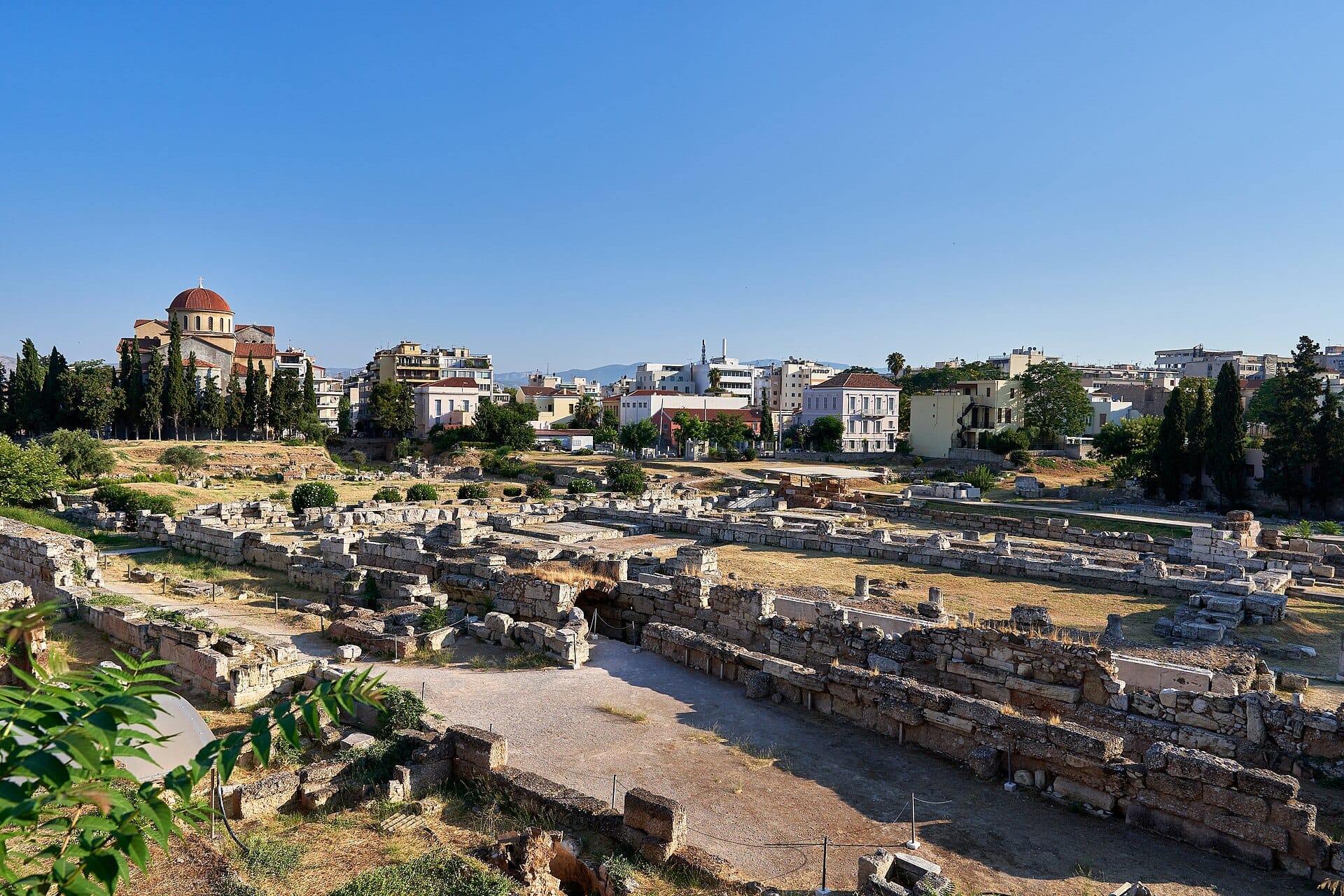
The Kerameikos Archaeological Site occupies roughly 27 acres on the northwest edge of central Athens, straddling what were once the most important entry and exit points of the ancient city. The name derives from the Greek word keramos, meaning fired clay, and this district was Athens' main pottery-producing quarter from at least the Geometric period. By the 7th century BC, however, a different purpose came to define it: Kerameikos became the city's principal necropolis, the largest and most prestigious burial ground in the ancient Greek world.
What makes the site exceptional is not just its age, but its layering. You are walking through a place that served as workshop, cemetery, ceremonial gateway, and urban thoroughfare simultaneously across centuries. The Dipylon and Sacred Gates, two of ancient Athens' most significant entry points, stand here. The Sacred Way, along which the Eleusinian Mysteries procession traveled toward Eleusis, begins here. The street lined with funerary monuments, known as the Street of Tombs, preserved some of the finest examples of classical Athenian funerary sculpture anywhere.
ℹ️ Good to know
The Archaeological Site and the on-site Archaeological Museum of Kerameikos are closed for works from 5 May 2025 until further notice. Check the official Ministry of Culture page before your visit for updated reopening status.
The Atmosphere at Different Times of Day
Arriving at Kerameikos early, around 8:00 when the gates open in summer, is a noticeably different experience from the midday visit. The site sits low relative to the surrounding city streets, so morning light enters at a low angle across the grave plots and monument bases, casting long shadows across carved marble. The sounds from Ermou Street fade quickly once you pass the entrance. Birdsong, the rustle of cypress trees, and the trickle of the Eridanos River, which cuts across the site, create an atmosphere that feels genuinely separated from the city beyond the walls.
By late morning, especially from May through September, the heat becomes a real factor. The site offers little shade over the main monument areas. Wear a hat and bring water. The grass paths between grave plots can be uneven and become dry and dusty in summer. By contrast, spring visits in April and May see the grass green and wildflowers scattered between the ancient stones, making the site feel considerably more alive.
Late afternoon in summer, from around 17:00 onward, usually brings softer light and a slight drop in temperature. Under normal operations, visitor numbers are typically lowest in the last hour before closing, with official opening hours set by the Ministry of Culture (generally 08:00–20:00 in summer and 08:00–15:00 in winter, with seasonal variations and last entrance 30 minutes before closing). Always confirm current hours on the Ministry of Culture website, especially while upgrade works are ongoing.
💡 Local tip
Standard hours under normal operation are generally: Summer 08:00–20:00, last entrance 19:30; Winter 08:00–15:00, last entrance 14:30, with seasonal variations in September and October. Check the Ministry of Culture website for current hours and temporary closures before your visit. Free admission days include 6 March, 18 April, 18 May, the last weekend of September, 28 October, and first Sundays of November through March.
Tickets & tours
Hand-picked options from our booking partner. Prices are indicative; availability and final rates are confirmed when you complete your booking.
Entrance ticket to Delphi archaeological site and museum
From 26 €Instant confirmationDelphi archaeological site with virtual reality from Athens
From 37 €Instant confirmationFree cancellationAthens National Archaeological Museum e-ticket and audio tour
From 22 €Instant confirmationAthens sightseeing Spanish guide tour with Acropolis site entrance and museum
From 90 €Instant confirmationFree cancellation
The Historical Weight of the Place
The fortification walls running through Kerameikos were built by the Athenian statesman Themistocles after the Persian sack of Athens in 480–479 BC. These walls, constructed hastily using whatever materials were available including older grave stelae and architectural fragments, effectively divided Kerameikos into two sections: an inner area incorporated within the city, and an outer section beyond the walls that became the formal burial ground. This division gives the site its archaeological complexity; layers from different centuries are compressed into a relatively compact area.
The Dipylon, the Double Gate, was the largest city gate in the ancient Greek world. It served as the official entry point for visitors arriving from northern Greece and the rest of the Greek world via the road from Plataea and Corinth. State funerals for Athenian war dead began here, and the procession route into the city passed through this point. Standing at the remains of the Dipylon today, you can still read the scale of the structure in the surviving stone sockets and paving.
The Sacred Gate, slightly to the south, was the starting point for the Sacred Way to Eleusis, along which the annual Eleusinian Mysteries procession traveled. These were among the most important religious events in the ancient Greek world. The Eridanos River passes beneath this gate, and its channel is still visible in the site today. For context on how this processional landscape connected to Athens' broader sacred geography, the nearby Ancient Agora and the Acropolis formed the destination points of these ritual routes.
Walking the Street of Tombs
The most visually striking part of Kerameikos is the Street of Tombs, a paved road lined with monumental grave enclosures dating mostly from the 4th century BC. These are not simple headstones. The tombs are architectural structures, some with sculpted marble figures in relief, others topped with stone vessels, and still others enclosed within low stone walls with multiple burial plots inside. The quality of workmanship is extraordinary. Carved marble bulls, stone lekythoi (oil vessels), and relief-carved stelae showing the deceased in moments of everyday life line both sides of the path.
What visitors see today are largely high-quality replicas. The originals have been moved to the on-site museum (currently closed for renovation works) and to the National Archaeological Museum. This is not a reason to skip the site. The replicas are accurate and the spatial arrangement of the tombs is original, allowing you to understand the actual scale and sequence of the monuments as ancient Athenians would have experienced them walking this road.
If you intend to see the original carved stelae and funerary vessels from Kerameikos, a visit to the National Archaeological Museum is the logical complement. Several of the finest pieces from this site are housed there, including the Stele of Hegeso, one of the most reproduced images from classical Athenian funerary art.
Getting There and Navigating the Site
The site entrance is at 148 Ermou Street. The most straightforward approach is from Monastiraki Metro station on Line 3 (Blue Line), a roughly 10-minute walk west along Ermou Street.
If you are combining Kerameikos with other nearby ancient sites, it connects naturally with the Ancient Agora a short walk to the east, and the Temple of Hephaestus which is visible from the Agora hillside. The site is also within easy walking distance of the Gazi neighborhood, making a late afternoon visit easy to combine with dinner nearby.
Inside the site, a free map is available at the ticket desk. The Archaeological Museum of Kerameikos is fully accessible to visitors with reduced mobility and wheelchair users, and a WC for persons with special needs is provided. The ground is uneven throughout, with gravel paths, grass sections, and paved ancient roadway. Sturdy footwear is strongly recommended. Mobility-impaired visitors should contact the Ephorate of Antiquities of the City of Athens directly before visiting to confirm current accessibility conditions, as the terrain presents genuine challenges in several sections.
Photography and What to Notice
Kerameikos rewards photographers who focus on texture and detail rather than wide panoramas. The carved relief surfaces on the tomb monuments, the tool marks on ancient stone blocks, and the weathered marble against the green of the grass make for strong close-up compositions. Early morning provides the best light for the Street of Tombs, where the east-facing relief carvings catch the direct light. The Dipylon and Sacred Gate area, by contrast, photographs better in late afternoon when the lower light picks out the depth of the surviving stonework.
The Eridanos River channel running through the site is a detail many visitors miss. It is shallow, clearly visible, and genuinely ancient in its routing. Photographed from the small bridge crossing, it provides a rare image of a natural element that has existed continuously within an archaeological site from antiquity to today.
⚠️ What to skip
The Archaeological Site and the on-site Archaeological Museum of Kerameikos are closed for renovation and infrastructure upgrade works from 5 May 2025 until further notice. If seeing original artifacts is a priority, plan a visit to the National Archaeological Museum, which holds key Kerameikos pieces.
Who This Site Suits and Who It Doesn't
Kerameikos works best for travelers with genuine interest in classical Athenian history, funerary culture, or Greek archaeology. If you are working through Athens' ancient sites systematically, this pairs well with the Ancient Agora and the Roman Agora on the same day. For travelers following a focused ancient sites itinerary, see our Athens ancient sites guide for sequencing advice.
Visitors who expect dramatic standing monuments or the visual impact of the Acropolis will find Kerameikos more subdued. The structures are low, fragmentary, and require some background reading to fully appreciate. Children under 10 may find the site difficult to engage with unless accompanied by an adult who can frame the stories. Those with significant mobility limitations will face challenges given the uneven terrain across much of the site.
For travelers who want atmosphere over spectacle, the combination of ancient funerary art, visible city walls, and relative quiet places Kerameikos in a different category from the main tourist circuit entirely. The absence of large tour groups is noticeable, even in high season.
Insider Tips
- Visit on a free admission day to maximize value: the first Sunday of each month from November through March, or on 18 May (International Museum Day) and 28 October. The site is rarely significantly busier on these dates compared to paid days.
- The Eridanos River runs below the level of the main paths and is easy to miss. Follow the lower path toward the Sacred Gate to see where the ancient channel passes under the gate foundations. It is one of the few surviving ancient waterways still visible in their original urban context in Athens.
- Bring the National Archaeological Museum into your planning if you want to see original carved stelae from the Street of Tombs. The replicas in situ are accurate, but the originals in the museum allow you to examine the fine details of the carving up close.
- The ticket normally covers both the outdoor site and the on-site museum, with current official prices at €10 full and €5 reduced. However, both the archaeological site and the museum are closed for upgrade works from 5 May 2025 until further notice; verify status and any ticketing updates at hhticket.gr or the Ministry of Culture page before planning a visit.
- Combine Kerameikos with the Gazi neighborhood for a full afternoon once the site reopens. Under normal summer operations the site has extended opening hours into the evening, and the streets of Gazi immediately to the west begin to animate in the early evening, making the transition from ancient archaeology to contemporary Athens particularly sharp and enjoyable.
Who Is Kerameikos Archaeological Site For?
- Classical history and archaeology enthusiasts who want serious depth without the crowds
- Photographers seeking texture, light, and quiet ancient stonework
- Travelers on a multi-site ancient Athens day combining Agora, Kerameikos, and the Acropolis Museum
- Budget-conscious visitors on free admission days
- Anyone who finds the main Acropolis site too overwhelming and wants a more contemplative experience of ancient Athens