Roman Agora of Athens: The Ancient Marketplace Built by Caesar and Augustus
The Roman Agora of Athens is a remarkably preserved 1st-century BC commercial complex that once served as the city's main marketplace under Roman rule. Spanning roughly 111 by 104 metres in the heart of the old city, it offers a quieter and often overlooked counterpoint to the crowded Acropolis. Its crowning feature, the Gate of Athena Archegetis, remains one of the finest surviving Roman gateways in Greece.
Quick Facts
- Location
- Polignotou 3, Monastiraki, Athens 105 55
- Getting There
- Monastiraki Metro (Lines 1 & 3), approx. 3-min walk
- Time Needed
- 45–75 minutes
- Cost
- General admission €10 / reduced €5 (separate site ticket; verify at hhticket.gr). Not included in the Acropolis & Slopes ticket.
- Best for
- History lovers, Roman-era archaeology, uncrowded ancient sites
- Official website
- www.odap.gr
What Is the Roman Agora of Athens?
The Roman Agora of Athens, officially known as the Roman Agora of Caesar and Augustus, is a large open-air archaeological site sitting just north of the Acropolis and directly east of the older Ancient Agora. Construction began in the second half of the 1st century BC, funded by Julius Caesar and later Augustus, and the complex was built to serve as a new commercial centre as Athens expanded under Roman patronage.
The site measures approximately 111 by 104 metres, forming a rectangular courtyard once lined with colonnaded stoas and rows of shops and storerooms. While the Ancient Agora to the west was the civic and philosophical heart of classical Athens, the Roman Agora was built for trade: a covered market where merchants sold goods and where the administrative functions of a Roman provincial city could operate efficiently.
It is not the same site as the Ancient Agora, a confusion many first-time visitors make. The two are separate complexes, roughly 200 metres apart, with different histories, layouts, and surviving structures. If you are planning a thorough archaeological day, budget time for both.
💡 Local tip
The Roman Agora requires its own ticket (currently €10 full / €5 reduced; verify at hhticket.gr). The Ministry discontinued the multi-site combo pass in 2025, so each archaeological site in Athens now sells admission separately.
The Gate of Athena Archegetis: The Site's Most Iconic Structure
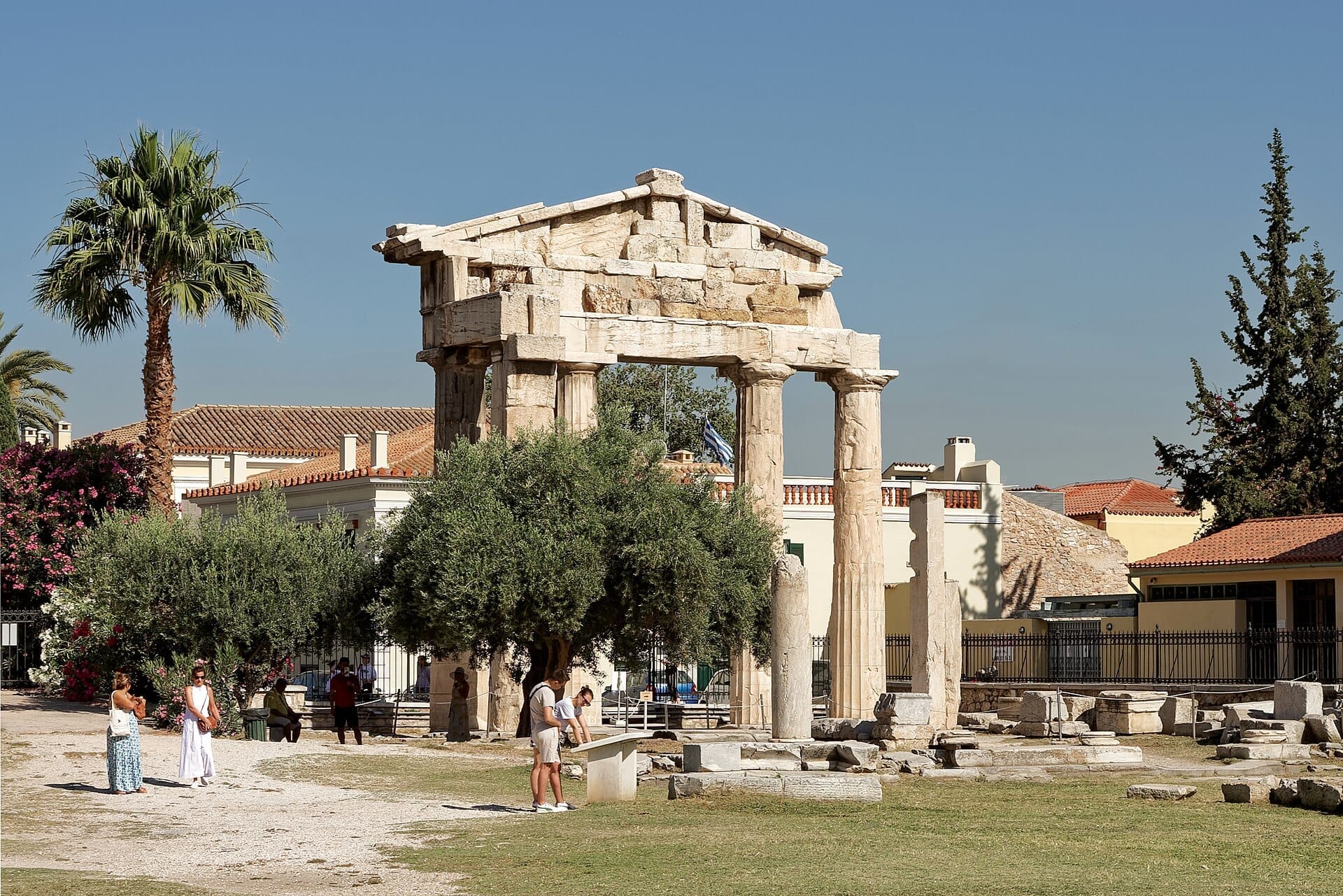
The western entrance to the Roman Agora is the Gate of Athena Archegetis, a four-columned propylon dedicated in 11/10 BC during the archonship of Nikias. Its inscription records the Athenian deme's dedication to Athena Archegetis, meaning Athena as 'founder' or 'leader' of the city. Four Doric columns still stand at their original height, and the entablature above them carries the faint traces of the dedicatory inscription.
The gate faces west toward the old Athenian agora, positioning the Roman complex as a deliberate extension of the existing civic fabric rather than a replacement of it. Standing in front of it in the early morning, with the Acropolis rising behind you and the Monastiraki rooftops ahead, the visual alignment between ancient and Roman Athens becomes immediately legible. Afternoon light from the west catches the column drums at an angle that emphasizes the texture of the Pentelic marble, making this one of the better times to photograph the gate.
Tickets & tours
Hand-picked options from our booking partner. Prices are indicative; availability and final rates are confirmed when you complete your booking.
Roman Agora e-ticket and self-guided audio tour in Athens
From 19 €Instant confirmationAthens Roman Agora and Ancient Agora e-tickets with two self-guided audio tours
From 44 €Instant confirmationAncient Agora self-guided audio tour
From 12 €Instant confirmationFree cancellationThe Path to Democracy Guided Tour with Acropolis and Agora
From 67 €Instant confirmationFree cancellation
The Tower of the Winds: The Site's Other Star
Just to the east of the main courtyard stands the Tower of the Winds, known in Greek as the Horologion of Andronikos Kyrrhestes. Built in the 1st century BC, likely shortly before the Roman Agora itself, this octagonal marble structure is one of the best-preserved ancient buildings in the entire Mediterranean. Each of its eight sides faces a cardinal or intercardinal wind direction, and the frieze at the top of each face depicts the corresponding wind deity in relief.
The tower originally housed a water clock, or clepsydra, powered by a stream channelled from the Acropolis slopes, and its exterior once displayed sundials on multiple faces. It is approximately 12 metres tall and around 8 metres in diameter, and standing close to it, the precision of the marble carving on the wind figures remains striking even after two millennia. During the Ottoman period it served as a tekke, a gathering place for Sufi dervishes, and British travellers in the 18th century were among the first Europeans to document and draw it in detail.
The Tower of the Winds is included within the Roman Agora site boundaries and accessed on the same ticket. Many visitors spend more time studying the tower than the main courtyard itself, and for good reason: the state of preservation, the quality of the sculptural relief, and the architectural ingenuity of combining timekeeping with architectural form make it genuinely extraordinary.
The Site Through History: From Roman Marketplace to Ottoman Athens
After the Herulian raid of AD 267, which severely damaged much of Athens, the Roman Agora and the adjacent Hadrian's Library became the new commercial and administrative core of the city, a role they held for several centuries. The courtyard paving visible today dates to the reign of Hadrian or Marcus Aurelius in the 2nd century AD, reflecting ongoing Roman investment in the complex.
During the Byzantine and Ottoman periods, the site continued to be used. The ruins of the Fethiye Mosque stand at the northwest corner of the courtyard, a converted Byzantine church that became a mosque after the Ottoman conquest in 1458. This layering of Greek, Roman, Byzantine, and Ottoman history within a single enclosed space is unusual even by Athens standards. For context on the broader picture of medieval Athens, the Byzantine and Christian Museum explores that period in depth.
The Fethiye Mosque is open to visitors every Wednesday and Sunday, from 08:00 to 15:00, but on other days you can only view its exterior, a low whitewashed structure with a shallow dome, from the main path through the courtyard and it adds a distinctly different visual layer to the site. The coexistence of a Roman propylon, a Hellenistic tower, and an Ottoman mosque within 100 metres of each other is one of the Roman Agora's genuinely unusual qualities.
When to Visit and What to Expect on the Ground
The Roman Agora is open year-round. In the main summer season (April 1 to August 31), hours run from 08:00 to 20:00. In the winter season (November 1 to March 31), the site closes earlier at 15:00, and in September and October the closing time is gradually reduced from 19:30 to 18:00; always verify the current schedule with the Hellenic Ministry of Culture before your visit, as seasonal adjustments and special closures can apply.
Visiting within the first hour after opening, between 08:00 and 09:30, offers the best combination of cool temperatures, low crowds, and clear light on the Gate of Athena Archegetis. By late morning, particularly from May through September, tour groups from nearby hotels begin arriving in number and the courtyard fills quickly. In July and August, afternoon temperatures in Athens regularly exceed 35°C, and the site offers almost no shade in the central courtyard. A hat, sunscreen, and water are practical necessities from May onwards.
Spring and autumn, roughly April to early June and September to October, offer the most comfortable conditions. These periods align well with broader Athens travel planning; for more on seasonal timing, see the best time to visit Athens guide.
⚠️ What to skip
The central courtyard is almost entirely exposed. In summer, visiting between 11:00 and 17:00 without sun protection is genuinely uncomfortable and can be hazardous during heatwaves. Wear light clothing, bring at least half a litre of water per person, and consider the morning slot seriously.
Getting There and Getting Around the Site
The Roman Agora sits at Polignotou 3, within easy walking distance of Monastiraki Square. From Monastiraki Metro Station (Lines 1 & 3), the entrance is about a 3-minute walk east along Adrianou Street. Akropoli station (Metro Line 2) is also accessible in roughly 10–12 minutes on foot. There is no dedicated parking at the site, and the narrow surrounding streets make driving impractical; public transit or walking from the central Monastiraki area is the standard approach.
The site is located at the intersection of several walkable archaeological zones. Hadrian's Library lies immediately to the north, and the Ancient Agora begins a short walk to the west. Combining all three into a single half-day walk is very manageable and gives a coherent picture of how Athens developed from the classical through the Roman periods.
The site is pedestrian-only. Visitors with mobility considerations should note that the courtyard surface is uneven ancient paving, with some raised sections and loose gravel paths around the periphery. Guide dogs for visitors with disabilities are permitted; other animals are not. For detailed step-free access information, contact the Ministry of Culture directly before your visit.
Photography and What You Will Actually See
The main photographic subjects at the Roman Agora are the Gate of Athena Archegetis and the Tower of the Winds. The gate photographs well from the street before you enter, framed against the Acropolis in the distance, and from the interior courtyard looking back west. A wide-angle lens captures the full four-column facade. The Tower of the Winds is best photographed from the southeast, where the wind relief figures receive directional light in the morning.
For visitors interested in photography across Athens's ancient sites, the best views in Athens guide covers additional vantage points including rooftop terraces in nearby Monastiraki.
The interior of the site itself, beyond the gate and tower, is largely a ruined open courtyard. Column bases, shop foundations, and sections of the stoa walls are visible but require some imagination to reconstruct. Informational panels are positioned around the site and provide context in both Greek and English. Compared to the Ancient Agora, which has the Stoa of Attalos reconstructed and functioning as a museum, the Roman Agora is more austere and requires visitors to engage more actively with the visible remains.
ℹ️ Good to know
Tripods and professional camera equipment may require prior permission from the site authorities. For casual photography with phones or compact cameras, no special permit is needed.
Insider Tips
- The best exterior view of the Gate of Athena Archegetis, with the Acropolis as a backdrop, is from Adrianou Street before you enter the site. This is also where tour groups photograph it most efficiently, so arrive before 09:00 to have the street to yourself.
- The Tower of the Winds is visible from outside the site boundary on Aiolou Street. If you are pressed for time or budget, you can observe the exterior reliefs from the street, though entering the site gives you access to the base and the eastern faces.
- If you are visiting multiple archaeological sites in one day, start at the Roman Agora when it opens at 08:00, then walk to the Ancient Agora, and finally climb to the Acropolis by mid-morning before the main crowds arrive. This sequence also follows a logical historical arc.
- The Fethiye Mosque in the northwest corner of the courtyard is often overlooked because visitors focus on the classical remains. Take a moment to look at it closely: it is one of the few surviving Ottoman structures in central Athens and adds genuine historical texture to the site.
- The surrounding streets of Monastiraki fill with vendors and foot traffic from around 10:00 onward. If you want a quiet coffee before your visit, the cafes along Adrianou Street are calm before 09:00 and offer close views of the site's perimeter wall.
Who Is Roman Agora For?
- Travellers with a specific interest in Roman-era Greece rather than classical Athens
- Visitors who want to explore a major archaeological site without the intensity of Acropolis crowds
- History enthusiasts combining the Roman Agora with Hadrian's Library and the Ancient Agora in a single half-day walk
- Photographers looking for early-morning light on ancient stonework with minimal interference
- Those on the combined archaeological ticket who want to use it fully across multiple sites
Nearby Attractions
Other things to see while in Monastiraki:
- Ancient Agora of Athens
The Ancient Agora of Athens was the civic, commercial, and philosophical center of the ancient city for over a thousand years. Today, its open archaeological site combines sweeping ruins, one of the best-preserved Greek temples in existence, and a world-class on-site museum — all within easy walking distance of Monastiraki Square.
- Athens Central Market (Varvakios Agora)
Open since 1884, the Athens Central Market — officially the Varvakios Agora — is where Athenian chefs, home cooks, and curious travelers collide under a 19th-century iron-and-glass roof. It is raw, fragrant, occasionally confronting, and entirely genuine. This is what a food market looks like before it becomes a tourist attraction.
- Hadrian's Library
Built by Emperor Hadrian in 132 AD, the Library of Hadrian is one of Athens' most underappreciated ancient sites. A short walk from Monastiraki Square, it offers a rare, close encounter with Roman imperial architecture layered over centuries of Greek and Byzantine history.
- Monastiraki Flea Market
Sprawling across the cobbled lanes around Monastiraki Square, the Monastiraki Flea Market is where Athens does its most honest selling. Free to enter, chaotic by design, and best on Sunday mornings when antique dealers take over Avissinia Square.