Athens Central Market (Varvakios Agora): A Real Working Market at the Heart of the City
Open since 1884, the Athens Central Market — officially the Varvakios Agora — is where Athenian chefs, home cooks, and curious travelers collide under a 19th-century iron-and-glass roof. It is raw, fragrant, occasionally confronting, and entirely genuine. This is what a food market looks like before it becomes a tourist attraction.
Quick Facts
- Location
- 43 Athinas Street, between Athinas, Sofokleous, Euripidou, and Aiolou Streets, central Athens (between Omonia and Monastiraki squares)
- Getting There
- Closest: Monastiraki Metro (5–8 min walk, Lines 1 and 3). Also Omonoia Metro (6 min walk, Lines 1 and 2) or Panepistimio Metro (7 min walk, Line 2).
- Time Needed
- 45 minutes to 1.5 hours depending on how deep you go
- Cost
- Free to enter. Budget extra for purchases from vendors.
- Best for
- Food lovers, photographers, early risers, cultural explorers
- Official website
- www.thisisathens.org/shopping/athens-central-food-market
What the Varvakios Agora Actually Is
The Athens Central Market, known locally as the Varvakios Agora (Βαρβάκειος Αγορά), occupies an entire city block in central Athens and has been feeding the city since its inauguration in the 1880s. It is a municipal food market in the fullest sense: not curated, not boutique, not aimed at visitors. Butchers, fishmongers, and vegetable traders work here daily alongside wholesale buyers, restaurant kitchen staff, and Athenians who have been shopping this block for decades.
The name derives from Ioannis Varvakis, an 18th-century Greek merchant and benefactor whose legacy funded much of the city's early civic infrastructure. Planning for the market structure began in the late 19th century, and a glass roof along with basement-level storage were added soon after the opening. That iron-framed roof still defines the interior today, filtering pale morning light down over rows of fish on ice and hanging carcasses in a way that photographers consistently underestimate until they're standing inside.
💡 Local tip
Arrive before 10:00 to see the market at full capacity. By early afternoon, many fish and meat vendors begin winding down, and the energy shifts considerably. The market is open Monday to Saturday, roughly 8:00 to 18:00, and closed on Sundays.
The Layout: Meat Hall, Fish Hall, and the Street Stalls Outside
The market divides broadly into two indoor sections and an outdoor perimeter. The meat hall runs along the central covered corridor: a long gallery of marble-topped counters and hanging hooks where whole lambs, sides of beef, and pig heads are displayed without apology. The smell hits you at the entrance — a combination of cold iron, sawdust, and raw protein that is jarring if you are not expecting it. The butchers work fast and loudly, calling to each other and to customers in the shorthand of people who do this every day.
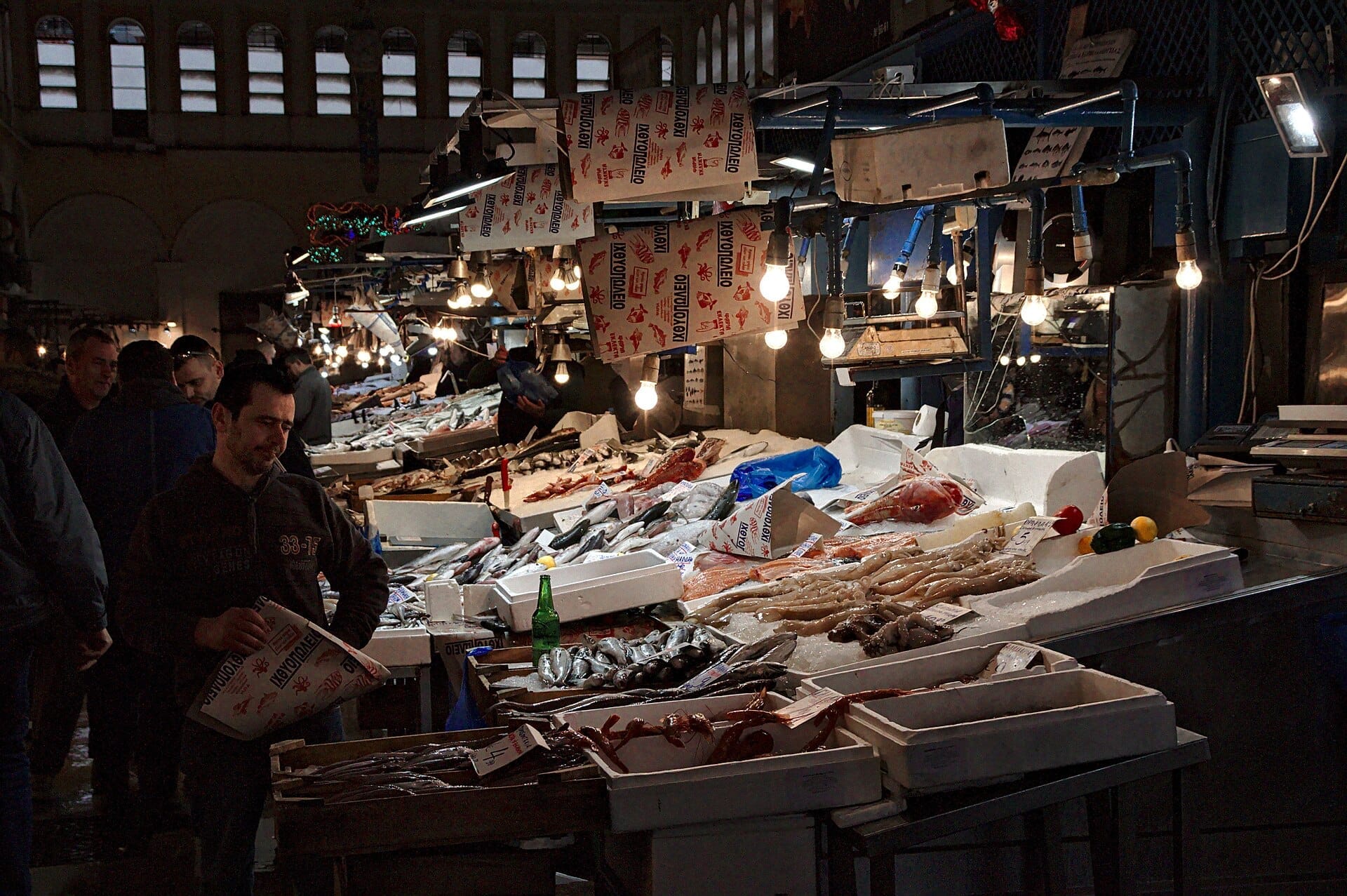
The fish section occupies its own hall and carries a different atmosphere entirely. The presentation is almost theatrical: whole sea bream, red mullet, octopus, squid, and clams arranged on crushed ice in radiating patterns. Vendors mist the display periodically, keeping everything glistening. The catch changes by season, which means a visit in spring looks and smells quite different from a winter morning. In summer, the air conditioning in the fish hall is doing serious work — without it, the experience would be considerably less pleasant.
Outside the main building, Athinas Street and the surrounding pavements become an informal extension of the market. Stalls selling vegetables, olives, dried herbs, nuts, and spices spread outward in both directions. The outdoor section is looser and more navigable for those who find the indoor meat and fish halls too intense. Bags of dried oregano, jars of local honey, and baskets of fresh figs sit alongside more prosaic piles of onions and potatoes.
Tickets & tours
Hand-picked options from our booking partner. Prices are indicative; availability and final rates are confirmed when you complete your booking.
Guided tour of the Acropolis, Parthenon and Museum in Athens
From 50 €Instant confirmationFree cancellationAthens: Temple of Olympian Zeus E-ticket with audio tour on your phone
From 10 €Instant confirmationAthens full-day tour with Acropolis and Cape Sounion
From 92 €Instant confirmationFree cancellationAthens National Archaeological Museum e-ticket and audio tour
From 22 €Instant confirmation
How the Market Changes Through the Day
The Varvakios Agora is generally open Monday through Saturday, from early morning until late afternoon (roughly 8:00 to 18:00). But those hours describe availability, not experience. The market runs at peak intensity from around 7:30 (when many traders are already setting up) until roughly 11:00. During this window, the indoor halls are packed with professional buyers, the loading area outside hums with delivery activity, and every counter is fully stocked. The noise level is significant: overlapping conversations in Greek, the percussion of cleavers, the scrape of ice buckets.
By midday, the professional buyers have largely cleared out and the market takes on a more relaxed rhythm. Some vendors begin reducing prices on remaining stock — particularly in the fish section — which attracts a second wave of shoppers looking for value. The afternoon is quieter and easier to move through, but some stalls will have already closed or thinned their displays. If your goal is photography or atmosphere rather than shopping, late morning around 9:30 to 10:30 offers a good balance: busy enough to be lively, late enough that the initial pre-dawn chaos has settled.
⚠️ What to skip
The market is closed on Sundays. If you are planning a visit as part of a wider Monastiraki or Omonia itinerary, check the day carefully and aim for Monday to Saturday during daytime hours.
The Architecture Worth Pausing For
The Varvakios Agora is a piece of 19th-century civic architecture that has aged into something better than its original design might have suggested. The iron structural framework, the vaulted glass roof added in the late 19th century, and the tiled flooring worn smooth by over a century of foot traffic give the interior a solidity that many newer market buildings simply fail to achieve. Stand at one end of the main hall and look down its length: the proportion is that of a small train station, and the light entering from above creates long shadows that shift through the morning hours.
This is not a protected monument in the same category as the ancient sites nearby, and it does not market itself as architecture worth seeing. That understated quality is part of what makes it interesting. The building exists entirely in service of its function, and the function has not changed materially since the late 19th century.
For travelers spending multiple days in Athens, the market pairs naturally with the surrounding streets. The Monastiraki Flea Market is a 10-minute walk south, while the ancient civic spaces of the Ancient Agora are close enough to visit in the same morning. Together, these three sites trace the commercial and civic life of Athens across roughly 2,500 years.
What to Buy and What to Expect as a Visitor
The market is not organized for tourist shopping in the way that, say, a covered souvenir market might be. Most vendors are dealing in quantities that suit home cooking or professional use. That said, the outdoor stalls on Athinas Street are genuinely accessible to visitors: small bags of dried herbs, local thyme honey, olive oil, olives marinated in various ways, and dried fruit are all practical purchases that travel well.
Prices in the outdoor produce section are typically competitive with or lower than supermarkets, and negotiation is not expected the way it might be at a flea market — these are food traders with fixed pricing logic. What you will notice is that quality in the fresh sections is high. The fish is very fresh by most standards, and the meat counters stock cuts that never appear in standard supermarkets.
If you want to understand how this market fits into the broader food culture of the city, the Athens food guide provides useful context on Greek ingredients, eating hours, and neighborhood food culture across the city.
ℹ️ Good to know
Bring a reusable bag. The vendors in the outdoor section will hand you produce in thin plastic, but if you are moving between multiple stalls, having your own carrier makes navigation easier. Cash is widely used here, though some stalls accept cards.
Getting There and Practical Notes
The market sits between Omonoia and Monastiraki squares, two of Athens' major transit hubs. From Omonoia Metro Station (Lines 1 and 2), the walk is approximately six minutes south along Athinas Street. From Panepistimio Metro Station (Line 2), the walk is about seven minutes. The market is also walkable from Monastiraki Square in around five minutes heading north on Athinas Street.
Athinas Street itself is worth understanding before your visit. It runs between Monastiraki and Omonia and functions as a working commercial artery: hardware shops, tool merchants, and kitchen supply stores line much of its length alongside the market. If you are navigating Athens on foot using the Athens walking tour routes, Athinas Street connects several significant areas without requiring any transit.
Accessibility information for the Varvakios Agora is not formally published in available sources. The indoor halls have tiled floors that can be wet and uneven in places, particularly in the fish section where misting and foot traffic create slippery conditions. The outdoor stalls along the street are on standard Athenian pavement, which is often uneven. Visitors with mobility limitations should approach with some caution and may find the outdoor section more manageable than the indoor halls.
Photography is generally tolerated in the market, but some vendors actively dislike cameras pointed at their stalls, particularly in the meat section. A reasonable approach is to ask before photographing at close range, which most vendors will appreciate even if they decline. Wide shots of the architecture and the overall scene rarely cause friction.
An Honest Assessment: Who This Is For, and Who Should Skip It
The Athens Central Market is not a soft experience. The meat hall in particular is confronting if you are not accustomed to seeing food in its unprocessed form. Whole animal carcasses, offal displays, and the general reality of industrial butchery are present and unhidden. Children may react unpredictably, and visitors who are sensitive to the realities of meat production should be prepared before entering, or should stick to the vegetable and spice stalls outside. For a gentler introduction to Athens' food culture that works well for families, the Athens with kids guide suggests alternatives that may be more appropriate.
For food-focused travelers, photographers, urban explorers, and anyone interested in how a city actually feeds itself, the Varvakios Agora is one of the most honest places in Athens. It has not been renovated into a food hall or repackaged as a cultural experience. It remains, stubbornly, a working municipal market doing what it has done since 1884.
Visitors building a broader Athens itinerary can use the 3 days in Athens guide to see how the market fits into a morning that also takes in the nearby ancient sites and surrounding neighborhoods.
Insider Tips
- The basement level of the main building houses additional wholesale traders and storage areas that most visitors never see. If you find the stairs, it is worth a brief look for a different perspective on the building's scale.
- The small tavernas and lunch spots on Evripidou Street (one block south of the market) serve simple Greek lunches to market workers starting around 11:00 — lamb chops, offal dishes, and fried fish at prices aimed at people who work nearby, not tourists.
- Mid-week mornings (Tuesday through Thursday) are less hectic than Mondays and Fridays, when professional buyers and home cooks both tend to stock up before and after weekends.
- If you want to buy fish or seafood as a gift or to cook later, the vendors will wrap your purchase in paper and ice. Ask before you buy how long it will travel safely, as quality depends heavily on how much time has passed since the morning delivery.
- The spice and dried goods stalls on Evripidou Street, just outside the main market building, specialize in Greek herbs and are a better place to buy cooking ingredients than the souvenir shops near the Acropolis, where prices are significantly higher for identical products.
Who Is Athens Central Market (Varvakios Agora) For?
- Food travelers who want to see Greek cuisine at its source, before it reaches a restaurant plate
- Photographers looking for genuine texture, light, and human activity in an unscripted setting
- Early risers who want to experience Athens at work before the tourist day begins
- Travelers who want to buy quality Greek pantry ingredients at local prices
- Urban explorers interested in 19th-century civic architecture that is still fully functional
Nearby Attractions
Other things to see while in Monastiraki:
- Ancient Agora of Athens
The Ancient Agora of Athens was the civic, commercial, and philosophical center of the ancient city for over a thousand years. Today, its open archaeological site combines sweeping ruins, one of the best-preserved Greek temples in existence, and a world-class on-site museum — all within easy walking distance of Monastiraki Square.
- Hadrian's Library
Built by Emperor Hadrian in 132 AD, the Library of Hadrian is one of Athens' most underappreciated ancient sites. A short walk from Monastiraki Square, it offers a rare, close encounter with Roman imperial architecture layered over centuries of Greek and Byzantine history.
- Monastiraki Flea Market
Sprawling across the cobbled lanes around Monastiraki Square, the Monastiraki Flea Market is where Athens does its most honest selling. Free to enter, chaotic by design, and best on Sunday mornings when antique dealers take over Avissinia Square.
- Roman Agora
The Roman Agora of Athens is a remarkably preserved 1st-century BC commercial complex that once served as the city's main marketplace under Roman rule. Spanning roughly 111 by 104 metres in the heart of the old city, it offers a quieter and often overlooked counterpoint to the crowded Acropolis. Its crowning feature, the Gate of Athena Archegetis, remains one of the finest surviving Roman gateways in Greece.