Hadrian's Library: The Roman Emperor's Grand Complex in the Heart of Athens
Built by Emperor Hadrian in 132 AD, the Library of Hadrian is one of Athens' most underappreciated ancient sites. A short walk from Monastiraki Square, it offers a rare, close encounter with Roman imperial architecture layered over centuries of Greek and Byzantine history.
Quick Facts
- Location
- Areos 3, Monastiraki, Athens 105 55
- Getting There
- Monastiraki Metro Station (Lines 1 & 3), approx. 1-minute walk
- Time Needed
- 45–75 minutes
- Cost
- General admission €6 (verify before visiting; reduced/free categories may apply)
- Best for
- Roman history, archaeology, classical architecture, photography
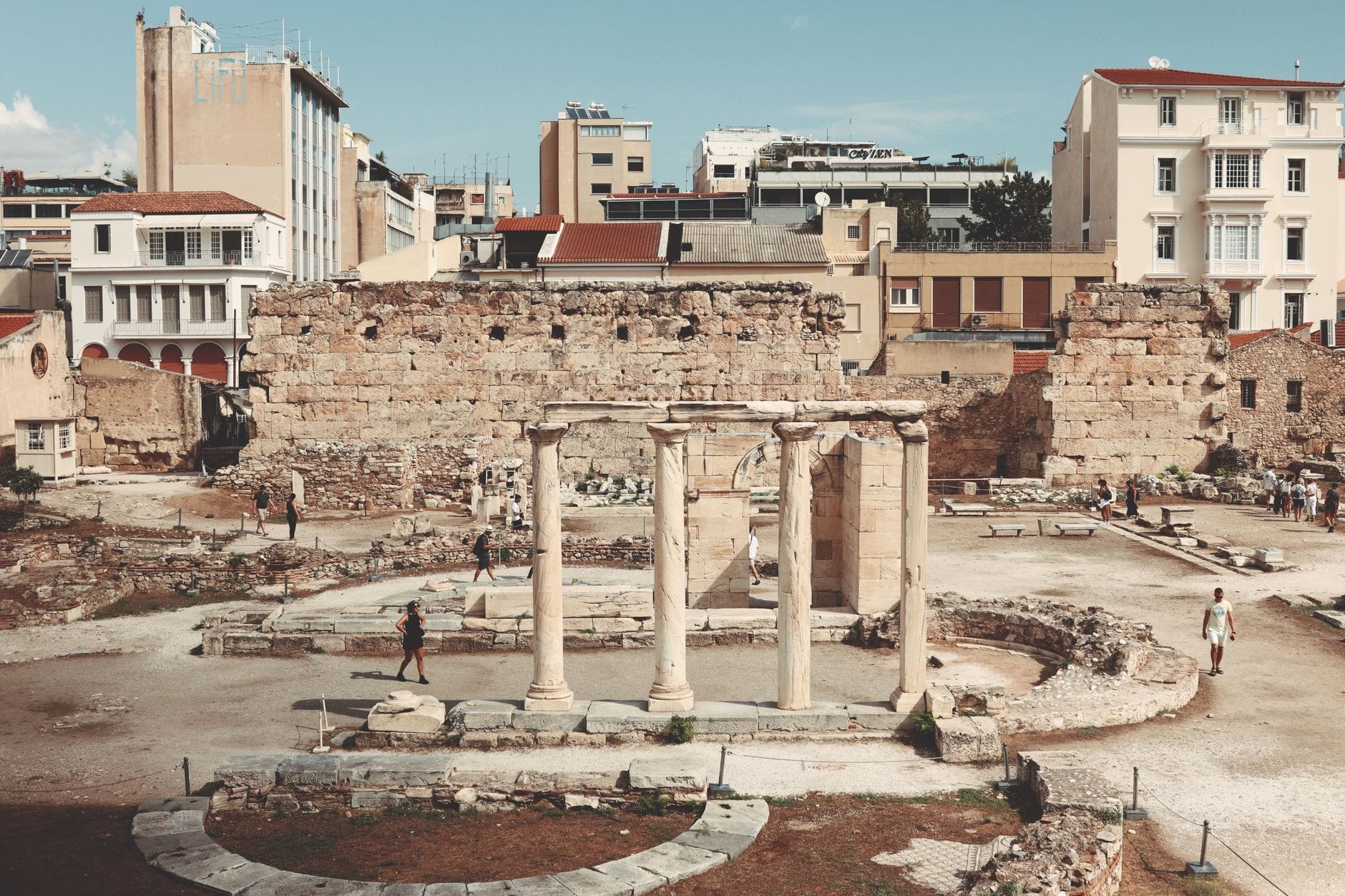
What Is Hadrian's Library and Why Does It Matter?
The Library of Hadrian is a monumental Roman complex covering roughly 122 by 80 meters, constructed in 132 AD by the Roman Emperor Hadrian during his transformative second visit to Athens. Despite its name, the building was far more than a repository for scrolls. It was a cultural campus: a grand colonnaded courtyard, gardens, lecture halls, reading rooms, and ceremonial spaces, all built to project Roman power and reverence for Greek intellectual heritage in equal measure.
The site sits immediately north of the Roman Agora, directly beside Monastiraki Square, which means millions of visitors walk past its massive west facade every year without stopping to understand what they are seeing. That facade, a towering stretch of Pentelic marble punctuated by Corinthian columns, is one of the best-preserved Roman walls in Athens and one of the city's most photogenic ancient fragments.
For visitors already planning time at the Acropolis or the Ancient Agora, Hadrian's Library offers a distinct perspective: this is Roman Athens, not classical Greek Athens, and the distinction is worth an hour of your time.
💡 Local tip
Opening hours for the summer season (typically April 1–October 31) are 8:00–20:00, with last entry 30 minutes before closing. Hours change in shoulder seasons and winter, so check the official Greek e-ticket system before your visit.
The Architecture: 100 Columns and a Marble Wall
The west facade facing Areos Street is the first thing visitors see, and it stops people mid-stride. The original design called for one hundred Corinthian columns lining a large rectangular courtyard, giving the complex its ancient nickname as the “One Hundred Column Library”. What stands today is a long, solid marble wall with surviving columns and a central propylon (gateway), enough to communicate the sheer scale of Hadrian's ambitions.
Once inside, the layout becomes clear. A rectangular pool once occupied the center of the courtyard, flanked by symmetrical porticoes. At the east end stood the actual library hall where papyrus scrolls were stored in recessed wall niches. Smaller exedrae, or semicircular recesses, lined the long sides of the courtyard, likely used as lecture and reading spaces. The whole ensemble was designed to be experienced as a sequence of spaces moving from public to private, from spectacle to study.
Later centuries added layers. A tetraconch church was built inside the ruins in the 5th century AD, followed by a larger basilica, and later a domed Byzantine church. The archaeological site preserves the foundations and fragments of all these phases, making the ground plan a compressed timeline of Athenian religious and civic history from Roman imperial rule through early Christianity and Byzantine occupation.
Tickets & tours
Hand-picked options from our booking partner. Prices are indicative; availability and final rates are confirmed when you complete your booking.
Guided tour of the Acropolis, Parthenon and Museum in Athens
From 50 €Instant confirmationFree cancellationAthens: Temple of Olympian Zeus E-ticket with audio tour on your phone
From 10 €Instant confirmationAthens full-day tour with Acropolis and Cape Sounion
From 92 €Instant confirmationFree cancellationAthens National Archaeological Museum e-ticket and audio tour
From 22 €Instant confirmation
What the Visit Actually Feels Like
Entering through the main gate on Areos Street, the noise of Monastiraki drops away more quickly than expected. The site sits slightly below street level in places, and the remaining walls create a sense of enclosure that muffles the square's foot traffic and market sounds. In the morning, the marble facade catches direct eastern light, which makes the stone appear almost pale gold rather than white. By midday, the courtyard fills with flat overhead light that flattens the ruins photographically but makes the inscriptions and carved details easier to read.
The paving is uneven throughout. Flat stones alternate with exposed archaeological layers, gravel fills, and stabilized earth. Comfortable shoes with closed toes are practical, not optional. There is no formal guided tour pathway; visitors circulate freely around the perimeter and through the excavated interior, with printed site maps available at the entrance. Interpretive signage is present in Greek and English, clear enough for an informed self-guided visit.
The site is rarely crowded to the point of difficulty, even in peak summer months. Most visitors on their way between Monastiraki Square and the Acropolis pass the facade and keep walking, which means the interior stays manageable. Mornings before 10:00 are the quietest window. By early afternoon, small group tours arrive and tend to cluster at the entrance propylon and around the tetraconch foundations near the east end.
⚠️ What to skip
The site has no shade structures inside the courtyard. In July and August, midday temperatures in Athens regularly exceed 35°C. Visiting between 8:00 and 10:00, or after 17:00, makes a significant practical difference. Bring water.
Historical Context: Hadrian and Athens
Hadrian was unusual among Roman emperors in his genuine attachment to Greek culture. He visited Athens multiple times, funded major building projects across the city, and was initiated into the Eleusinian Mysteries. The library complex was part of a broader program that also included the completion of the Temple of Olympian Zeus (begun centuries earlier and finally finished under Hadrian) and the construction of a new district called Hadrianopolis east of the old city center.
The Temple of Olympian Zeus and Hadrian's Library represent the two poles of his Athenian legacy: one a completion of something ancient, the other a new Roman imposition on a Greek city. The library was not a gift to the Athenians in any neutral sense; it was also a statement of imperial patronage, designed to position Hadrian as a successor to the great benefactors of Greek intellectual life.
The building functioned as an active cultural institution through late antiquity. Its transformation into a Christian religious site reflects the layered history common to Athens' ancient monuments, where each era repurposed what came before without entirely erasing it. The Byzantine church whose foundations are visible at the east end of the courtyard was still in use in the medieval period, long after the library function had ceased.
Photography and Practical Details
The west facade on Areos Street is photographable from outside the site at no cost and is often better captured from the street level before entering, where the full height of the remaining wall reads clearly. Inside, the best framing opportunities are from the northwest corner looking southeast across the courtyard, which captures the surviving column stubs against the open sky. The tetraconch foundations in the east half of the site are more architecturally legible in late afternoon light, when raking shadows define the curved walls.
Personal photography with handheld cameras and phones is permitted throughout the site. Tripods may require prior approval; check with the site staff at the entrance if needed. Drone use is not permitted over archaeological sites in Greece without specific authorization.
Hadrian's Library uses the same ticketing framework as other central Athens archaeological sites. Each site now requires its own ticket — the former combo pass that bundled the Roman Agora, Ancient Agora was discontinued in 2025. General admission here is €6 (verify at hhticket.gr). Budget separately if you also plan to visit the Roman Agora, Ancient Agora, or other Ministry-managed sites the same day.
Getting There and Accessibility
The site is approximately one minute on foot from Monastiraki Metro Station, served by Metro Line 1 (Green) and Metro Line 3 (Blue). Exit the station toward Monastiraki Square and the library's marble facade is immediately visible to the north on Areos Street. From Syntagma Square, the walk takes about 10 minutes through Ermou Street.
The surrounding Monastiraki neighborhood is one of Athens' most walkable areas, and the library sits naturally on any route connecting the square to Plaka or the Acropolis slopes.
Accessibility inside the site is limited. The ground is uneven archaeological terrain with no paved accessible pathway through the interior. Visitors with mobility impairments can view the facade and part of the entrance area but may find full exploration of the courtyard difficult. There are no elevators or ramps within the site itself. Contact the site administration in advance if accessibility assistance is needed.
ℹ️ Good to know
The library entrance on Areos Street is roughly equidistant from the Monastiraki Flea Market to the west and the Plaka neighborhood to the east, making it a natural midpoint stop on a walking itinerary through central Athens.
Insider Tips
- The marble facade on Areos Street is lit at night and visible from outside the gates for free. If you are in the area after dark, it is worth a detour just for the view, even without entering.
- Visit early in the morning if you want the interior to yourself. By 9:30 on summer mornings, tour groups begin arriving. Before 9:00, you may have the courtyard almost entirely alone.
- Buy a standalone site ticket at the entrance or via hhticket.gr. The Ministry discontinued the multi-site combo pass in 2025, so each archaeological site in central Athens now requires its own admission.
- The tetraconch church foundations at the east end of the courtyard are worth spending extra time on. Most visitors photograph the entrance and the surviving columns and leave, missing the most historically layered part of the site.
- Monastiraki Square directly outside has several cafes with views of the facade. Arriving slightly before the site opens and having coffee with a view of the marble wall is a calm way to start before the square fills up.
Who Is Hadrian's Library For?
- Travelers with an interest in Roman history who want to see Athens beyond the classical Greek narrative
- Architecture enthusiasts drawn to imperial Roman design and its spatial logic
- Photographers looking for ancient marble texture and monumental scale without the crowds of the Acropolis
- Visitors building a full-day ancient sites itinerary through central Athens
- Anyone spending time in Monastiraki who wants genuine historical context alongside the market and street food
Nearby Attractions
Other things to see while in Monastiraki:
- Ancient Agora of Athens
The Ancient Agora of Athens was the civic, commercial, and philosophical center of the ancient city for over a thousand years. Today, its open archaeological site combines sweeping ruins, one of the best-preserved Greek temples in existence, and a world-class on-site museum — all within easy walking distance of Monastiraki Square.
- Athens Central Market (Varvakios Agora)
Open since 1884, the Athens Central Market — officially the Varvakios Agora — is where Athenian chefs, home cooks, and curious travelers collide under a 19th-century iron-and-glass roof. It is raw, fragrant, occasionally confronting, and entirely genuine. This is what a food market looks like before it becomes a tourist attraction.
- Monastiraki Flea Market
Sprawling across the cobbled lanes around Monastiraki Square, the Monastiraki Flea Market is where Athens does its most honest selling. Free to enter, chaotic by design, and best on Sunday mornings when antique dealers take over Avissinia Square.
- Roman Agora
The Roman Agora of Athens is a remarkably preserved 1st-century BC commercial complex that once served as the city's main marketplace under Roman rule. Spanning roughly 111 by 104 metres in the heart of the old city, it offers a quieter and often overlooked counterpoint to the crowded Acropolis. Its crowning feature, the Gate of Athena Archegetis, remains one of the finest surviving Roman gateways in Greece.