Temple of Olympian Zeus: Athens' Most Ambitious Ancient Monument
The Temple of Olympian Zeus took nearly 700 years to complete and was once the largest temple in Greece. Today, 15 of its original 104 Corinthian columns still rise above central Athens (with a 16th lying fallen on the ground), offering one of the most atmospheric ancient sites in the city. Here is everything you need to visit it well.
Quick Facts
- Location
- Leoforos Vasilissis Olgas & Leoforos Amalias, Athens 105 57 — about 500 m southeast of the Acropolis
- Getting There
- Akropoli (Metro Line 2), approx. 9-minute walk; also walkable from Syntagma (served by Metro Lines 2 and 3).
- Time Needed
- 45–75 minutes on-site; longer if combined with nearby Hadrian's Arch and the surrounding park
- Cost
- €6 adult / €3 reduced (single-site ticket at hhticket.gr; verify before visiting)
- Best for
- Ancient history, architecture photography, and visitors combining multiple archaeological sites in one day
- Official website
- http://odysseus.culture.gr/h/2/eh255.jsp?obj_id=12863
What You Are Actually Looking At
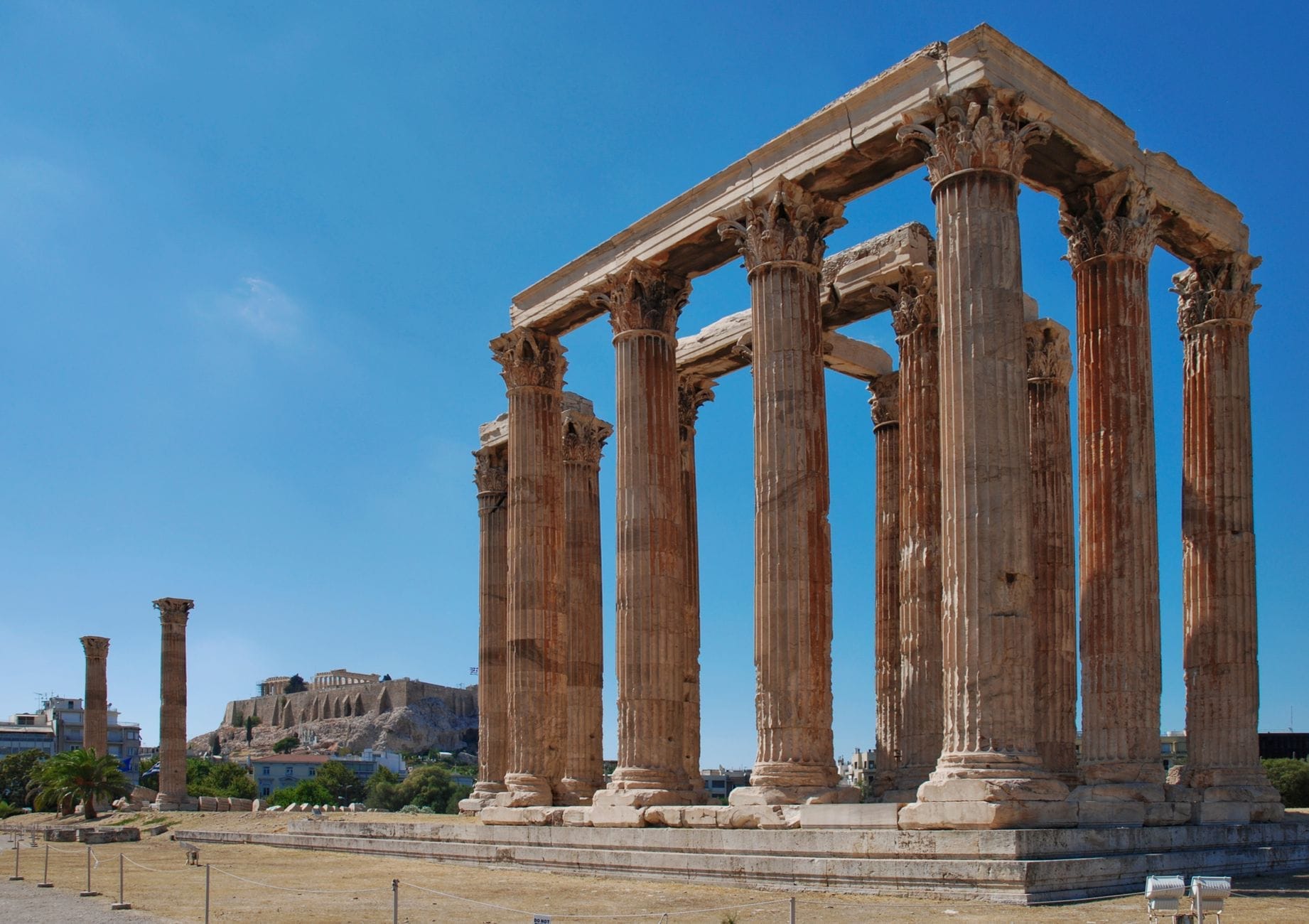
The Temple of Olympian Zeus, also known as the Olympieion, stands on a large flat terrace just southeast of the Acropolis hill in central Athens. What greets you at the entrance is arresting: fifteen enormous Corinthian columns, standing roughly 15 to 17 metres tall, grouped in a loose cluster against the sky. They are the survivors of an original 104, of which 15 still stand upright. The sixteenth column toppled in a storm in 1852 and now lies exactly where it fell, a collapsed stack of drum-shaped marble segments stretched across the grass. It remains there deliberately, an unscripted exhibit in itself.
The columns are not the thin, elegant type common to Classical-era temples. These are thick, deeply fluted, and capped with the elaborate acanthus-leaf capitals that define the Corinthian order. Up close, the scale becomes physical rather than abstract. The diameter of each column base is approximately 1.7 metres. Standing beside one reframes your understanding of the monument's original ambition.
ℹ️ Good to know
Opening hours are currently 08:00–15:00 (last admission 14:30), though these may shift seasonally. Confirm current hours through the Hellenic Ministry of Culture before visiting.
Seven Centuries in the Making: A Construction History Unlike Any Other
Construction on the Temple of Olympian Zeus began around 520 BC, initiated by the Athenian tyrant Peisistratos or his sons as a statement of political power. The project was enormous from conception: a dipteral octastyle plan measuring approximately 96 metres long by 40 metres wide, intended to be the grandest temple on the Greek mainland. But when Athenian democracy replaced tyranny, work stopped. Building a monument to personal power no longer fit the city's political mood.
The site sat largely dormant for centuries. Various rulers attempted to revive the project, including the Seleucid king Antiochus IV Epiphanes in the 2nd century BC, who commissioned the Roman architect Cossutius to redesign the temple in the Corinthian order rather than the original Doric. Antiochus died before completion, and work halted again. The Roman dictator Sulla is said to have stripped some columns from the site to use in Rome's Temple of Jupiter Capitolinus.
It was the Roman Emperor Hadrian who finally completed the temple around 132 AD, dedicating it to Olympian Zeus and, pointedly, to himself. The Roman imperial cult had evolved to the point where emperors were worshipped alongside gods, and Hadrian used the Olympieion as a centerpiece of his broader program to reshape Athens as a culturally prestigious imperial city. A colossal statue of Zeus is believed to have stood inside the cella, possibly accompanied by an equally large one of Hadrian himself, though neither survives today.
This six-century construction arc makes the Olympieion unique in the ancient world. For context on how this Roman-era transformation fits into the broader archaeological landscape of Athens, the Roman Agora and Hadrian's Library nearby show a similar imperial fingerprint on what was already an ancient city.
Tickets & tours
Hand-picked options from our booking partner. Prices are indicative; availability and final rates are confirmed when you complete your booking.
Athens: Temple of Olympian Zeus E-ticket with audio tour on your phone
From 10 €Instant confirmationAudio tour of the Temple of Olympian Zeus of Athens
From 12 €Instant confirmationFree cancellationAncient Olympia full day guided tour from Athens
From 70 €Instant confirmationFree cancellationGuided tour of the Acropolis, Parthenon and Museum in Athens
From 50 €Instant confirmationFree cancellation
How the Site Feels at Different Times of Day
Early morning, before 9:00, the site is at its quietest. The light from the east catches the fluted surfaces of the columns and deepens their texture dramatically. The surrounding grass is still cool, and the noise from Leoforos Amalias, the boulevard running alongside, has not yet built to its daytime intensity. Serious photographers come at this hour. The Acropolis is visible on the hill to the northwest, giving compositions that include both monuments in the same frame.
By mid-morning, tour groups begin arriving. The terrace is large enough that crowding rarely feels oppressive, but the area directly around the cluster of standing columns fills up with people stopping to photograph. The open layout means you can always step back to find space, and the fallen column, slightly away from the main cluster, often has nobody near it.
Afternoon visits in summer come with full sun exposure and heat. There is almost no shade on the terrace. The stone and dry grass reflect heat upward, and temperatures in Athens regularly exceed 35°C from June through August. Morning visits from April through October are strongly preferable. In winter and early spring, the grass is green, the columns are clean grey against pale skies, and the site has a calm that summer cannot offer.
⚠️ What to skip
The site is largely unshaded. In summer months, bring water, wear sun protection, and plan to arrive at opening time. There is no cafe or shelter inside the enclosure.
Hadrian's Arch: The Free Companion Piece
Immediately outside the site entrance, on the edge of Leoforos Vasilissis Olgas, stands Hadrian's Arch. Built around the same time the temple was completed, it marked the boundary between the old Athenian city and the new Roman quarter Hadrian was constructing. The inscription on the northwest face reads 'This is Athens, the ancient city of Theseus,' and on the southeast side, 'This is the city of Hadrian, not of Theseus.' The arch is free to view from the street and requires no ticket.
The arch sits between the temple enclosure and the busy boulevard, which means traffic noise is constant. It is best viewed in the early morning or at dusk, when vehicle volume drops and the stone takes on a different colour. At night, it is lit with warm artificial light and makes for a striking photograph.
Practical Walkthrough: What to Do Inside
The enclosed site covers around 4 hectares. After entering through the ticket gate on Leoforos Vasilissis Olgas, a path leads across flat ground toward the column cluster. The main group of fifteen standing columns occupies the southeastern portion of the original cella area. Interpretive panels in Greek and English explain the architectural phases and historical context, and they are worth reading if you want the site to mean something beyond its visual impact.
The fallen column, located slightly to the south of the main cluster, is one of the most photographed objects in the complex. Its arrangement on the ground makes the column's construction immediately legible: you can count the individual drums, examine the joints, and see how the capital was carved separately before assembly. It is a more intimate, instructive experience than looking up at the standing columns from below.
Visitors who are working through multiple archaeological sites in a single day should budget for separate tickets at each location — the Ministry discontinued the multi-site combo pass in 2025. The Acropolis & Slopes ticket (€30) covers the Acropolis, the Ancient Agora, the Kerameikos Archaeological Site, and the south slope monuments. Sites like this temple, the Ancient Agora, and Kerameikos each require their own admission — verify current pricing at hhticket.gr.
💡 Local tip
Each archaeological site in Athens now requires its own ticket — the Ministry discontinued the multi-site combo pass in 2025. The Temple of Olympian Zeus costs €6 full / €3 reduced as a standalone admission (verify at hhticket.gr).
Photography, Accessibility, and Getting There
The site sits at the intersection of Leoforos Vasilissis Olgas and Leoforos Amalias, with the National Garden beginning just a few hundred metres to the north. The Akropoli Metro station on Line 2 is the closest stop, roughly a 9-minute walk east and then north. Syntagma station, served by both Metro Lines 2 and 3, is also about 9 minutes on foot heading southwest. The walk from either station passes through pleasant streets and requires no particular navigation skill.
The terrace itself is mostly level grass and compacted earth paths. The surface is uneven in places, particularly near the fallen column, which requires stepping over low ground-level markers. Visitors using wheelchairs or with reduced mobility should check current accessibility provision with the site or the Ministry of Culture before visiting, as detailed accessibility information changes and should be confirmed directly.
For photography, the optimal positions are from the western and southwestern edges of the terrace, which place the column group against open sky with the Acropolis visible in the background. A standard 24-70mm lens covers most compositions comfortably. The columns are too tall and closely grouped to capture cleanly with a wide-angle lens from close range. Early morning and the hour before closing are the most workable for light quality.
The temple sits in the broader archaeological corridor that links the Acropolis area with the neighborhood of Syntagma. If you are building a route, the National Garden, Hadrian's Arch, and this site cluster naturally together and can all be covered in a single unhurried morning. For a fuller framework, the Athens ancient sites guide offers a structured approach to sequencing the major archaeological stops.
An Honest Assessment: Is It Worth Your Time?
The Temple of Olympian Zeus is not the most immersive ancient site in Athens. There are no interior spaces, no museum-quality exhibits within the enclosure, and the surrounding boulevards mean you are never entirely removed from urban Athens. The site closes relatively early (15:00), which limits flexibility for afternoon visitors.
What it offers is scale and clarity. The fifteen standing columns are among the largest surviving ancient columns anywhere in the Mediterranean world, and their Corinthian detailing is in excellent condition. The sense of incomplete ambition, six centuries of on-and-off construction ending in Roman imperial dedication rather than Greek democratic ceremony, gives the site a historical character that is genuinely different from the Acropolis or the Agora. It rewards visitors who engage with that story.
Visitors who are short on time, have already seen several archaeological sites, or are travelling with very young children who need more active engagement may find the site underwhelming for the ticket price on its own. Pair it with nearby Hadrian's Arch and the National Garden rather than making it a standalone destination.
Insider Tips
- Enter through the northern gate on Leoforos Vasilissis Olgas rather than approaching from the Amalias side, which tends to have more pedestrian congestion during peak hours.
- The fallen column on the southern end of the terrace is often overlooked by visitors moving straight toward the standing cluster. Spend time here: the individual marble drums show the construction method more clearly than anything else on the site.
- Hadrian's Arch is visible from inside the enclosure near the entrance, but walk out to it after your visit. It is free to view from street level and reads differently once you understand the boundary it was marking between the ancient Greek city and Hadrian's new Roman quarter.
- If you are visiting in spring (April to early June), the grass on the terrace is green and the columns appear especially clean against bright skies. This is also when the site is at its least crowded on weekday mornings.
- The site is within a 10-minute walk of both the Acropolis Museum and the Theatre of Dionysus. Combining all three into a single morning is entirely feasible if you arrive at the Olympieion at opening time and move efficiently.
Who Is Temple of Olympian Zeus For?
- Travellers with a genuine interest in ancient Greek and Roman history who want context, not just photos
- Architecture and photography enthusiasts drawn to the scale and detail of Corinthian column work
- Visitors holding the combined archaeological sites ticket who are systematically covering Athens' major ancient monuments
- Those who prefer open-air sites with space to move and reflect, rather than dense museum environments
- Repeat visitors to Athens who have already seen the headline sites and want to spend more time with a monument that rewards attention
Nearby Attractions
Other things to see while in Syntagma & the Historic Centre:
- Athenian Trilogy (Academy, University, Library)
Three neoclassical monuments designed by the Hansen brothers line central Athens' Panepistimiou Street, forming one of the most coherent 19th-century architectural ensembles in Europe. The Academy, University, and National Library are free to view from outside and take less than an hour to walk, yet they reward careful attention from anyone interested in architecture, modern Greek history, or the idea of what a newly independent nation chose to build first.
- Hellenic Parliament & Tomb of the Unknown Soldier
Standing at the head of Syntagma Square, the Hellenic Parliament occupies the Old Royal Palace, a neoclassical landmark built between 1836 and 1840. In front of it, the Tomb of the Unknown Soldier is guarded around the clock by Evzones in ceremonial uniform, offering one of the most visually striking public rituals in Greece. Free guided tours of the building are offered on specific days and months and require advance booking, but even without booking, the square-level spectacle rewards any visit.
- National Garden of Athens
The National Garden of Athens is a 15.6-hectare historic public park in the heart of the city, free to enter and open every day from sunrise to sunset. Originally the private gardens of the Royal Palace, it now offers shaded paths, a small zoo, ancient fragments, and a duck pond within walking distance of Syntagma Square.
- Numismatic Museum of Athens
The Numismatic Museum of Athens houses roughly 500,000–600,000 coins, medals, gems, and weights spanning three millennia of monetary history, all inside the spectacular neoclassical Iliou Melathron mansion built for archaeologist Heinrich Schliemann. It sits on Panepistimiou Street, a short walk from Syntagma Square, and rewards visitors who appreciate both Greek history and 19th-century architectural grandeur.