Hellenic Parliament & Tomb of the Unknown Soldier: Athens' Living Symbol of Democracy
Standing at the head of Syntagma Square, the Hellenic Parliament occupies the Old Royal Palace, a neoclassical landmark built between 1836 and 1840. In front of it, the Tomb of the Unknown Soldier is guarded around the clock by Evzones in ceremonial uniform, offering one of the most visually striking public rituals in Greece. Free guided tours of the building are offered on specific days and months and require advance booking, but even without booking, the square-level spectacle rewards any visit.
Quick Facts
- Location
- Syntagma Square, Athens GR-10021
- Getting There
- Syntagma Metro Station (Lines 2 & 3), at the upper side of the square below Amalias Avenue
- Time Needed
- 20–30 min for the exterior and guard ceremony; 1 hour for a guided interior tour
- Cost
- Free (guided tours also free; advance booking required by email at least 5–15 days prior, depending on program)
- Best for
- History enthusiasts, architecture lovers, first-time Athens visitors, families
- Official website
- www.hellenicparliament.gr/en
What You're Actually Looking At
The Hellenic Parliament sits at the eastern end of Syntagma Square, its pale neoclassical facade rising above a broad marble terrace. The building was constructed between 1836 and 1840 as the Old Royal Palace, designed by Bavarian architect Friedrich von Gärtner for Greece's first king, Otto. The Greek state began converting it into the seat of parliament in the late 1920s, and it has housed the Vouli ton Ellinon, the single-chamber legislature of the Hellenic Republic, since the mid-1930s.
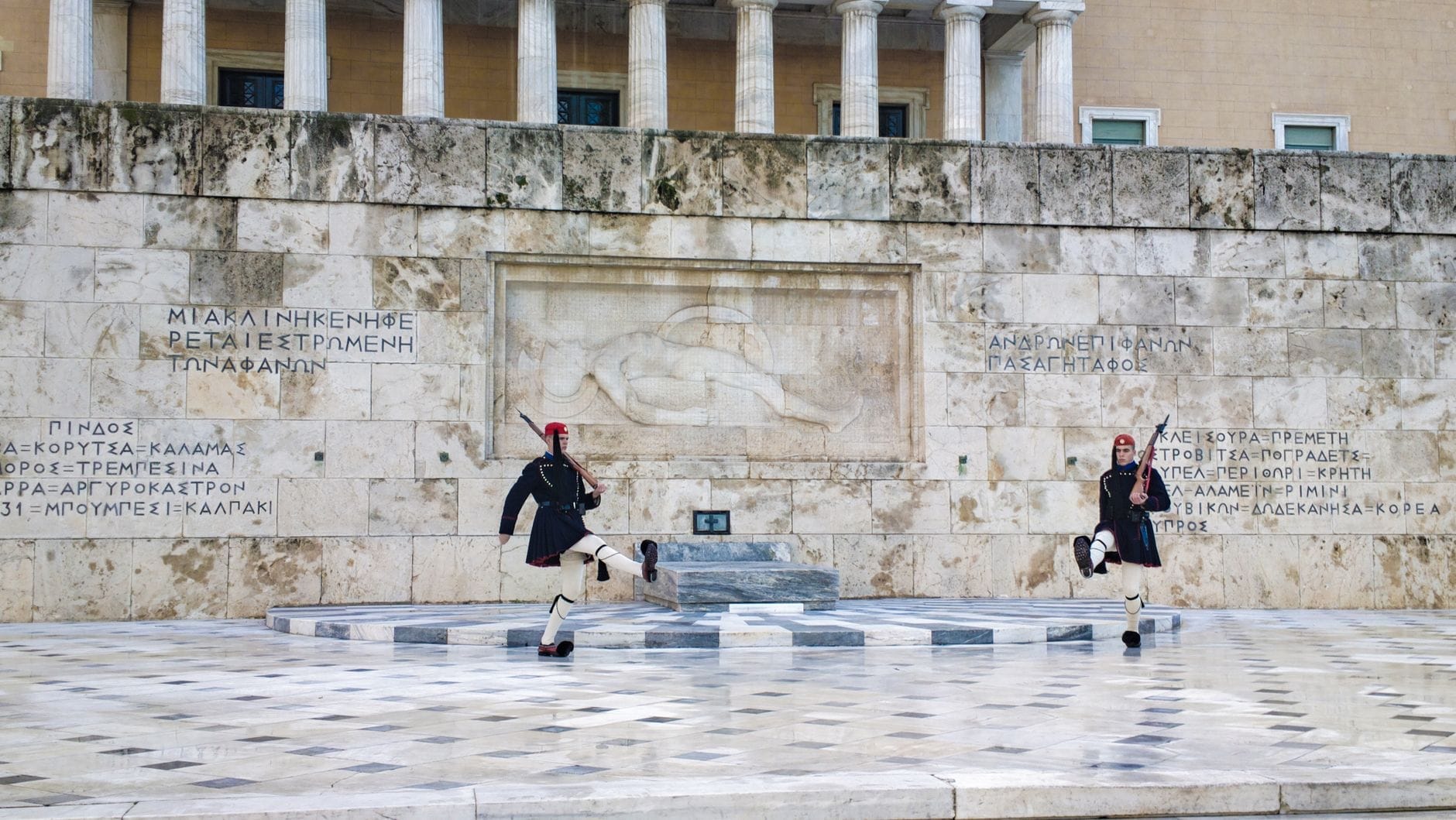
At the base of the building's grand staircase lies the Tomb of the Unknown Soldier, a low relief monument carved directly into the retaining wall. The sculpted figure depicts a fallen Greek warrior in the classical style, flanked by inscriptions citing battles from the wars of Greek independence and the twentieth century. This is not simply a decorative element: it is the ceremonial heart of Greek military remembrance, and it is guarded continuously throughout the year.
ℹ️ Good to know
The full-dress changing of the guard (Allagi Frouras) takes place every Sunday at 11:00 AM, when an entire company of Evzones in ceremonial uniform assembles on the square. The hourly single-guard rotation happens daily and is worth timing your visit around.
The Evzones: Understanding the Ceremony
The soldiers standing guard at the Tomb of the Unknown Soldier are Evzones, members of the Presidential Guard regiment. Their uniform, the fustanella, is one of the most recognizable in the world: a pleated white kilt traditionally said to have hundreds of folds symbolizing years of Ottoman rule, paired with a heavy wool cloak in winter, red cap with a long tassel, and tsarouchia, shoes with large black pompoms that clap audibly against the marble pavement.
The hourly rotation involves a slow, deliberate high-stepping march from the Parliament entrance to the tomb, with two soldiers performing synchronized movements that look choreographed because they are, refined over decades of training. The movements are slow enough to watch carefully, and most visitors stop instinctively. The soldiers maintain composure regardless of typical weather, crowd noise, or camera proximity, and both the ceremony and the sentry post normally continue through rain, summer heat, and national holidays.
The Sunday ceremony at 11:00 AM is the one to plan around if you have a choice. The full regiment arrives in formation, and the square fills with Athenians alongside tourists. Arrive 15 to 20 minutes early to secure a viewing position near the front of the crowd. The marble surface around the tomb can become extremely crowded during this ceremony, particularly in July and August.
💡 Local tip
For the hourly guard rotation on weekdays, the area immediately in front of the tomb is far less crowded, and you can stand close enough to hear the tsarouchia on the marble. Early morning, around 8:00–9:00 AM, is the least congested time.
Tickets & tours
Hand-picked options from our booking partner. Prices are indicative; availability and final rates are confirmed when you complete your booking.
Guided tour of the Acropolis, Parthenon and Museum in Athens
From 50 €Instant confirmationFree cancellationAthens: Temple of Olympian Zeus E-ticket with audio tour on your phone
From 10 €Instant confirmationAthens full-day tour with Acropolis and Cape Sounion
From 92 €Instant confirmationFree cancellationAthens National Archaeological Museum e-ticket and audio tour
From 22 €Instant confirmation
The Building: Neoclassical Architecture and Parliamentary History
Friedrich von Gärtner's design for the Old Royal Palace followed the Neoclassical idiom fashionable across Europe in the 1830s, with a long symmetrical facade, Doric pilasters, and a central portico projecting from the upper story. The building was scaled to project authority in a newly independent nation-state that was still constructing its institutional identity. The Greek government's decision to relocate parliament here in 1929 was itself politically significant: the royal palace became the people's house.
Guided tours of the interior are organized by the Hellenic Parliament Foundation and run Monday through Friday, excluding August. Each tour lasts approximately one hour and covers the main debating chamber, historic rooms, and the parliamentary library. Tours are free of charge but require advance booking by email at least 15 days before your visit. Details are on the Foundation's site at foundation.parliament.gr. If you are traveling on a tight schedule or arriving without a reservation, the exterior and the tomb area offer a complete experience on their own.
The interior tours tend to attract visitors with a specific interest in Greek political history or architectural heritage rather than casual sightseers. If that describes you, the advance planning is worthwhile. The debating chamber retains much of its original nineteenth-century character, and the library holds rare documents from the early decades of the Greek state.
How the Experience Changes Through the Day
Syntagma Square is Athens' central transit and civic hub, which means the atmosphere around the Parliament shifts considerably depending on when you arrive. Early mornings are quieter: commuters cross the square, the orange trees in the adjacent National Garden release a faint citrus smell, and the Evzone sentries stand against the monument in near-silence. The marble terrace catches the eastern light, and the relief carving on the tomb is easier to read without crowds in the way.
By midday, particularly in summer, the square is crowded and the sun reflects hard off the pale stone surface. Temperatures in Athens often exceed 35°C in July and August, and there is minimal shade on the terrace immediately in front of the building. If you are visiting during summer, the National Garden begins directly behind the Parliament and offers immediate relief: its tree canopy drops the temperature noticeably and connects the square to Kolonaki without backtracking.
Late afternoon and early evening bring a different quality to the square. Athenians gather on the steps, the light turns golden on the building's upper facade, and the atmosphere is more social than touristic. The Parliament is illuminated at night, and the Evzone sentries continue their rotation under floodlights, which creates a photographic opportunity distinct from the daytime experience.
Getting There and Practical Navigation
Syntagma Metro Station, served by both Line 2 (Red) and Line 3 (Blue), places you directly beneath the square. From the station exit facing the Parliament, the building is visible immediately. The metro station itself is worth a few minutes: its excavation exposed ancient artifacts that are now displayed in a glass-fronted exhibit in the concourse and near the platforms, a small but genuine archaeological layer beneath the modern city. For broader orientation across Athens, the Athens transport guide covers metro, bus, and tram options in detail.
From the airport, Line 3 runs directly to Syntagma in approximately 40 minutes. Bus X95 also connects the airport to Syntagma Square and operates day and night with frequent departures. Taxis from the airport charge an official flat rate; verify current figures with the airport's official transport page before your trip.
The Parliament is a natural anchor point for a longer walk through central Athens. Syntagma connects westward to Monastiraki and the ancient sites within a 15-minute walk. Heading south takes you along Amalias Avenue toward the Temple of Olympian Zeus. The pedestrianized route through the National Garden leads northeast toward Kolonaki.
⚠️ What to skip
Syntagma Square is the site of political demonstrations and protests in Athens. These can affect access to the square and the area around the Parliament. On days with scheduled protests, the metro station may see increased security checks, and the square itself may be temporarily restricted. Check local news if visiting during politically sensitive periods.
Photography, Accessibility, and What to Bring
Photography of the exterior, the monument, and the Evzone ceremony is permitted and widely practiced. The most effective positions for photographing the guard rotation are slightly elevated: the steps and raised platforms on either side of the tomb give a cleaner sightline than standing at ground level in a crowd. A zoom lens or telephoto setting on a phone is useful for the soldiers' facial details and uniform elements, since you are not permitted to approach the sentries closely.
The terrace and marble steps are uneven in places and involve several flights of stairs. The official visit page for guided tours does not specify accessibility arrangements for visitors with mobility limitations; contact the Parliament Foundation directly before your visit if this is relevant to your planning. The square itself is wheelchair accessible from all metro exits.
In summer, bring water and sun protection. The terrace provides no shade, and the ceremony area in front of the tomb is entirely exposed. In winter, the marble can become slippery when wet. There are no on-site facilities for visitors at the monument itself; cafes and kiosks are available around the square perimeter.
Honest Assessment: Who Will Find This Worthwhile
As a purely visual and civic experience, the exterior visit is worth 20 to 30 minutes for almost any visitor to Athens, particularly if you time it around the guard rotation. It requires no booking, costs nothing, and the building itself is the most prominent piece of nineteenth-century neoclassical architecture in the city center. Combined with a walk through the National Garden or a continuation toward the Temple of Olympian Zeus, it fits naturally into any first-day itinerary.
The guided interior tour, on the other hand, is a niche experience that requires real advance planning and serves a specific audience: those with genuine interest in Greek parliamentary history, nineteenth-century royal interiors, or institutional architecture. It is not the kind of tour that surprises casual visitors with unexpected highlights. If that is not your focus, the exterior gives you most of what this site offers.
Visitors who find ceremonial military rituals uninteresting, or who are visiting Athens primarily for ancient history, may want to spend their time budget at the Acropolis, the Ancient Agora, or the Acropolis Museum instead. This site is best understood as a civic and political monument, not an ancient archaeological one.
Insider Tips
- The hourly guard rotation on weekday mornings between 8:00 and 10:00 AM draws almost no crowd. You can stand within a few meters of the tomb and watch the entire ceremony without anyone blocking your view.
- For the Sunday 11:00 AM full-dress ceremony, position yourself on the raised marble platform to the left of the tomb (facing the building) rather than at ground level. The elevated angle gives a much cleaner view over the crowd.
- The Syntagma Metro Station has one of the most unusual platform displays in Europe: excavated artifacts and layers of ancient Athens are visible behind glass along the platform walls. Allow five extra minutes to walk its length.
- Guided tours of the interior require email booking several days in advance and are only available on specific days and months (often weekends in June, July and September). If you are visiting in summer and want the interior, plan and book before you leave home.
- The National Garden entrance directly behind the Parliament building is unmarked from the square side. Look for the iron gate on the right side of the building's rear perimeter; it opens onto shaded paths that are significantly cooler than the square in summer heat.
Who Is Hellenic Parliament & Tomb of the Unknown Soldier For?
- First-time visitors to Athens wanting to anchor themselves at the city's civic center
- History and political history enthusiasts willing to book the free guided interior tour in advance
- Photographers interested in ceremonial subjects, particularly for the Sunday 11:00 AM full-dress guard rotation
- Families with older children who can engage with the ceremony and the monument's historical context
- Travelers building a walking itinerary that connects Syntagma to the ancient sites to the west or the coast to the south
Nearby Attractions
Other things to see while in Syntagma & the Historic Centre:
- Athenian Trilogy (Academy, University, Library)
Three neoclassical monuments designed by the Hansen brothers line central Athens' Panepistimiou Street, forming one of the most coherent 19th-century architectural ensembles in Europe. The Academy, University, and National Library are free to view from outside and take less than an hour to walk, yet they reward careful attention from anyone interested in architecture, modern Greek history, or the idea of what a newly independent nation chose to build first.
- National Garden of Athens
The National Garden of Athens is a 15.6-hectare historic public park in the heart of the city, free to enter and open every day from sunrise to sunset. Originally the private gardens of the Royal Palace, it now offers shaded paths, a small zoo, ancient fragments, and a duck pond within walking distance of Syntagma Square.
- Numismatic Museum of Athens
The Numismatic Museum of Athens houses roughly 500,000–600,000 coins, medals, gems, and weights spanning three millennia of monetary history, all inside the spectacular neoclassical Iliou Melathron mansion built for archaeologist Heinrich Schliemann. It sits on Panepistimiou Street, a short walk from Syntagma Square, and rewards visitors who appreciate both Greek history and 19th-century architectural grandeur.
- Temple of Olympian Zeus
The Temple of Olympian Zeus took nearly 700 years to complete and was once the largest temple in Greece. Today, 15 of its original 104 Corinthian columns still rise above central Athens (with a 16th lying fallen on the ground), offering one of the most atmospheric ancient sites in the city. Here is everything you need to visit it well.