The Athenian Trilogy: University, Academy, and Library on Panepistimiou Street
Three neoclassical monuments designed by the Hansen brothers line central Athens' Panepistimiou Street, forming one of the most coherent 19th-century architectural ensembles in Europe. The Academy, University, and National Library are free to view from outside and take less than an hour to walk, yet they reward careful attention from anyone interested in architecture, modern Greek history, or the idea of what a newly independent nation chose to build first.
Quick Facts
- Location
- Leoforos Eleftheriou Venizelou (Panepistimiou Street), central Athens
- Getting There
- Panepistimio station, Metro Line 2 (Red Line); short walk to Syntagma
- Time Needed
- 30–60 minutes for the exterior ensemble; longer if entering the National Library
- Cost
- Free to view exteriors; interior access governed by each institution's own rules
- Best for
- Architecture enthusiasts, history lovers, photography, and city walkers
- Official website
- http://www.academyofathens.gr
What the Athenian Trilogy Is and Why It Matters
The Athenian Trilogy is the collective name for three neoclassical institutions that stand in sequence along Panepistimiou Street in central Athens: the National and Kapodistrian University of Athens, the Academy of Athens, and the National Library of Greece. Designed in the mid-19th century by Danish brothers Christian Hansen and Theophil Hansen, the ensemble represents one of the most deliberate acts of national identity-building in modern European history. A country that had only recently gained independence from Ottoman rule was, in stone and marble, declaring its intellectual lineage directly back to ancient Greece.
Walking past these three buildings in sequence is a different experience from visiting a single monument. The effect is cumulative. Each facade references classical Athens, particularly the Ionic and Doric orders of the Acropolis, yet each building has its own character and function. This is not a single campus or a tourist site with a ticket booth. It is a working stretch of a major city avenue, and that ordinariness is part of what makes it striking.
ℹ️ Good to know
All three buildings can be viewed from the street at any hour, completely free of charge. Interior access depends on each institution's own schedule and rules, not a unified tourist admission system.
The Three Buildings: Architecture and History Up Close
The University of Athens (1864)
The University of Athens, designed by Christian Hansen, was the first of the three to be completed, in 1864, and it is the building that gave Panepistimiou Street its name. Its Ionic portico is elegant rather than imposing, the columns slender and the proportions carefully restrained. The building still functions as the ceremonial seat of the National and Kapodistrian University of Athens, even as the university's academic departments have expanded across the city.
The painted friezes along the portico ceiling are unusual and easy to miss. They depict allegorical scenes referencing Greek learning and the arts, rendered in a style that mixes 19th-century romanticism with deliberate classical allusion. Look up before moving on.
The Academy of Athens (completed 1885, operational from 1903)
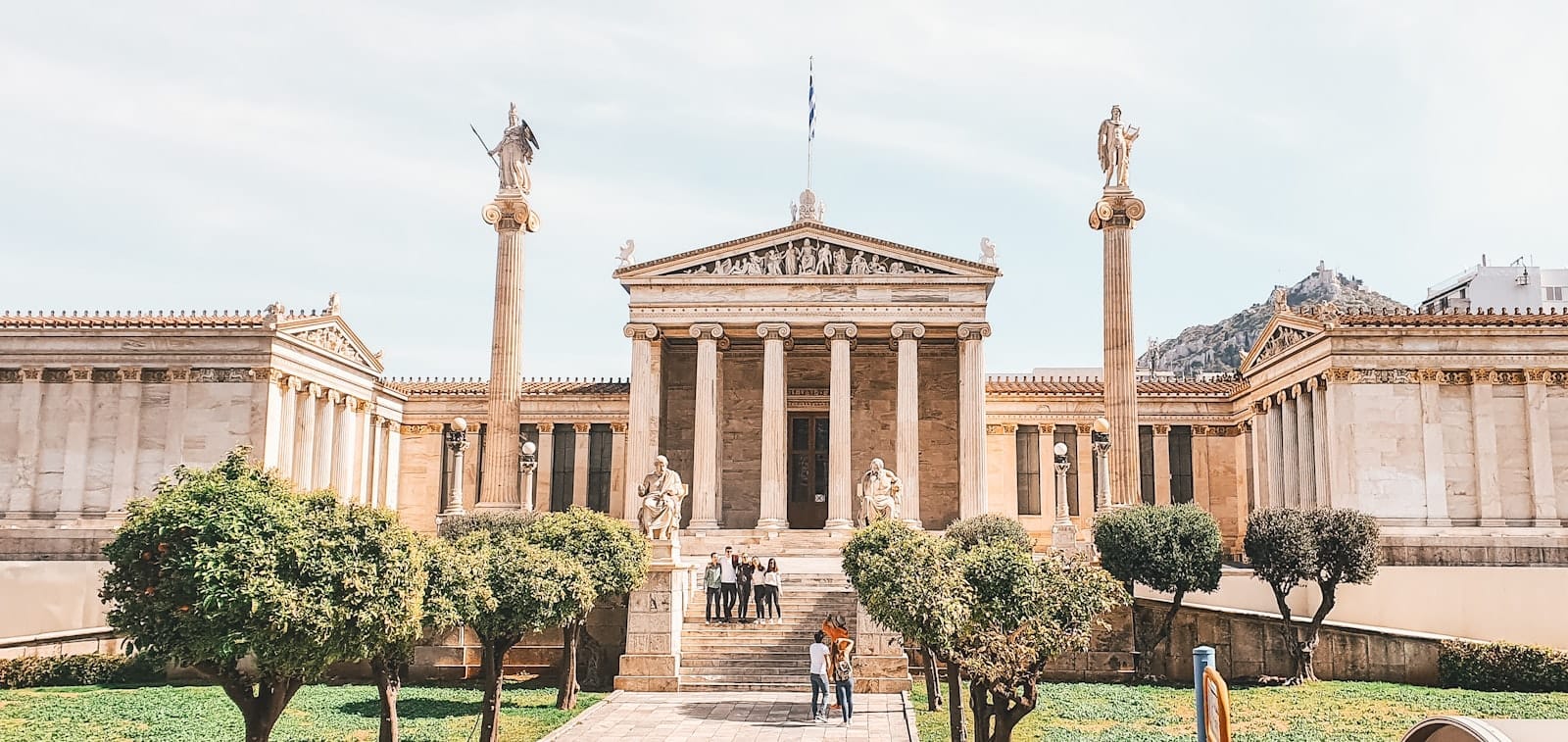
The Academy of Athens, designed by Theophil Hansen, is the most theatrical of the three. Its facade draws direct inspiration from the Propylaea of the Acropolis, the monumental gateway that leads to the Parthenon. Two tall Ionic columns frame the entrance, topped by statues of Athena and Apollo. Seated marble figures of Plato and Socrates occupy the bottom of the exterior columns, an arrangement that places modern Greece's intellectual aspirations in explicit continuity with ancient philosophy.
The Academy has served since 1903 as the highest research institution in Greece, encompassing humanities, sciences, and fine arts. It is not a teaching university but a learned academy in the European tradition, similar in concept to the Académie française or the Royal Society. The interior, which includes a ceremonial hall with painted murals, is not regularly open to the public but is occasionally accessible during cultural events.
The National Library of Greece (completed 1887)
Also designed by Theophil Hansen, the National Library building is perhaps the most architecturally cohesive of the three. Its symmetrical Ionic facade, wide ceremonial staircase, and flanking curved ramps give it a gravity that the other two buildings approach but do not quite match. The interior reading room, which features a glass ceiling and original cast-iron bookstands, is one of the finest 19th-century library interiors in southeastern Europe.
Note that while this historic building on Panepistimiou retains its architectural significance, the National Library of Greece's main collections and primary reading rooms have relocated to the Stavros Niarchos Foundation Cultural Center in Kallithea. The Panepistimiou building remains an important landmark and is still associated with the institution, but visitors interested in using the library's full resources should confirm current arrangements directly with the National Library.
Tickets & tours
Hand-picked options from our booking partner. Prices are indicative; availability and final rates are confirmed when you complete your booking.
Guided tour of the Acropolis, Parthenon and Museum in Athens
From 50 €Instant confirmationFree cancellationAthens: Temple of Olympian Zeus E-ticket with audio tour on your phone
From 10 €Instant confirmationAthens full-day tour with Acropolis and Cape Sounion
From 92 €Instant confirmationFree cancellationAthens National Archaeological Museum e-ticket and audio tour
From 22 €Instant confirmation
What It Feels Like to Visit: Time of Day and Atmosphere
Panepistimiou Street is one of Athens' main central arteries, and the Trilogy sits on a median strip that runs alongside car traffic. At rush hour, the avenue is loud and the air carries the faint diesel smell common to central Athens. Early mornings on weekdays, before 8:30, the street is relatively quiet and the light falls cleanly on the marble facades from the east. This is the best window for photography: the stonework is warm-toned in the morning sun, the street is not yet choked with traffic, and the buildings read clearly against the sky.
Midday in summer is the hardest time to visit. Panepistimiou Street has very little shade, and temperatures regularly exceed 35 degrees Celsius in July and August. The marble facades reflect heat, and there is nowhere obvious to sit and rest along this stretch. If you are visiting in summer, plan this walk early in the morning or in the early evening, when the facades take on a cooler, more diffuse light and the heat eases.
On weekend afternoons and during public holidays, the street quiets considerably. Small groups of visitors, often on walking tours of the city centre, stop to photograph the Academy's entrance columns. There is a steady low hum of pigeons on the upper cornices. The overall atmosphere is that of a civic landmark rather than a tourist attraction: Athens goes about its business around these buildings without making much ceremony of them.
💡 Local tip
For the cleanest photographs of all three buildings, walk the street from east to west (starting near Syntagma) in the morning, when the light is behind you and the facades face east.
Getting There and Practical Navigation
The Trilogy is straightforward to reach. Take Metro Line 2 (Red Line) to Panepistimio station, which exits almost directly in front of the University building. From Syntagma Square, it is a five-minute walk west along Panepistimiou. From Monastiraki, the walk takes around twelve minutes along the same avenue.
The Trilogy fits naturally into a longer walk through central Athens. Many visitors combine it with the National Archaeological Museum to the north, or use it as a midpoint on a route between Syntagma and the ancient sites around Monastiraki and Thissio. The Benaki Museum is also within walking distance to the east, in Kolonaki.
The pavements along Panepistimiou are wide and generally level, making the exterior walkthrough accessible for most visitors. Detailed step-free access to interiors and ramp availability should be confirmed directly with each institution, as facilities vary between buildings.
Historical Context: Why These Buildings Were Built Here
Greece declared independence from the Ottoman Empire in 1821 and had its sovereignty internationally recognized by 1832. Athens, chosen as the new capital partly for its symbolic weight, was at that point a small town of a few thousand people clustered around the base of the Acropolis. The new Greek state needed institutions, and it needed buildings that would announce to Europe that this was a nation with roots in the very civilization that had shaped Western thought.
The decision to commission neoclassical architecture from northern European architects, particularly the Hansen brothers, was a deliberate political and aesthetic choice. It aligned the new Greek state with the Western European intellectual tradition, which had itself been drawing on ancient Greek models for centuries. The result was an architectural feedback loop: buildings in Athens designed to look like ancient Greek temples, built by Danish architects trained in Vienna, as a statement of cultural legitimacy for a newly independent nation. For anyone interested in this period of Athenian history, the Trilogy should be read alongside a visit to the Panathenaic Stadium, another 19th-century project that used classical form to stake a claim on ancient legacy.
For a deeper understanding of how Greek identity was constructed and displayed through objects and collections in this same era, the Museum of Cycladic Art nearby in Kolonaki provides useful counterpoint.
Photography, What to Wear, and Practical Limitations
The Trilogy photographs well but requires some patience. The buildings sit on a divided avenue with traffic on both sides, and getting a clean wide-angle shot without parked motorcycles or buses in frame takes timing. A telephoto lens or a phone camera zoomed in on individual architectural details, the carved Ionic capitals, the painted ceiling panels of the University portico, the Athena and Apollo statues atop the Academy columns, tends to produce more satisfying results than wide establishing shots.
There is no dress code for the exterior, and you do not need to carry water specifically for this stop since you will pass cafes and kiosks along Panepistimiou. Comfortable walking shoes matter more than anything else, since the best viewing involves moving between buildings and occasionally crossing the avenue carefully.
⚠️ What to skip
In summer, avoid this walk between 11:00 and 17:00. The avenue is fully exposed to sun, there is no seating, and the heat radiating from the road surface and marble significantly shortens how long most visitors want to spend here.
For those who want the broader context of Athens' ancient architecture before or after visiting the Trilogy, the Athens ancient sites guide provides a useful framework for understanding how the 19th-century neoclassical projects relate to the monuments they were deliberately echoing.
Who Should Skip This and Why
Visitors with very limited time who are prioritizing ancient Athens over modern Greek history may find the Trilogy a low priority. The experience is almost entirely exterior and architectural. If you are not drawn to the visual language of neoclassicism or the history of 19th-century nation-building, an hour here may feel like walking past elaborate civic buildings without a clear payoff.
Families with young children may also find this stop less engaging than the Acropolis or the National Archaeological Museum, since there is nothing interactive here and the street is not particularly child-friendly for extended stops. The Trilogy is a reward for patient, attentive walkers with a specific interest in architecture or history, not a kinetic experience.
Insider Tips
- Stand directly in front of the Academy of Athens and look at the two seated marble figures of Plato and Socrates at the base of the columns. Most visitors photograph the upper statues and miss the detail work on these lower figures, which are some of the finest 19th-century sculptural work on the street.
- The University building's painted ceiling panels under the entrance portico are easy to overlook because visitors instinctively look forward at the facade. Step close and look up once you are under the portico roof.
- Panepistimiou Street has a long central pedestrian strip with benches slightly further west toward Omonia. If you want to sit and take in the Academy facade at distance, walk about fifty metres toward Omonia and turn back.
- Evening visits between 19:00 and 21:00 in spring and autumn offer the most comfortable temperatures and golden-hour light on the marble. The street is quieter than midday and the facades reflect warm amber tones.
- The three buildings are spaced close enough together that you can read them as a single composition, but far enough apart that each needs to be approached individually. Budget time to stand in front of each one separately rather than trying to take in the whole ensemble from a single viewpoint.
Who Is Athenian Trilogy (Academy, University, Library) For?
- Architecture and design enthusiasts interested in neoclassical European buildings
- History travellers exploring modern Greek identity and the post-independence period
- Photography walkers looking for grand marble facades with classical detailing
- Those building a full walking itinerary through central Athens between Syntagma and Monastiraki
- Visitors who want a free, high-quality architectural experience outside the main archaeological sites
Nearby Attractions
Other things to see while in Syntagma & the Historic Centre:
- Hellenic Parliament & Tomb of the Unknown Soldier
Standing at the head of Syntagma Square, the Hellenic Parliament occupies the Old Royal Palace, a neoclassical landmark built between 1836 and 1840. In front of it, the Tomb of the Unknown Soldier is guarded around the clock by Evzones in ceremonial uniform, offering one of the most visually striking public rituals in Greece. Free guided tours of the building are offered on specific days and months and require advance booking, but even without booking, the square-level spectacle rewards any visit.
- National Garden of Athens
The National Garden of Athens is a 15.6-hectare historic public park in the heart of the city, free to enter and open every day from sunrise to sunset. Originally the private gardens of the Royal Palace, it now offers shaded paths, a small zoo, ancient fragments, and a duck pond within walking distance of Syntagma Square.
- Numismatic Museum of Athens
The Numismatic Museum of Athens houses roughly 500,000–600,000 coins, medals, gems, and weights spanning three millennia of monetary history, all inside the spectacular neoclassical Iliou Melathron mansion built for archaeologist Heinrich Schliemann. It sits on Panepistimiou Street, a short walk from Syntagma Square, and rewards visitors who appreciate both Greek history and 19th-century architectural grandeur.
- Temple of Olympian Zeus
The Temple of Olympian Zeus took nearly 700 years to complete and was once the largest temple in Greece. Today, 15 of its original 104 Corinthian columns still rise above central Athens (with a 16th lying fallen on the ground), offering one of the most atmospheric ancient sites in the city. Here is everything you need to visit it well.