National Garden of Athens: The City's Green Refuge Next to Parliament
The National Garden of Athens is a 15.6-hectare historic public park in the heart of the city, free to enter and open every day from sunrise to sunset. Originally the private gardens of the Royal Palace, it now offers shaded paths, a small zoo, ancient fragments, and a duck pond within walking distance of Syntagma Square.
Quick Facts
- Location
- Leoforos Amalias 1, Athens 10557
- Getting There
- Syntagma Metro Station (Lines 2 & 3), 2–3-minute walk
- Time Needed
- 45 minutes to 1.5 hours
- Cost
- Free admission
- Best for
- Families, solo walkers, midday heat escapes, photography
- Official website
- green-athens.gr/en/national-garden
What the National Garden Actually Is
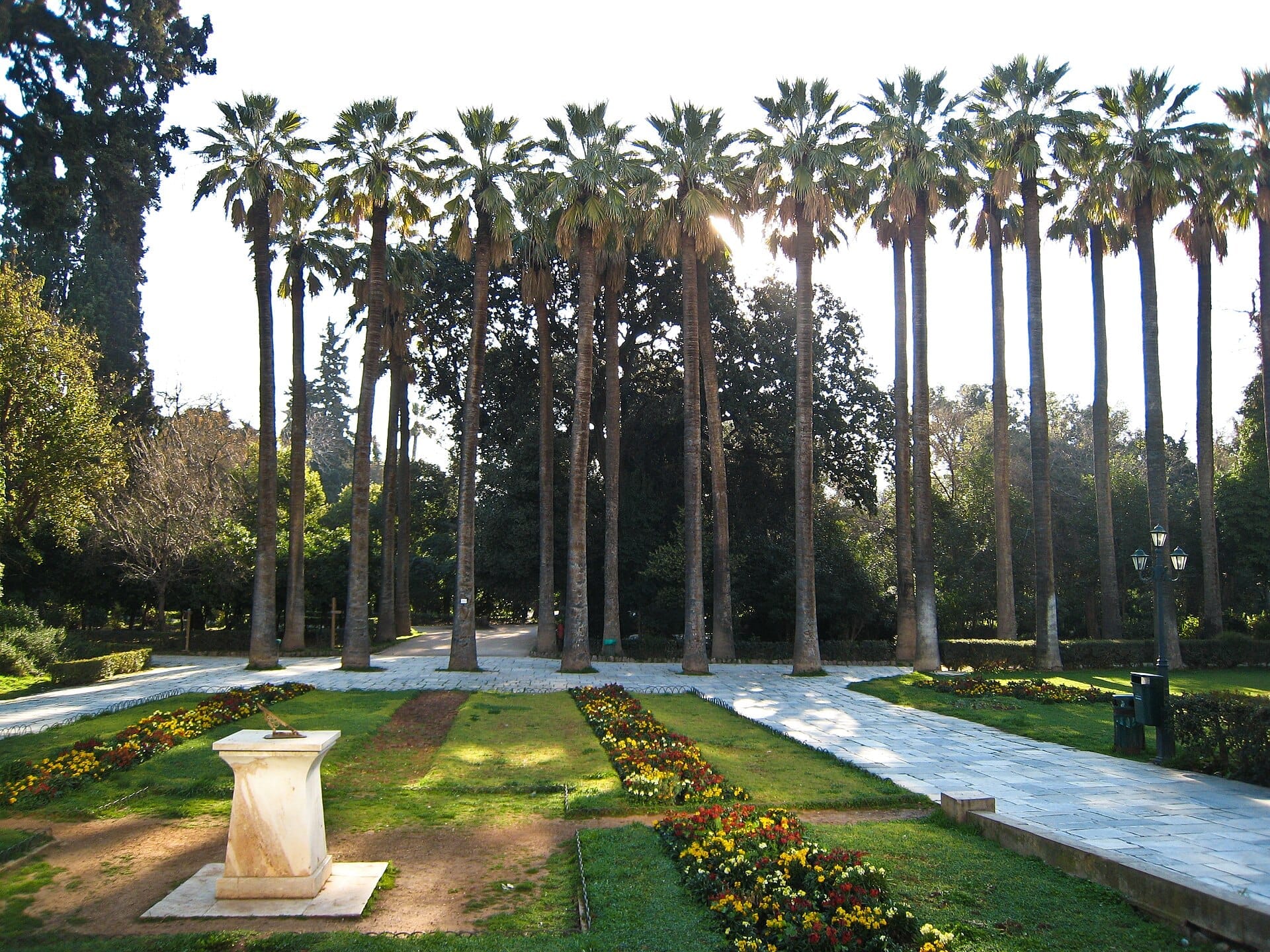
The National Garden of Athens is a 15.6-hectare public park that sits directly behind the Hellenic Parliament building, separated from Syntagma Square by a low iron fence and a shift in atmosphere so dramatic it can feel like stepping into a different city entirely. One moment you are on one of Athens' most trafficked intersections; thirty seconds later you are under a dense canopy of trees, listening to water and birdsong.
The garden was declared a Historic Garden and Historic Site by the Greek Ministry of Culture in 2011, and that designation matters. This is not a manicured European-style formal garden with symmetrical flower beds. It is older, shaggier, and more interesting than that: a complex of interlocking paths, mature trees, a small zoo with waterfowl and turtles, a children's playground, a botanical museum, scattered ancient column fragments used as decorative features, and a central pond where ducks and geese have operated on their own schedule for generations.
💡 Local tip
Entrance is free and requires no ticket. The garden opens at sunrise and closes at sunset every day of the year. There are multiple entrances; the main one faces Leoforos Amalias, directly across from the Parliament side.
History: From Royal Garden to Public Park
The garden's origins trace back to the mid-19th century, when it was designed as the private grounds of the Royal Palace — the neoclassical building that is now the Hellenic Parliament. Queen Amalia, consort of King Otto, oversaw the creation of the garden from the 1840s onward. Thousands of plant species were imported, water was diverted from the Ilissos river to irrigate what was, at the time, a largely arid site, and the result was one of the few genuinely green spaces in central Athens.
The garden was opened to the public in 1923, following Greece's transition to a republic, and was renamed the National Garden. Since then it has absorbed various structures: a small café, a children's library that operates on select days, an open-air theatre used for cultural events, and the scattered Roman and Hellenistic marble fragments that give certain corners a pleasantly archaeological quality.
For visitors already exploring the ancient city, the garden's historical layer is thin compared to what awaits at the Ancient Agora or the Acropolis, but its 19th-century royal history gives it a different kind of character: aristocratic rather than ancient, intimate rather than monumental.
Tickets & tours
Hand-picked options from our booking partner. Prices are indicative; availability and final rates are confirmed when you complete your booking.
Guided tour of the Acropolis, Parthenon and Museum in Athens
From 50 €Instant confirmationFree cancellationAthens: Temple of Olympian Zeus E-ticket with audio tour on your phone
From 10 €Instant confirmationAthens full-day tour with Acropolis and Cape Sounion
From 92 €Instant confirmationFree cancellationAthens National Archaeological Museum e-ticket and audio tour
From 22 €Instant confirmation
How the Garden Changes Throughout the Day
Early morning, roughly between 7 and 9 AM, is when the garden operates at its quietest and most pleasant. The air temperature is lower, the light filters through the canopy in long horizontal shafts, and the crowd is almost entirely local: older Athenians doing their morning walk, dog owners on timed circuits, the occasional jogger. The bird noise at this hour is notable — the garden hosts a surprisingly dense population of songbirds alongside the semi-tame waterfowl at the central pond.
By late morning the character shifts. Families with young children start arriving, particularly around the small zoo and playground in the northeastern section of the garden. The zoo is modest, housing mostly waterfowl, turtles, and a few other small animals, but it works well for children under 10 who need a short, manageable attraction.
Midday in summer is when the garden earns its most practical reputation: shade. Athens' central districts offer almost no natural cover during July and August, when temperatures regularly exceed 35°C in open squares. The National Garden's canopy, built up over 180 years of growth, drops the perceived temperature noticeably. Benches under the trees fill with office workers, tourists seeking relief from the heat, and elderly residents who treat the garden as an informal social club.
⚠️ What to skip
In summer, the garden closes at sunset, which varies by month. In June and July that means roughly 8:30–9 PM, but staff begin encouraging visitors toward exits before that. Do not assume a fixed closing time; check the posted schedule at the entrance on the day of your visit.
Late afternoon, particularly from 5 PM onward in spring and autumn, offers ideal conditions for a slower walk. The light becomes warmer, the temperature drops to something manageable, and the mood of the garden relaxes. This is also when the café near the central pond area tends to be occupied and the children's playground reaches peak activity.
What to Actually See and Do
The garden has no formal visitor route and no signage directing you from one highlight to the next. That informality is part of its appeal and also its mild frustration: first-time visitors sometimes wander in circles. The network of paths is dense and not obviously logical, though the garden is small enough that getting genuinely lost is nearly impossible.
The central duck pond is the navigational anchor. Most internal paths eventually circle back near it, and it is the most photographed feature in the garden: shallow, surrounded by papyrus plants and large trees, populated with ducks and geese who show no particular wariness of humans. Turtles can often be seen basking on rocks at the water's edge.
Scattered throughout the garden are ancient marble fragments: column drums, capitals, and inscribed blocks used as decorative garden elements. They are not labeled or explained with any depth, but they are authentic, and the effect of stumbling across a Roman column base half-covered in ivy, used as a garden bench, is quietly striking.
The small botanical museum on the grounds documents some of the garden's plant collection. It keeps limited opening hours and is primarily of interest to visitors with a specific botanical curiosity rather than general tourists.
Getting There and Accessibility
The garden is a 2–3-minute walk from Syntagma Metro Station, which is served by Lines 2 (Red) and 3 (Blue). From the metro exit facing the Parliament building, cross Leoforos Amalias and the main garden entrance is immediately in front of you. Visitors arriving as part of a broader exploration of Syntagma will find the garden an obvious next stop after watching the Evzone guard change at the Parliament.
Accessibility is worth noting specifically: the garden has multiple entrances, and four of them are accessible for visitors with mobility limitations. The entrances on Vasilissis Sofias Avenue and Jean Morais Street are not accessible. Internal paths are described by the garden's management as comfortable and navigable, though some sections have uneven surfaces from tree roots, so wheelchair users may find certain paths more practical than others.
Visitors with strollers will find the main central paths manageable. The garden connects at its southern end to the Zappeion Hall, a neoclassical exhibition building surrounded by its own formal gardens, and from there it is a short walk toward the Temple of Olympian Zeus, making this entire southeastern corner of the city a logical half-day walking circuit.
Photography and Practical Considerations
The garden photographs well in early morning and late afternoon. The overhead canopy is dense enough that midday light produces heavy, unflattering shadows in most directions. Early light filters through the trees in ways that work particularly well around the duck pond and the older, larger tree sections toward the center of the garden.
There is a small café inside the garden that serves coffee and light snacks. It is a functional stop rather than a destination in itself, useful if you want to sit rather than move on immediately. Water fountains are available at various points inside the garden.
ℹ️ Good to know
Dogs are allowed in the garden on a leash. The garden is popular with local dog owners, particularly early in the morning and in the early evening. If you have a concern about dogs, that is worth knowing before you visit.
The National Garden makes the most sense as part of a broader Syntagma and Plaka circuit rather than as a standalone destination from the other side of the city. If you are already exploring the Hellenic Parliament or planning to walk through Plaka, folding in the garden adds very little travel time and offers a genuine change of pace.
Honest Assessment: Is It Worth Your Time?
The National Garden is not a world-class botanical attraction. Visitors expecting the precision of Kew Gardens or the drama of a Mediterranean cliff-top garden will find it unremarkable. The labeling of plants is inconsistent, the zoo is minor, and the overall maintenance level reflects the constraints of a publicly managed urban park rather than a curated horticultural destination.
What it actually delivers is something harder to find in central Athens: genuine quiet, dense shade, and a place to sit without being asked to buy anything. For visitors on a tight itinerary focused entirely on ancient sites and museums, it is easy to skip. For anyone traveling with young children, recovering from heat exhaustion, or simply needing thirty minutes of decompression in the middle of a full day, it earns its place.
If your Athens visit includes time to walk and explore without a fixed agenda, consult our Athens walking tours guide for routes that incorporate the garden naturally alongside the surrounding neighborhoods.
Insider Tips
- Enter from the Leoforos Amalias side for the most direct route to the duck pond. The Vasilissis Sofias entrance on the opposite side drops you into the less interesting northeastern section near the children's zoo.
- The garden's oldest and largest trees are toward its interior center, away from the perimeter paths. If you want shade in summer, move away from the edges.
- On weekday mornings, the garden is largely free of tourist groups. Weekend afternoons in spring and autumn bring Athenian families in numbers, and benches fill quickly near the playground.
- The Zappeion Hall and its surrounding formal gardens are directly accessible from the southern end of the National Garden without re-entering the street. It is a calmer, more photogenic space than many visitors realise.
- Bring water if you are visiting in summer. The internal café can run out of cold beverages during peak afternoon hours, and the nearest large supermarket is a 10-minute walk away.
Who Is National Garden of Athens For?
- Families with children under 10 who need a short, low-pressure outdoor stop
- Visitors looking for shade and rest during a full day of sightseeing in summer
- Early risers who want a quiet morning walk before the ancient sites open
- Photographers wanting soft morning light and a non-archaeological subject
- Budget travelers building a free, walkable day around central Athens
Nearby Attractions
Other things to see while in Syntagma & the Historic Centre:
- Athenian Trilogy (Academy, University, Library)
Three neoclassical monuments designed by the Hansen brothers line central Athens' Panepistimiou Street, forming one of the most coherent 19th-century architectural ensembles in Europe. The Academy, University, and National Library are free to view from outside and take less than an hour to walk, yet they reward careful attention from anyone interested in architecture, modern Greek history, or the idea of what a newly independent nation chose to build first.
- Hellenic Parliament & Tomb of the Unknown Soldier
Standing at the head of Syntagma Square, the Hellenic Parliament occupies the Old Royal Palace, a neoclassical landmark built between 1836 and 1840. In front of it, the Tomb of the Unknown Soldier is guarded around the clock by Evzones in ceremonial uniform, offering one of the most visually striking public rituals in Greece. Free guided tours of the building are offered on specific days and months and require advance booking, but even without booking, the square-level spectacle rewards any visit.
- Numismatic Museum of Athens
The Numismatic Museum of Athens houses roughly 500,000–600,000 coins, medals, gems, and weights spanning three millennia of monetary history, all inside the spectacular neoclassical Iliou Melathron mansion built for archaeologist Heinrich Schliemann. It sits on Panepistimiou Street, a short walk from Syntagma Square, and rewards visitors who appreciate both Greek history and 19th-century architectural grandeur.
- Temple of Olympian Zeus
The Temple of Olympian Zeus took nearly 700 years to complete and was once the largest temple in Greece. Today, 15 of its original 104 Corinthian columns still rise above central Athens (with a 16th lying fallen on the ground), offering one of the most atmospheric ancient sites in the city. Here is everything you need to visit it well.