Benaki Museum: Greece's Most Complete Cultural Institution
Housed in a neoclassical mansion in Kolonaki, the Benaki Museum traces Greek civilization from prehistoric times through the 20th century. With an extraordinary permanent collection, rooftop cafe, and late Thursday opening until midnight at its Museum of Greek Culture building, it rewards both first-time visitors and repeat ones.
Quick Facts
- Location
- 1 Koumbari St. & Vasilissis Sofias Ave., Kolonaki, Athens
- Getting There
- Syntagma Metro Station (Lines 2 or 3), then about a 10-min walk along Vasilissis Sofias Ave.
- Time Needed
- 2–3 hours for the permanent collection; longer if a temporary exhibition is on
- Cost
- €12 full / €9 reduced; temporary exhibitions currently €8–10 (check the official website for up-to-date details)
- Best for
- History enthusiasts, culture-focused travelers, rainy-day escapes, Thursday evening visits
- Official website
- www.benaki.org/index.php?lang=en
What the Benaki Museum Actually Is
The Benaki Museum is not a single building but a network of specialized museums spread across Athens. The flagship, officially called the Benaki Museum of Greek Culture, occupies the former Benakis family mansion at the corner of Koumbari Street and Vasilissis Sofias Avenue in Kolonaki. This is the one most visitors mean when they say 'the Benaki,' and it is the focus of this guide.
Founded in 1930 by Antonis Benakis, an Alexandria-born cotton merchant who donated his personal collection and family home to the Greek state, the museum opened as a private legal entity under Greek law. Benakis spent decades assembling artifacts spanning prehistoric Greece through the 20th century, including Byzantine icons, Ottoman-era costumes, ancient goldwork, and modern Greek paintings. After a major refurbishment, the main building reopened in its current form on 7 June 2000, with collections previously housed there redistributed across the network's satellite sites.
What makes the Benaki unusual among Athens museums is its chronological sweep. Where the National Archaeological Museum focuses almost entirely on antiquity, and the Byzantine and Christian Museum concentrates on the medieval period, the Benaki connects those dots, carrying Greek cultural history forward through Byzantium, Ottoman rule, the War of Independence, and into the 20th century.
For context on how the Benaki fits into Athens' broader museum landscape, see the best museums in Athens guide.
The Collection: What You Will Actually See
The permanent collection is organized chronologically across four floors, and the density of objects is significant. The ground floor opens with prehistoric and ancient Greek artifacts, including Cycladic figurines, Mycenaean jewelry, and Bronze Age ceramics. Cases are well-lit and labeled in both Greek and English, though the volume of material in some rooms can feel overwhelming if you try to absorb everything.
The Byzantine section occupies a substantial part of the upper floors and is one of the collection's strongest areas. Coptic textiles, Byzantine silverware, and a sequence of icons spanning several centuries are displayed with enough contextual information to be meaningful even to visitors unfamiliar with Orthodox Christian art. The icons here are not the gilded, heavily restored pieces that dominate some church collections; many retain the subtle, muted tones of their original pigments.
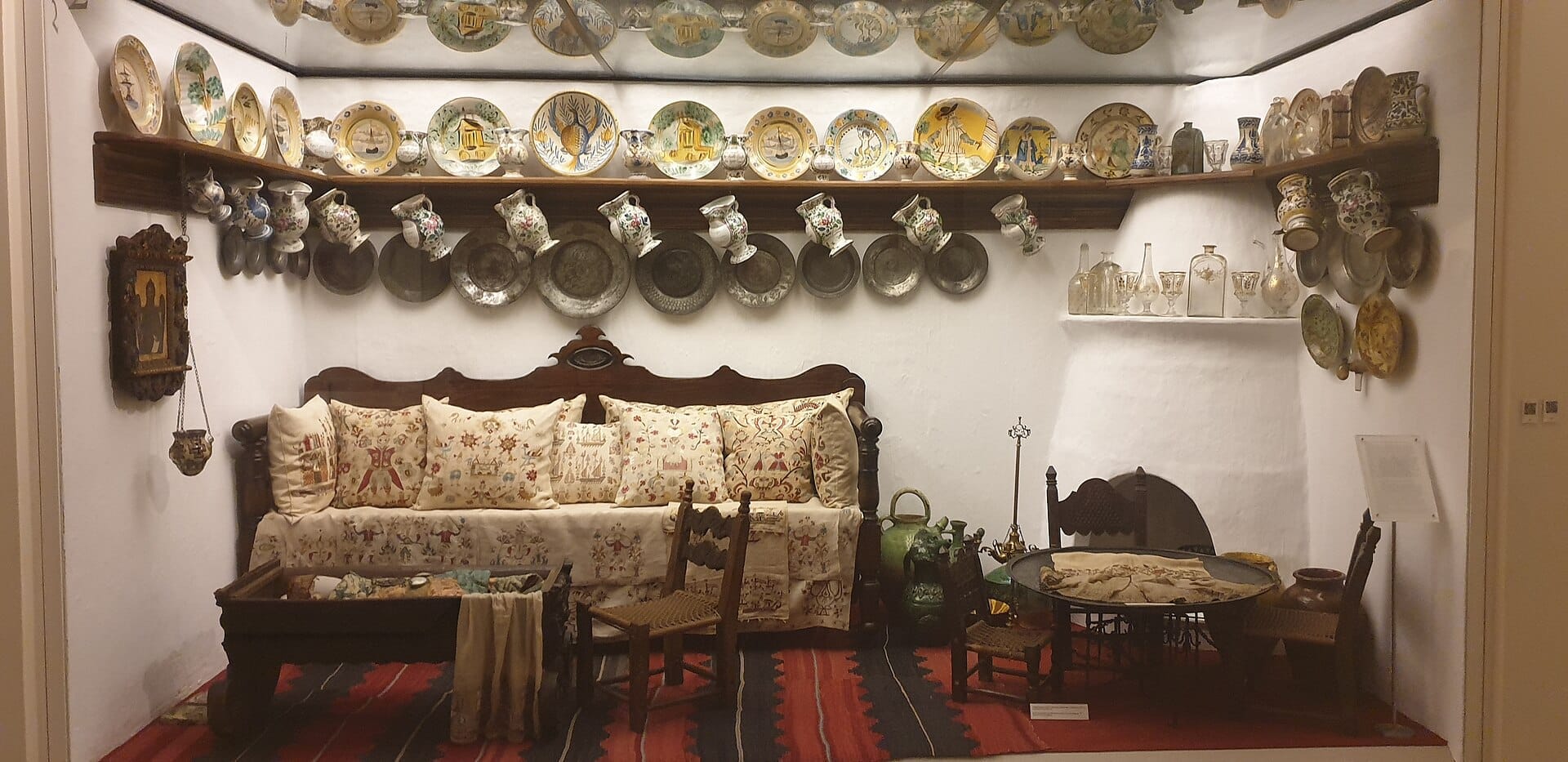
The floors covering the Ottoman period and the Greek War of Independence (1821) are genuinely distinctive. Regional costumes, weapons, documents, and personal objects from the independence era give material form to a period usually reduced to dates and battles in history books. This section in particular holds objects you will not find duplicated elsewhere in Athens.
The top floor is devoted to modern Greek history, including photographs, political memorabilia, and artworks from the late 19th and early 20th centuries. It is less visited than the floors below, partly because visitors run out of energy before reaching it, but it contains some of the collection's most intimate pieces.
💡 Local tip
Budget your energy deliberately. Start at the top floor and work downward rather than beginning at ground level. This counterintuitive approach gets you through the quieter modern Greek history galleries first, then reaches the busier prehistoric and ancient floors when afternoon crowds often thin.
Tickets & tours
Hand-picked options from our booking partner. Prices are indicative; availability and final rates are confirmed when you complete your booking.
Guided tour of the Acropolis, Parthenon and Museum in Athens
From 50 €Instant confirmationFree cancellationAthens: Temple of Olympian Zeus E-ticket with audio tour on your phone
From 10 €Instant confirmationAthens full-day tour with Acropolis and Cape Sounion
From 92 €Instant confirmationFree cancellationAthens National Archaeological Museum e-ticket and audio tour
From 22 €Instant confirmation
The Building Itself
The neoclassical mansion that houses the museum was originally the Benakis family residence. Its street-facing facade on Vasilissis Sofias Avenue is formal and restrained, typical of the aristocratic architecture that lined this boulevard during the late 19th and early 20th centuries. From the outside, it reads as a grand private house, which is exactly what it was.
Inside, the original room layouts have been substantially modified to accommodate museum circulation, but the proportions of the main halls retain a domestic scale that contrasts favorably with the cathedral-ceilinged grandeur of some state museums. Display cases sit in rooms of manageable size, which paradoxically makes concentration easier. Natural light enters through tall windows in several galleries, shifting the mood of the rooms across the day in ways that modern gallery design rarely allows.
The museum sits at the edge of Kolonaki, one of Athens' more upscale central neighborhoods. After your visit, the streets immediately north offer good coffee and lunch options. The Kolonaki neighborhood is also worth walking through for its gallery scene and neoclassical streetscape.
When to Visit and How the Experience Shifts
The Museum of Greek Culture opens at 10:00 on all days it operates. Mornings on weekdays are the quietest, with fewer group tours and more space to move slowly through the rooms. By early afternoon, particularly on Saturdays, visitor numbers increase noticeably and the galleries on the ground and second floors can become congested around popular cases.
Thursday is the standout option for evening visitors to the Museum of Greek Culture. The museum stays open until midnight, admission is the same as regular days, and the rooftop cafe takes on a different atmosphere after dark on the evenings it operates late. The view across Vasilissis Sofias toward the National Garden shifts from bright afternoon glare to a softer nighttime cityscape, and the galleries thin out considerably after 20:00. If your schedule allows a Thursday visit, the evening hours between 19:00 and 21:00 offer the best combination of comfortable crowd levels and natural light still lingering in the upper rooms.
ℹ️ Good to know
The museum is closed on Tuesdays, and also closed on major Greek public holidays including New Year's Day, Epiphany, Clean Monday, March 25th, Easter Sunday and Easter Monday, May 1st, Holy Spirit Day, August 15th, October 28th, Christmas Day, and Boxing Day. Check the official website before traveling specifically for a visit.
Athens' summer heat (temperatures regularly exceed 33°C in July and August) makes indoor attractions significantly more appealing between 12:00 and 16:00. The Benaki is well air-conditioned, and its position near Syntagma makes it a logical midday refuge if you are following an itinerary that includes outdoor ancient sites in the morning.
For a structured approach to combining the Benaki with other sites, the Athens ancient sites guide suggests a sensible morning-to-afternoon sequence.
The Rooftop Cafe
The museum cafe operates on the rooftop terrace and is accessible to ticket holders and, during some periods, visitors who have not paid museum admission. The terrace faces Vasilissis Sofias Avenue and offers views toward Lycabettus Hill to the northeast and the National Garden's tree canopy to the south. It is a functional cafe rather than a destination restaurant: coffee, light snacks, and a small lunch menu, served in reasonable portions at prices that are somewhat above Athens street-cafe level but not extravagant by Athens museum standards.
In summer, the terrace is in direct sun through the afternoon. Shade is available at some tables but limited. If you plan to eat there, aim for late morning before the midday heat builds, or after 18:00 on a Thursday when the temperature drops and the light improves for photography. The cafe is a genuine pleasure in spring and autumn.
Practical Walkthrough: Getting There and Getting In
The most straightforward route from central Athens is via Syntagma Metro Station (Line 2 or 3). From the station exit on Vasilissis Sofias Avenue, the museum is approximately a 10-minute walk along the same boulevard toward Kolonaki. The building is on the left side approaching from Syntagma, marked by a modest entrance sign and a small forecourt. It is easy to miss if you are moving quickly: the entrance is recessed slightly from the street.
Multiple bus lines run along Vasilissis Sofias Avenue and stop close to the museum. The official museum website lists specific bus line numbers, which are worth confirming before your visit as routes are subject to change. Taxis and ride-hailing apps (such as Beat, which operates in Athens) can drop you directly at the entrance.
Ticket purchase is available at the entrance desk. As of the time of writing, full admission is €12 and reduced admission (for eligible categories including EU students and seniors) is €9. Temporary exhibitions carry separate pricing of approximately €8–10 full price. A combined ticket may be available when a temporary exhibition runs concurrently. Verify current pricing on the official Benaki Museum website before visiting, as admission fees are subject to revision.
💡 Local tip
Photography is generally permitted in the permanent collection galleries without flash. Confirm current policy at the ticket desk, as restrictions may apply to specific objects or temporary exhibitions.
Visitors with specific accessibility requirements should contact the museum directly before visiting. The building is a converted neoclassical mansion and its layout includes stairs; the museum can be reached at +30 210 367 1000 or info@benaki.org for up-to-date accessibility information.
If you are planning a full day around the Kolonaki and Syntagma area, the National Garden is directly across Vasilissis Sofias and makes for a natural complement before or after the museum.
Who Should Reconsider
The Benaki Museum asks something of its visitors. The collection is large, the labeling is informative but text-heavy, and there is no single showpiece object that carries the visit on its own. Visitors who find ancient site visits tiring, or who prefer a highly curated selection of a few dozen objects over a comprehensive institution, may find the scale and density of the Benaki exhausting rather than rewarding.
Children under around 10 will likely find the museum difficult to engage with. The objects are behind glass, the rooms are quiet, and the collection does not include the kind of interactive elements or visual spectacle that holds younger attention. Families with children would find better fit at the Acropolis Museum, which has stronger visual impact and more child-oriented programming.
If you are working through Athens on a tight one-day schedule, the Benaki requires a time commitment that may not be compatible. The Athens 1-day itinerary can help you weigh it against other priorities.
Insider Tips
- Thursday evenings until midnight are the most underused visiting window in the museum's week. The galleries after 20:00 are quiet enough to feel almost private, and the rooftop is pleasant once the day's heat fades.
- The museum shop, located near the entrance, stocks a well-selected range of art books, reproductions, and design objects. It is one of the better museum shops in Athens and worth visiting even if you are short on time in the galleries.
- Start your visit on the top floor and work downward. Most visitors begin at the ground level and run out of energy before reaching the 20th-century collections. Reversing the route gets you to the quieter, less-visited floors while you are still fresh.
- The reduced ticket price applies to EU citizens over 65, students with valid ID, and several other categories specified by the museum. Bring identification if you think you qualify, as reduced admission is not automatically applied.
- If a temporary exhibition is running alongside the permanent collection, check whether a combined ticket offers better value than buying separately. This is not always prominently advertised at the entrance.
Who Is Benaki Museum For?
- Travelers who want to understand Greek history beyond antiquity, including Byzantine, Ottoman, and modern periods
- Visitors seeking a serious cultural institution with scholarly depth rather than a highlight-reel experience
- Anyone visiting Athens in summer who needs a quality indoor option during the hot midday hours
- Thursday evening visitors looking for a relaxed, uncrowded cultural experience
- Travelers with a particular interest in Byzantine art, Greek folk traditions, or the War of Independence
Nearby Attractions
Other things to see while in Kolonaki:
- Byzantine and Christian Museum
The Byzantine and Christian Museum in Athens holds one of the world's most significant collections of Byzantine art, spanning the 3rd to 20th centuries. Housed in the elegant 19th-century Villa Ilissia on Vassilissis Sofias Avenue, it offers an unhurried alternative to the city's blockbuster ancient sites, with approximately 30,000 artifacts spanning from the 3rd century to the 21st.
- Mount Lycabettus
At 277 meters, Mount Lycabettus is the tallest hill in central Athens, rising sharply above the upscale Kolonaki neighborhood. Reach the summit by cable car or on foot, and you'll find one of the most complete panoramas in the city, stretching from the Acropolis to the Saronic Gulf on clear days.
- Museum of Cycladic Art
Housed in an elegant Kolonaki building, the Museum of Cycladic Art holds one of the world's finest collections of prehistoric Aegean art, spanning 5,000 years from the early Bronze Age to antiquity. Small enough to absorb in a half-day, precise enough to reward careful attention.
- National Gallery – Alexandros Soutsos Museum
The National Gallery – Alexandros Soutsos Museum is Greece's most important fine art institution, housing over 20,000 works spanning Greek art from the post-Byzantine period to the present. Reopened in its fully renovated Kolonaki building in 2021, it offers a rare chance to trace the arc of Greek artistic identity from Byzantine tradition to contemporary expression.