National Gallery – Alexandros Soutsos Museum: Greece's Premier Art Collection
The National Gallery – Alexandros Soutsos Museum is Greece's most important fine art institution, housing over 20,000 works spanning Greek art from the post-Byzantine period to the present. Reopened in its fully renovated Kolonaki building in 2021, it offers a rare chance to trace the arc of Greek artistic identity from Byzantine tradition to contemporary expression.
Quick Facts
- Location
- Leof. Vasileos Konstantinou 50, Kolonaki, Athens 115 25
- Getting There
- Evangelismos station, Metro Line 3 (Blue Line) – approx. 300 m away. Bus lines 550 and 10, stop 'Pinakothiki'
- Time Needed
- 2 to 3 hours for the permanent collection; longer with temporary exhibitions
- Cost
- General admission €10; reduced €5. Free on the first Sunday of each month (Nov–Mar), 6 Mar, 18 Apr, 18 May, and the last weekend of September. Prices valid until 31 Oct 2026 – verify before visiting.
- Best for
- Art lovers, Greek history enthusiasts, museum regulars, and anyone escaping the midday heat
- Official website
- www.nationalgallery.gr/en
What the National Gallery Actually Is
The National Gallery – Alexandros Soutsos Museum is the foremost fine art institution in Greece, and one of the more significant art museums in southeastern Europe. Its collection of more than 20,000 works – paintings, sculptures, and engravings – covers a sweep from the post-Byzantine period through the twentieth century, with Greek artists at the centre and major European masters providing context around them.
The museum traces its origins to 1900, when businessman and art patron Alexandros Soutsos bequeathed his personal collection to the Greek state. In 1954 the institution adopted the double name it carries today. The current building on Vasileos Konstantinou Avenue dates to 1976, but it was comprehensively renovated and expanded, reopening to visitors in May 2021. What you walk into today is a genuinely modern museum infrastructure, not a crumbling civic institution held together by good intentions.
ℹ️ Good to know
The museum is closed every Tuesday. On all other days, last admission is one hour before closing. It also closes on major Greek public holidays – check the official site if your visit falls near Orthodox Easter, 15 August, or the Christmas period.
Opening Hours and Getting There
The National Gallery is open Monday and Wednesday through Sunday, with slightly extended evening hours on Wednesdays (14:00–22:00 vs. the standard 10:00–18:00 on other open days). Tuesday is always closed. The Evangelismos Metro station on Line 3 (Blue Line) is roughly a two-minute walk, making this one of the more straightforward museum trips in Athens. If you are coming from Syntagma Square on foot, allow around 20 minutes along Vasileos Konstantinou Avenue.
Bus lines 550 and 10 stop directly outside at the 'Pinakothiki' stop. For those staying in Kolonaki or the Hilton area, the gallery is effectively walkable. Arriving by metro and walking the short stretch past the War Museum is the smoothest approach for most visitors.
💡 Local tip
Wednesday evenings (until 22:00) are the quietest window to visit. Weekday mornings from opening until around 11:30 also see noticeably lower foot traffic than weekend afternoons.
Tickets & tours
Hand-picked options from our booking partner. Prices are indicative; availability and final rates are confirmed when you complete your booking.
Guided tour of the Acropolis, Parthenon and Museum in Athens
From 50 €Instant confirmationFree cancellationAthens: Temple of Olympian Zeus E-ticket with audio tour on your phone
From 10 €Instant confirmationAthens full-day tour with Acropolis and Cape Sounion
From 92 €Instant confirmationFree cancellationAthens National Archaeological Museum e-ticket and audio tour
From 22 €Instant confirmation
The Collection: What You Will Actually See
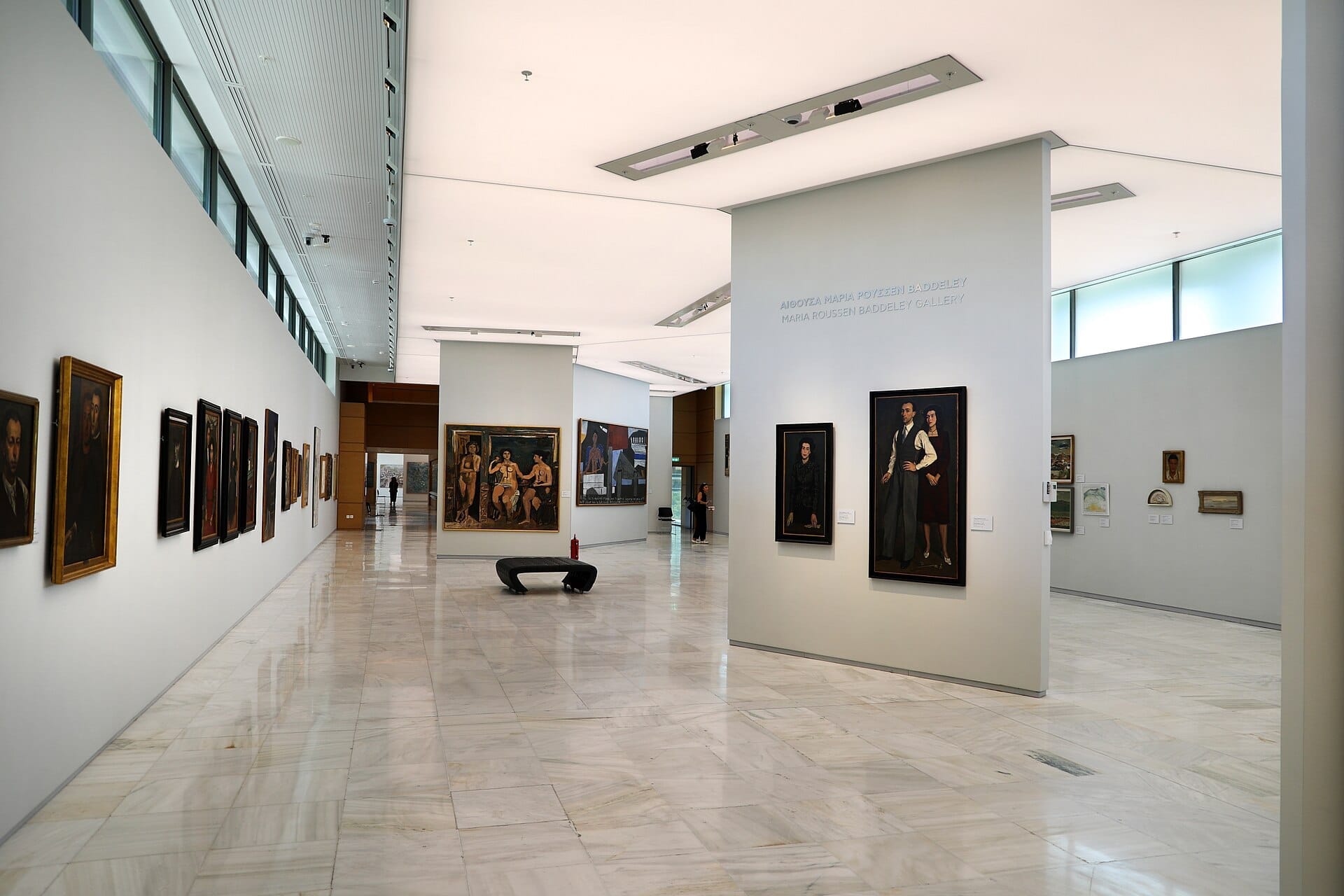
The permanent collection is organized to give a coherent reading of Greek artistic development over roughly seven centuries. The post-Byzantine section is a genuine anchor: icons and religious works that bridge the theological visual culture of the Byzantine Empire with the emerging secular European painting tradition. This isn't decorative churchware – these are precisely rendered objects that shaped how Greek artists thought about form, gold, and the human figure for centuries after Constantinople fell.
The nineteenth-century galleries are where many visitors spend the longest time. Greek Romantic painting – works responding to independence, national identity, and landscape – fills these rooms with a kind of earnest ambition that is easy to underestimate. Theodoros Vryzakis, Nikolaos Gysis, and Nikiphoros Lytras are the names to look for here. European holdings include works by El Greco (born in Crete as Domenikos Theotokopoulos), which carry particular weight given his roots in the Greek tradition before his move to Spain.
Twentieth-century Greek modernism occupies the newer wings and tends to surprise visitors who arrive expecting only classical references. Painters like Nikos Hadjikyriakos-Ghikas and sculptors engaging with cubist and expressionist idioms sit alongside more figurative postwar work. The collection does not end with safe canonical choices – there is real range here, even if the curation remains somewhat conservative by international standards.
How the Visit Feels at Different Times of Day
Morning visits, particularly on weekdays, have a specific quality: the light in the renovated building is well-managed, the galleries are cool and relatively empty, and you can stand in front of major works without navigating around school groups. The main foyer smells faintly of the climate-controlled air common to institutions that take conservation seriously – dry, slightly neutral, a reminder that you are in a building engineered around preservation.
Weekend afternoons are busier, particularly when there is a major temporary exhibition running alongside the permanent collection. The atrium fills with the low murmur of Greek families and international visitors, and the ticketing queue, while rarely excessive, can take 10 to 15 minutes. The Wednesday evening slot (the museum stays open until 22:00) is the practical insider choice: attendance drops off sharply after 18:00, the natural light has faded to something more uniform, and the galleries take on a different, more contemplative atmosphere.
In summer, the building's air conditioning makes it a genuine refuge. Athens often exceeds 35°C in summer, and a two-to-three-hour museum visit in the middle of the day is a rational as well as cultural choice. In winter, the museum is pleasantly uncrowded – the first Sunday free admission days (November through March) are worth timing if your budget is tight, though those days bring more visitors than average.
Practical Details Worth Knowing
Credit cards are accepted and actively encouraged – the museum has moved away from cash-first operations following the renovation. The phone line for visitor inquiries is +30 214 408 6201. The official website provides updated information on temporary exhibitions, which rotate regularly and are not always included in the base admission price.
Accessibility information is not comprehensively published on the museum's website. Visitors with specific mobility requirements are advised to contact the museum directly before visiting. The renovated building does incorporate modern infrastructure, but the exact scope of accessibility provisions is best confirmed in advance rather than assumed.
Photography policies for the permanent collection are typical of European institutions – non-flash photography for personal use is generally permitted, but confirm at the entrance for temporary exhibitions. If you are planning a fuller museum day in Athens, the National Gallery pairs logically with the Benaki Museum and the Museum of Cycladic Art, both nearby in Kolonaki.
Honest Assessment: Is It Worth Your Time?
For visitors whose primary reason to come to Athens is the ancient world – the Acropolis, the Ancient Agora, the National Archaeological Museum – the National Gallery will feel like a detour. It holds no ancient art. Its focus is painting and sculpture from the post-Byzantine period onward, which is a different kind of cultural experience entirely.
For visitors with genuine interest in European painting traditions, Greek national identity as expressed through art, or the mechanics of how a small nation's artistic culture developed in parallel with and in dialogue with broader European movements, this is a serious and rewarding collection. The 2021 renovation brought the building up to contemporary museum standards – sightlines are good, labeling is available in English, and the curatorial logic is legible even without a guide.
If you are working through a broader Athens museum itinerary, the National Gallery earns its place comfortably. If you have one day and archaeological priorities, it can be skipped without regret – there is no shame in being honest about what a particular attraction serves.
⚠️ What to skip
The museum is closed on Tuesdays and on a significant number of Greek public holidays, including both Orthodox and civic observances. Always check the official site before building it into your itinerary, particularly around Orthodox Easter, which falls on a different date each year.
Free Admission Days
Free admission is available on a predictable schedule that makes budget planning straightforward. From November through March, the first Sunday of each month is free for all visitors. Additionally, three fixed calendar dates offer free entry regardless of month: 6 March (in memory of Melina Mercouri), 18 April (International Monuments Day), and 18 May (International Museums Day). The last weekend of September is also free as part of the European Heritage Days programme.
If you are traveling on a tight budget, these dates are worth building into your plans alongside other free cultural options in Athens. Free Sundays in winter are more crowded than usual but still manageable, and winter light in Athens is often cleaner and less brutal than the summer haze.
Insider Tips
- Wednesday evening is the least crowded time to visit the permanent collection – foot traffic drops significantly after 18:00, and the museum stays open until 22:00, giving you the galleries almost to yourself.
- The reduced ticket (€5) covers a wide eligibility range including students, seniors, and certain professional categories – check the museum's official list before assuming you pay full price.
- Combine the National Gallery with the Museum of Cycladic Art, which is about a 10-minute walk through Kolonaki. Both institutions reward serious attention and the neighborhood between them has good café options for a midday break.
- The first Sunday free admission applies only from November through March – if you are visiting in summer and hoping for a free entry day, you will need to plan around the fixed holiday dates (18 April or 18 May) instead.
- Temporary exhibitions are not always included in the base ticket price. Check the museum's current programme online before arriving so you know what additional admission, if any, applies.
Who Is National Gallery – Alexandros Soutsos Museum For?
- Art and painting enthusiasts interested in Greek and European traditions from the post-Byzantine period onward
- Visitors seeking a midday refuge from Athens' summer heat in a properly air-conditioned, architecturally substantial space
- Travelers on multi-day Athens itineraries who have already covered the main archaeological sites and want cultural depth beyond antiquity
- Budget travelers who can time a visit to a free admission day between November and March
- Anyone interested in how a modern nation-state constructs and expresses cultural identity through art
Nearby Attractions
Other things to see while in Kolonaki:
- Benaki Museum
Housed in a neoclassical mansion in Kolonaki, the Benaki Museum traces Greek civilization from prehistoric times through the 20th century. With an extraordinary permanent collection, rooftop cafe, and late Thursday opening until midnight at its Museum of Greek Culture building, it rewards both first-time visitors and repeat ones.
- Byzantine and Christian Museum
The Byzantine and Christian Museum in Athens holds one of the world's most significant collections of Byzantine art, spanning the 3rd to 20th centuries. Housed in the elegant 19th-century Villa Ilissia on Vassilissis Sofias Avenue, it offers an unhurried alternative to the city's blockbuster ancient sites, with approximately 30,000 artifacts spanning from the 3rd century to the 21st.
- Mount Lycabettus
At 277 meters, Mount Lycabettus is the tallest hill in central Athens, rising sharply above the upscale Kolonaki neighborhood. Reach the summit by cable car or on foot, and you'll find one of the most complete panoramas in the city, stretching from the Acropolis to the Saronic Gulf on clear days.
- Museum of Cycladic Art
Housed in an elegant Kolonaki building, the Museum of Cycladic Art holds one of the world's finest collections of prehistoric Aegean art, spanning 5,000 years from the early Bronze Age to antiquity. Small enough to absorb in a half-day, precise enough to reward careful attention.