Mount Lycabettus: Athens from Its Highest Point
At 277 meters, Mount Lycabettus is the tallest hill in central Athens, rising sharply above the upscale Kolonaki neighborhood. Reach the summit by cable car or on foot, and you'll find one of the most complete panoramas in the city, stretching from the Acropolis to the Saronic Gulf on clear days.
Quick Facts
- Location
- Kolonaki, central Athens (cable car entrance at Plutarch St. & Aristippou St.)
- Getting There
- Evangelismos (Line 3, Blue Line), approx. 10-minute walk to cable car station
- Time Needed
- 1.5 to 3 hours depending on whether you hike or take the cable car
- Cost
- Cable car: €10 round trip, €7 one way. Hiking the trail is free.
- Best for
- Sunset panoramas, photography, couples, first-time visitors wanting a full city overview
- Official website
- www.lycabettushill.com
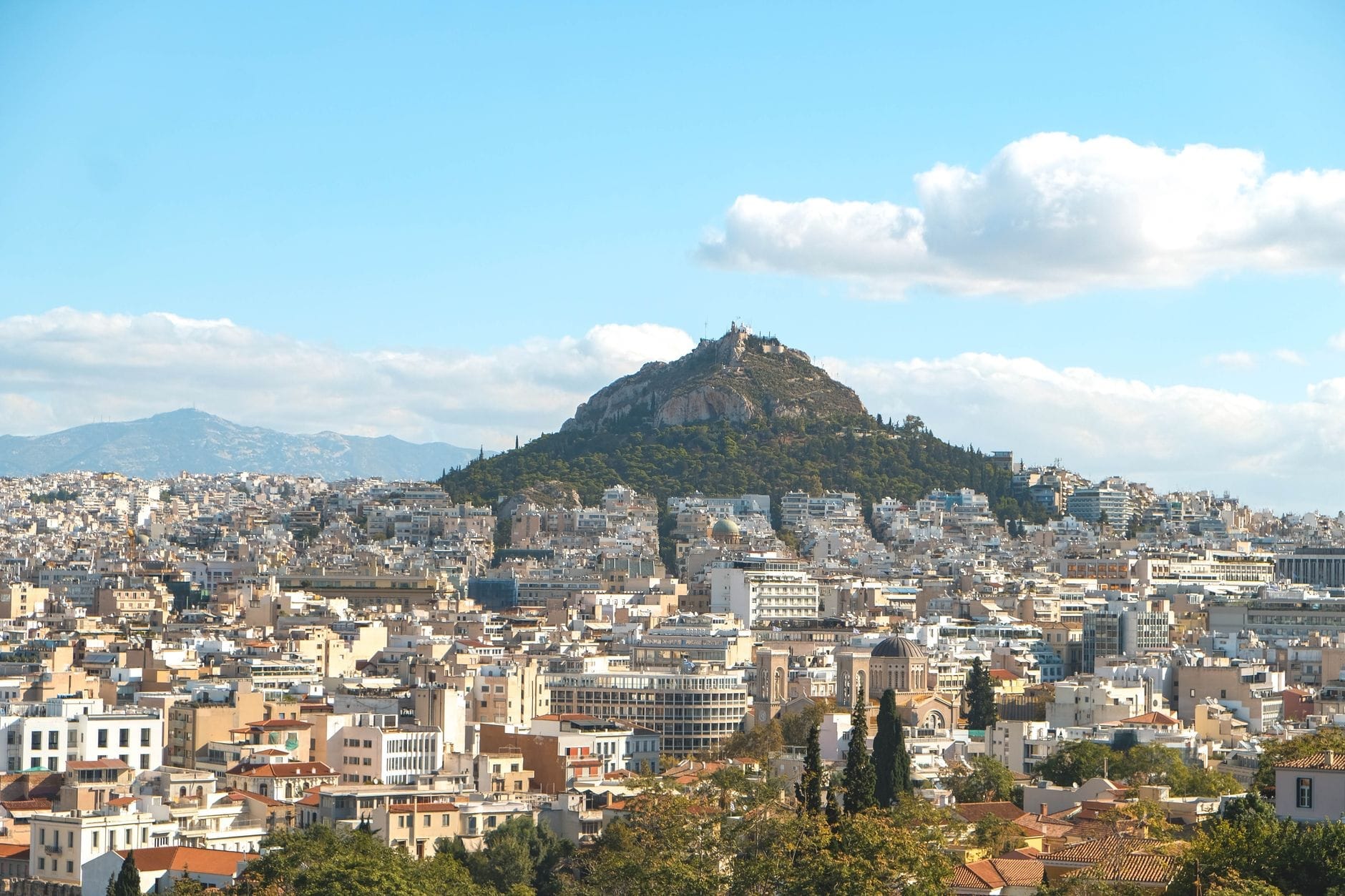
What Mount Lycabettus Actually Is
Mount Lycabettus (Greek: Λυκαβηττός, pronounced Lykavittós) is a steep limestone hill that rises 277 meters above sea level and towers over the low-rise fabric of central Athens. It is the city's highest central point, sitting roughly 200 meters above the surrounding streets, and visible from most parts of the Athens basin. From the summit, the urban sprawl rolls out in every direction: the Acropolis to the southwest, the port of Piraeus and the Saronic Gulf to the south, and the ring of mountains — Hymettus, Penteli, Parnitha — that frame the Attica basin.
The hill is officially part of the Kolonaki district, and its lower slopes are stitched into one of Athens' more refined neighborhoods, known for its galleries, boutiques, and pavement cafes. That contrast — gritty limestone cliff above polished city streets — is part of what makes the hill feel distinct. It doesn't blend into its surroundings; it erupts from them.
💡 Local tip
The cable car (teleferik) departs from the end of Plutarch Street at its junction with Aristippou Street in Kolonaki. From Evangelismos Metro station, allow around 10 minutes on foot. The ride itself takes approximately 3 minutes through a tunnel cut into the rock.
Getting Up: Cable Car vs. the Hiking Trail
The Lycabettus Cable Car has been running since 19 April 1965, the day after its official inauguration. The funicular-style line is 210 meters long and travels through a tunnel bored into the hillside, emerging near the summit terrace. The ride takes about 3 minutes each way. Cable car hours are generally 9:00 a.m. to 1:30 a.m., operating 365 days a year, though hours may be reduced in winter — confirm current times at lycabettushill.com before visiting. Round-trip fare is €10; a one-way ticket costs €7.
The hiking option is free and gives you a very different experience of the hill. Several paths wind up through the pine and cypress trees that cover much of the slope. The most commonly used route starts in Kolonaki and takes roughly 20 to 30 minutes at a moderate pace, though the final sections are steep and the stone steps can be uneven. Wear proper footwear — not sandals. In summer, attempt the hike early in the morning or after 5 p.m., as the exposed sections of trail hold heat intensely between midday and late afternoon.
⚠️ What to skip
In July and August, the trail temperature on exposed sections can exceed 40°C during peak hours. Carry at least 500ml of water per person regardless of how short the hike looks on paper.
Tickets & tours
Hand-picked options from our booking partner. Prices are indicative; availability and final rates are confirmed when you complete your booking.
Guided tour of the Acropolis, Parthenon and Museum in Athens
From 50 €Instant confirmationFree cancellationAthens: Temple of Olympian Zeus E-ticket with audio tour on your phone
From 10 €Instant confirmationAthens full-day tour with Acropolis and Cape Sounion
From 92 €Instant confirmationFree cancellationAthens National Archaeological Museum e-ticket and audio tour
From 22 €Instant confirmation
The Summit: What You Find at the Top
The summit plateau is compact. There is a small whitewashed chapel dedicated to Saint George (Agios Georgios), which dates to the 19th century and is still used for services. Its bell tower is a common photographic subject. Adjacent to the chapel is a café-restaurant and a small terrace with railings and coin-operated telescopes. There is also an open-air theatre on the upper slopes — the Lycabettus Theatre — which hosts concerts and performances during the summer festival season, though it sits slightly below the summit and has its own separate access.
The view is the main event. To the southwest, the Acropolis sits on its own rock plateau, and the relationship in scale between the two hills is immediately apparent: the Acropolis is lower but more dramatic in its architectural presence. On clear days, Piraeus port and the islands of the Saronic Gulf — Aegina among them — are visible on the southern horizon. Pollution and heat haze affect visibility significantly in summer, particularly between noon and early evening. The sharpest, clearest views come in late autumn, winter, and early spring, when the air is cleaner and the light is lower.
For context on what you're looking at from the top, the best viewpoints in Athens guide compares Lycabettus with other elevated spots around the city, including Philopappos Hill and the Acropolis itself.
Time of Day: How the Experience Changes
Early morning, roughly 8 to 10 a.m., offers a quieter summit with cooler temperatures and softer light. The café is usually not yet busy, and the hilltop has a calm, almost deserted quality. This window is ideal for photography if you want clear shots without other visitors crowding the railings.
Midday in summer should generally be avoided unless you take the cable car and plan to spend only a short time at the top. Between roughly 11 a.m. and 4 p.m. in July and August, the exposed terraces are uncomfortably hot, and the trail becomes genuinely draining.
Sunset is the summit's peak hour. Crowds begin arriving around 90 minutes before dusk, and by the time the sun drops toward Piraeus and the horizon turns amber and rose, the terrace fills considerably. The atmosphere is social rather than solemn. Expect groups of visitors, ambient conversation, and people jostling for railing space with cameras out. It is genuinely beautiful, but it is not a quiet experience. If you want sunset views without the crowd density, arriving 2 hours before sunset gives you better positioning.
After dark, the illuminated Acropolis becomes the focal point of the view. The cable car running until 1:30 a.m. makes a late evening visit practical, and the summit takes on a noticeably different atmosphere after 10 p.m., when the day-trip volume drops and the visitors who remain tend to be locals or travelers with more time.
Historical and Cultural Context
In ancient mythology, Lycabettus was said to have been dropped by the goddess Athena while she was carrying a large rock intended for the construction of the Acropolis. She reportedly dropped it when startled by crows bearing bad news, and the rock became the hill. The story, recorded in ancient sources, reflects how prominent the hill was in the ancient Athenian landscape even when it lacked the civic and religious infrastructure of the Acropolis.
Unlike the Acropolis, Lycabettus was not a major site of ancient temples or political institutions. Its role in the city's history is geographic more than architectural. It provided a watchtower position and a reference point visible across the basin. The pine trees covering its slopes today are largely the result of 20th-century planting efforts; the hill was historically more barren.
The hill sits in the Kolonaki district, which is covered in detail in the Kolonaki neighborhood guide. The streets immediately below the hill are among the more pleasant in central Athens for walking, with good cafes and relatively low traffic.
Practical Walkthrough: Planning Your Visit
From Evangelismos Metro station, follow signs or map toward Kolonaki and head up the hill streets toward Aristippou and Plutarch Streets. The cable car entrance is clearly marked. If hiking, several trailheads are accessible from the residential streets on the hill's lower slopes — the paths are generally signed in Greek and English.
Photography works best on the summit terrace with a wide-angle or standard lens. The view is large and doesn't compress well at longer focal lengths. If you carry a tripod, the lower trail areas provide stable ground for longer exposures; the summit terrace itself is often crowded enough that tripod use is impractical at peak times.
Accessibility is limited for visitors with mobility restrictions. The cable car itself is accessible by most accounts, but the summit pathways have uneven stone surfaces, and the approach from the street to the cable car station involves some gradient. The hiking trail is not suitable for wheelchairs or pushchairs.
If you are planning to combine this with a broader Athens day, the Athens one-day itinerary includes Lycabettus as an afternoon or evening stop to pair with morning visits to the ancient sites.
Honest Assessment: Is It Worth the Time?
For first-time visitors to Athens, yes, the panoramic view from the summit is valuable as an orientation exercise alone. Standing at 277 meters and seeing the Acropolis, the ancient Agora area, Piraeus, and the mountains all at once gives you a spatial understanding of the city that maps cannot provide.
That said, some visitors find the summit itself underwhelming relative to the effort. The chapel and café are modest. There are no major archaeological remains at the top. If you have visited Athens before and have already seen the view, there is less reason to return unless you are specifically attending a Lycabettus Theatre event.
Visitors primarily interested in archaeology will likely get more out of spending that time at the Ancient Agora or the Acropolis Museum, both of which are substantially more content-rich. Lycabettus is best understood as a complement to those sites, not a replacement.
Visitors who dislike steep climbs, heat, or crowds at viewpoints may find the experience frustrating at peak times. The cable car solves the physical effort, but nothing solves the summer crowds at sunset except arriving earlier or later than everyone else.
Insider Tips
- The cable car queue can build significantly on weekend evenings in summer. Arriving at the station by 6 p.m. on a Saturday avoids the worst of the wait before sunset.
- The St. George chapel holds a small candlelit service on its feast day (23 April) that draws locals up the hill in a way that has nothing to do with tourism — it is a genuinely different atmosphere from the usual visitor experience.
- If you hike up and take the cable car down (or vice versa), you get two distinct perspectives on the hill without paying twice for the cable car. Buy a one-way cable car ticket if you plan to walk one direction.
- Winter mornings after a cold front produces the clearest air in Athens, and from the summit you can see detail on the islands that is simply not possible in summer haze. January and February visits often yield unexpectedly sharp conditions.
- The stretch of Plutarch Street leading to the cable car entrance is lined with quiet residential buildings and has a noticeably different pace from the commercial parts of Kolonaki below — worth walking slowly rather than rushing through.
Who Is Mount Lycabettus For?
- First-time visitors wanting a city-wide orientation before diving into individual sites
- Photographers targeting sunset panoramas with the Acropolis and Saronic Gulf in frame
- Couples looking for an evening destination with atmosphere and a view
- Travelers combining a Kolonaki walk with an elevated finish to the afternoon
- Anyone visiting Athens during spring or autumn when the air is clear and temperatures make the summit genuinely pleasant
Nearby Attractions
Other things to see while in Kolonaki:
- Benaki Museum
Housed in a neoclassical mansion in Kolonaki, the Benaki Museum traces Greek civilization from prehistoric times through the 20th century. With an extraordinary permanent collection, rooftop cafe, and late Thursday opening until midnight at its Museum of Greek Culture building, it rewards both first-time visitors and repeat ones.
- Byzantine and Christian Museum
The Byzantine and Christian Museum in Athens holds one of the world's most significant collections of Byzantine art, spanning the 3rd to 20th centuries. Housed in the elegant 19th-century Villa Ilissia on Vassilissis Sofias Avenue, it offers an unhurried alternative to the city's blockbuster ancient sites, with approximately 30,000 artifacts spanning from the 3rd century to the 21st.
- Museum of Cycladic Art
Housed in an elegant Kolonaki building, the Museum of Cycladic Art holds one of the world's finest collections of prehistoric Aegean art, spanning 5,000 years from the early Bronze Age to antiquity. Small enough to absorb in a half-day, precise enough to reward careful attention.
- National Gallery – Alexandros Soutsos Museum
The National Gallery – Alexandros Soutsos Museum is Greece's most important fine art institution, housing over 20,000 works spanning Greek art from the post-Byzantine period to the present. Reopened in its fully renovated Kolonaki building in 2021, it offers a rare chance to trace the arc of Greek artistic identity from Byzantine tradition to contemporary expression.