Stavros Niarchos Foundation Cultural Center: Athens' Coastal Cultural Hub
The Stavros Niarchos Foundation Cultural Center (SNFCC) is one of Europe's most architecturally significant public spaces, combining a 210,000 m² landscaped park, the Greek National Opera, and the National Library of Greece under a soaring photovoltaic canopy in Kallithea, roughly 4–5 km south of central Athens. It offers free public access daily and sweeping views of the Saronic Gulf.
Quick Facts
- Location
- Kallithea, Athens (approx. 4 km south of city centre)
- Getting There
- Bus/tram stop Tzitzifies (approx. 5-minute walk); shuttle bus and other buses from central Athens
- Time Needed
- 2–4 hours (half day for opera, library, and full park walk)
- Cost
- Free public access; ticketed for opera and select events (verify on official site)
- Best for
- Architecture, families, evening strolls, cultural events, sea views
- Official website
- www.snfcc.org
What Is the SNFCC and Why Does It Matter?
The Stavros Niarchos Foundation Cultural Center is not a single building. It is a complete urban district pressed into a coherent architectural and ecological vision. Opened to the public in 2016 after eight years of construction, the complex was designed by Renzo Piano Building Workshop and built on a former horse-racing track in Kallithea, a coastal neighborhood that connects Athens to the Athenian Riviera. The result is a 210,000-square-meter landscaped park containing two major national institutions: the Greek National Opera and the National Library of Greece, both relocated here from older, undersized facilities in the city centre.
The project was entirely funded by the Stavros Niarchos Foundation, a private philanthropic organization, and handed over to the Greek state as a public asset. That funding structure is unusual enough to be worth noting: the SNFCC is a rare example of a major cultural infrastructure project in Greece that arrived on budget, on schedule, and to an international design standard. It received LEED Platinum certification in 2016 for its building complex, placing it among the most sustainably engineered large cultural facilities in Europe.
ℹ️ Good to know
The outdoor park and public grounds are open daily, with hours generally running from 06:00 to midnight for the park. Verify current hours and any seasonal changes at snfcc.org before visiting, as event schedules can affect access to specific areas.
The Architecture: Renzo Piano's Sloped Roof and the Canopy Above It All
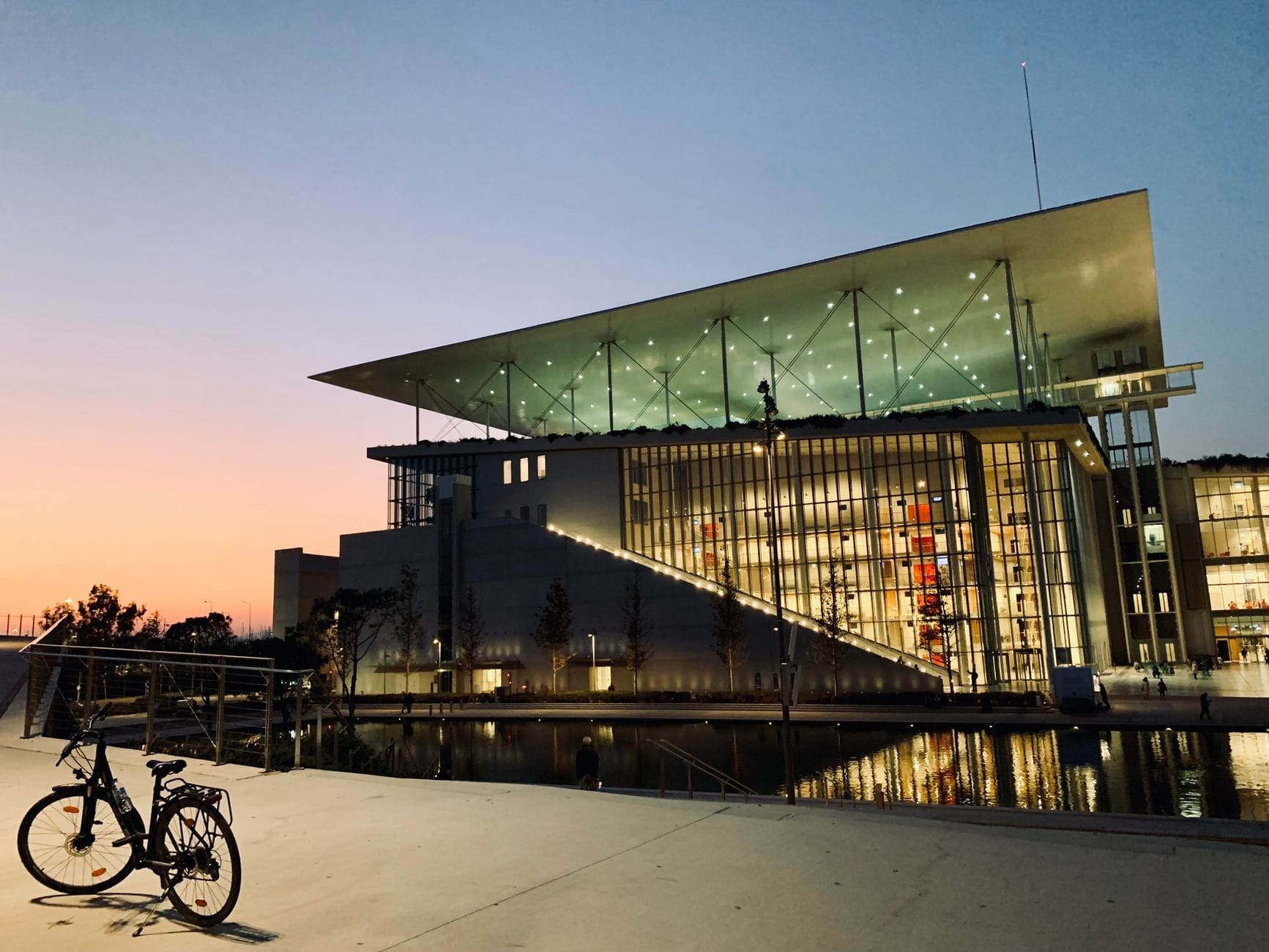
The most distinctive element of the SNFCC is visible before you enter: a massive tilted green roof, planted with Mediterranean vegetation, that slopes gradually from ground level up to a height where a photovoltaic canopy stretches out over the entire complex. Renzo Piano, the Genoa-born architect whose studio also designed the Centre Pompidou and the Shard, conceived the roof as a continuation of the landscape rather than a ceiling. Walking up it feels less like climbing a building and more like ascending a gentle hill, with olive trees and drought-resistant shrubs planted across the incline.
Beneath the canopy, the two main cultural buildings sit side by side: the glass-and-steel National Library to the west and the National Opera to the east, with its main hall and a smaller experimental stage. The interiors are minimalist and generous with natural light, using glass extensively so that the sea view stays present even from inside. The structural engineering involved in suspending the canopy above this configuration is quietly extraordinary: it appears almost weightless from below, filtering sunlight rather than blocking it.
For architecture-focused visitors, the building rewards slow attention. Walk the perimeter, look at how the planted roof transitions into the canal waterway at the base, and spend time under the canopy itself at different times of day. In the morning, the glass facades catch the eastern light sharply. By late afternoon, the entire complex shifts into warm gold tones that read better in photographs.
Tickets & tours
Hand-picked options from our booking partner. Prices are indicative; availability and final rates are confirmed when you complete your booking.
Guided tour of the Acropolis, Parthenon and Museum in Athens
From 50 €Instant confirmationFree cancellationAthens: Temple of Olympian Zeus E-ticket with audio tour on your phone
From 10 €Instant confirmationAthens full-day tour with Acropolis and Cape Sounion
From 92 €Instant confirmationFree cancellationAthens National Archaeological Museum e-ticket and audio tour
From 22 €Instant confirmation
The Park: Mediterranean Landscape Design at Scale
The park surrounding and covering the SNFCC buildings is its most accessible and frequently used feature. Designed around Mediterranean climate principles, it uses almost exclusively drought-tolerant species: olive trees, lavender, rosemary, thyme, and various native grasses. On a warm morning, the scent from the herb plantings is genuinely noticeable as you walk the upper paths of the roof garden. This is not incidental; the planting plan was coordinated with the LEED certification to minimize irrigation requirements.
A canal runs along the eastern edge of the complex, connecting the site to the sea and providing a water element that draws birds and softens what would otherwise be an expanse of hard surfaces. Children regularly feed fish here; it is one of the quieter pockets of the grounds on a busy afternoon. The canal path also serves as a natural corridor for the evening crowd that gravitates toward the waterfront side to watch the sun drop toward the Saronic Gulf.
Families with children will find the park genuinely comfortable: wide open lawns, shaded seating, a playful water feature near the main plaza, and no barriers to movement. It pairs well with a wider coastal afternoon along the Athenian Riviera, which extends south from Kallithea toward Vouliagmeni.
How the Experience Changes by Time of Day
The SNFCC operates very differently at 8am, 2pm, and 9pm. Early mornings are almost meditative. Joggers use the perimeter paths; dog walkers cross the lawns; a handful of people sit with coffee on the stepped terraces overlooking the water. The building itself is largely quiet, and the light on the water to the south is direct and clear. If you want to photograph the architecture without crowds, arriving before 9am on a weekday is the practical approach.
Midday in summer brings a different character. The park is popular with local families, and the shaded areas under the photovoltaic canopy become sought-after resting spots. Temperatures in central Athens routinely exceed 35°C between June and August, and the SNFCC's design actually addresses this: the canopy creates substantial shade, and the canal introduces a degree of cooling. Even so, bring water and plan for the heat if visiting between noon and 4pm in peak summer.
Evenings are the most atmospheric time to visit. As the light fades, the building's glass facades begin to glow from within, the Saronic Gulf catches the last of the colour, and the park fills with a relaxed Athenian crowd. If there is a National Opera performance scheduled, the energy around the entrance escalates noticeably after 7pm. Even without a ticket, watching the audience arrive and the building come alive is part of what makes the SNFCC feel like a genuinely used cultural space rather than a monument.
💡 Local tip
For the best views of Athens and the sea simultaneously, walk to the top of the planted roof. The sight line south toward the Saronic Gulf and west toward the city is one of the better elevated perspectives in Athens that doesn't require hiking.
The National Library and National Opera: What Visitors Can Expect Inside
The National Library of Greece relocated here from its historic neoclassical building on Panepistimiou Street, and the SNFCC facility is a dramatic contrast: open-plan reading rooms with floor-to-ceiling glazing, digital archives, and public programming that extends well beyond book lending. The library is free to enter and worth walking through even if you are not a researcher. The reading rooms are calm, bright, and designed to be used; you will find Athenians of all ages inside on any given afternoon.
The Greek National Opera houses both a main stage and the Alternative Stage (Nikos Skalkottas Hall), used for experimental and chamber productions. The opera season runs primarily from autumn through spring. Tickets vary by production and seat category; check the official SNFCC website for the current season program and pricing. Even if opera is not your priority, the foyer and public areas of the building are accessible and architecturally worth seeing.
⚠️ What to skip
Opera and cultural event tickets are not included with park access and should be booked in advance, especially for popular productions during the main season (October to May). Verify availability and pricing at snfcc.org.
Getting There: Tram, Bus, and Practical Notes
The most convenient public transport option from central Athens is the Athens Tram, specifically the coastal line (T3) that runs from Syntagma through Koukaki and south along the waterfront. There is a dedicated tram stop for the SNFCC. The journey from Syntagma takes approximately 25 to 30 minutes and offers coastal views along the final stretch. The tram runs frequently enough that you do not need to time your visit around it, but verify current timetables with OASA before travelling.
Several bus routes from central Athens also serve Kallithea, and the site is straightforward to reach by taxi or ride-hailing apps. If you are combining the SNFCC with broader coastal exploration, consider pairing it with a walk or short tram ride further south into the Athenian Riviera. For visitors planning a full day around modern Athens, the SNFCC slots naturally into itineraries that also include the Acropolis Museum or the National Museum of Contemporary Art (EMST), both of which share a modern cultural register.
Parking is available on site for those arriving by car. Accessibility is well considered throughout the complex: ramps, lifts, and wide paths mean that the building and park are navigable for wheelchair users and visitors with pushchairs, though the sloped roof garden does have gradient sections that require more effort.
Honest Assessment: Strengths and Limitations
The SNFCC is one of the most intelligently designed public spaces in Athens, and arguably one of the most successful large-scale architectural projects completed in Greece in the past two decades. The park is genuinely pleasant rather than ceremonial, the institutions inside are operational and well-programmed, and the setting at the junction of city and sea is hard to replicate.
That said, it is not the right stop for everyone. Visitors primarily interested in ancient history and classical archaeology will find little here that connects to that context; the SNFCC is resolutely contemporary. The distance from the city centre (about 4 km from Plaka) means it is not a casual detour but a deliberate half-day commitment. And on hot summer afternoons, the open park areas can feel exposed despite the canopy. The complex is also still building its cultural identity within Athens: it is well respected but has not yet generated the concentrated programming depth of older European cultural centres.
Visitors with a strong interest in ancient sites should prioritise the Ancient Agora and the Acropolis before making the trip south. The SNFCC is best appreciated by those who have already spent time in the historical core of the city and want to understand how Athens is remaking itself.
Insider Tips
- The rooftop garden is the best vantage point at the complex, but most visitors stop short of the top. Follow the path all the way to the upper terrace under the canopy for unobstructed views of both Athens and the Saronic Gulf.
- The National Library hosts free public events, talks, and temporary exhibitions on a rotating basis. Check the SNFCC events calendar before your visit: you may be able to combine a park walk with something programmed inside at no cost.
- Evening visits during a National Opera performance offer the best atmosphere even without tickets. The plaza around the entrance becomes lively from around 7pm, and the illuminated facade against the dark water is one of the more photogenic scenes in modern Athens.
- The tram ride from Syntagma to the SNFCC runs along the coast for part of its route and is itself a pleasant way to transition from the city centre to the waterfront. Sit on the sea-facing side heading south.
- If visiting in summer, come before 10am or after 6pm. The park's shade coverage is better than it looks from photos, but midday heat in July and August is significant. The canal-side path on the eastern edge catches a sea breeze more reliably than the main plaza.
Who Is Stavros Niarchos Foundation Cultural Center For?
- Architecture and design enthusiasts who want to see how contemporary Greek public infrastructure can compete at a European level
- Families looking for a large, free, well-designed outdoor space with room to move
- Opera and classical music audiences visiting Athens during the National Opera season (October to May)
- Travellers spending multiple days in Athens who want to see the city beyond its ancient core
- Photographers interested in modernist architecture, particularly in the golden hour before sunset
Nearby Attractions
Other things to see while in Athenian Riviera:
- Cape Sounion & Temple of Poseidon
Perched on the southernmost tip of Attica, 70 metres above the Aegean Sea, the Temple of Poseidon at Sounion is one of the most striking ancient monuments in Greece. Built around 444–440 BCE, it draws visitors for its archaeology and for sunsets that turn the marble columns amber. The drive from Athens along the coastal road is itself a worthwhile journey.
- Lake Vouliagmeni
Lake Vouliagmeni is a brackish thermal spring lake on the Athenian Riviera, about 25 km south of central Athens. Warm waters, a cave-collapsed shoreline, and a well-run spa complex make it a genuinely unusual day out — especially in the cooler months when you can swim outdoors while the city feels firmly autumnal.