Lake Vouliagmeni: Athens' Natural Thermal Lake, Explained
Lake Vouliagmeni is a brackish thermal spring lake on the Athenian Riviera, about 25 km south of central Athens. Warm waters, a cave-collapsed shoreline, and a well-run spa complex make it a genuinely unusual day out — especially in the cooler months when you can swim outdoors while the city feels firmly autumnal.
Quick Facts
- Location
- Poseidonos Avenue, Vouliagmeni, Athenian Riviera — approx. 25 km south of central Athens
- Getting There
- Bus 122 (Athens–Sounio coastal route) stops near the lake; taxis and rideshares from central Athens also serve the area directly
- Time Needed
- 2–4 hours for a relaxed visit; half a day if you use the sunbeds and restaurant
- Cost
- Approx. €25 weekdays / €30 weekends in high season (verify current rates at lakevouliagmeni.gr before visiting)
- Best for
- Off-season swimmers, couples, spa-seekers, and anyone wanting nature without a long drive
- Official website
- lakevouliagmeni.gr
What Lake Vouliagmeni Actually Is
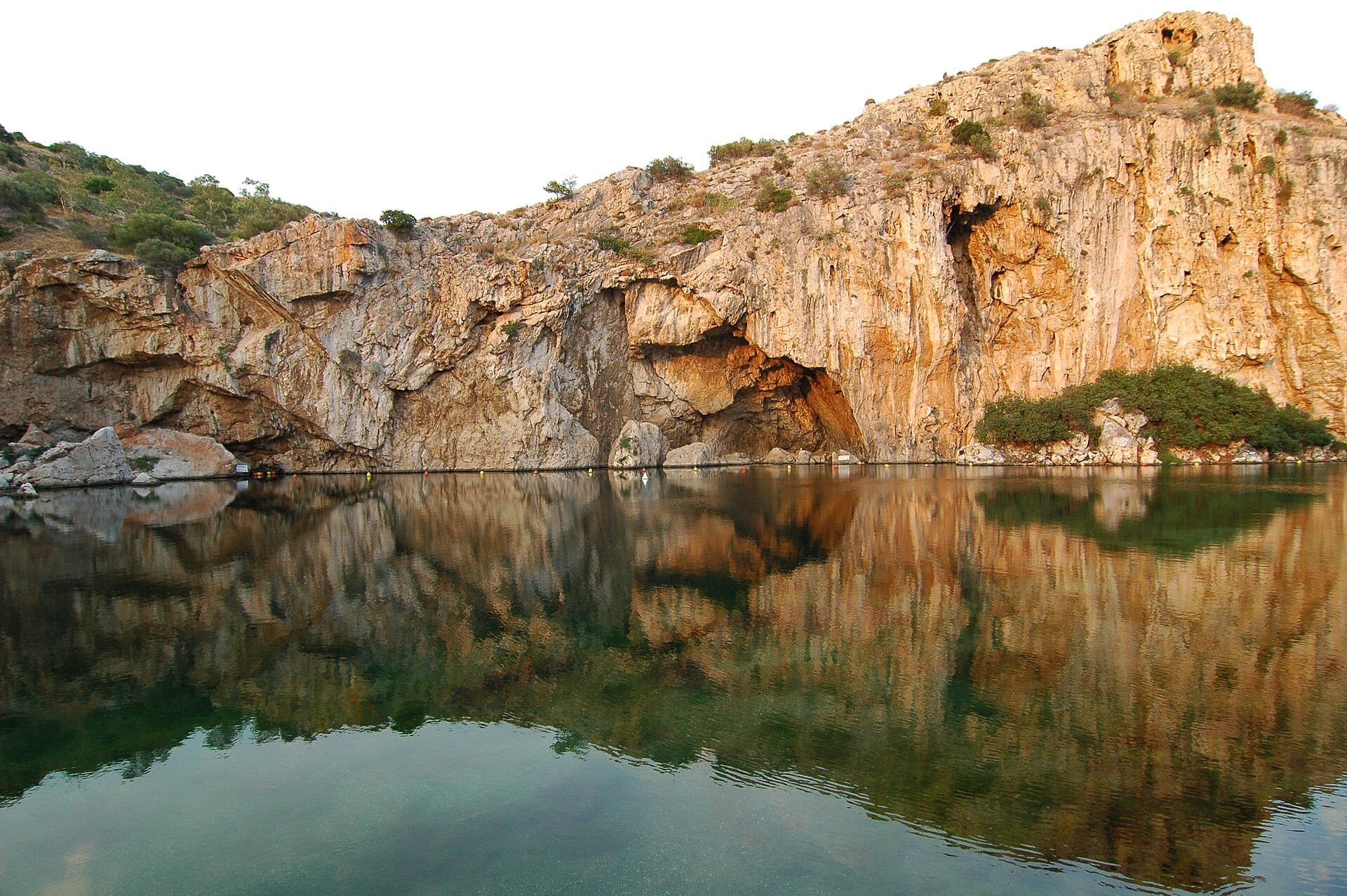
Lake Vouliagmeni (Λίμνη Βουλιαγμένης — Limni Vouliagmenis) is not a lake in the conventional sense. It is a brackish, thermally heated body of water formed by the geological collapse of a large limestone cave roof, a process that exposed an underground spring system connected to the sea through subterranean channels. The name says it plainly: 'Vouliagmeni' translates from Greek as 'sunken.' What you see today is essentially the flooded interior of a former cave, framed by eroded limestone cliffs on the inland side and open to a managed beach and spa complex on the other.
The water temperature holds between roughly 21 and 29 degrees Celsius throughout the year, fed continuously by geothermal springs that mix with seawater through underground connections. That consistency is what makes the lake genuinely unusual: you can swim here in January while the surrounding landscape is cold and grey, or in the shoulder months of October and November when every outdoor pool in the city has long since closed. The thermal quality is mild rather than intensely medicinal — this is not a sulphur spring — but the mineral content is high enough that the water has a slightly silky texture and a faint salinity different from either fresh water or open sea.
ℹ️ Good to know
The lake operates year-round, but during the winter months only the main deck area is open. If you're visiting between November and March, check the official site (lakevouliagmeni.gr) before going, as access to some areas of the complex may be restricted.
The Setting: What You See When You Arrive
Arriving at Lake Vouliagmeni from the coastal road, the first thing that registers is the scale: smaller than most people expect. The lake covers a modest area, enclosed on its northern edge by steep pale limestone cliffs streaked with mineral deposits and draped with low scrub. The southern shore, where the managed complex sits, is flat and developed — sunbeds in rows, a restaurant terrace, wooden decking over the water's edge, and a small beach area. It reads more like a luxury lido than a wild lake, which is either a draw or a deterrent depending on what you came for.
The water colour shifts through the day. In the early morning, with low-angle light and few people in the water, the lake takes on a pale blue-green tone that makes the limestone cliff walls look almost theatrical. By mid-morning in summer, the surface glitters intensely, and the colour deepens to turquoise in the shallower sections near the decking. The cliff face on the far side reflects into the water when the sun is overhead. Photographers generally find the morning light far more cooperative — direct midday sun flattens everything and the crowds add visual noise.
Tickets & tours
Hand-picked options from our booking partner. Prices are indicative; availability and final rates are confirmed when you complete your booking.
Private Marathon Lake and Lazaridis Domaine winery tour with tasting
From 660 €Free cancellationGuided tour of the Acropolis, Parthenon and Museum in Athens
From 50 €Instant confirmationFree cancellationAthens: Temple of Olympian Zeus E-ticket with audio tour on your phone
From 10 €Instant confirmationAthens full-day tour with Acropolis and Cape Sounion
From 92 €Instant confirmationFree cancellation
Swimming in the Lake: What to Expect
Entry into the water is from ladders and steps built into the decking — there is no shallow-entry beach slope here. The bottom drops away gradually but is not immediately visible from the surface, which can be disorienting for nervous swimmers. The depth at the centre is substantial, and the water carries a mild natural turbidity from the mineral content rather than pollution. Visibility is not crystal clear in the way that coastal coves can be, but the water quality is monitored and the lake is classified as safe for bathing.
The thermal temperature means the water never feels cold, even on a winter morning when the air temperature hovers around 12 or 13 degrees. That contrast between cool air and warm water is a genuine sensory experience — the surface steams faintly in cold weather, and getting out is the hard part. Summer swimmers should be aware that the lack of wave action and the mineral richness mean the water feels noticeably heavier and saltier than open-sea swimming nearby.
Fish are visible in the water throughout the year. The lake is home to small grey mullet and other species that have adapted to the brackish thermal conditions. They tend to cluster near the ladders and sunlit shallows, and are entirely accustomed to swimmers. Some visitors feed them, which is discouraged by the management as it disrupts the natural balance of the lake ecosystem.
💡 Local tip
Wear water shoes or sandals you can swim in. The decking and ladder steps can be slippery, and there is no sandy bottom to stand on — it's either decking or open water.
How the Experience Changes by Time of Day and Season
Early morning arrivals, especially on weekdays, encounter a noticeably quieter lake. Around opening time in the morning, there may be only a handful of regulars — local Athenians who treat a morning swim here as a ritual rather than a tourist excursion. The air still carries a faint mineral smell from the springs, stronger near the cliff face. The restaurant has not yet opened, and the atmosphere is calm in a way that the midday scene rarely achieves. This is the window for good photographs of the cliff reflections and for an undisturbed swim.
By 10:30 to 11:00 on a summer weekend, the dynamic shifts sharply. Sunbeds fill up, and the limited space of the complex means that latecomers may wait for available spots. The restaurant terrace becomes fully occupied by early afternoon. Noise levels rise considerably, and the lake itself gets busy enough that the swimming area feels crowded. Weekend afternoons in July and August are when the experience most closely resembles a popular city beach rather than a contemplative lakeside retreat.
In spring and autumn, the balance is more agreeable. September and October bring mild air temperatures and genuinely pleasant swimming conditions — the water retains its summer warmth well into autumn, and the crowds thin considerably after the school year resumes. April and May offer warm enough water for most swimmers without the summer pressure on facilities. Winter visits are quieter still, though the reduced facility access should be confirmed in advance.
For context on seasonal conditions across Athens more broadly, the best time to visit Athens guide covers temperature ranges and crowd patterns month by month, which applies directly to Vouliagmeni's coastal microclimate.
Getting There and Practical Logistics
The lake sits on Poseidonos Avenue in Vouliagmeni, about 25 kilometres south of central Athens along the coastal road. Bus 122, which runs the Athens–Sounio coastal route, stops near the lake. Journey time from central Athens by bus is roughly 50 to 70 minutes depending on traffic — the coastal road can slow significantly in summer. A taxi or rideshare from Syntagma takes around 30 to 40 minutes, faster outside peak hours, and costs considerably less than a beach transfer to many Aegean island destinations.
Driving is straightforward via the coastal Poseidonos Avenue. Parking is available in the surrounding area, though spaces near the entrance fill early on summer weekends. Arriving by 08:30 on a weekend virtually guarantees parking; arriving at 10:00 may not.
Vouliagmeni is part of the Athenian Riviera, a stretch of coastline running south from the city through Glyfada, Voula, and Vouliagmeni. The lake sits near the southern end of this corridor, making it logical to combine with other Riviera stops if you have a car.
⚠️ What to skip
Admission prices listed here are indicative and have changed in recent years. Always check the current rates on the official site (lakevouliagmeni.gr) before visiting, particularly if you are travelling as a group or bringing children.
The Facility: Beyond the Water
Lake Vouliagmeni operates as a managed spa complex rather than a public beach. The entrance fee covers access to the lake for swimming, use of the deck areas, and in season, the option to rent sunbeds. The restaurant and café on site serve food and drinks throughout operating hours, ranging from coffee and light snacks to full meals — quality is adequate for the setting, priced at resort-level rather than neighbourhood-café rates. Locker facilities and showers are available within the complex.
The managed environment means cleanliness is maintained to a higher standard than many free public beaches in the area. There is no litter on the decks, the water is regularly tested, and staff are present throughout operating hours. It is a polished experience, and the entry price reflects that. Whether the cost feels justified depends largely on how long you stay — a quick swim and departure feels expensive; a half-day with sunbed, lunch, and multiple swims feels more proportionate.
Who This Attracts, and Who Might Be Disappointed
The lake draws a genuinely mixed crowd: local Athenians using it as a year-round wellness resource, tourists seeking something distinctive beyond city archaeology, couples on a coastal day out, and older visitors who find the calm, current-free water easier than open-sea swimming. The absence of waves and the thermal temperature make it popular with older swimmers and those with joint conditions, who find extended immersion in the warm water genuinely therapeutic.
Visitors primarily motivated by beach culture and sea swimming may find the entry cost difficult to justify when free coastal beaches are accessible along the Riviera. Those expecting a wild or secluded natural lake will also be disappointed — the facility is comfortable and orderly, not rugged. If you are visiting Athens for ancient sites, the Acropolis and Ancient Agora should take priority over a half-day trip south of the city unless you have time to spare.
Children are welcome and the calm water is safe for confident young swimmers, but the lack of a sandy beach or shallow entry means it is not ideal for toddlers or non-swimmers. The decking and ladders require some physical confidence to navigate, and there is no gradual wading-in option.
Insider Tips
- Arrive as close to opening time as possible on a weekday for the quietest conditions and the best light on the cliff face — the lake is a different place before the sun climbs and the crowds arrive.
- The fish in the lake are accustomed to people and will approach swimmers closely, particularly near the entry ladders. Do not feed them, but do not be startled — they are harmless and add to the experience.
- In October and November, the water is still warm from summer, the air is cool, and the facility is nearly empty on weekdays. This is arguably the most pleasant time to visit if you can plan around it.
- If you are driving, the easiest parking is a short walk south along Poseidonos Avenue rather than directly at the entrance, where competition for spaces is highest.
- Bring your own snacks and water if the café prices feel steep — the entry fee does not restrict you from bringing food, and there are shaded seating areas on the decking where you can eat.
Who Is Lake Vouliagmeni For?
- Off-season swimmers who want warm water without travelling to an island
- Couples looking for a half-day coastal escape from central Athens
- Older travellers or those with joint conditions seeking calm, thermally warm water
- Photographers interested in geological landscapes and unusual natural settings
- Visitors with a full itinerary who want a genuinely relaxing afternoon after days of city sightseeing
Nearby Attractions
Other things to see while in Athenian Riviera:
- Cape Sounion & Temple of Poseidon
Perched on the southernmost tip of Attica, 70 metres above the Aegean Sea, the Temple of Poseidon at Sounion is one of the most striking ancient monuments in Greece. Built around 444–440 BCE, it draws visitors for its archaeology and for sunsets that turn the marble columns amber. The drive from Athens along the coastal road is itself a worthwhile journey.
- Stavros Niarchos Foundation Cultural Center
The Stavros Niarchos Foundation Cultural Center (SNFCC) is one of Europe's most architecturally significant public spaces, combining a 210,000 m² landscaped park, the Greek National Opera, and the National Library of Greece under a soaring photovoltaic canopy in Kallithea, roughly 4–5 km south of central Athens. It offers free public access daily and sweeping views of the Saronic Gulf.