Cape Sounion and the Temple of Poseidon: Athens' Most Dramatic Ancient Site
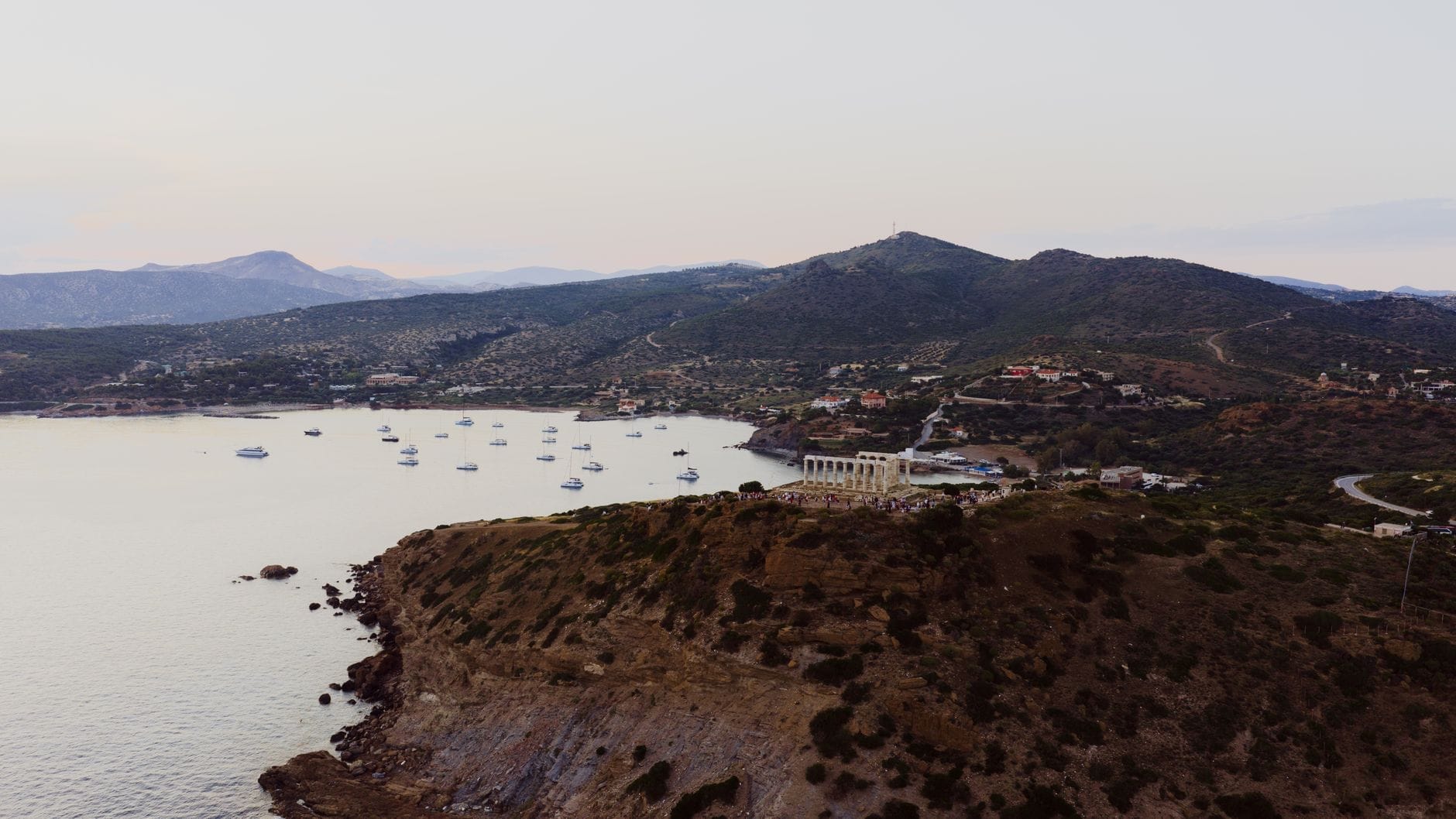
Perched on the southernmost tip of Attica, 70 metres above the Aegean Sea, the Temple of Poseidon at Sounion is one of the most striking ancient monuments in Greece. Built around 444–440 BCE, it draws visitors for its archaeology and for sunsets that turn the marble columns amber. The drive from Athens along the coastal road is itself a worthwhile journey.
Quick Facts
- Location
- Cape Sounio, Sounio 195 00, Attica — approximately 70 km south of central Athens
- Getting There
- KTEL buses depart from Pedion Areos bus terminal in Athens; by car or taxi via the coastal Poseidonos Avenue route (about 1.5 hours each way depending on traffic)
- Time Needed
- 2–3 hours on site; allow a full half-day including travel from Athens
- Cost
- Admission charged; verify current fees at the official Ministry of Culture site before visiting
- Best for
- Ancient history, sunset photography, coastal scenery, day trips from Athens
- Official website
- http://odysseus.culture.gr/h/3/eh355.jsp?obj_id=2390
What You're Looking At
The Temple of Poseidon at Sounion stands on a headland where the land drops sharply on three sides into the Aegean Sea. At this point the sea spreads out in every direction, with no visible horizon obstruction on a clear day. The marble columns you see today, sixteen of the original thirty-four, belong to a Doric peristyle temple constructed between roughly 444 and 440 BCE during the same cultural flowering that produced the Parthenon. The proportions are deliberately slender, giving the colonnade a lightness unusual for Doric work of the period.
The site has been sacred far longer than the standing temple suggests. Evidence of a sanctuary here dates to at least the 7th century BCE, and an earlier Archaic temple occupied the same plateau before the Persian forces destroyed it in 480 BCE during the same campaign that damaged the Acropolis. The current temple was built as part of a broader reconstruction effort under Pericles. Recognising this sequence matters, because the plateau itself carries nearly three thousand years of accumulated religious significance, not just the five centuries visible in stone.
ℹ️ Good to know
Look for a carved name low on one of the interior column drums: Lord Byron scratched his name here during his 1810–1811 visit. It is not a sanctioned piece of history, but it is there, and it connects the Romantic fascination with classical ruins to the physical stone in front of you.
The Drive Down: Coastal Road vs. Inland Route
Two roads connect Athens to Cape Sounion. The coastal route, which follows the Saronic Gulf shoreline through the Athenian Riviera suburbs before swinging around the peninsula, takes longer but offers a sequence of sea views, beach towns, and gradual reveals of the cape itself. The inland route through Lavrio is faster and more direct but passes through unremarkable terrain. For most visitors making a dedicated trip, the coastal road is worth the extra time, particularly in the morning when the light comes off the water at a low angle.
The coastal road passes through the resort towns of the Athenian Riviera, where you will see beach clubs, marinas, and the organized seafront strip of Vouliagmeni before the road narrows and the landscape becomes more austere. The last stretch before Sounion feels noticeably emptier: low scrub, views of open water, and the first glimpse of the temple from the road below the cape, which prepares you for the ascent.
Tickets & tours
Hand-picked options from our booking partner. Prices are indicative; availability and final rates are confirmed when you complete your booking.
Temple of Poseidon and Cape Sounion private sunset tour with audio guide
From 210 €Instant confirmationFree cancellationCape Sounion and Temple of Poseidon sunset experience from Athens
From 22 €Instant confirmationFree cancellationAthens combo hop-on hop-off bus and Cape Sounion sunset tour
From 13 €Instant confirmationFree cancellationCape Sounion Temple of Poseidon sunset tour with audio guide
From 13 €Instant confirmationFree cancellation
Arriving at the Site
The archaeological site entrance is at the base of the headland, and the path climbs steadily to the temple plateau. The ground is uneven stone and packed earth in places, and the last section involves steps. Footwear with grip matters here, particularly in winter when the surface can be damp. In summer, the exposed climb in full sun is warm work between midday and mid-afternoon, and there is no shade on the path or on the plateau itself.
Once at the top, the sense of exposure is immediate. The cliff edge is unfenced in most sections, and the drop is real. Wind is almost always present, sometimes strongly. On days when the meltemi blows from the north in July and August, gusts at the cape can be forceful enough to make standing at the edge uncomfortable. This is not a place for inattentive children near the perimeter, and it bears stating plainly.
The plateau holds the main temple and the remains of a smaller propylon and other ancillary structures. Signage explains the layout of the sanctuary, including the location of the Archaic temple that preceded the current one. The site is compact enough to walk fully in under an hour even at a slow pace, but the temptation to stay longer, particularly late in the afternoon, is strong.
⚠️ What to skip
There is no shade on the temple plateau. In summer (June–August), midday temperatures in Attica regularly exceed 35°C and the cliff receives unfiltered sun. Bring water, a hat, and sunscreen regardless of how the morning felt in Athens.
Time of Day and the Sunset Question
Sounion is closely associated with sunset, and for good reason. When the sun descends over the Saronic Gulf in the west, the light catches the west-facing columns of the temple and shifts them from white through pale gold to a deep amber. The sea below takes on colour at the same time, and on evenings with some cloud, the combination is genuinely arresting. This is not tourist-board exaggeration: the geometry of the site and the orientation of the temple relative to the sunset are exceptional.
The practical consequence is crowds. In spring and summer, the site in the final two hours before closing is significantly more crowded than it is in the morning. Buses arrive in sequence from Athens, and the plateau becomes busy. If your priority is photography without crowds, or simply having the site feel quiet, arrive as early as the site opens. The morning light falls on the east-facing interior of the colonnade and the sea is a deeper, calmer colour.
For visitors building a full-day itinerary, one approach is to combine Sounion with a morning stop at one of the beaches along the coastal road south of Athens, then arrive at the site in mid-afternoon and stay through sunset. This lines up well with how many day trips from the city are structured. See also a broader guide to day trips from Athens for other half-day and full-day options in the Attica region.
Historical and Cultural Context
Poseidon was not only the god of the sea but the divine patron of the Athenians' naval power. Siting his most prominent Attic temple on a headland visible to every ship approaching from the south was a deliberate statement of civic identity. Sailors returning from voyages would have seen the temple from their vessels and known they were nearly home. Sailors departing made offerings here before heading into open water. The religious function and the navigational landmark were inseparable.
The temple's construction date, roughly 444–440 BCE, places it in the years immediately following the completion of the Parthenon, when Athenian monumental architecture was at its peak. The architect is unknown, but stylistic analysis suggests strong similarities to the Temple of Hephaestus in Athens. If that attribution is correct, Sounion and the Agora share a designer working across two of the most intact Classical temples to survive anywhere in Greece.
The Temple of Hephaestus in central Athens, also from the mid-5th century BCE, offers a useful point of comparison. It is better preserved and set in a very different context, within the Ancient Agora. Visiting both gives a clearer picture of what Classical Doric temple architecture looked like in its full context.
Photography at Cape Sounion
The classic composition places the columns against the sea and sky, usually from the northwest corner of the temple looking southeast. In the late afternoon and at sunset this framing works naturally. In morning light the angle is different and the cliff edge below the temple reads more strongly, which produces images with a stronger sense of the drop.
A polarising filter is genuinely useful here. The sea reflects hard light for much of the day, and cutting that glare reveals the colour gradient of the water from turquoise near the rocks to deep blue at distance. A moderate telephoto lets you isolate individual columns against the horizon without distortion. Wide-angle lenses emphasize the height and exposure of the site but can make the temple itself feel smaller than it appears to the eye.
💡 Local tip
For sunset photography, arrive at least 90 minutes before the sun drops to the horizon. The best light occurs 20–40 minutes before actual sunset, not at the moment of sunset itself. If you wait until the sun hits the water to position yourself, you will have missed the warmest column light.
Who Will Not Enjoy This Visit
Visitors who find archaeological ruins without significant contextual explanation unrewarding may feel that the site's appeal rests almost entirely on its setting. The columns are striking and the view is exceptional, but there is no reconstruction, no museum on-site, and no immersive experience. What you have is stone and sky. Travelers who want interpretive depth alongside the ancient ruins are better served beginning their Attica itinerary with the Acropolis and its museum, which together provide the richest classical archaeology experience in the country.
The Acropolis Museum in particular offers close-up access to original sculpture and detailed context about 5th-century BCE Athens that Sounion cannot provide. If you have limited days in Greece, the Acropolis and its museum should come first. Sounion is most rewarding as an addition to a broader Athens itinerary rather than as a standalone substitute for it.
The site also has real physical limitations for visitors with mobility difficulties. The path from the entrance to the temple plateau involves uneven surfaces and steps. There is no bypass route, and the terrain cannot reasonably be described as accessible without specific current guidance from the site operator.
Insider Tips
- The KTEL bus from Athens to Sounion runs along the coastal route, making it the cheapest and most scenic option for visitors without a car. Check departure times from the Pedion Areos terminal before you go, as schedules change seasonally.
- There is a cafe and a small restaurant near the site entrance. The food is acceptable but unremarkable. If you are visiting in the afternoon and staying for sunset, bring snacks and extra water rather than depending on the on-site facilities.
- Byron's carving is on one of the columns in the interior of the temple, not the exterior colonnade. Most visitors photograph the exterior and leave without finding it. Walk into the cella area and look at the lower drum sections of the interior columns.
- The cliff on the north side of the plateau offers a view back toward the Attic coastline that most visitors skip in favour of the sea view to the south. On a clear day you can see the outline of the Athens basin from this angle, which puts the geography of Attica in useful perspective.
- If driving down via the coastal road, the town of Lavrio on the return journey is a functional port with a few straightforward tavernas that are significantly less expensive than anything at Sounion itself. Worth a stop if you are heading back after sunset.
Who Is Cape Sounion & Temple of Poseidon For?
- Travelers with a strong interest in Classical Greek archaeology who have already seen the central Athens sites and want to extend their understanding
- Photographers looking for ancient ruins in dramatic natural settings, particularly for sunset light
- Anyone on a half-day or full-day road trip along the Athenian Riviera coastal route who wants a clear destination at the southern end
- Visitors who find urban archaeological sites crowded and want a more expansive, open-air setting for a historical monument
- Couples or small groups looking for a scenic evening excursion from Athens that combines coastal driving with a historic landmark
Nearby Attractions
Other things to see while in Athenian Riviera:
- Stavros Niarchos Foundation Cultural Center
The Stavros Niarchos Foundation Cultural Center (SNFCC) is one of Europe's most architecturally significant public spaces, combining a 210,000 m² landscaped park, the Greek National Opera, and the National Library of Greece under a soaring photovoltaic canopy in Kallithea, roughly 4–5 km south of central Athens. It offers free public access daily and sweeping views of the Saronic Gulf.
- Lake Vouliagmeni
Lake Vouliagmeni is a brackish thermal spring lake on the Athenian Riviera, about 25 km south of central Athens. Warm waters, a cave-collapsed shoreline, and a well-run spa complex make it a genuinely unusual day out — especially in the cooler months when you can swim outdoors while the city feels firmly autumnal.