Panathenaic Stadium (Kallimarmaro): The World's Only All-Marble Stadium
The Panathenaic Stadium, known locally as Kallimarmaro, is one of Athens' most extraordinary monuments. Originally built around 330 BC for the ancient Panathenaic Games and rebuilt entirely in marble for the first modern Olympic Games in 1896, it remains a fully intact, working piece of sports history that visitors can walk, run, and stand inside.
Quick Facts
- Location
- Vasileos Konstantinou Avenue, Athens 116 35 (opposite the Discobolus statue)
- Getting There
- Syntagma, Akropoli, or Evangelismos metro stations (~1,000 m walk); tram stop 'Zappeio' is a 3-minute walk
- Time Needed
- 45–90 minutes
- Cost
- General €12 / Reduced (students and seniors 65+) €6 / Free for children under 6 and school groups (as of 01.10.2025; verify at panathenaicstadium.gr)
- Best for
- History enthusiasts, Olympic fans, architecture lovers, and families with older children
- Official website
- www.panathenaicstadium.gr
What Is the Panathenaic Stadium?
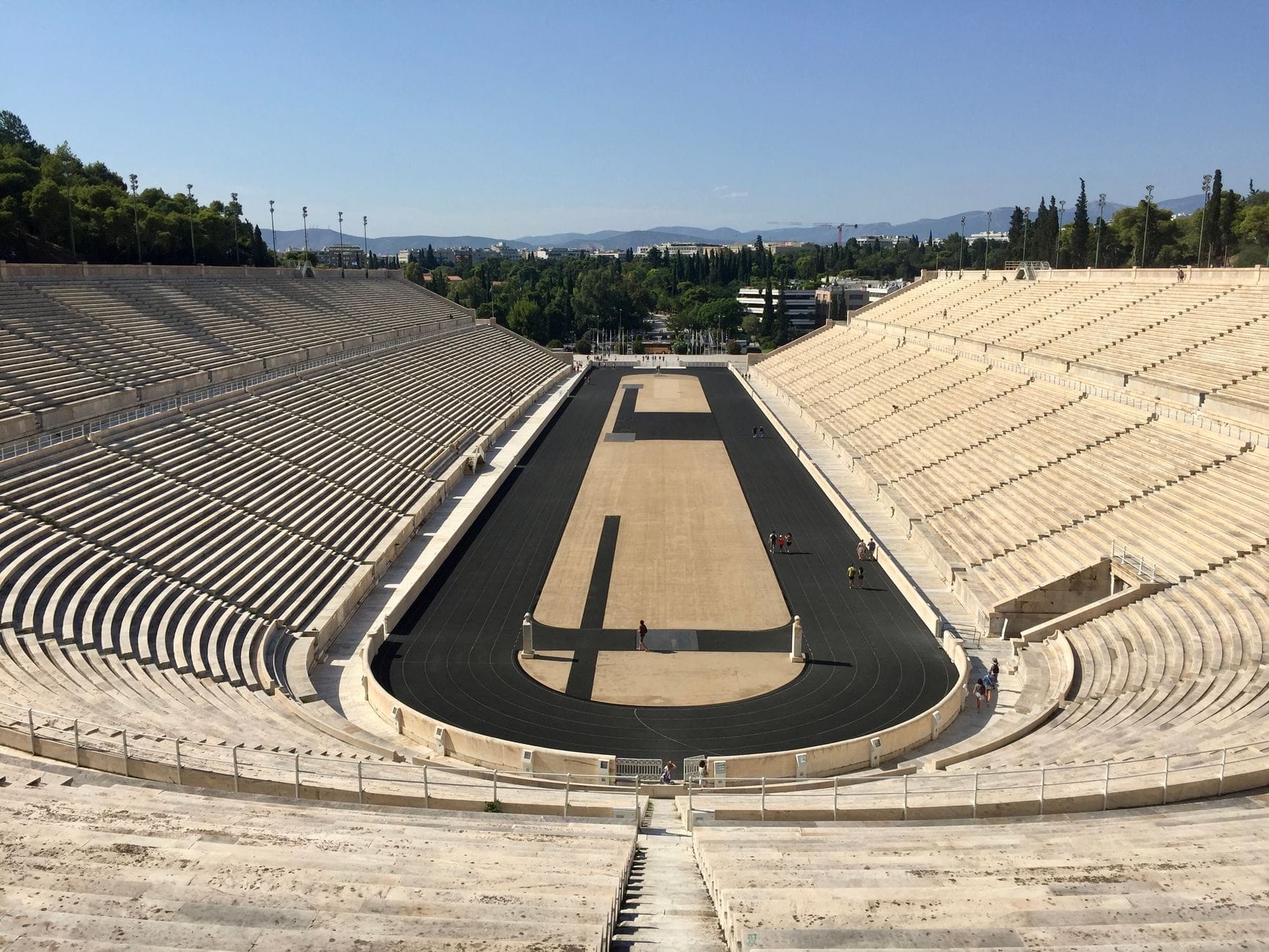
The Panathenaic Stadium, or Kallimarmaro (literally 'beautiful marble' in Greek), is the only stadium in the world constructed entirely from white Pentelic marble. It sits in a natural valley between two low hills in the Pangrati district, near the National Gardens and the Zappeion, and its gleaming tiers are visible from Vasileos Konstantinou Avenue as you approach on foot.
The site has a layered history that spans more than 2,300 years. A simple earthen racecourse existed here before the 4th century BC, when the Athenian statesman Lykourgos ordered the construction of a proper stone stadium for the Panathenaic Games, the great festival held in honour of the goddess Athena. In the mid-2nd century AD, the wealthy Athenian benefactor Herodes Atticus rebuilt and expanded it in marble, giving it a capacity estimated at around 50,000 spectators.
After centuries of disuse and systematic quarrying of its marble for other building projects, the stadium was excavated and restored in the 1890s under the direction of Georgios Averoff, a Greek-Egyptian philanthropist who funded the reconstruction almost entirely from his own fortune. On 6 April 1896, it hosted the opening ceremony of the first modern Olympic Games, making it the birthplace of the contemporary Olympic movement. It hosted the marathon finish in the 2004 Athens Olympics, closing a symbolic circle more than a century later.
ℹ️ Good to know
Opening hours: March–October daily 08:00–19:00; November–February daily 08:00–17:00. The stadium is open every day of the year.
Arriving and First Impressions
Most visitors arrive on foot along Vasileos Konstantinou Avenue, passing through the Zappeion gardens. The approach is part of the experience: the stadium appears gradually as you clear the tree line, its curved marble façade catching the light and looking almost impossibly white against the Athens sky. On sunny mornings between April and October, the glare from the seats is intense enough to require sunglasses before you even enter.
The entrance is at the open southern end of the horseshoe, the same end through which Olympic athletes once entered. There is a small ticketing booth and a modest gift shop. The queue moves quickly outside of peak summer weekends, and you can typically be inside the track within minutes of arriving. Lockers are not available, so keep your bags with you throughout.
If you are walking from Syntagma Square, the journey takes around 20–25 minutes through the Zappeion park, which is pleasant and shaded. The National Garden of Athens runs along the north side of this route and is worth a brief detour if you have extra time.
💡 Local tip
Come early on summer mornings. By 09:00 the marble seats are cool, the light is soft, and school groups have not yet arrived. By 11:00 in July or August, the stadium becomes an unshaded oven. Bring water regardless of season.
Tickets & tours
Hand-picked options from our booking partner. Prices are indicative; availability and final rates are confirmed when you complete your booking.
Guided tour of the Acropolis, Parthenon and Museum in Athens
From 50 €Instant confirmationFree cancellationAthens: Temple of Olympian Zeus E-ticket with audio tour on your phone
From 10 €Instant confirmationAthens full-day tour with Acropolis and Cape Sounion
From 92 €Instant confirmationFree cancellationAthens National Archaeological Museum e-ticket and audio tour
From 22 €Instant confirmation
Inside the Stadium: What You Actually See
Walking through the entrance tunnel and onto the track is the moment most visitors remember. The stadium itself is a long narrow horseshoe shape, with 47 rows of marble seating rising steeply on both sides and a curved closed end at the north. Standing on the track and looking up at 50,000 empty marble seats arranged in perfect symmetry is genuinely arresting.
The track itself is a hard-packed surface rather than a modern synthetic oval. Visitors are free to run or walk a lap, and a surprising number do, including serious runners who time their circuits. The atmosphere shifts depending on the hour: early morning brings a quiet, almost contemplative stillness; mid-morning sees small guided groups, often with audio guides raised to their ears; by early afternoon in summer the heat radiating from the marble creates a haze and most visitors move in short bursts between shaded spots.
The seating tiers are accessible and visitors can climb to the top rows, which offer a clear view over the curve of the stadium toward the Athens cityscape. The Acropolis is visible from the upper seats at the northern end, a detail that places the stadium within the broader geography of ancient Athens in a way no photograph quite replicates. The marble underfoot is worn smooth in the heavily trafficked areas and faintly warm to the touch even on cool days.
At the northern end, a small underground museum contains exhibits covering both the ancient Panathenaic Games and the 1896 Olympics. It is compact, well-labelled in Greek and English, and takes roughly 20 minutes to cover thoroughly. There is also a reproduction of the first Olympic torch, used in the relay that began at this stadium.
Historical and Architectural Context
The marble used throughout the stadium is Pentelic marble, quarried from Mount Pentelikon northeast of Athens, the same source that supplied the Parthenon. Pentelic marble is noted for its fine grain and the way it weathers to a warm ivory tone over time, though freshly cut sections remain bright white. The 1890s restoration used new Pentelic marble for the seating and structural elements, meaning that what you see today is a 19th-century reconstruction built to ancient proportions, not original ancient fabric.
This distinction matters for how you interpret the site. The Panathenaic Stadium is not a ruin in the conventional sense. It is a functional monument, rebuilt with historical intent, and it reads more like an inhabited space than an excavated one. The trade-off is that it lacks the raw archaeological texture of sites like the Kerameikos or the Ancient Agora, but it compensates with an immediacy and accessibility that fragmented ruins cannot offer.
For the deeper archaeological experience of ancient Athens, the Ancient Agora and the Kerameikos Archaeological Site provide unrestored complexity that contrasts sharply with Kallimarmaro's polished completeness.
How the Experience Changes by Time of Day and Season
Early morning, particularly between 08:00 and 09:30, is when the stadium is at its most atmospheric. The low-angle light rakes across the marble tiers and casts long shadows down the rows of seats. The air is cool, the space is nearly empty, and the scale of the place registers most clearly without crowds as a reference point. If you are in Athens from November through February, the cool clear winter light produces particularly sharp photographs and the stadium feels almost private.
Summer midday visits between 12:00 and 15:00 are the least comfortable. The stadium is an open bowl with no shade on the seating tiers, and surface temperatures on the marble can be extreme. If summer is your only option, wear a hat, bring water, and plan to spend most of your time on the track level rather than climbing the upper rows. Late afternoon from around 16:30 onward brings lower temperatures and softer light, and the crowd thins noticeably after 17:00.
Spring and autumn, roughly April through May and September through October, offer the most balanced conditions: warm enough to be comfortable, cool enough that you can linger in the seats, and with daylight lasting until early evening.
⚠️ What to skip
The stadium has almost no shade on the marble seating tiers. In summer, wear sun protection and bring water. There is a small café area near the entrance but no food or drink is permitted on the track or in the seating areas.
Photography Tips
The symmetry of the stadium rewards wide-angle photography from the track level, looking toward the curved northern end. The best shots require patience: wait for a moment when the central lane is clear of other visitors, then photograph down the length of the track with the seats converging toward the far curve. This perspective communicates the scale better than any elevated angle.
From the upper rows at the northern end, a wide-angle lens can frame the stadium foreground with the Acropolis Hill visible in the distance to the northwest. The clearest atmospheric conditions for this shot are typically early morning or after light rain has settled the dust. Noon light in summer creates harsh blown-out whites on the marble and is the worst time for photography of the tiers.
If aerial or citywide views are your priority, Mount Lycabettus offers a panoramic perspective that places the stadium within the full Athens basin, with the sea visible on clear days.
Practical Walkthrough: Getting There and Getting Around
The stadium is approximately a short walk from Syntagma, Akropoli, and Evangelismos metro stations. The walk from Syntagma takes 20–25 minutes via the Zappeion gardens and is pleasant and mostly flat. From Evangelismos metro station the walk is somewhat shorter and slightly more direct. Tram stop 'Zappeio' on the coastal tram line is about a 3-minute walk from the stadium entrance.
By taxi or ride-hailing app, the stadium is a 10-minute drive from central Athens in normal traffic. There is no dedicated parking facility at the stadium itself, and parking on surrounding streets is limited and monitored. Walking or using public transit is the practical choice for most visitors.
Accessibility: entrance is free for children under six and school groups, and ground-level access on the track is manageable, but the marble seating tiers involve steep steps that are not adapted for mobility impairments.
The stadium pairs naturally with a morning that includes the Temple of Olympian Zeus, which is a 10-minute walk away, and the Acropolis Museum to the southwest, making a logical half-day circuit of major ancient sites.
Is It Worth Your Time?
The Panathenaic Stadium is not an overhyped attraction. It delivers something singular: a complete, walk-in ancient sports venue that connects directly to both classical antiquity and modern Olympic history. The experience of standing on the track or sitting in the upper rows is qualitatively different from looking at ruins behind a rope line.
That said, visitors looking primarily for excavated archaeological depth may find the restored marble somewhat sanitised. The stadium tells a story of reconstruction and sporting legacy rather than the unmediated encounter with the ancient world that sites like the Agora or the Acropolis provide. It also sits at a price point of €12, which, combined with the relatively short dwell time of around an hour, makes it feel more expensive than some larger sites.
Visitors working within a tight budget should note that the free things to do in Athens guide covers several ancient sites and public monuments that cost nothing to visit from the outside.
For anyone with even a passing interest in Olympic history, ancient Greek athletics, or marble architecture, Kallimarmaro earns its place on a two- or three-day Athens itinerary without question. For travelers with only one full day in the city, it is a worthwhile addition if you are already passing through the Zappeion area, but it should not displace the Acropolis or the National Archaeological Museum.
Insider Tips
- Arrive at opening time (08:00) on weekdays, especially in summer. The stadium is genuinely empty for the first 30–40 minutes, and the morning light on the marble is the best it will be all day.
- You can run a lap of the track. The surface is firm and roughly 400 metres per circuit. Some visitors arrive specifically for this, and the staff are accustomed to it. Wear appropriate footwear if this is your intention.
- The small underground museum at the northern end is easy to miss because it is not prominently signed from the track. Look for the staircase entrance in the curved wall at the closed end of the stadium. The 1896 Olympic exhibits are the highlight.
- The upper rows at the curved northern end provide the clearest sightline to the Acropolis. On a clear morning, the Parthenon is distinctly visible. This view is not mentioned in most guidebooks but is one of the more memorable perspectives available at the site.
- Toilet facilities are available near the entrance. Use the facilities at a nearby café before entering if you want to avoid waiting.
Who Is Panathenaic Stadium (Kallimarmaro) For?
- Olympic history enthusiasts who want to stand in the stadium where the modern Games were born
- Architecture lovers interested in 19th-century neoclassical restoration and ancient spatial design
- Runners and active travellers who want to jog a lap of a 2,300-year-old track
- Families with children aged 8 and up who can engage with the Olympic story
- Photographers seeking dramatic marble geometry and an Acropolis backdrop
Nearby Attractions
Combine your visit with:
- Ancient Corinth & Acrocorinth
Ninety kilometres west of Athens, Ancient Corinth and the towering fortress of Acrocorinth pack more history per square metre than almost anywhere in Greece. Roman temples, Greek agora ruins, a world-class on-site museum, and a 575-metre hilltop citadel often described as one of the largest castles in Greece make this one of the most rewarding day trips from the capital.
- Daphni Monastery
Standing on the ancient Sacred Way to Eleusis, Daphni Monastery is one of the finest surviving examples of middle Byzantine architecture in Greece. Its 11th-century golden mosaics rival anything in Ravenna or Constantinople — and most visitors to Athens never make it here.
- Delphi
Perched on the slopes of Mount Parnassus, the Archaeological Site of Delphi was once the spiritual centre of the ancient Greek world. A UNESCO World Heritage Site since 1987, it combines dramatic mountain scenery with some of the most significant ruins in Greece, including the Temple of Apollo, the Sacred Way, and a first-rate archaeological museum.
- Ancient Theatre of Epidaurus
Carved into a hillside in the Peloponnese, the Ancient Theatre of Epidaurus is the best-preserved ancient theatre in the Greek world. With seating for around 14,000 spectators and acoustics that still astonish architects and engineers, it remains a working performance venue during the Athens Epidaurus Festival each summer. This is one of the most rewarding day trips from Athens.