Ancient Theatre of Epidaurus: Greece's Most Perfect Ancient Stage
Carved into a hillside in the Peloponnese, the Ancient Theatre of Epidaurus is the best-preserved ancient theatre in the Greek world. With seating for around 14,000 spectators and acoustics that still astonish architects and engineers, it remains a working performance venue during the Athens Epidaurus Festival each summer. This is one of the most rewarding day trips from Athens.
Quick Facts
- Location
- Sanctuary of Asklepios, near Lygourio, Argolis, Peloponnese — approx. 2 hours by car from Athens
- Getting There
- By car via Athens–Corinth motorway, or KTEL intercity bus toward Old Epidaurus then local taxi to the site
- Time Needed
- 2–3 hours at the site; full day including travel from Athens
- Cost
- Paid entry via archaeological site ticket (Ministry of Culture; verify current price before visiting). Festival performance tickets sold separately via Athens Epidaurus Festival.
- Best for
- History enthusiasts, architecture lovers, theatre fans, day-trippers from Athens
- Official website
- aefestival.gr/venues/ancient-theatre-of-epidaurus/?lang=en
What You're Actually Looking At
The Ancient Theatre of Epidaurus is not simply a ruin. It is the most complete ancient Greek theatre surviving anywhere in the world, and standing inside it for the first time tends to produce a specific kind of silence in visitors — the kind that comes from recognising something as genuinely extraordinary.
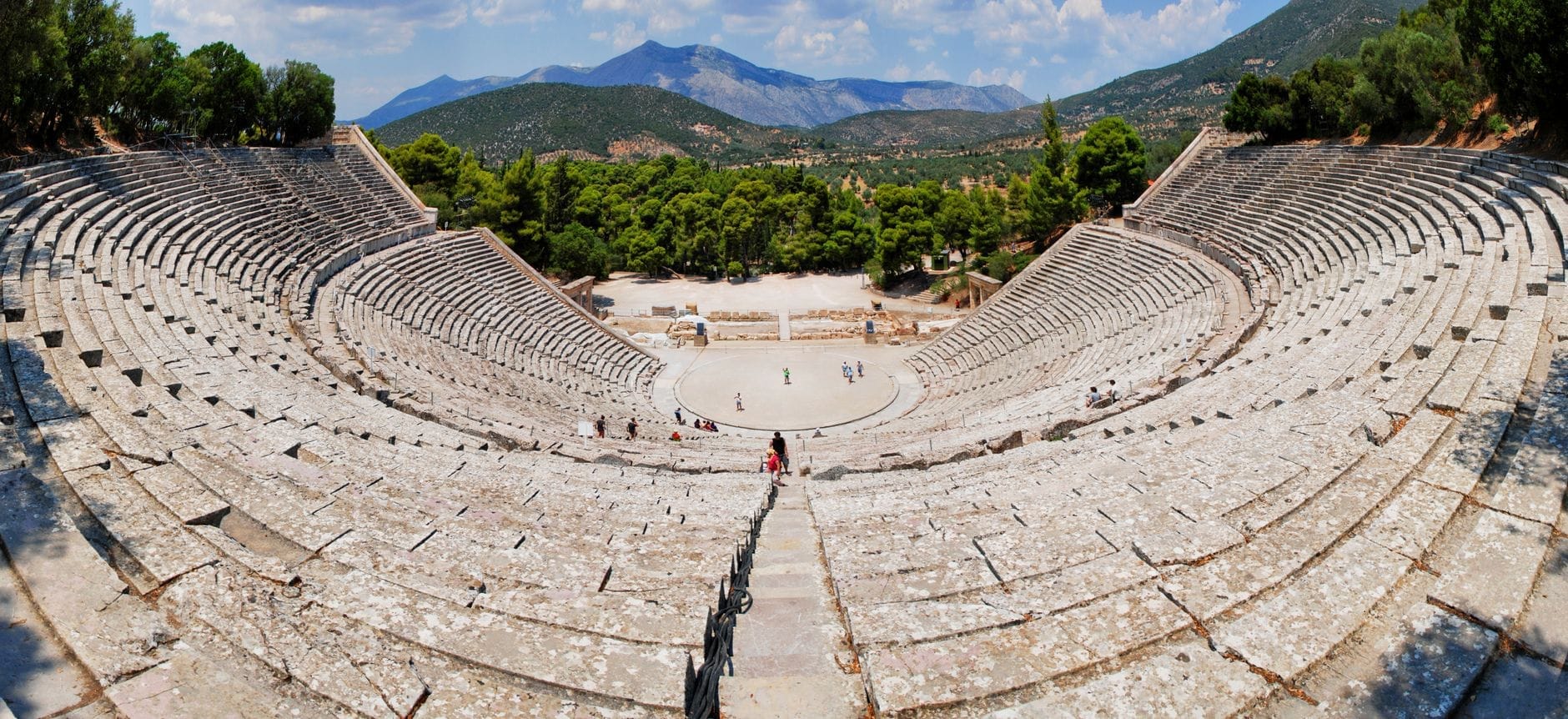
Set within the UNESCO-listed Sanctuary of Asklepios, the theatre was built in two phases: the initial cavea dates to the 4th century BC, attributed by ancient sources to the architect Polykleitos the Younger, while a second phase of expansion in the mid-2nd century BC extended the seating to its current capacity of approximately 14,000 spectators. The result is a near-perfect semicircle of 55 tiered rows in pale limestone, rising from the circular orchestra floor at its centre up into the pine-covered hillside of Mount Kynortion.
The proportions are deliberate and precise: the lower 34 rows belong to the original 4th-century construction, while the upper 21 rows were added in the Hellenistic period to reach a total of 55. These rows are divided into 12 wedge-shaped sections (kerkides). From the top row, the view extends across the Argolid plain toward the distant sea. From the orchestra floor, the entire stone arc curves above you with a weight that feels both mathematical and alive.
💡 Local tip
The site is part of the larger Sanctuary of Asklepios archaeological complex. Allow at least 30 minutes beyond the theatre itself to explore the Tholos, the stadium, and the museum on site. Entry is via a single archaeological site ticket.
The Acoustics: Why Everyone Drops a Coin
Every visitor eventually does it: stands at the centre of the circular orchestra, drops a coin, tears a piece of paper, or whispers something — and listens. The acoustic properties of the theatre are exceptional and well-documented. A person speaking at normal volume from the orchestra can be heard clearly in the uppermost rows, roughly 60 metres away, without any amplification whatsoever.
Research published by Georgia Tech acoustical engineers in the early 2000s proposed that the limestone seating acts as a natural acoustic filter, suppressing low-frequency background noise (wind, crowd murmur) while preserving the higher frequencies of the human voice. Whether or not the original architects understood this effect through calculation or empirical refinement over time, the result is a space where the relationship between performer and audience was engineered to a level not matched by most modern theatres.
During a summer festival performance, when the seats are full at dusk and the stage lighting is minimal against the darkening sky, the acoustic effect becomes visceral rather than academic. Sound arrives without delay or muddiness. The experience of watching ancient drama — Sophocles, Euripides, Aristophanes — in the original performance context feels less like a historical re-enactment and more like an acknowledgement that the architecture was right the first time.
Tickets & tours
Hand-picked options from our booking partner. Prices are indicative; availability and final rates are confirmed when you complete your booking.
Ancient Corinth and Nafplion full-day tour from Athens
From 56 €Instant confirmationFree cancellationAncient Agora self-guided audio tour
From 12 €Instant confirmationFree cancellationAncient Olympia full day guided tour from Athens
From 70 €Instant confirmationFree cancellationPrivate Biblical Tour of Ancient Corinth and Isthmus Canal from Athens
From 499 €Instant confirmationFree cancellation
The Sanctuary of Asklepios: Context You Shouldn't Skip
The theatre is the most famous component of a much larger sacred complex. The Sanctuary of Asklepios at Epidaurus was inscribed as a UNESCO World Heritage Site in 1988 and functions as one of the most significant healing sanctuaries of the ancient Greek world. Asklepios, the god of medicine, was said to have been born in this region, and pilgrims came here from across the Mediterranean seeking cures. For visitors planning a broader Peloponnese itinerary, the Ancient Corinth is a natural complement — roughly 50 kilometres northwest — offering a different register of Greek history within the same region.
Within the sanctuary grounds you'll find the remains of the Tholos (a circular building whose purpose remains debated by scholars — possibly connected to healing rituals or the cult of Asklepios), the abaton or enkoimeterion where patients would sleep hoping for divine cure, the temple of Asklepios itself, a stadium, and Greek baths. The on-site Archaeological Museum of Epidaurus holds significant finds from the excavations, including architectural fragments from the Tholos and inscriptions recording miraculous cures.
Arriving with some understanding of this healing context changes how you read the theatre's presence here. Drama in ancient Greece was not purely entertainment — it was a civic and religious act, inseparable from the life of the sanctuary. Theatre, healing, and worship occupied the same physical and conceptual landscape.
How the Experience Changes by Time of Day and Season
Morning visits, particularly in spring and early autumn, offer the clearest conditions. The light in the Argolid at 9–10am is sharp and directional, cutting across the stone rows to emphasise the geometry of the cavea. The site receives relatively fewer visitors in the first hour after opening, which means you can walk down to the orchestra and stand there without a crowd pressing in behind you.
By midday in July and August, the exposed limestone seating radiates heat intensely. There is almost no shade within the theatre itself. A midday visit in peak summer requires a hat, sunscreen, and water — this is not overstated. The surrounding pinewood beyond the theatre offers shelter, but the seating rows do not.
The festival experience is categorically different from a daytime archaeological visit. Performances by the Athens Epidaurus Festival, typically held on summer evenings, begin after sunset. The temperature drops to something manageable. The stone, which has absorbed heat all day, releases warmth gently from beneath you. Bring a light layer regardless of forecast temperatures — the upper rows can turn cool by midnight. The drive back to Athens (approximately two hours) will end well after midnight, so plan accommodation in Nafplio or nearby if you prefer not to return the same night.
⚠️ What to skip
Festival rules are strictly enforced: no entry after the performance begins (except at the interval), no children under six years old, no food or drink inside, no photography or recording, and no high-heeled footwear on the stone seating. The no-heels rule is both a conservation measure and a practical one — the ancient steps are uneven.
Getting There from Athens: The Practical Reality
Epidaurus is a day trip that requires planning, not something you can improvise on the same morning. The site sits near Lygourio in the Argolis region of the Peloponnese, roughly 150 kilometres from central Athens. By car, the route follows the Athens–Corinth motorway (E94), crosses the Corinth Canal area, and then continues south on the road toward Epidaurus and the sanctuary. Allow two hours in normal traffic. If you're combining the visit with Ancient Corinth or Mycenae, both are within 45–60 minutes of Epidaurus and make logical additions to a full Peloponnese day.
KTEL intercity buses connect Athens (Kifissos terminal) with the Epidaurus area, but schedules are limited and the bus typically serves coastal Epidaurus settlements rather than stopping directly at the archaeological site. From there, a taxi to the sanctuary adds additional time and logistics. For daytime visits without a car, a guided day tour from Athens is a practical option and typically more efficient than piecing together public transport.
For festival performance nights, the Athens Epidaurus Festival organises dedicated coach transfers from central Athens on performance evenings. These sell out, so book alongside your performance ticket. Full details on the day trips from Athens guide covers transport options in more detail.
ℹ️ Good to know
The archaeological site opening hours vary by season and are set by the Hellenic Ministry of Culture. Always verify current hours on the official ministry or site listing before making the journey — arriving to find the site closed after a two-hour drive is a recoverable but avoidable mistake.
Accessibility, Photography, and What to Bring
Wheelchair users can access the site by vehicle up to the square immediately outside the theatre, and accessible toilet facilities are available on site. The seating rows themselves are stone steps without handrails, making independent navigation of the full cavea physically challenging for visitors with limited mobility. The orchestra level and lower sections of the site are more accessible than the upper tiers.
Photography during daytime visits is unrestricted and the conditions are excellent: the geometry of the theatre rewards a wide lens from the upper rows, while close-up work on the limestone texture and ancient inscriptions is worth time at the orchestra level. During festival performances, photography and recording of any kind are prohibited, including with mobile phones.
Bring water and snacks. There is a cafe and shop near the site entrance, but the distances inside the sanctuary are greater than they appear on maps, and the heat in summer is significant. Comfortable walking shoes with grip are important — the ancient stone surfaces, particularly the stepped seating, become smooth and slightly slippery when dry.
Who This Trip Is Really For — and Who Might Reconsider
Epidaurus rewards visitors who are genuinely curious about ancient Greek civilisation, architecture, or performing arts history. If your Athens itinerary is already dense with archaeological sites — the Acropolis, the Ancient Agora, the Acropolis Museum — Epidaurus adds something qualitatively different rather than more of the same. Its scale, its acoustic character, and its setting in a healing sanctuary give it a distinct atmosphere from urban Athens sites.
That said, visitors expecting a highly curated, interpretive experience should calibrate expectations. On-site signage is present but not exhaustive. The museum is relatively modest in scale. What the site offers is presence and space — the sense of standing inside something that has functioned continuously as a gathering place for human expression for over two millennia. If that resonates with you, the two-hour drive is worth it without qualification.
Families with young children will find the journey long relative to the time children can comfortably spend at an archaeological site. The festival specifically prohibits children under six. For families travelling with older children interested in history or myth, it works well, particularly if paired with a stop at the beach near Nafplio on the return.
Insider Tips
- Stand at the exact centre of the circular orchestra — there is usually a worn mark on the stone — and whisper or drop a small object. The acoustic return from the upper rows is immediately audible and more striking than any description of it.
- Festival coach transfers from Athens book up quickly. Purchase your transport ticket at the same time as your performance ticket through the Athens Epidaurus Festival website, not separately afterward.
- The Archaeological Museum on site is small but contains the carved acanthus column capital from the Tholos — one of the most refined surviving examples of late Classical Greek architectural ornament. Most visitors walk past it to reach the theatre and never see it.
- If driving, arrive when the site opens and walk the full sanctuary circuit before the main tour groups arrive around 10:30–11am. The theatre will be largely yours for the first 30–45 minutes.
- Nafplio, 30 minutes south, is one of the most pleasant towns in the Peloponnese and a logical base if you're attending a festival performance. Staying overnight removes the pressure of the midnight return drive to Athens and allows an early start the next morning.
Who Is Ancient Theatre of Epidaurus For?
- History and archaeology enthusiasts who want more than Athens city sites
- Architecture and engineering fans drawn to ancient acoustic design
- Theatre and performing arts visitors, especially during the Athens Epidaurus Festival in summer
- Road-trippers planning a wider Peloponnese itinerary including Mycenae and Corinth
- Travellers seeking a slow, contemplative experience in a landscape that hasn't changed fundamentally in 2,400 years
Nearby Attractions
Combine your visit with:
- Ancient Corinth & Acrocorinth
Ninety kilometres west of Athens, Ancient Corinth and the towering fortress of Acrocorinth pack more history per square metre than almost anywhere in Greece. Roman temples, Greek agora ruins, a world-class on-site museum, and a 575-metre hilltop citadel often described as one of the largest castles in Greece make this one of the most rewarding day trips from the capital.
- Daphni Monastery
Standing on the ancient Sacred Way to Eleusis, Daphni Monastery is one of the finest surviving examples of middle Byzantine architecture in Greece. Its 11th-century golden mosaics rival anything in Ravenna or Constantinople — and most visitors to Athens never make it here.
- Delphi
Perched on the slopes of Mount Parnassus, the Archaeological Site of Delphi was once the spiritual centre of the ancient Greek world. A UNESCO World Heritage Site since 1987, it combines dramatic mountain scenery with some of the most significant ruins in Greece, including the Temple of Apollo, the Sacred Way, and a first-rate archaeological museum.
- Mycenae
The Archaeological Site of Mycenae stands on a commanding hill in the Peloponnese, about 120 kilometres southwest of Athens. Home to the Lion Gate, massive Cyclopean walls, and royal shaft graves, this UNESCO World Heritage Site was the dominant power centre of prehistoric Greece between roughly 1600 and 1100 BCE. A visit combines monumental architecture, mythological weight, and sweeping views across the Argolic plain.