Delphi Archaeological Site: The Oracle, the Ruins, and the Journey from Athens
Perched on the slopes of Mount Parnassus, the Archaeological Site of Delphi was once the spiritual centre of the ancient Greek world. A UNESCO World Heritage Site since 1987, it combines dramatic mountain scenery with some of the most significant ruins in Greece, including the Temple of Apollo, the Sacred Way, and a first-rate archaeological museum.
Quick Facts
- Location
- Near the village of Delphi, Phocis, Central Greece, on the slopes of Mount Parnassus. Approx. 180 km northwest of Athens.
- Getting There
- KTEL intercity bus from Athens Liossion terminal (verify current schedules). By car: roughly 2.5–3 hours via the Athens–Lamia highway and local roads through Arachova.
- Time Needed
- Half day minimum; a full day allows the site, museum, and lunch in the village without rushing.
- Cost
- Combined ticket (site + museum): €20 full, €10 reduced. Verify current prices and free-entry days at delphi.culture.gr before visiting.
- Best for
- History enthusiasts, archaeology buffs, day-trippers from Athens seeking ancient sites beyond the city.
- Official website
- delphi.culture.gr
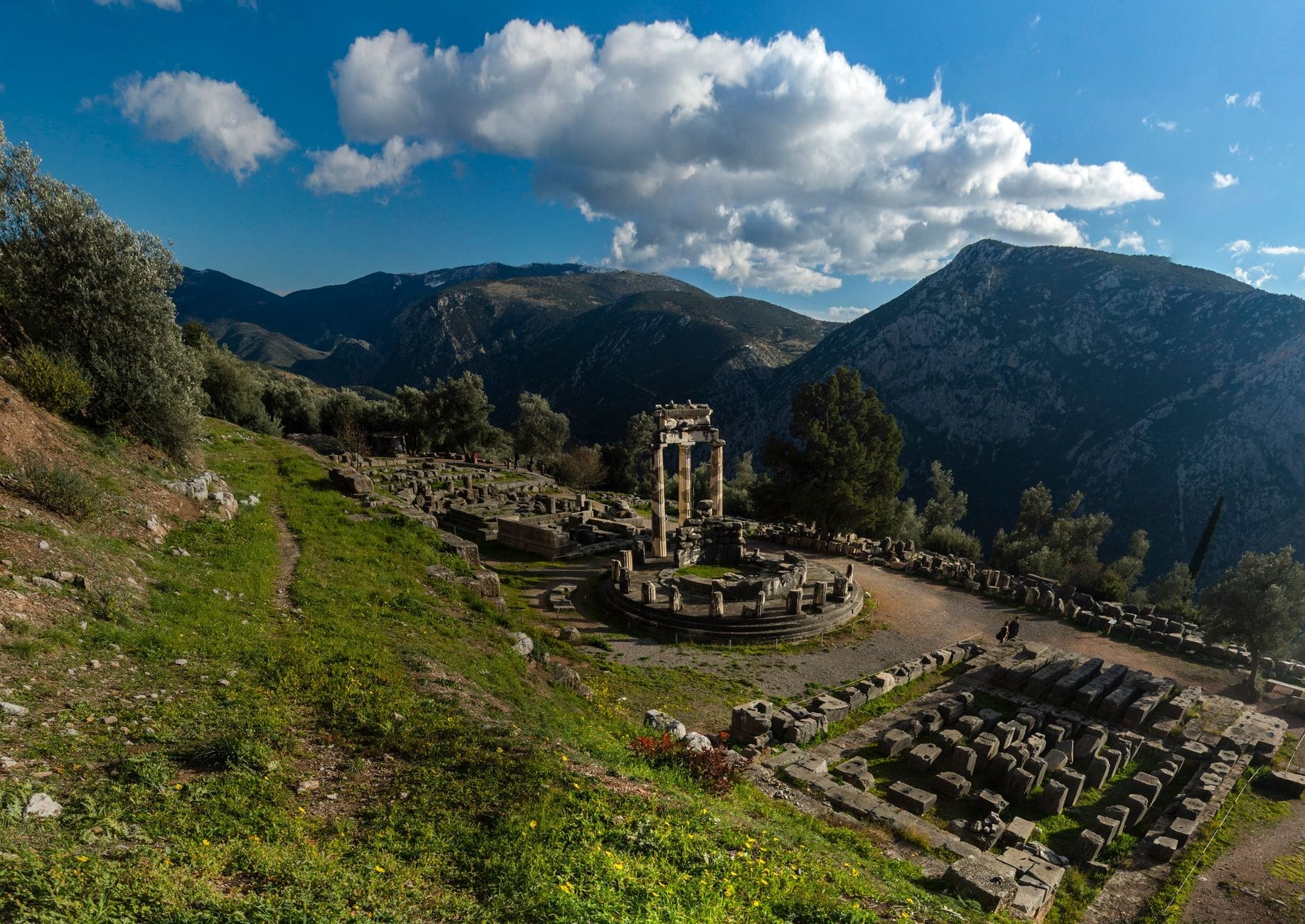
Why Delphi Deserves More Than a Glance
The Archaeological Site of Delphi occupies a ledge on the southern slope of Mount Parnassus, above a steep gorge falling toward the Gulf of Corinth. From this vantage point, the ancient Greeks believed they stood at the navel of the world, the omphalos, the exact centre of the earth. That belief shaped a sanctuary whose influence stretched from Iberia to the Black Sea for nearly a thousand years.
What you find here today is not a single monument but a layered landscape: the worn limestone steps of the Sacred Way climbing toward the Temple of Apollo, the restored columns of the Treasury of the Athenians, the theatre carved into the hillside above, and the stadium higher still. Every level reveals something, and the mountain drops away behind you the whole time.
For visitors already covering the Acropolis and the Ancient Agora in Athens, Delphi adds a completely different dimension: sanctuary architecture in a natural setting rather than an urban one, and a cultural weight that is harder to compress into a single afternoon.
💡 Local tip
Arrive by 9:00 at the latest if you come by private car. The site gets genuinely congested between 10:30 and 13:00 when tour buses arrive from Athens. The light is also far better in the morning, with Parnassus still in shadow behind you and the valley catching the sun below.
The Historical Weight of the Place
The area around Delphi shows evidence of occupation stretching back to the 2nd millennium BC, with Mycenaean remains dated to roughly 1500–1100 BC. But the site as a religious centre took shape in the 8th century BC, when the oracle of Apollo began attracting city-states, kings, and individuals seeking guidance on everything from colonisation ventures to personal decisions. By the 6th century BC, Delphi had become a symbol of pan-Hellenic unity, the one place where rival states sent gifts, built treasuries, and agreed on a common set of religious rules.
The Temple of Apollo that stands, partially, today dates to around 510 BC. It was funded by contributions from multiple Greek cities and built under the influence of the Alcmaeonid family of Athens. Earlier temples occupied the same terrace before it, a poros-stone version from the 7th century BC and another from the 6th. The famous maxims inscribed at the entrance, including 'Know thyself,' were attributed to the Seven Sages. Inside, the Pythia, Apollo's priestess, sat on a tripod above a chasm and delivered her oracles. The consultations stopped in 390 AD, when the Roman Emperor Theodosius I prohibited non-Christian religious practices.
UNESCO inscribed the Archaeological Site of Delphi on its World Heritage List in 1987 (list no. 393), recognising both its outstanding universal value as a historic sanctuary and the quality of its surviving structures and landscape.
Tickets & tours
Hand-picked options from our booking partner. Prices are indicative; availability and final rates are confirmed when you complete your booking.
Entrance ticket to Delphi archaeological site and museum
From 26 €Instant confirmationDelphi archaeological site with virtual reality from Athens
From 37 €Instant confirmationFree cancellationDelphi Archaeological Museum E-ticket and Audio Tour
From 12 €Instant confirmationAthens National Archaeological Museum e-ticket and audio tour
From 22 €Instant confirmation
Walking the Site: What You Actually See
The modern entrance puts you at the lower edge of the Sanctuary of Apollo. You climb the Sacred Way on foot, a paved route that bends upward between the stone bases of long-vanished statues and the facades of city-state treasuries. The Treasury of the Athenians is the most complete structure here, a compact Doric building reconstructed in the early 20th century using original blocks. It was built after the Athenian victory at the Battle of Marathon in 490 BC, and the walls are still faintly carved with hymns to Apollo.
Further up, the Sanctuary of Athena Pronaia sits on the lower, separate terrace on the other side of the main road. This is where the Tholos stands, the circular building whose three restored Doric columns appear in almost every photograph taken of Delphi. Its exact function is still debated by archaeologists, which makes it more interesting, not less. Allow time to walk down to this area; the views from the Tholos terrace across the olive grove toward the sea are among the best on the entire site.
Above the Temple of Apollo, the ancient theatre seats roughly 5,000 people and is remarkably well preserved. Performances still take place here occasionally. From the highest rows, the spatial relationship between the sanctuary below and the mountains above becomes fully legible. Higher still, a 15-minute uphill walk through the trees, the stadium held the Pythian Games, which were second in prestige only to the Olympics. The starting and finishing lines are still visible in the stone.
⚠️ What to skip
The climb from the entrance to the stadium involves significant elevation gain on uneven ancient paving. Wear proper shoes with grip, not sandals or smooth-soled footwear. The site is not suitable for wheelchairs or pushchairs in most sections due to steep gradients and irregular terrain.
The Archaeological Museum of Delphi
The museum sits just below the main entrance to the site and is included in the combined ticket. It deserves at least 90 minutes. The collection focuses entirely on objects excavated at Delphi, which means everything here has a direct physical connection to the sanctuary you just walked through. The Charioteer of Delphi, a full-size bronze figure from around 478 BC, is one of the finest surviving bronzes from classical antiquity. The realism of the eyes, the detail of the footwear, the precise drapery of the robe are all the more striking for how rarely bronze survived the ancient world.
Elsewhere in the museum, the Omphalos stone, a carved marble navel marker, anchors the claim that this was the centre of the world. The friezes from the Siphnian Treasury, displayed in a long gallery, show scenes from the Gigantomachy and the Trojan War in high-relief marble with original painted details still faintly visible in places. Museum hours broadly follow the archaeological site’s seasonal schedule (longer in summer, shorter in winter); verify current hours at delphi.culture.gr before your visit.
Getting There from Athens
Delphi is around 180 kilometres from central Athens, and the drive takes approximately 2.5 to 3 hours depending on traffic, particularly on the Athens ring road on weekends. The route runs northwest via the Athens–Lamia motorway, then branches toward Arachova, the mountain village just under 10 kilometres before Delphi. Arachova itself is worth a brief stop: its main street sits at over 900 metres elevation and the air quality is noticeably different from the Attica basin.
KTEL operates intercity buses from Athens to Delphi. Departures are typically from the Liossion terminal in Athens; verify current timetables and booking options directly with KTEL before travelling. The journey takes approximately three hours. For travellers without a car who want to cover multiple archaeological sites in the region, day trips from Athens can also be combined with ancient Corinth or other Peloponnese stops on a longer itinerary.
Organised day tours from Athens to Delphi depart regularly from the city centre and typically include transport, a guided walk of the site, and museum entry. These work well for first-time visitors who want context without the logistics of self-driving, though they usually impose a fixed timetable that limits time at the museum.
ℹ️ Good to know
If you are driving, be aware that the road through Arachova narrows significantly in the village centre. In winter and early spring, the road to Delphi can be affected by snow or ice, as Parnassus is an active ski area. Check road conditions before departure between November and March.
Practical Details and Photography
The combined ticket covering the archaeological site and museum is priced at €20 full and €10 reduced, though prices and free-entry days change periodically under Ministry of Culture policy. Check the current tariff at delphi.culture.gr before you go. There is a small gift shop at the museum exit and a café in the modern village, a short walk from the entrance, where lunch options are adequate without being memorable.
Photography without tripod or flash is generally permitted across the site and in most museum galleries. The best natural light for photographing the Temple of Apollo columns falls in the morning, when the sun is still in the east and the limestone glows without harsh shadows. The Tholos at the Sanctuary of Athena Pronaia photographs well at almost any hour because the olive grove around it catches and diffuses light. Inside the museum, the Charioteer gallery is artificially lit to a consistent standard and photographs cleanly even with a phone camera.
Visitors staying overnight in Athens planning their broader itinerary should consult the Athens ancient sites guide for context on how Delphi fits alongside the city's own archaeological landscape. If you are spending several days, the 3-day Athens itinerary suggests how to build Delphi into a longer visit without sacrificing the main city sites.
Who This Attraction Suits, and Who It Does Not
Delphi rewards visitors who bring some context with them, either from reading beforehand, using a guided tour, or spending time in the museum before the site. Without that frame, the ruins can feel like a sequence of stone platforms and column stumps, atmospheric but hard to read. Families with young children face the additional challenge of the steep terrain and the distance between the sanctuary sections. Those with limited mobility should be aware that much of the site is inaccessible due to the slope and uneven ancient surfaces.
Visitors who prefer urban experiences, contemporary art, or a more relaxed pace will likely find the journey long relative to the time spent. The round trip from Athens is roughly six hours of travel alone for a day visit. That said, for travellers with a serious interest in classical antiquity, Delphi ranks alongside the Acropolis as a formative experience of ancient Greece, and the natural setting gives it a character that no urban site can replicate.
Insider Tips
- The Sanctuary of Athena Pronaia, where the Tholos stands, is on a separate lower terrace across the main road from the Apollo sanctuary. Many visitors on tight schedules skip it entirely. Do not: the Tholos and the view across the olive groves toward the Gulf of Corinth are among the most visually striking things at Delphi.
- The village of Arachova, 10 km before Delphi on the road from Athens, has better restaurants and a more authentic atmosphere than the tourist-facing village directly adjacent to the site. If you are making a day of it, eat in Arachova rather than at the site cafe.
- Spend time with the Siphnian Treasury frieze in the museum before you walk the site. The visual grammar of the relief carvings makes the stripped stone bases along the Sacred Way much easier to imagine when you have seen what once decorated them.
- The stadium at the top of the site is the least visited section simply because of the climb required. Arriving early and going straight to the stadium first, while it is empty and cool, then working back downhill through the theatre and temple, reverses the natural flow but avoids both crowds and midday heat.
- Free entry days are offered periodically by the Hellenic Ministry of Culture, including the last weekend of September during European Heritage Days and certain national holidays. Check the official calendar at delphi.culture.gr if your visit date is flexible.
Who Is Delphi For?
- Classical history enthusiasts who want to understand the oracle and its pan-Hellenic significance beyond textbook descriptions
- Day-trippers from Athens seeking an archaeological site with dramatic natural scenery rather than an urban setting
- Photography-focused travellers interested in ancient architecture framed by mountain landscape
- Museum visitors: the Delphi Archaeological Museum holds one of the finest collections of archaic and classical Greek sculpture and bronze work in Greece
- Travellers combining Delphi with a stop in Arachova or a broader circuit through Central Greece and the Peloponnese
Nearby Attractions
Combine your visit with:
- Ancient Corinth & Acrocorinth
Ninety kilometres west of Athens, Ancient Corinth and the towering fortress of Acrocorinth pack more history per square metre than almost anywhere in Greece. Roman temples, Greek agora ruins, a world-class on-site museum, and a 575-metre hilltop citadel often described as one of the largest castles in Greece make this one of the most rewarding day trips from the capital.
- Daphni Monastery
Standing on the ancient Sacred Way to Eleusis, Daphni Monastery is one of the finest surviving examples of middle Byzantine architecture in Greece. Its 11th-century golden mosaics rival anything in Ravenna or Constantinople — and most visitors to Athens never make it here.
- Ancient Theatre of Epidaurus
Carved into a hillside in the Peloponnese, the Ancient Theatre of Epidaurus is the best-preserved ancient theatre in the Greek world. With seating for around 14,000 spectators and acoustics that still astonish architects and engineers, it remains a working performance venue during the Athens Epidaurus Festival each summer. This is one of the most rewarding day trips from Athens.
- Mycenae
The Archaeological Site of Mycenae stands on a commanding hill in the Peloponnese, about 120 kilometres southwest of Athens. Home to the Lion Gate, massive Cyclopean walls, and royal shaft graves, this UNESCO World Heritage Site was the dominant power centre of prehistoric Greece between roughly 1600 and 1100 BCE. A visit combines monumental architecture, mythological weight, and sweeping views across the Argolic plain.