Ancient Corinth and Acrocorinth: The Day Trip That Rewrites Athens
Ninety kilometres west of Athens, Ancient Corinth and the towering fortress of Acrocorinth pack more history per square metre than almost anywhere in Greece. Roman temples, Greek agora ruins, a world-class on-site museum, and a 575-metre hilltop citadel often described as one of the largest castles in Greece make this one of the most rewarding day trips from the capital.
Quick Facts
- Location
- Ancient Corinth village, Corinthia, Peloponnese — approx. 90 km west of central Athens
- Getting There
- Train from Athens Larissa Station to Corinth, then local taxi or bus to Ancient Corinth village; by car via E94 motorway, roughly 1 hour
- Time Needed
- 4–6 hours for site, museum, and Acrocorinth combined; full day recommended
- Cost
- Ancient Corinth site + museum: €15 combined ticket (verify before visiting); Acrocorinth: currently free of charge. Free entry on select national holidays and every first Sunday Nov–Mar
- Best for
- History enthusiasts, archaeology fans, hikers, photographers, day-trippers from Athens
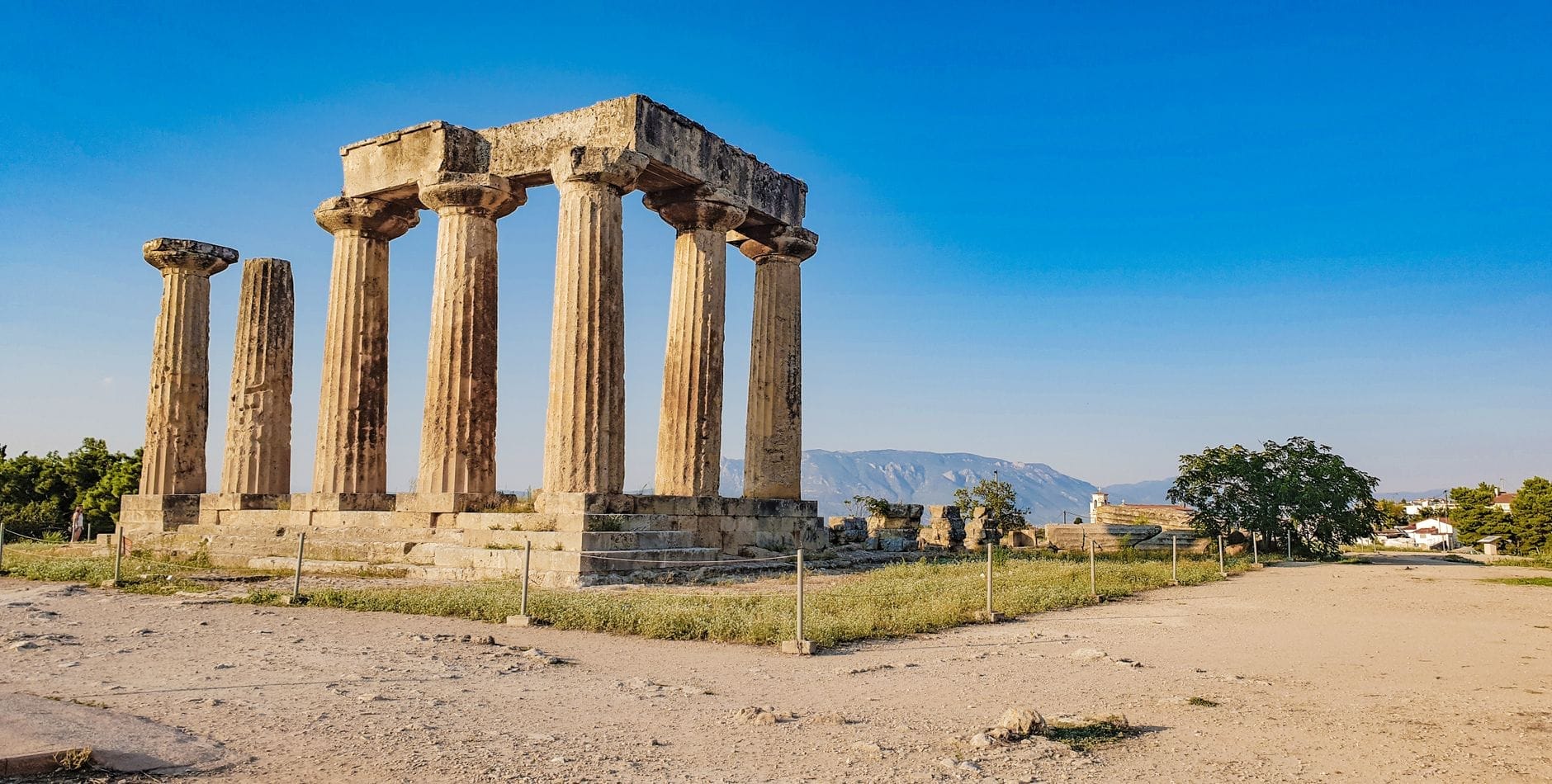
Why Ancient Corinth Deserves More Attention Than It Gets
Ancient Corinth is chronically underestimated. Most Athens visitors are so focused on the Acropolis that this site — once one of the richest and most powerful cities in the ancient Mediterranean — barely makes the shortlist. That is a genuine mistake. The archaeological site at Ancient Corinth, paired with the mountainous fortress of Acrocorinth looming overhead, offers a layered historical experience that spans Mycenaean foundations, classical Greek power politics, Roman colonial ambition, Byzantine Christianity, Frankish crusaders, Ottoman occupation, and Venetian military engineering. Very few places in Greece compress that many civilisations into a single afternoon.
Ancient Corinth controlled the narrow Isthmus of Corinth, the land bridge connecting mainland Greece with the Peloponnese, making it one of the great commercial hubs of antiquity. Goods were physically dragged across the isthmus on a stone trackway called the diolkos to avoid the dangerous sea route around the southern Peloponnese. For a day trip that gives real context to why ancient Greece worked the way it did, this site pairs naturally with a broader plan. If you are building an Athens itinerary, our Athens ancient sites guide covers how to sequence your visits across multiple days.
💡 Local tip
Arrive at the archaeological site when it opens (08:00 in summer, 08:30 in winter). The light is cooler, the crowds are minimal, and the Temple of Apollo looks spectacular in early morning sun. Leave Acrocorinth for mid-morning, when the haze has lifted enough for panoramic views, noting that the fortress itself currently opens at 08:30 year-round.
The Archaeological Site: What You Actually See
The formal address of the site is Ancient Corinth 20007, Greece, in the small modern village of Ancient Korinthos that has grown up around the ruins. Entry covers both the open-air archaeological zone and the Archaeological Museum of Ancient Corinth, housed in a handsome early 20th-century building at the heart of the site. The combined ticket is currently €15 (verify before visiting, as prices are subject to revision by the Greek Ministry of Culture).
The dominant visual anchor is the Temple of Apollo, seven of whose original Doric columns still stand. They date to around 550 BC, making them among the oldest standing monolithic columns in Greece. The columns are thick-set and slightly tapering, their limestone surface worn to a warm honey colour that shifts to almost orange in the afternoon light. Standing beneath them gives a clear sense of the scale ancient Greek architecture operated at, without the crowds that make a similar moment at the Parthenon harder to achieve.
Beyond the temple, the site spreads into what was the Roman forum, laid out after Julius Caesar refounded Corinth as a Roman colony in 44 BC. The city had been razed to the ground by the Roman general Lucius Mummius in 146 BC, a deliberate act of destruction that effectively ended the Greek city. The Roman rebuilding overlaid the Greek street plan but respected some of its bones. You walk across the bema, a raised stone platform from which Roman officials addressed the city's population, and past the remains of marble-clad shops lining the south stoa. The scale of the Roman city becomes clear when you realise these colonnaded commercial streets stretched for hundreds of metres.
The On-Site Museum: Don't Rush This Part
Many visitors spend most of their time in the open-air ruins and give the museum only a cursory glance. That is worth reconsidering. The Archaeological Museum of Ancient Corinth holds material that would be headline exhibits in most national collections: Archaic-period pottery with extraordinarily sophisticated polychrome decoration, Roman portrait sculpture, terracotta votives from the sanctuary of Asklepios (many depicting human body parts left as offerings for healing), and a collection of mosaic floors from Roman-era Corinthian houses. The mosaics alone justify spending 45 minutes here. The museum is air-conditioned, which matters considerably if you visit between June and August, when outdoor temperatures regularly exceed 35°C.
Tickets & tours
Hand-picked options from our booking partner. Prices are indicative; availability and final rates are confirmed when you complete your booking.
Ancient Corinth and Nafplion full-day tour from Athens
From 56 €Instant confirmationFree cancellationPrivate Biblical Tour of Ancient Corinth and Isthmus Canal from Athens
From 499 €Instant confirmationFree cancellationAncient Corinth and Canal Tour with Audio Guide and Virtual Reality
From 35 €Instant confirmationFree cancellationAncient Corinth Self-Guided Audiovisual Tour with 3D Models
From 9 €Instant confirmationFree cancellation
Acrocorinth: The Fortress Above Everything
Acrocorinth sits on a table mountain approximately 575 metres above sea level, connected to the ancient site below by an asphalt road that takes about 10 minutes by car or taxi. It is often described as one of the largest castles in Greece, and when you see the walls stretching across the ridge, that claim feels entirely plausible. The fortifications have foundations reaching back to the Mycenaean period, but took their most monumental form in the 7th to 6th centuries BC under the Cypselid tyrants. Everything that came after — Byzantine additions, Frankish towers built by the crusading Villehardouin family, Venetian reinforcements, Ottoman modifications — stacked itself on those early foundations.
The entrance is reached through three successive gates, each from a different historical period, which gives an immediate physical lesson in how the site was layered over centuries. Inside, the fortress contains the remains of a sanctuary to Aphrodite (ancient sources claimed it housed over a thousand sacred prostitutes, though modern historians treat that figure with considerable scepticism), a Frankish tower, a mosque from the Ottoman period, and the upper spring of Peirene, one of Corinth's two famous fresh water sources. The lower spring of Peirene is visible at the main archaeological site.
The views from the summit are the practical reason most people make the climb. On a clear day you can see across the Gulf of Corinth to the mountains of central Greece to the north, south across the Peloponnese, and east toward the Saronic Gulf. In spring and autumn, when the air is cleaner, this panorama is genuinely extraordinary. In summer, midday haze often reduces visibility significantly, which is another reason to arrive early. Admission to Acrocorinth is currently free of charge.
⚠️ What to skip
Acrocorinth involves a steep ascent on uneven stone paths inside the fortress walls. Visitors with limited mobility will find significant sections inaccessible. Sturdy shoes with grip are essential regardless of fitness level. The road up to the entrance from the village below is long enough that walking it in summer heat is inadvisable; take a taxi or drive.
How the Experience Changes by Time of Day
The archaeological site at Ancient Corinth has very little shade. By mid-morning in summer, the exposed forum area becomes genuinely uncomfortable, and by early afternoon, walking across the marble and limestone surfaces in full sun is punishing. Tour groups typically arrive between 10:00 and 11:30, which is also when the site gets loudest and most crowded around the Temple of Apollo. If you want contemplative space around the ruins, the opening hour window and the hour before closing are the most useful.
Acrocorinth is best in the morning for photography. The fortress faces generally west, so afternoon light falls across the walls from the side, which is not ideal for capturing the main gate structures. Morning light from the east illuminates the triple gate sequence well. The interior of the fortress, being a large walled space open to the sky, is hot at any point during a summer afternoon but catches a breeze more reliably than the lower site.
Winter visits have a completely different character. The archaeological site and on-site museum close at 15:30 and are shut on Tuesdays. The low season solitude is real: you may have long stretches of the ruins entirely to yourself, the light is softer and more photogenic, and the landscape turns green around the site in a way that summer completely removes. The first Sunday of every month from November through March brings free admission to the site and museum, which can make a winter trip particularly good value.
Getting Here from Athens
By car, Ancient Corinth is roughly 90 kilometres from central Athens via the E94 motorway, passing the Corinth Canal before turning south toward the ancient village. Allow around 1–1.5 hours in normal traffic, more if departing after 08:00 on a summer weekday when motorway congestion builds.
By public transport, suburban trains on the Proastiakos line run from Athens Larissa Station to Corinth (modern Korinthos). From modern Corinth, a local taxi or infrequent bus covers the remaining distance to Ancient Corinth village. The journey requires planning since local connections are not as reliable as the train itself. Schedules and fares should be verified before travel through the official Hellenic Train network. If you are combining multiple Peloponnese sites in one trip, see our day trips from Athens guide for logistics and pairing options.
Organised tours from Athens are available and typically include both Ancient Corinth and Acrocorinth with transport and a guide, which removes the logistical overhead entirely. They are worth considering if you plan to add the nearby Corinth Canal to your itinerary, since juggling three sites independently across a day can become time-pressured.
Historical Context: Why Corinth Mattered
At its classical height, Corinth was among the wealthiest poleis in Greece. Its position astride the isthmus meant it collected tolls and trans-shipment fees from trade moving in every direction. The city developed its own distinctive ceramic style, Corinthian pottery, which was exported across the Mediterranean from the 8th century BC and is instantly recognisable by its animal friezes and geometric precision. Corinth was also an early naval power, credited in ancient sources with developing the trireme, the warship that would define Greek naval warfare.
The destruction of Corinth by Rome in 146 BC was a deliberate political signal: the same year Rome destroyed Carthage, wiping out two great rivals in a single year of war. The Roman city that Julius Caesar planted on the ruins a century later became the capital of the province of Achaea and the largest city in Roman Greece, larger than Athens. The Apostle Paul spent eighteen months in Roman Corinth around 50–51 AD, an episode documented in Acts of the Apostles and referenced in his two letters to the Corinthians. For those interested in early Christian history, Corinth is one of the key physical locations in the entire New Testament story. This historical richness makes it a natural complement to Athens's own ancient layers, which our 3-day Athens itinerary covers in depth.
Practical Notes Before You Go
Opening hours shift seasonally and are managed by the Greek Ministry of Culture. In summer (1 April to 31 October) the main archaeological site of Ancient Corinth and the on-site museum open at 08:00, with hours expected to extend to 20:00 in the summer season from May 2026. In winter (1 November to 31 March) they open at 08:30 and close at 15:30, with Tuesdays as the weekly closure day for the museum and main site. Last admission is 20 minutes before closing. Always verify current hours on the Ministry of Culture's official site before travelling, as schedules can change with short notice.
The site closes on 1 January, 25 March, Orthodox Easter Sunday, 1 May, and 25 to 26 December. It operates with adjusted hours on some other public holidays. Free entry applies on 6 March, 18 April, 18 May, the last weekend of September, 28 October, and every first Sunday from November through March.
There is a small cafe near the museum entrance and a few tavernas in the village of Ancient Korinthos just outside the site perimeter. These are perfectly adequate for a lunch break but not particularly notable for food quality. For serious eating, modern Corinth town has more options, or you can return to Athens where the food scene is considerably richer — our Athens food guide covers the city's best eating neighbourhoods and dishes.
ℹ️ Good to know
Photography inside the museum is generally permitted for personal use without flash. The open-air site is fully photographable. Drone use requires advance permission from the Ministry of Culture and is not permitted for casual visitors.
Who Should Reconsider This Trip
Ancient Corinth and Acrocorinth are not for everyone. Visitors looking for a tight two-hour cultural tick-box experience will find the logistics of reaching both sites from Athens disproportionate to what they gain. The site also lacks the immediate wow-factor of Athens's Acropolis: there is no single monument here that reads as dramatically from a distance. You need some interest in Roman urbanism, Greek colonial history, or military architecture to find the detail-level exploration genuinely rewarding.
Families with very young children face a practical challenge at Acrocorinth specifically, where the terrain inside the fortress is rough and the climb to the upper areas is steep. The main archaeological site below is manageable with older children who have some patience for ruins. Visitors with significant mobility limitations should note that Acrocorinth is largely inaccessible beyond the lower gates.
Insider Tips
- The lower spring of Peirene, visible within the main archaeological site near the museum, is one of the most intact ancient fountain houses in Greece. Most visitors walk past it quickly. Spend a few minutes here: the carved limestone basin and the underground collection channels are still in excellent condition, and it is a rare chance to see ancient water infrastructure at close range.
- If you are driving, the road up to Acrocorinth passes a small car park near the triple gate entrance. Park here rather than in the village below and walk the final stretch. The gate sequence — Venetian outer gate, Frankish middle gate, Byzantine inner gate — reveals itself gradually as you approach on foot, which is far more dramatic than arriving by car.
- Free entry days (first Sunday of the month, November through March) attract slightly more local visitors than a typical winter weekday, but crowds remain minimal compared to any summer day. A winter Sunday visit is one of the best combinations of value and solitude this site offers.
- The view from the upper sanctuary area inside Acrocorinth, looking down over the archaeological site and village to the Gulf of Corinth beyond, makes the effort of the full ascent worthwhile. Many visitors stop at the lower areas of the fortress and miss this perspective entirely.
- If you are visiting in spring, the hillside around Acrocorinth is covered in wildflowers, particularly from late March through April. The contrast between the grey fortress walls and the flowering landscape below is photographically striking and completely absent in the dry summer months.
Who Is Ancient Corinth & Acrocorinth For?
- History and archaeology enthusiasts who want depth beyond Athens's primary sites
- Travellers with an interest in Roman provincial life or early Christian history
- Hikers and active visitors comfortable with uneven terrain and a steep fortress ascent
- Photographers seeking dramatic ancient architecture without the crowds of central Athens
- Day-trippers from Athens looking to combine a major archaeological site with sweeping Peloponnese landscapes
Nearby Attractions
Combine your visit with:
- Daphni Monastery
Standing on the ancient Sacred Way to Eleusis, Daphni Monastery is one of the finest surviving examples of middle Byzantine architecture in Greece. Its 11th-century golden mosaics rival anything in Ravenna or Constantinople — and most visitors to Athens never make it here.
- Delphi
Perched on the slopes of Mount Parnassus, the Archaeological Site of Delphi was once the spiritual centre of the ancient Greek world. A UNESCO World Heritage Site since 1987, it combines dramatic mountain scenery with some of the most significant ruins in Greece, including the Temple of Apollo, the Sacred Way, and a first-rate archaeological museum.
- Ancient Theatre of Epidaurus
Carved into a hillside in the Peloponnese, the Ancient Theatre of Epidaurus is the best-preserved ancient theatre in the Greek world. With seating for around 14,000 spectators and acoustics that still astonish architects and engineers, it remains a working performance venue during the Athens Epidaurus Festival each summer. This is one of the most rewarding day trips from Athens.
- Mycenae
The Archaeological Site of Mycenae stands on a commanding hill in the Peloponnese, about 120 kilometres southwest of Athens. Home to the Lion Gate, massive Cyclopean walls, and royal shaft graves, this UNESCO World Heritage Site was the dominant power centre of prehistoric Greece between roughly 1600 and 1100 BCE. A visit combines monumental architecture, mythological weight, and sweeping views across the Argolic plain.