Daphni Monastery: Athens' Overlooked UNESCO Masterpiece
Standing on the ancient Sacred Way to Eleusis, Daphni Monastery is one of the finest surviving examples of middle Byzantine architecture in Greece. Its 11th-century golden mosaics rival anything in Ravenna or Constantinople — and most visitors to Athens never make it here.
Quick Facts
- Location
- Daphni/Chaidari, approx. 9 km west of the Acropolis in central Athens, along the ancient Sacred Way (Iera Odos) to Eleusis
- Getting There
- Athens Metro Line 3 to Agia Marina, then bus 866 or 876 toward Chaidari along Iera Odos; also reachable by taxi or car
- Time Needed
- 1 to 1.5 hours on site; allow extra for transit from central Athens
- Cost
- Free entrance (verify before visiting — opening days and seasonal hours may change)
- Best for
- Byzantine art lovers, history enthusiasts, travelers seeking major sites without the crowds
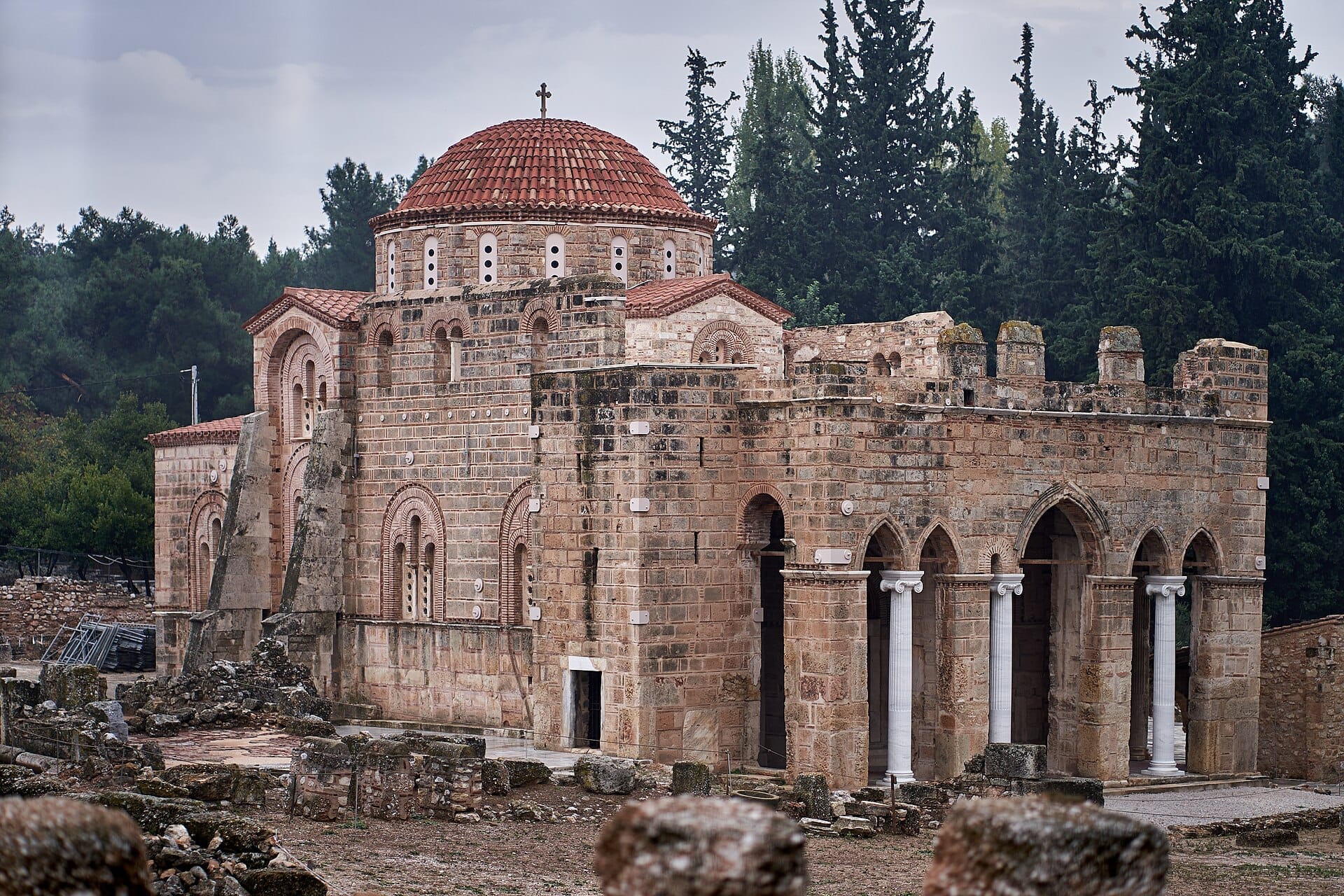
What Daphni Monastery Actually Is
Daphni Monastery is an 11th-century Byzantine church and monastic complex located in the western suburbs of Athens, roughly 9 kilometers from Syntagma Square along the route of the ancient Sacred Way (Iera Odos) that once connected Athens to Eleusis. Its full Greek name is Μονή Δαφνίου. The site forms part of the UNESCO World Heritage property "Monasteries of Daphni, Hosios Loukas and Nea Moni of Chios," inscribed in 1990 as an outstanding expression of middle Byzantine art and architecture.
The complex you visit today was built in the late 11th century, but its sacred history runs deeper. A Christian monastery was established here as early as the 6th century CE, itself built over an earlier sanctuary dedicated to Apollo — the name "Daphni" derives from the laurel (daphne) sacred to that god. The location was no accident: this stretch of road carried enormous religious traffic in antiquity, and later Byzantine builders understood the power of continuity.
⚠️ What to skip
Opening hours have been expanded following restoration and may change due to seasonal schedules and fire-risk closures. As of the latest official information, the monastery is open Monday, Wednesday, Thursday, Friday, Saturday and Sunday with defined winter and summer hours, and closed on Tuesday — always confirm current details with the Hellenic Ministry of Culture or the Ephorate of Antiquities of Western Attica before making the trip.
The Mosaics: Why This Place Matters
The reason art historians and Byzantine scholars travel specifically to Daphni is the mosaic program inside the katholikon, the main church. Executed around 1100 CE in gold tesserae and colored glass, these mosaics represent the high point of middle Byzantine monumental art. The technique involves tiny pieces of glass and stone set at slightly varying angles to catch and reflect candlelight, creating an effect that feels almost luminous rather than static.
The central dome contains the image that defines the monastery: the Pantokrator, a monumental bust of Christ as ruler of the universe. The face is rendered with an intensity that contemporary visitors consistently describe as arresting. This is not the gentle Christ of Western medieval iconography — the Pantokrator of Daphni has a severe, direct gaze that fills the dome with psychological weight. Surrounding figures in the apse and on the walls include the Virgin, the Annunciation, the Nativity, and the Crucifixion, all executed with the same controlled, hieratic authority.
Byzantine mosaic programs were theological arguments rendered in light and gold. The placement of each figure in the church was deliberate: Christ in the dome above, angels in the drum below, the Virgin and apostles in the apse, scenes from the life of Christ and the Virgin on the walls and vaults. At Daphni, enough of this program survives to understand its logic. That is not the case at many comparable sites.
Tickets & tours
Hand-picked options from our booking partner. Prices are indicative; availability and final rates are confirmed when you complete your booking.
Meteora monasteries and Hermit Caves full-day tour from Athens
From 120 €Instant confirmationFree cancellationFull-Day Excursion to Meteora Monasteries from Athens
From 100 €Instant confirmationFree cancellationGuided tour of the Acropolis, Parthenon and Museum in Athens
From 50 €Instant confirmationFree cancellationAthens: Temple of Olympian Zeus E-ticket with audio tour on your phone
From 10 €Instant confirmation
A Complicated History Worn in the Walls
After the Fourth Crusade and the Latin conquest of Greece in the early 13th century, Daphni was handed to Cistercian monks from Bellevaux in Burgundy. The Cistercians adapted the church to Catholic practice, and the Gothic funerary monuments of Frankish dukes were installed in the portico — some fragments survive. This collision of Byzantine and Western medieval cultures visible in a single building is historically unusual and underexplored in mainstream travel coverage.
The Ottomans later used the monastery as a garrison and the complex fell into disrepair. By the 19th century, after Greek independence, it served at various points as a psychiatric hospital — a jarring chapter in its story. The 1999 Athens earthquake caused significant structural damage to both the building and the mosaics, triggering a long restoration effort that has kept access limited and intermittent for years.
Understanding this layered history makes the physical visit far richer. If you want broader context for Byzantine Athens before you go, the Byzantine and Christian Museum in Kolonaki covers the arc of Byzantine civilization in Greece with exceptional clarity and is worth visiting alongside Daphni.
What the Visit Feels Like
The approach to Daphni is not glamorous. The monastery sits on a busy road in a suburban setting in Haidari, flanked by warehouses and light industrial buildings — nothing in the surrounding streetscape signals that you are about to encounter a UNESCO World Heritage site. The contrast between the exterior context and what waits inside is one of the more surprising experiences available on the Athens day-trip circuit.
The octagonal dome of the katholikon is relatively modest from the outside. The brickwork shows the characteristic Byzantine technique of alternating stone and brick courses in decorative patterns. Entering the church, your eyes need a moment to adjust. When they do, the gold of the mosaics catches the available light and the Pantokrator in the dome becomes the dominant visual fact of the space. The interior is small enough that you are never far from the mosaics — this is not a cathedral where you strain to see detail from a nave. At Daphni, you can stand close enough to study individual tesserae.
Because visitor numbers are low compared to the Acropolis or the main archaeological museums, the atmosphere inside is quiet in a way that feels genuine rather than managed. On a weekday morning in spring or autumn, you may have stretches of the interior largely to yourself. That kind of uninterrupted time with major Byzantine art is increasingly rare in Europe.
💡 Local tip
Bring a small torch or use your phone's flashlight to examine mosaic details in shadowed sections of the vaults. Natural light in the dome is usually adequate, but lower sections and the narthex can be dim.
Getting There and Practical Logistics
Daphni is not on any metro line directly. The most practical public transport approach involves taking Athens Metro Line 3 westward to Agia Marina and then connecting to bus routes 866 or 876 in the direction of Chaidari along the old Sacred Way (Iera Odos). The journey from central Athens takes roughly 30 to 45 minutes depending on connections. Taxi and rideshare services are considerably more convenient for a direct trip and the fare from the city center is reasonable.
By car, the monastery is straightforward to reach via the Iera Odos road and the nearby A6 corridor west of Athens. Parking is available near the site.
For travelers planning a broader ancient sites itinerary, Daphni pairs naturally with the Ancient Agora and the Kerameikos Archaeological Site — both accessible along or near the same westward axis from central Athens.
Dress code matters here. Modest clothing covering shoulders and knees is expected at religious monuments in Greece. Even if the church is not currently functioning as an active place of worship, the convention applies. Lightweight layers in summer are practical since the interior stays cooler than the open air, but the approach and courtyard offer no shade in midday heat.
When to Visit and Who Should Skip It
Spring (April to early June) and autumn (September to October) offer the most comfortable conditions for the journey out from central Athens. Summer heat on the exposed road and suburban surroundings can be punishing, and the current morning–afternoon opening hours mean a morning visit is usually preferable regardless of season. Winter access generally follows the regular schedule but may be affected by restoration work or temporary fire-risk closures, so always check current information.
Travelers with only one or two days in Athens should think carefully about the time investment. The transit journey is real, the opening hours are narrow, and the experience — extraordinary as the mosaics are — is focused and specialist rather than broad. If your Athens trip centers on a packed itinerary of the Acropolis, the Acropolis Museum, and central neighborhoods, Daphni fits better into a longer stay. A three-day Athens itinerary can accommodate it; a one-day visit probably cannot without sacrificing other major sites.
Travelers who will find this most rewarding: anyone with a serious interest in Byzantine art or medieval architecture; visitors who have already covered the classical sites and want the next layer; people who appreciate low-crowd, high-density historical experiences. Families with young children may find the limited access, modest scale, and art-history focus less engaging than other Athens options — the site has no visitor facilities to speak of and the surroundings offer nothing additional for non-specialist companions.
ℹ️ Good to know
Photography inside Byzantine churches in Greece is typically permitted without flash for personal use, but always check posted signs or ask staff on arrival. Flash photography damages fragile gilded mosaics over time.
Photography and What to Look For
The Pantokrator in the dome is the image most photographed at Daphni, and the challenge is the same as in any domed space: a wide-angle lens and patience with available light will serve you better than a standard smartphone shot from ground level. The apse mosaics, particularly the Virgin Orans (arms raised in prayer), photograph more easily from the nave. Look also at the treatment of drapery in individual figures — the Byzantine artists at Daphni used subtle color gradations within robes that compress poorly in direct flash photography but reward slower, natural-light shooting.
If Byzantine mosaics and church interiors are a particular interest, the Byzantine and Christian Museum in Athens holds a substantial collection of portable icons and ecclesiastical objects that complement what you see at Daphni. For the broader picture of Athens' ancient and medieval layers, the Athens ancient sites guide provides useful orientation.
Insider Tips
- Call ahead or check with the Hellenic Ministry of Culture or the Ephorate of Antiquities of Western Attica before visiting — Daphni’s schedule now follows regular winter/summer hours but can change due to restoration work or fire-risk closures, and arriving to find the site unexpectedly closed is a real risk without confirmation.
- The Cistercian Gothic tomb niches in the monastery's outer portico are easy to walk past without noticing. Look for the carved stone fragments along the arcade walls — these are the physical remains of the Frankish dukes who ruled Athens after 1204, an almost unbelievable collision of medieval cultures in a single building.
- Visit on a Wednesday through Monday morning if the current schedule holds, and arrive as close to opening time as possible. The handful of visitors who arrive early tend to have the interior largely to themselves for the first 20 to 30 minutes.
- Combining Daphni with a taxi or car visit to Elefsina (the ancient sanctuary of the Eleusinian Mysteries) turns the trip into a genuinely substantial half-day excursion along one of the most historically significant roads in the ancient world.
- The exterior courtyard and garden are worth a slow walk even if interior access is restricted on a given day — the medieval walls, the tower, and the general landscape of the site convey the monastery's layered history in ways that the church interior alone cannot.
Who Is Daphni Monastery For?
- Byzantine art and architecture enthusiasts who want to see major 11th-century mosaics in Greece alongside those of Istanbul or Ravenna
- History-focused travelers on a longer Athens stay who have already covered the classical highlights
- Photographers seeking extraordinary subjects in low-crowd conditions
- Anyone combining Athens with a Sacred Way itinerary toward Elefsina
- Travelers who prefer depth over breadth and are willing to plan around limited access hours
Nearby Attractions
Combine your visit with:
- Ancient Corinth & Acrocorinth
Ninety kilometres west of Athens, Ancient Corinth and the towering fortress of Acrocorinth pack more history per square metre than almost anywhere in Greece. Roman temples, Greek agora ruins, a world-class on-site museum, and a 575-metre hilltop citadel often described as one of the largest castles in Greece make this one of the most rewarding day trips from the capital.
- Delphi
Perched on the slopes of Mount Parnassus, the Archaeological Site of Delphi was once the spiritual centre of the ancient Greek world. A UNESCO World Heritage Site since 1987, it combines dramatic mountain scenery with some of the most significant ruins in Greece, including the Temple of Apollo, the Sacred Way, and a first-rate archaeological museum.
- Ancient Theatre of Epidaurus
Carved into a hillside in the Peloponnese, the Ancient Theatre of Epidaurus is the best-preserved ancient theatre in the Greek world. With seating for around 14,000 spectators and acoustics that still astonish architects and engineers, it remains a working performance venue during the Athens Epidaurus Festival each summer. This is one of the most rewarding day trips from Athens.
- Mycenae
The Archaeological Site of Mycenae stands on a commanding hill in the Peloponnese, about 120 kilometres southwest of Athens. Home to the Lion Gate, massive Cyclopean walls, and royal shaft graves, this UNESCO World Heritage Site was the dominant power centre of prehistoric Greece between roughly 1600 and 1100 BCE. A visit combines monumental architecture, mythological weight, and sweeping views across the Argolic plain.