Mycenae: The Bronze Age Citadel That Shaped the Ancient World
The Archaeological Site of Mycenae stands on a commanding hill in the Peloponnese, about 120 kilometres southwest of Athens. Home to the Lion Gate, massive Cyclopean walls, and royal shaft graves, this UNESCO World Heritage Site was the dominant power centre of prehistoric Greece between roughly 1600 and 1100 BCE. A visit combines monumental architecture, mythological weight, and sweeping views across the Argolic plain.
Quick Facts
- Location
- Mykines, Argolida, Peloponnese — approx. 120 km southwest of Athens
- Getting There
- By car via Athens–Corinth–Argos (A8), then local road to Mykines. Bus from Athens to Argos, then taxi or local connection to the site.
- Time Needed
- 3–4 hours for site and museum; half-day if combined with the Treasury of Atreus
- Cost
- €20 full, €10 reduced (Oct–May). From 1 June to 30 September, only the full ticket (€20) is valid; includes site, museum, and Treasury of Atreus.
- Best for
- History enthusiasts, archaeology lovers, mythology fans, day-trippers from Athens
- Official website
- http://odysseus.culture.gr/h/3/eh355.jsp?obj_id=2573
What Mycenae Actually Is
The Archaeological Site of Mycenae (Greek: Αρχαιολογικός Χώρος Μυκηνών) is one of the most significant Bronze Age sites in the world. Perched on a rocky hill between two mountain ridges in the northeastern Peloponnese, the citadel was the political and military capital of the Mycenaean civilization, the culture that gave rise to many of the myths preserved in Homer's Iliad and Odyssey. Agamemnon, the legendary king said to have commanded the Greek forces at Troy, was supposedly lord of this place.
Archaeological evidence confirms the site's real power: Mycenae controlled trade routes across prehistoric Greece and beyond from roughly 1600 to 1100 BCE, reaching its peak influence around 1350 to 1200 BCE. The UNESCO inscription in 1999 (covering both Mycenae and the nearby site of Tiryns) recognized its outstanding universal value as the architectural and cultural pinnacle of a civilization that preceded classical Greece by nearly a millennium.
This is not a reconstructed heritage park. What you walk through are actual Cyclopean walls, actual shaft graves, and an actual gate that has stood for over three thousand years. That context changes how the place feels underfoot.
ℹ️ Good to know
Opening hours vary by season. Winter (Nov–Mar): 08:30–15:30. Summer (Apr–Oct): opens at 08:00, with closing times ranging from 18:00 to 20:00 depending on the exact date. The site is closed on 1 January, 25 March, 1 May, Easter Sunday, and 25–26 December. Always verify current hours before visiting.
The Lion Gate and the First Impression
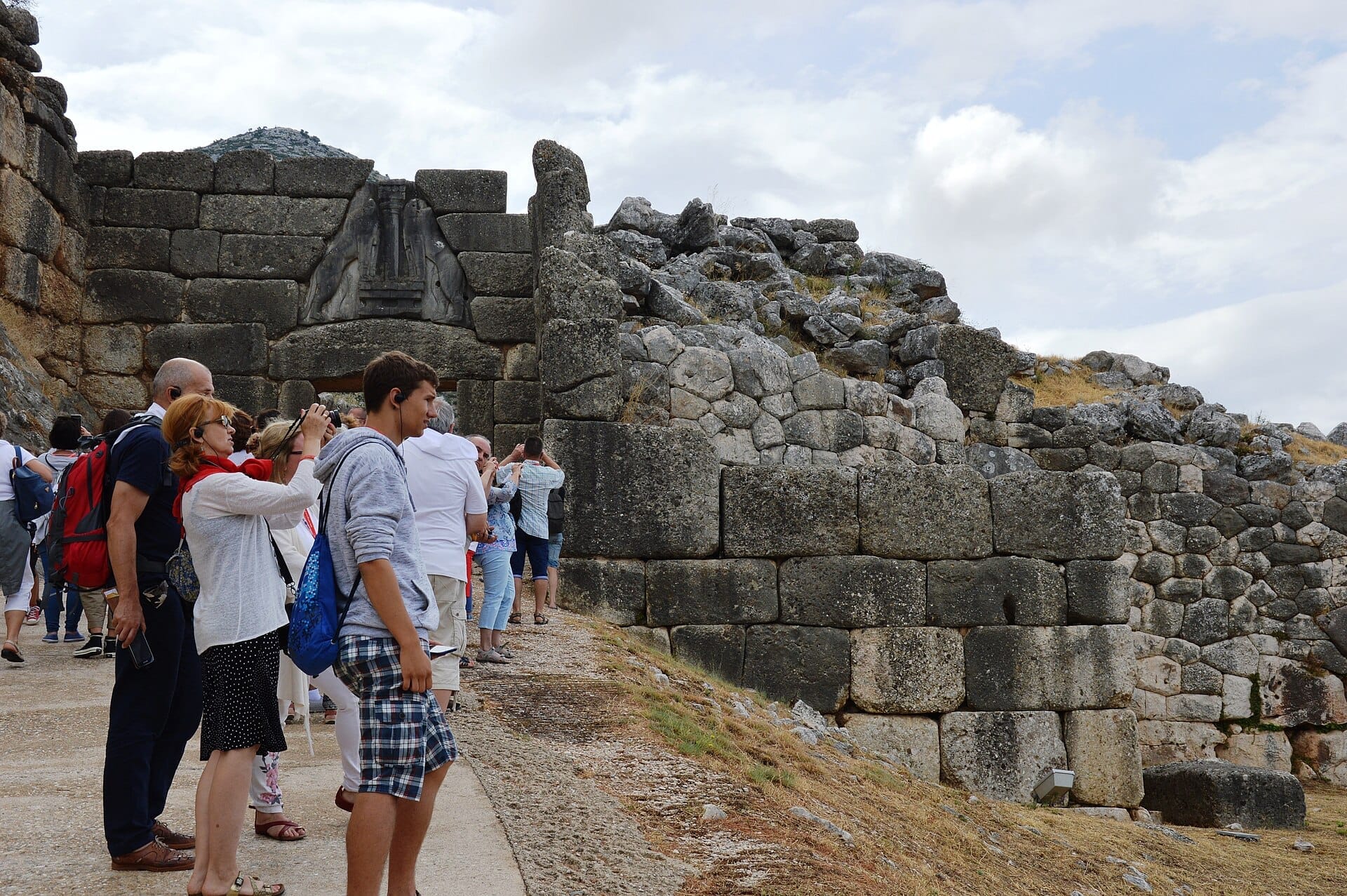
The approach to the citadel follows a ramp that rises from the ticket booth toward the main entrance: the Lion Gate. Built around 1250 BCE, this is among the oldest monumental sculptures in Europe still standing in its original position. Two lionesses (the exact identification of the animals remains debated by scholars) flank a central column carved in high relief above the massive lintel stone, which weighs an estimated 20 tonnes. Arriving at it, many visitors instinctively stop and look up before stepping through.
The gate itself is narrow enough that you walk through in single file. The stone on either side of the threshold is worn smooth from millennia of use. The relief above sits at the junction of two enormous Cyclopean walls, built from limestone blocks so large that later Greeks assumed they must have been placed by giants. Standing in the passageway, you can run a hand along the stones: they are rough-textured, slightly gritty, and warm in the sun. The scale is unsettling in the best possible way.
💡 Local tip
Photography of the Lion Gate is best in the morning before tour groups fill the passageway. By 10:30–11:00am on peak summer days, large groups tend to queue in front of the relief. The light is also more directional in the early hours, which sharpens the carved detail.
Tickets & tours
Hand-picked options from our booking partner. Prices are indicative; availability and final rates are confirmed when you complete your booking.
Corinth Canal, Mycenae and Nafplion Full-day Tour
From 113 €Instant confirmationFree cancellationMycenae and Nafplio premium tour with an expert guide
From 59 €Instant confirmationFree cancellationMycenae, Nafplion and Epidaurus day trip from Athens
From 42 €Instant confirmationFree cancellationMycenae e-ticket with smartphone audio tour
From 35 €Instant confirmation
Inside the Citadel: What You Walk Through
Beyond the Lion Gate, the path divides. To the right, a circular enclosure known as Grave Circle A holds the royal shaft graves excavated by Heinrich Schliemann in 1876. It was here that Schliemann found the gold death masks he believed belonged to Agamemnon himself. The masks are now in Athens at the National Archaeological Museum, but the stone grave markers remain, and the circular formation of upright slabs gives the space an immediately ceremonial quality.
The path continues uphill toward the palace complex. The gradient is steady rather than steep, but the terrain is uneven: packed earth, exposed rock, and ancient stone thresholds. Wear shoes with grip. At the top, the remains of the megaron (the great hall of the palace) include a circular hearth surrounded by column bases. The view from this elevation looks out over the Argolic plain in one direction and back toward the mountains in the other. It is immediately clear why a Bronze Age king chose this hill. For visitors interested in how Athens fits into the broader ancient landscape, the Athens ancient sites guide provides useful context for understanding the wider network of Mycenaean and classical-era locations.
Further into the citadel is a cistern, accessible by a long underground stairway cut into the rock. The stairway descends in near-darkness (bring a phone torch), and the stone walls become damp as you go deeper. The cistern was fed by an underground spring and allowed the citadel's inhabitants to withstand sieges. It is one of the most atmospheric spaces on the site and, for reasons that are not entirely clear, frequently skipped by visitors who stick to the main path.
The Treasury of Atreus: Outside the Walls
The ticket price includes entry to the Treasury of Atreus, located a short walk downhill from the main citadel entrance, along a separate signposted path. Despite its name, it has no confirmed connection to the mythological figure of Atreus. It is a tholos tomb, a beehive-shaped burial chamber built around 1250 BCE, and it ranks among the most sophisticated examples of Mycenaean construction that survives anywhere.
The approach is through a long stone-lined dromos, or entrance corridor, flanked by walls of carefully fitted ashlar masonry. The chamber itself is roughly 14 metres in diameter and 13 metres high, constructed without mortar using corbelled courses of stone that converge at the apex. When you stand at the centre and look up, the acoustics are striking: voices carry and echo against the dome in ways that suggest, though cannot prove, ritual use. The chamber was robbed in antiquity, so nothing remains inside except the stone, the silence, and the precision of the construction.
💡 Local tip
Visit the Treasury of Atreus either first or last in your itinerary. It tends to be less crowded than the Lion Gate and is most impactful when you can stand inside alone or nearly alone. Midday light illuminates the dromos entrance dramatically.
The Archaeological Museum of Mycenae
The on-site museum is included in the ticket price and is worth the thirty to forty minutes it takes to walk through. The collection spans the full chronological arc of occupation at the site, from Early Helladic pottery through to the collapse of the Bronze Age palace system around 1100 BCE. Highlights include fresco fragments from the palace walls, carved ivory objects, and Linear B clay tablets, the administrative script of the Mycenaean Greeks.
The display of objects from Grave Circle B (a second royal burial enclosure outside the citadel walls, less famous than Grave Circle A but archaeologically significant) is particularly well-organized with clear English labeling. Visitors who want to see the gold death masks and the full collection of grave goods excavated by Schliemann will need to visit the National Archaeological Museum in Athens, where the most celebrated Mycenaean finds are held.
How the Experience Changes by Time of Day
Early morning visits, particularly between opening and 09:30, offer the site largely to yourself. The light is low and directional, ideal for photography, and the air is cooler. In summer this is not a small detail: by midday, exposed areas of the citadel reach temperatures that make sustained walking genuinely uncomfortable. There is no significant shade inside the main enclosure.
By late morning, organized tour groups from Athens and the Argolida region begin arriving in volume. The Lion Gate in particular becomes congested around 10:30–11:30am. Tour group noise in the enclosed spaces of the cistern and the Treasury of Atreus carries noticeably. Late afternoon (after 16:00 in summer) tends to quiet again as groups depart, and the light on the Cyclopean walls becomes warm and textured. If you are visiting independently, late afternoon is a viable alternative to early morning.
The site has no significant artificial lighting, so the quality of natural light matters for the experience. Overcast days flatten the texture of the stonework considerably. Spring and autumn visits offer moderate temperatures, cleaner air, and often softer light, making them climatically preferable to the peak of summer.
Getting There from Athens
Mycenae is approximately 120 kilometres southwest of central Athens, situated in the Prefecture of Argolida (Argolis) in the Peloponnese. The most practical route by car follows the Athens–Corinth motorway (A8), crossing the Corinth Canal and continuing toward Argos before turning northwest toward Mykines. Signage for the archaeological site is clear on the local roads. Journey time by car is typically 1.5 to 2 hours depending on traffic around the Corinth junction.
Without a car, the standard approach is to take a bus from Athens to Nafplio or Argos (KTEL intercity buses operate from the Kifissos bus terminal in Athens), and then arrange a taxi from Argos to the site, which is approximately 12 kilometres. The site is not easily walkable from any local town. Organized day tours from Athens are widely available and typically include transport, a guide, and sometimes a stop at nearby Nafplio. Travelers planning multiple Peloponnese sites in a day should consult the day trips from Athens guide for routing advice.
⚠️ What to skip
There is no public transit that runs directly to the Mycenae archaeological site entrance. Do not rely on reaching the site by bus alone without either planning to walk the last few kilometres from the nearest village (such as Fichti) or verifying local taxi availability in Argos and Fichti or pre-arranging transport.
Practical Details and What to Bring
Wear closed-toe shoes with a non-slip sole. The citadel involves walking on worn stone, compacted earth paths, and in places, loose gravel. Sandals are manageable in dry conditions but become slippery on the ancient thresholds. The cistern stairway in particular is unlit and the stone is damp — a phone with a working torch is sufficient, but important.
Sun protection is essential in spring and summer. The hilltop citadel has no canopy, and the exposed stone radiates heat from midmorning onward. Bring water: there is a small cafe near the ticket office but no facilities inside the enclosure itself. The museum is air-conditioned and provides a useful midday respite if heat becomes a factor.
The terrain presents genuine accessibility challenges. The citadel is built on a hill with significant elevation changes, uneven ground, and no ramp access to key areas including the palace platform and the cistern. Visitors with limited mobility should contact the site directly to clarify what is currently navigable. The on-site museum and parts of the lower enclosure may be more accessible than the upper citadel, but this should be confirmed before the visit.
Honest Assessment: Who Should Go and Who Might Not
Mycenae is not a site that stages itself for visitors. There are no reconstructions, no sound-and-light installations, and relatively sparse on-site interpretation beyond basic information panels. Travelers who prefer curated, narrative-driven experiences may find the ruins require more background knowledge than is provided in situ. Doing some reading beforehand, or joining a guided tour with an archaeologist-level guide, substantially increases the depth of the visit. The ancient sites guide and a look at the Mycenaean collection at the National Archaeological Museum in Athens are both useful preparation.
Travelers with very young children will find the terrain demanding and the site offers no specific family facilities. The site is also, frankly, a long way from Athens for a half-day excursion: combining it with nearby Nafplio or the ancient theatre at Epidaurus makes the journey worthwhile for most visitors.
For those who do make the trip, Mycenae delivers something that few sites in Greece can match: genuine monumental scale from a civilization that predates classical Greece by centuries. The Lion Gate, the Treasury of Atreus, and the view from the palace platform are not overhyped. They are simply impressive, and they remain so even after you have seen the Acropolis and the Ancient Agora in Athens.
Insider Tips
- Arrive at opening time (08:00 in summer, 08:30 in winter). The first hour on site is qualitatively different from what follows: quieter, cooler, and without the background noise of tour groups echoing off the stone.
- Download or print a site plan before you go. The on-site signage is adequate but does not clearly indicate the cistern stairway, which is one of the most atmospheric spaces and easy to walk past without noticing.
- The Treasury of Atreus and the citadel have separate entrances a few hundred metres apart. Many visitors do the citadel first and then skip the Treasury because they are tired. Do the Treasury first: it is slightly less physical and sets the architectural context well.
- Combining Mycenae with Nafplio (25 kilometres south) and the ancient theatre at Epidaurus makes for a full Peloponnese day that uses the drive efficiently and adds considerable variety to the itinerary.
- The reduced ticket (€10) applies from 1 October to 31 May. If your visit falls near these dates, it is worth checking which rate applies. From 1 June to 30 September, only the full price of €20 is valid regardless of eligibility criteria.
Who Is Mycenae For?
- History and archaeology enthusiasts who want to engage with Bronze Age Greece beyond the classical period
- Mythology readers coming to Homer, Aeschylus, or Sophocles with a desire to see the physical settings behind the stories
- Photographers looking for ancient architecture in landscape settings with strong structural geometry
- Day-trippers from Athens willing to combine Mycenae with Nafplio or Epidaurus for a full Peloponnese itinerary
- Travelers who have covered the main Athenian sites and want to understand a wider arc of Greek history
Nearby Attractions
Combine your visit with:
- Ancient Corinth & Acrocorinth
Ninety kilometres west of Athens, Ancient Corinth and the towering fortress of Acrocorinth pack more history per square metre than almost anywhere in Greece. Roman temples, Greek agora ruins, a world-class on-site museum, and a 575-metre hilltop citadel often described as one of the largest castles in Greece make this one of the most rewarding day trips from the capital.
- Daphni Monastery
Standing on the ancient Sacred Way to Eleusis, Daphni Monastery is one of the finest surviving examples of middle Byzantine architecture in Greece. Its 11th-century golden mosaics rival anything in Ravenna or Constantinople — and most visitors to Athens never make it here.
- Delphi
Perched on the slopes of Mount Parnassus, the Archaeological Site of Delphi was once the spiritual centre of the ancient Greek world. A UNESCO World Heritage Site since 1987, it combines dramatic mountain scenery with some of the most significant ruins in Greece, including the Temple of Apollo, the Sacred Way, and a first-rate archaeological museum.
- Ancient Theatre of Epidaurus
Carved into a hillside in the Peloponnese, the Ancient Theatre of Epidaurus is the best-preserved ancient theatre in the Greek world. With seating for around 14,000 spectators and acoustics that still astonish architects and engineers, it remains a working performance venue during the Athens Epidaurus Festival each summer. This is one of the most rewarding day trips from Athens.