Areopagus Hill: Athens' Ancient Court of Justice and Its Best Free View
Rising just northwest of the Acropolis, Areopagus Hill is a bare marble outcrop where Athenian aristocrats once judged homicide cases, Ares was tried by the gods, and the Apostle Paul addressed the city's intellectuals. Today it costs nothing to climb and rewards visitors with one of Athens' most unobstructed views of the Acropolis. No fence, no ticket, no tour guide required.
Quick Facts
- Location
- Theorias 21, Athens 105 55 — Thisio neighborhood, northwest of the Acropolis
- Getting There
- Thissio Metro (Lines 1 & 3), then a 10-minute walk via the Ancient Agora path; or a 5-minute walk from the Acropolis area along Theorias St
- Time Needed
- 30–60 minutes on the hill itself; combine with Acropolis or Ancient Agora for a half-day
- Cost
- Free — no ticket, no fence, open 24 hours
- Best for
- Sunset views, history enthusiasts, budget travelers, photographers, solo walkers
What Is Areopagus Hill, Exactly?
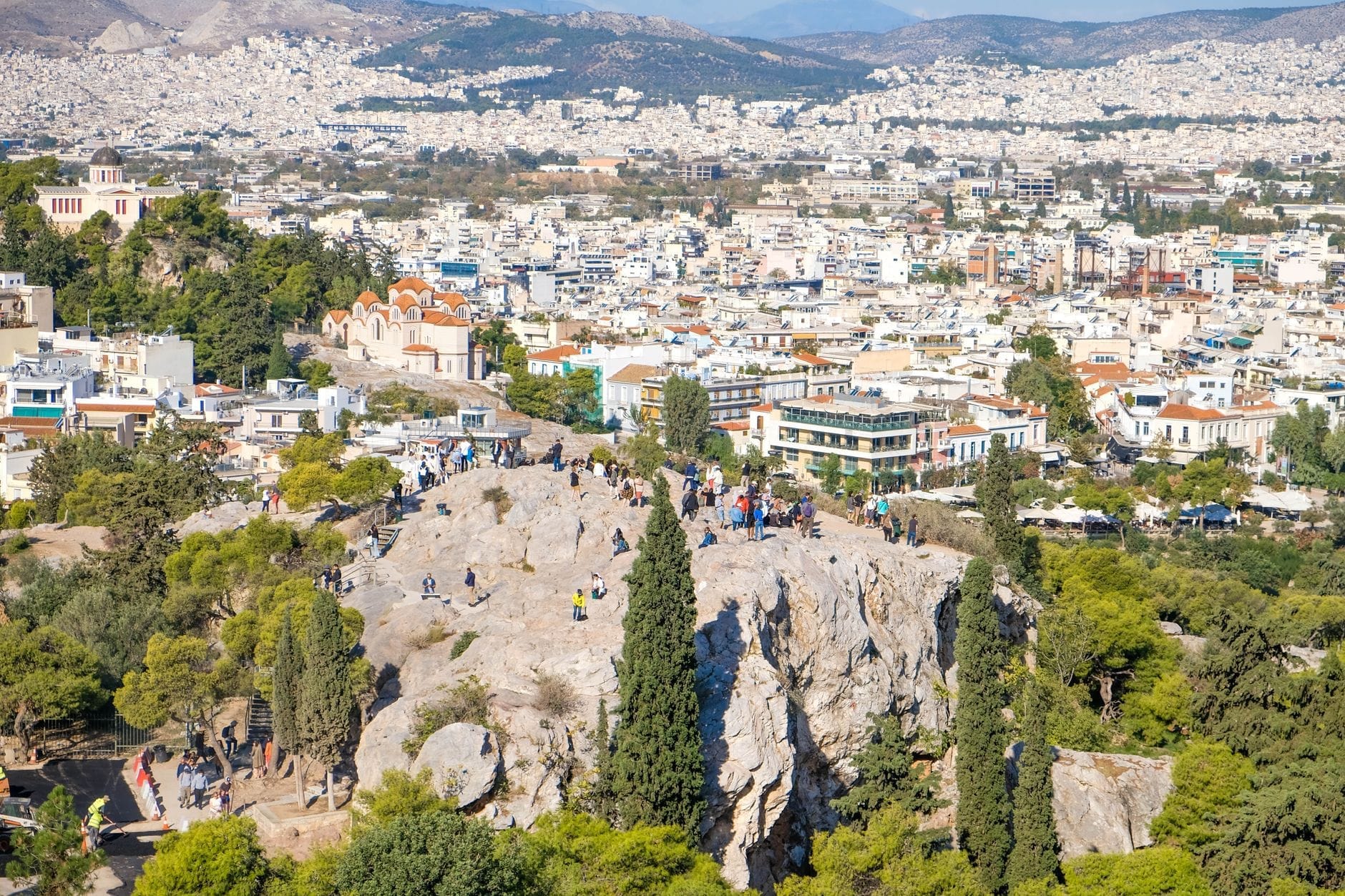
Areopagus Hill — known in Greek as Άρειος Πάγος (Areios Pagos), or "Hill of Ares" — is a low but prominent limestone and marble outcrop sitting between the Acropolis to the southeast and the Ancient Agora to the north. It stands roughly 115 meters above sea level and rises perhaps 20–25 meters above the surrounding streets. That's not dramatic altitude, but the position is everything: the summit provides an unobstructed sightline directly to the Parthenon above and across the terracotta rooftops of Plaka and Monastiraki below.
Unlike almost every other ancient site in Athens, Areopagus Hill is completely unfenced and free to access at any hour. There's no kiosk, no ticket scanner, and no audio guide to rent. You simply walk up the stone steps carved into the south face of the rock and find yourself standing on one of the most historically loaded surfaces in the Western world. The simplicity is part of its appeal, and part of its risk: the polished marble surface is genuinely treacherous in rain.
⚠️ What to skip
The marble summit of Areopagus Hill becomes dangerously slippery when wet. Wear rubber-soled shoes regardless of season. After rain, consider postponing your visit by an hour or two until the surface dries. Sandals and smooth-soled shoes are a serious hazard here.
A Council Older Than Democracy Itself
The Areopagus council is documented as one of Athens' earliest aristocratic governing bodies, predating the democratic reforms of Cleisthenes in 508 BC. By the 5th century BC, the council had a defined and fearsome jurisdiction: serious homicide cases, wounding with intent, arson, and certain religious offenses fell under its authority. Trials took place on the hill itself, in the open air, with both the prosecution and defense standing on rough stones rather than in any enclosed hall. The setting was deliberate: no roof, no shelter, no comfort to distract from the gravity of judgment.
Greek mythology adds a founding layer to this already ancient institution. According to the myth, the god Ares was tried here by the Olympian gods for the murder of Halirrhothius, son of Poseidon, who had assaulted Ares' daughter Alcippe. Ares was acquitted, and the hill took his name. The myth is revealing: even in divine affairs, the Greeks imagined formal trial as the proper response to violent death. The hill didn't just host legal proceedings; it embodied the idea that even the powerful must answer for what they do.
For visitors exploring Athens' archaeological landscape more broadly, the Ancient Agora just below Areopagus Hill served as the civic and commercial heart of the city — an essential companion site that makes the hill's judicial role easier to understand in context.
Tickets & tours
Hand-picked options from our booking partner. Prices are indicative; availability and final rates are confirmed when you complete your booking.
Guided tour of the Acropolis, Parthenon and Museum in Athens
From 50 €Instant confirmationFree cancellationAthens: Temple of Olympian Zeus E-ticket with audio tour on your phone
From 10 €Instant confirmationAthens full-day tour with Acropolis and Cape Sounion
From 92 €Instant confirmationFree cancellationAthens National Archaeological Museum e-ticket and audio tour
From 22 €Instant confirmation
Paul's Sermon and the Hill's Second Life
Around 50–51 AD, the Apostle Paul stood on Areopagus Hill and addressed the Athenians — or more precisely, the council and the curious crowd of Stoic and Epicurean philosophers who had gathered to hear this foreign voice speaking of a strange new teaching. The encounter is recorded in Acts 17:22–31. Paul's approach was tactically shrewd: he began by acknowledging an altar he had seen in the city inscribed "To an Unknown God," then used that as an entry point to introduce the Christian God.
A bronze plaque embedded near the steps on the north face of the hill commemorates the speech in Greek text. It's easy to walk past without noticing, but worth finding. Whether you approach the site from a religious, philosophical, or purely historical angle, the plaque marks one of the earliest recorded encounters between early Christianity and Greek philosophical culture. The response Paul received was mixed: some mocked, a few joined him, including a man named Dionysius the Areopagite, who later became the patron saint of Athens.
What the Summit Actually Looks and Feels Like
The climb up the south steps takes about two minutes from street level. The steps are ancient, worn smooth by millions of feet, and cut directly into the rock face at an angle steep enough to require attention. At the top, the surface opens into a broad, flat plateau of pale grey marble streaked with rust-colored veins. There are no guardrails on the edges closest to the Acropolis side. The wind picks up noticeably here, even on still days in the city below.
The Acropolis fills the skyline to the southeast, close enough that you can clearly distinguish the individual columns of the Parthenon without binoculars. Looking north, the rooftops of Monastiraki spread out toward the green dome of the Roman Agora and the tower of the winds beyond it. West, the hills of Philopappos and the Pnyx are visible. On a clear day in autumn or winter, you can see as far as the mountains ringing the Attica basin.
The rock itself is bare. No trees, no grass, no benches. People sit directly on the marble, which makes the experience feel genuinely ancient rather than managed. You'll find school groups, couples, solo travelers writing in notebooks, and locals who climb up mid-morning with a coffee. At peak tourist hours in summer, the summit can hold 50 to 100 people, which makes it feel busy but never claustrophobic given the open sky.
💡 Local tip
For photography: arrive at sunrise for golden light falling directly on the Parthenon from the east, or come 45 minutes before sunset when the Acropolis rock turns amber and the city lights begin to appear below. The midday summer light is harsh and washes out stone detail in photos.
Best Time to Visit and How to Get There
Areopagus Hill is worth visiting at almost any hour, but the experience varies considerably. Early morning, before 8 AM, the hill is nearly empty. The light is soft, the city sounds are muted, and the Acropolis above catches the first directional light of the day. This is the optimal time for photography and quiet reflection. By 10 AM in summer, tour groups begin arriving in force and the area around the steps gets congested.
Sunset draws the largest crowds of the day, particularly from April through October. Expect 80 to 150 people on the summit as the sun drops toward the western hills. It's a genuinely beautiful spectacle, but arrive 30 minutes early to secure a spot with an unobstructed western view. In winter, the sunset crowds thin considerably, and the hill at dusk can be nearly deserted despite equally dramatic light.
The most convenient approach is from MonastirakiThe most convenient approach is from Thissio Metro station (Lines 1 and 3), a 10-minute walk south along Adrianou Street and then up through the Ancient Agora path. Alternatively, from the main Acropolis area on Dionysiou Areopagitou, walk north along Theorias Street; the steps up to Areopagus Hill are on your left within a few minutes. Both routes are well-signed and on flat ground until the final ascent.
Climate matters here more than at most indoor sites. Athens summers regularly push above 35°C, and the exposed marble summit offers zero shade. Bring water, wear a hat, and plan visits before 10 AM or after 5 PM between June and August. For a broader view of how heat affects Athens sightseeing, the Athens in summer guide covers the full picture.
Accessibility and Who May Struggle Here
Areopagus Hill is not accessible for visitors with mobility impairments. The only way to the summit is via steep, uneven stone steps carved directly into the rock, some of which are at ankle-twisting angles. There are no lifts, no paved ramps, and no alternative route. Even for able-bodied visitors, the descent requires more care than the ascent: the worn marble is slicker underfoot than it looks, particularly near the shaded sections of the steps.
Visitors traveling with young children in strollers will need to carry them or leave the stroller below at street level with a companion. The open edges of the summit without guardrails also require close attention with small children.
Those who find the rock too challenging can get a reasonable view of the Acropolis from Dionysiou Areopagitou, the pedestrianized street below, or from the far more accessible Acropolis Museum terrace on the same street.
Fitting Areopagus Hill Into Your Athens Day
Areopagus Hill works best as a connector, not a destination in isolation. The logical sequence is to combine it with the Acropolis immediately above (book tickets in advance), then descend via Areopagus Hill to the Ancient Agora below. This north-facing descent puts you at the base of the Agora within five minutes of leaving the summit, and the combined walk makes the spatial relationship between Athens' religious, political, and judicial centers immediately legible.
If you're working from a tighter schedule, the Athens 1-day itinerary incorporates Areopagus Hill as a free addition between the Acropolis and an afternoon walk through Monastiraki and Plaka, making it possible to cover all three without backtracking.
The hill itself requires 30 minutes at most for a thorough visit: 5 minutes up, 15–20 minutes taking in the view and finding the Paul plaque, 5 minutes down. Allow more time if you plan to sit and sketch, read, or wait for sunset light. The unhurried pace is part of what makes Areopagus Hill feel different from most ancient sites in Athens.
Insider Tips
- The bronze plaque commemorating Paul's sermon is on the north face of the hill, near the bottom of the steps. Most visitors walk straight past it heading up. Pause and read it before you climb.
- On summer evenings, vendors near the Acropolis entry gate sell cold water at tourist prices. Fill a bottle before you leave Monastiraki, where supermarkets along Adrianou sell it for a fraction of the cost.
- The western edge of the summit plateau gives a better sunset angle than the center. Arrive early enough to claim a spot there, since the center fills first with people angling for Acropolis shots.
- The marble surface dries quickly after light rain but slowly in shaded sections near the steps. Check those shaded sections specifically before committing to the descent at full pace.
- If you visit the Acropolis on the same day, do Areopagus Hill first thing in the morning while the Acropolis ticket lines form below. By the time you descend, the lines have often shortened.
Who Is Areopagus Hill For?
- Budget travelers who want an authentic Acropolis view without paying for a ticket
- Photographers seeking golden-hour shots of the Parthenon from the northwest angle
- History enthusiasts interested in early Athenian law, Greek mythology, and early Christian history
- Solo walkers and slow travelers who want to sit, think, and absorb a place without a tour group dynamic
- Visitors combining an Acropolis morning with an Ancient Agora afternoon, using Areopagus as the connecting route
Nearby Attractions
Other things to see while in Thisio:
- Philopappos Hill
Standing about 147 metres above the city, Philopappos Hill is an open, free-access park in the Thisio area with panoramic views of the Acropolis, a Roman-era funerary monument at its summit, and shaded pine paths that feel a world away from the tourist crowds below. It rewards early risers and sunset chasers in equal measure.