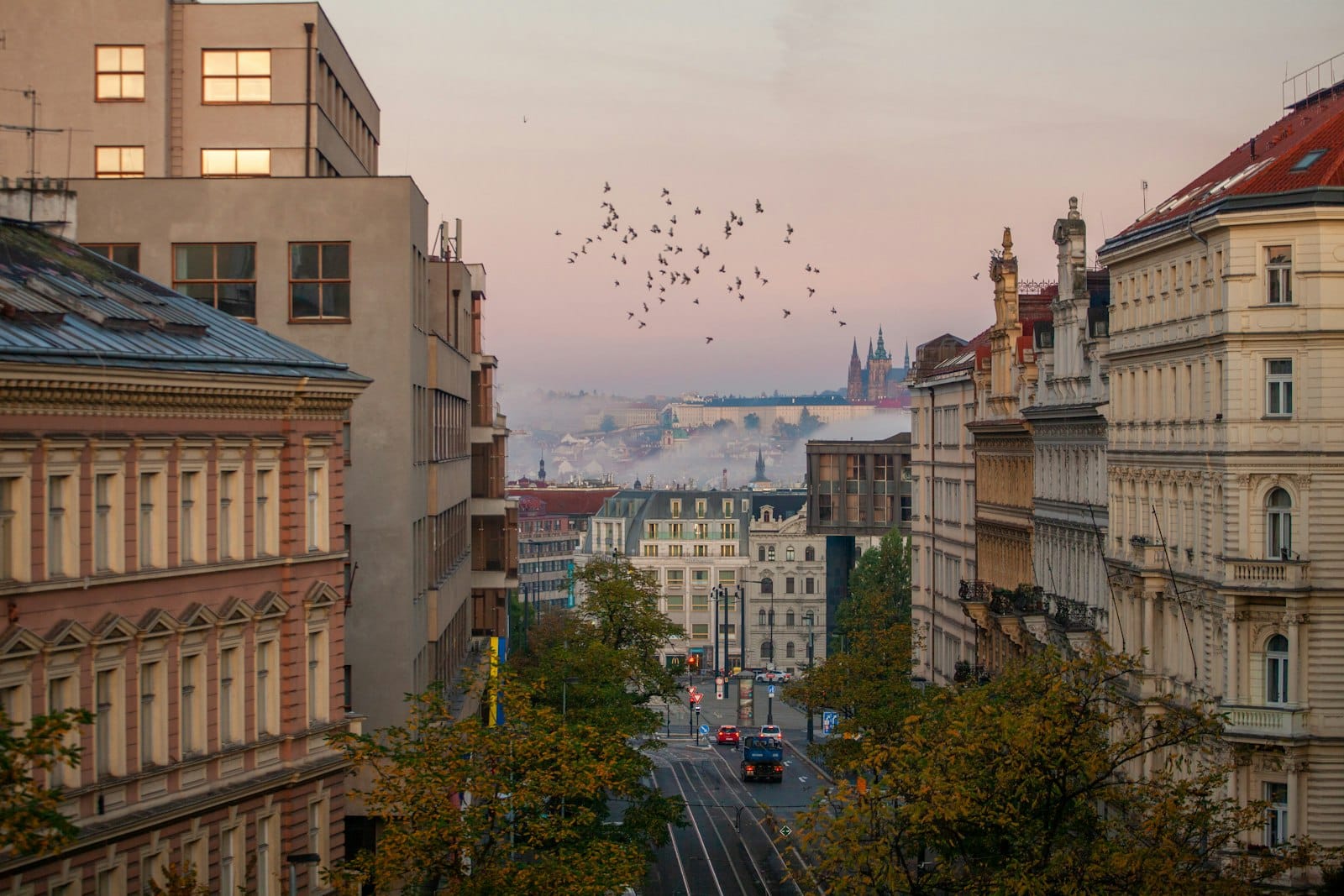
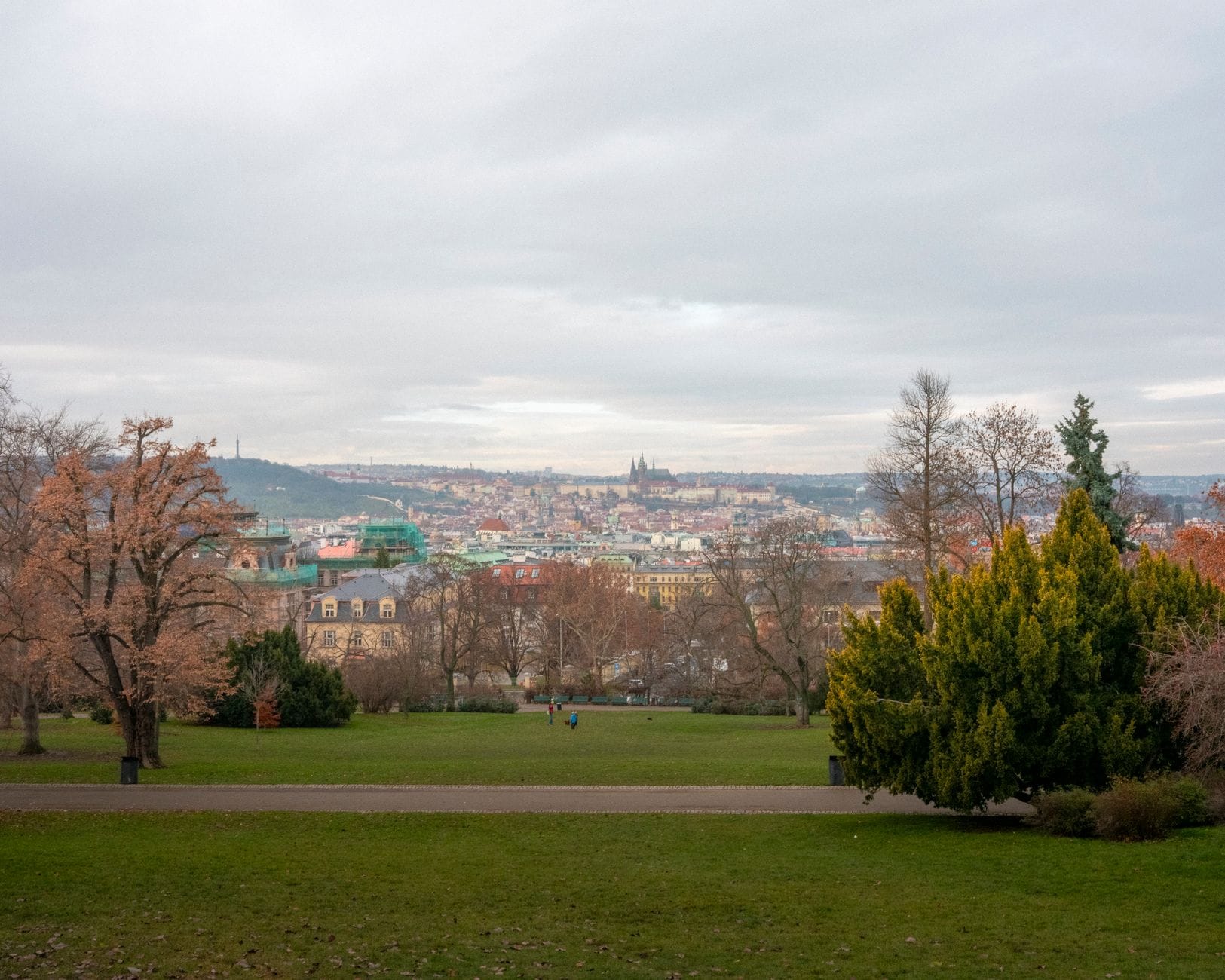
Vinohrady is an elegant inner-city residential district sitting just east of Wenceslas Square, built on land once covered in royal vineyards. Its wide boulevards are lined with late 19th and early 20th century apartment buildings in Neo-Renaissance, Art Nouveau, and Pseudo-Baroque styles, and the neighborhood anchors itself around two grand squares and two substantial parks. For travelers, it offers a rare combination: genuine city life, walkable streets, good transit, and a restaurant and café scene that serves residents rather than tour groups.
Vinohrady is Prague's most composed inner district, a place of wide tree-lined boulevards, ornate apartment facades, and neighborhood squares where people actually sit and stay. It sits just far enough from the tourist core to feel like a real city, while remaining close enough to reach Old Town in under fifteen minutes on the metro.
Orientation: Finding Your Bearings
Vinohrady occupies the sloped terrain immediately east and southeast of the New Town (Nové Město), beginning roughly where Legerova Street runs along the back side of the National Museum. From that western edge, the district spreads outward along three main arteries: Vinohradská to the north, Korunní through the middle, and Francouzská to the south, all running roughly parallel in an east-west direction before converging toward the district's outer limits.
The northern boundary is marked by Riegrovy sady park and the ridge above Žižkov. To the south, Havlíčkovy sady (known locally as Grébovka) forms a green edge above Vršovice. The district's eastern reach extends past Náměstí Jiřího z Poděbrad and the Flora shopping area toward Vinohrady Cemetery, which sits near Želivského metro station. Administratively, Vinohrady falls within Prague 2 (the western portion, which is the more prestigious address) and Prague 3 (the eastern portion, which blends toward Žižkov). Small sections touch Prague 10.
The district connects smoothly to the broader city. Walking west along Vinohradská from Náměstí Míru takes you past the upper end of New Town Prague and deposits you near the top of Wenceslas Square in about fifteen minutes on foot. Žižkov sits immediately to the north across the ridge, and Nusle stretches to the south. For a city this compact, Vinohrady's position is almost ideal: central without being overrun.
Character and Atmosphere
The name Vinohrady means vineyards, and the district was literally planted with royal wine-producing vines from the 14th century onward. That agricultural past ended in the second half of the 19th century, when Prague's rapid industrialization and population growth pushed the city limits outward. Vinohrady was developed quickly, mostly between 1880 and 1914, which gives it an architectural coherence rare among European inner suburbs: nearly every block is built to the same street line, with similar cornice heights, and the facades shift between Neo-Renaissance, Art Nouveau ornament, and Pseudo-Baroque detailing in a way that feels deliberate rather than chaotic.
Walking through Vinohrady at different hours produces noticeably different experiences. At eight in the morning on a weekday, Korunní Street carries a steady stream of people heading toward metro stations, coffee cups in hand, dogs being walked, bakeries opening their shutters. The light at that hour falls at a low angle across the facades, catching the carved stonework and making even the most routine apartment block look considered. By midday, Náměstí Míru fills with people eating lunch on benches around the Church of St. Ludmila, and the café terraces along Mánesova and Blanická streets are occupied by a mix of remote workers, young parents, and elderly residents who clearly regard this as their local square.
After dark, the character shifts again. The streets around Náměstí Míru and especially the stretch of Vinohradská between the two main squares carry a lively but never chaotic energy: restaurants full, wine bars doing steady trade, the occasional queue outside a cocktail bar. This is not a nightlife district in the same way that Žižkov or parts of Holešovice are. The bars close at a reasonable hour and the streets quiet down by midnight on most nights. That distinction matters for travelers choosing where to sleep.
ℹ️ Good to know
Vinohrady is popular with long-term foreign residents and expats, which means much of the restaurant and café scene is pitched at people with discerning tastes and local salaries. Prices are higher than in the historic center's tourist traps but represent better value: the food tends to be genuinely good.
What to See and Do
Vinohrady is not a district you visit for monuments. Its pleasures are more spatial and ambient than object-specific. That said, several places are worth orienting your exploration around.
Náměstí Míru (Peace Square) is the heart of the district. The square is anchored by the neo-Gothic Church of St. Ludmila, completed in 1893, whose twin towers are visible from a considerable distance and form the visual centerpiece of the neighborhood. The Vinohrady Theatre (Divadlo na Vinohradech) runs along one side of the square, a handsome early 20th century building that still operates as a serious repertory theatre. The square itself has been renovated and is now a genuinely pleasant public space: wide, tree-planted, with a functioning farmers market on several weekdays.
Náměstí Jiřího z Poděbrad, about ten minutes walk east along Vinohradská, is the district's second major square. It has a different feel: slightly more everyday, less grand, with a covered market hall on one side and the striking modernist Church of the Most Sacred Heart of Our Lord (1929, designed by Jože Plečnik) on the other. The Plečnik church is one of Prague's more unusual religious buildings, with a massive clock tower that reads more as a civic monument than a church spire. The square's market operates several mornings a week and draws a genuine local crowd.
The two main parks deserve time. Riegrovy sady, on the northern slope above the district, offers sweeping views toward the castle and Hradčany on clear days and contains one of Prague's most pleasant beer gardens. Further south, Havlíčkovy sady (Grébovka) is less visited by tourists and all the better for it: wooded paths, a small neo-Romantic villa, a functioning vineyard (the last survivor of Vinohrady's royal vine heritage), and a summer wine pavilion. For more perspective on Prague's parks and outdoor life, the Riegrovy sady beer garden is a reliable warm-weather anchor.
Náměstí Míru and the Church of St. Ludmila: the architectural and social center of Vinohrady
Church of the Most Sacred Heart of Our Lord on Náměstí Jiřího z Poděbrad: Plečnik's unconventional 1929 masterpiece
Riegrovy sady: hilltop park with city views and a classic Prague beer garden
Havlíčkovy sady (Grébovka): quieter southern park with the city's only inner-urban working vineyard
Vinohrady Theatre (Divadlo na Vinohradech): active Czech-language repertory theatre, Náměstí Míru
Weekday market at Náměstí Míru: local produce, bread, flowers, and prepared food
Weekend market at Náměstí Jiřího z Poděbrad: smaller but very local, several mornings per week
Vinohrady's architecture is itself worth studying as you walk. For travelers interested in the broader story of Prague's built environment, the Prague architecture guide provides useful context on why the late-Habsburg building boom looked the way it did.
Eating and Drinking
Vinohrady has one of Prague's strongest concentrations of independently owned restaurants, cafés, and wine bars, and the quality is consistently higher than what you find in the tourist-facing parts of the Old Town. The district's large population of foreign residents and Czech professionals keeps standards up and gimmicks down. You are unlikely to encounter menu photos or multilingual laminated cards here.
The café culture is particularly strong. Several specialty coffee shops operate in the streets between Náměstí Míru and Náměstí Jiřího z Poděbrad, and they function as neighborhood living rooms: slow service, good beans, people working on laptops for hours without being moved on. Blanická and Mánesova streets have a particularly dense run of places to sit and eat at various price points. Korunní Street has more variety over a longer stretch.
The restaurant scene spans a wide range. Czech cuisine done properly, without tourist-menu simplifications, is available at several spots. But Vinohrady is also where you find some of Prague's better Italian, Japanese, and modern European cooking. Wine bars are numerous and take their lists seriously: Czech and Moravian wines appear more consistently here than in most parts of central Prague, alongside Austrian and natural wine selections.
For a broader picture of where to eat across the city, the where to eat in Prague guide covers the full range of neighborhoods and cuisine types. Budget travelers should note that Vinohrady sits in a middle range: cheaper than upscale hotel restaurants in the center, more expensive than the working-class canteens of Žižkov just over the ridge.
💡 Local tip
The weekday farmers market at Náměstí Míru runs from morning until around early afternoon and is a good place to pick up fresh bread, local cheese, smoked meats, and seasonal produce. It draws a genuinely local crowd and is one of the more pleasant market experiences in the city.
Getting There and Around
Vinohrady is extremely well served by public transit. Metro line A (the green line) runs directly through the district, with four relevant stations: I. P. Pavlova on the western edge (technically in New Town but an easy walk into Vinohrady), Náměstí Míru at the center, Jiřího z Poděbrad further east, Flora beyond that, and Želivského at the far eastern boundary. From Náměstí Míru, you are one stop from Muzeum (connecting to line C) and three stops from Staroměstská, putting you within easy reach of Old Town and the entire metro network.
Trams complement the metro well and are particularly useful for north-south movement within the district. Lines run along Vinohradská, Korunní, and Francouzská streets, and the network connects efficiently to Wenceslas Square, the riverfront, and Žižkov. For most journeys to central attractions, the metro is faster; trams are better for exploring the district itself at a slower pace.
Walking into the historic center is possible and pleasant in good weather. The walk from Náměstí Míru to the top of Wenceslas Square takes about fifteen minutes downhill along Mánesova or Blanická and then through the upper New Town. From Wenceslas Square, the Old Town is another ten minutes on foot. For a full orientation to Prague's transit system, the getting around Prague guide covers tickets, passes, and practical logistics.
ℹ️ Good to know
Public transport in Prague operates on a timed ticket system rather than per-journey. Short-term tickets (valid 30 or 90 minutes) cover unlimited transfers between metro, tram, and bus. Day passes and multi-day passes are available and cost-effective for visitors making several journeys daily. Verify current fares at pid.cz before travel, as prices change periodically.
Where to Stay
Vinohrady is one of Prague's strongest neighborhoods for accommodation if you prefer a residential atmosphere over a central tourist location. The accommodation stock is dominated by boutique hotels, apartment rentals, and pension-style guesthouses occupying converted apartment buildings. The grand facades often conceal carefully renovated interiors with high ceilings, original tilework, and period details.
The western part of Vinohrady, within walking distance of Náměstí Míru and the streets between the square and I. P. Pavlova metro, is the most convenient base. From here, the metro takes you to Old Town in six or seven minutes, and you are within easy walking range of the New Town. Streets like Mánesova, Blanická, and the immediate surroundings of Náměstí Míru have the highest concentration of good accommodation options.
The eastern parts of the district, toward Flora and Želivského, are quieter and slightly cheaper, but the trade-off is a longer transit journey to the historic center and fewer immediately walkable eating options. For most travelers, the zone between Náměstí Míru and Jiřího z Poděbrad represents the optimal balance.
Vinohrady suits travelers who want to feel like they are staying in Prague rather than in a hotel annex to its attractions. It is a particularly good base for couples, independent travelers, and anyone spending more than a few days in the city. For a broader comparison of where to stay across different neighborhoods, the where to stay in Prague guide covers the full range from Old Town to the outer districts.
⚠️ What to skip
Vinohrady is not a good base if your primary goal is maximum walking proximity to the historic core. Old Town, Malá Strana, and the castle district are all reachable quickly by metro, but you will be using transit every day rather than rolling out of bed onto cobblestones. Travelers who want to wake up twenty steps from Charles Bridge should look elsewhere.
Honest Assessment: Is Vinohrady Right for You?
Vinohrady is easy to like but not universally suited. It lacks the concentrated historic spectacle of the Old Town or the castle district, and travelers on a short trip focused entirely on major monuments may find it less convenient than staying closer to the action. The streets are handsome but not dramatic. The atmosphere is pleasant but measured.
Where it excels is in offering a version of Prague that most short-stay visitors never reach: a neighborhood with genuine daily life, excellent eating and drinking, architectural quality that holds up to extended examination, and access to the rest of the city via a metro line that is fast, frequent, and reliable. For anyone spending four or more days in Prague, or anyone who has already seen the major sights and wants a different perspective on the city, Vinohrady is a consistently rewarding base. Pair it with a day exploring Josefov or an afternoon at Letna Park and you begin to see how the city's distinct neighborhoods connect into a coherent whole.
TL;DR
Vinohrady is an elegant, well-preserved inner residential district immediately east of Wenceslas Square, built almost entirely between 1880 and 1914 and showing a rare architectural coherence.
Metro line A connects the neighborhood to Old Town in under ten minutes, making it a practical base despite sitting outside the historic center.
The food, café, and wine bar scene is among the strongest in Prague, oriented toward residents rather than tourists and consistently higher quality than the tourist-facing center.
Best suited to: independent travelers, couples, longer stays, food-focused visitors, and anyone wanting to experience Prague as a city rather than a monument circuit.
Not ideal for: travelers wanting to walk directly from their hotel to Charles Bridge, or anyone seeking active late-night entertainment within the immediate neighborhood.
Three days is the ideal amount of time to experience Prague's historic core without rushing. This itinerary takes you from the medieval lanes of Old Town to the hilltop grandeur of Prague Castle, the haunting beauty of Josefov, and the quieter pleasures of Malá Strana and Vyšehrad.
Prague's museum scene stretches far beyond the obvious. This guide covers the city's finest art, history, and specialist museums, from the National Gallery's scattered palaces to underground alchemical laboratories and intimate synagogues that carry centuries of history.
Prague rewards visitors differently depending on when you arrive. This guide breaks down every season with clear seasonal notes of weather, crowd levels, hotel prices, and key events, so you can choose the right time for your trip rather than the most popular one.
Prague rewards those who climb. From medieval towers rising above Old Town to forested hills and riverside terraces, the city's skyline is best understood from above. This guide covers every worthwhile viewpoint, whether you're after a paid 360-degree panorama or a free hilltop perch with a cold beer.
Prague sits at the center of Bohemia, making it one of the best-positioned cities in Europe for day trips. Within two hours by train or bus, you can reach a Gothic castle above a forested valley, a UNESCO town wrapped in a river bend, a Nazi memorial site, and one of Europe's notable spa resorts.
Prague has one of Central Europe's most efficient public transport networks, covering the city by metro, tram, and bus under a single integrated ticket system. This guide covers fares updated for 2026, airport transfer options, ride-hailing realities, and the mistakes most visitors make on their first day.
Seven days is the right amount of time to see Prague properly. This guide breaks down exactly how to spend each day, which neighborhoods to prioritize, what the castle complex actually demands in terms of time, and how to fit in a day trip without losing a full day to logistics.
Prague's historic center packs over 1,100 years of architectural history into roughly 870–900 hectares, from Romanesque crypts and Gothic cathedrals to one of the world's most substantial collections of Cubist buildings. This guide breaks down every major style, tells you exactly what to see, and gives you the practical details to plan your visit.
Prague's Christmas markets run from late November through early January, turning Old Town Square and Wenceslas Square into some of Europe's most atmospheric winter destinations. This guide covers every major market, what to eat and drink, how to avoid the worst crowds, and exactly what to budget.
David Černý is the Czech Republic's most provocative public artist, and Prague is his gallery. This guide covers his major installations across the city, how to build a self-guided walking route, and what you need to know before you go.
Prague sets a high bar for romance: Gothic spires, cobblestone lanes, river views, and a classical music scene that rivals much larger capitals. This guide covers the best things to do in Prague for couples across every season, from iconic spots timed to avoid the crowds to quieter corners most visitors miss entirely.
Prague rewards those who look beyond Charles Bridge and Old Town Square. This guide reveals the city's quieter side: Baroque gardens tucked behind unmarked doors, medieval cellars beneath busy streets, panoramic hilltops where locals outnumber tourists, and neighborhoods reshaping Prague's creative identity.
Prague's history spans more than a thousand years of empire, revolution, occupation, and reinvention. This guide breaks down the key eras, explains what shaped the city's architecture and culture, and tells you exactly where to see that history in person.
Summer is Prague's most popular season, but it comes with trade-offs: intense heat, peak-season crowds, and higher prices. This guide covers everything you need to plan a smart trip to Prague in June, July, or August, from booking timelines to beat-the-crowd strategies.
Winter strips Prague back to its essentials: gothic spires against grey skies, Christmas markets on cobblestone squares, and a fraction of the summer crowds. This guide covers the real conditions — temperatures, daylight, costs, and which attractions stay open — so you can plan with confidence.
Josefov is one of Europe's most significant Jewish heritage sites, packed into just a few city blocks between Old Town Square and the Vltava River. This guide covers every major site, how ticketing works, the best time to visit, and what most visitors get wrong before they arrive.
Prague delivers five-star experiences at prices that would seem impossible in Paris or London. This guide covers the best luxury hotels with practical pricing data, the fine-dining restaurants worth booking weeks ahead, and the high-end experiences that go well beyond the standard tourist circuit.
Prague nightlife runs deeper than the tourist bars around Old Town Square. This guide breaks down the city's after-dark scene by district, covering the best clubs, bars, jazz venues, and rooftop spots, with practical advice on prices, timing, and where locals actually go.
Prague is one of Europe's better-value capitals, but it is not the ultra-cheap destination the myth suggests. This guide breaks down exactly what things cost in 2026, where to save money without sacrificing the experience, and which tourist traps quietly drain your wallet.
Prague rewards shoppers across every budget, from Bohemian crystal and hand-carved puppets to international luxury labels on Pařížská Street. This guide breaks down the best shopping districts, markets, malls, and genuinely worthwhile souvenirs, with practical details on hours, transport, and what to skip.
The journey from Prague to Munich covers just under 400 km and can be done by direct train, bus, or flight. This guide breaks down every realistic option with prices, journey times, and practical booking advice so you can choose the right one for your trip.
The Prague to Vienna corridor is one of Central Europe's best-connected routes, with trains, buses, and flights running daily. This guide breaks down every option by cost, comfort, and real travel time so you can pick the right one for your trip.
This step-by-step guide walks you through Prague's most rewarding route, from the medieval core of Old Town across Charles Bridge and up to the castle complex on Hradčany hill. Covers distances, timing, ticket costs, seasonal advice, and the shortcuts most visitors miss.
Prague is one of Europe's most rewarding cities for families, offering everything from a world-class zoo and a funicular railway to interactive museums and vast green parks. This guide covers the best activities for children of all ages, how to get around cheaply, which neighborhoods work best for families, and what to skip.
Prague rewards visitors with one of Europe's most intact medieval city centres, a world-class Jewish quarter, and neighbourhoods far beyond the tourist trail. This guide covers the best things to do in Prague across every budget and interest, with crowd warnings, seasonal advice, and precise logistics.
Prague's dining scene is far more nuanced than the tourist-trap stereotype suggests. This guide breaks down the best neighborhoods for food, what to order, which restaurants are worth booking in advance, and how much to expect to pay — from a 90 CZK bowl of goulash to a Michelin tasting menu.
Choosing where to stay in Prague shapes your entire trip. This guide breaks down every major neighborhood by location, price, atmosphere, and drawbacks so you can book with confidence, whether you have three days or three weeks.