Nowa Huta is Kraków's easternmost district, a vast planned city built from 1949 to house steelworkers and reflect socialist urban ideals. Its monumental architecture, wide boulevards, and Cold War history make it one of the most architecturally distinctive neighborhoods in Central Europe. Today it functions as a living residential district with strong local character and a growing appeal for history-minded travelers.
Nowa Huta is one of Europe's best-preserved examples of socialist realist urban planning: a purpose-built city within a city, conceived in 1949 to house workers at the massive Lenin Steelworks and to counterbalance Kraków's royalist, Catholic identity. Decades after the communist project collapsed, the broader Nowa Huta area remains a large residential part of Kraków, while today's District XVIII is a smaller administrative unit within that historic landscape.
Orientation: Where Nowa Huta Sits in Kraków
Nowa Huta occupies the north-eastern part of Kraków, with District XVIII covering roughly 65 square kilometres. Its western border begins around 8 kilometres from the Old Town, and the district stretches eastward along the left bank of the Vistula River toward the city limits. The scale is disorienting if you arrive expecting something compact: this is a complete urban settlement dropped beside an existing city, not a suburb that grew organically from it.
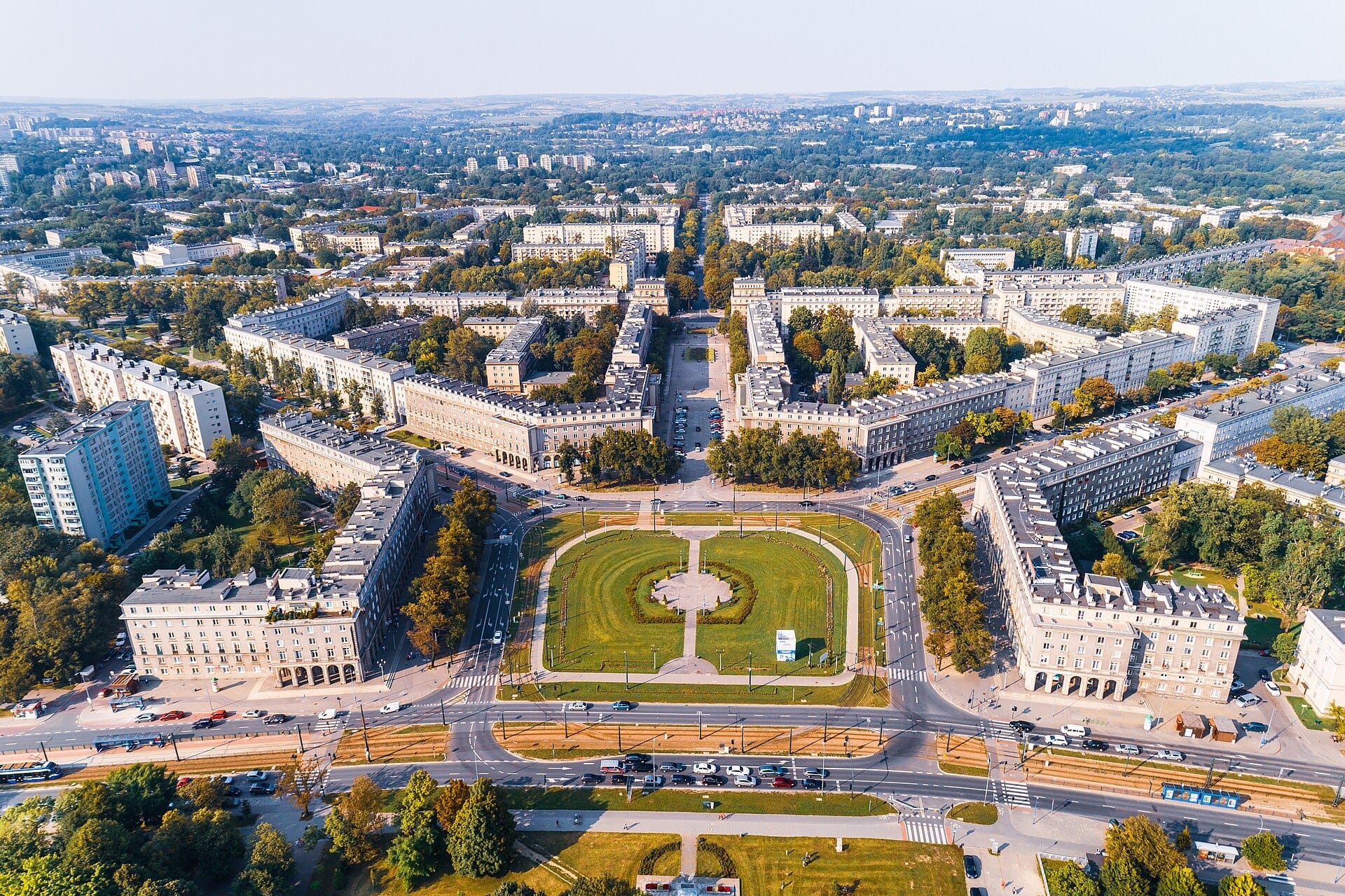
The layout follows a strict radial plan centred on Plac Centralny, the main square officially renamed Plac Centralny im. R. Reagana (Ronald Reagan Central Square) after 1989. Six broad avenues fan outward from this hub, lined with symmetrical housing blocks in stone and plaster. From Plac Centralny, the Central Square is the logical starting point for any visit: it orients the grid, concentrates the most photogenic architecture, and puts the steelworks' axis on your left as you face east.
To the west, Nowa Huta blends into the residential districts of Czyżyny and Mistrzejowice before reaching the inner tram network. To the east and north, the urban fabric thins into green corridors and the grounds of the Tadeusz Sendzimir Steelworks. The Vistula riverbank lies to the south, where recreational paths connect back toward central Kraków. Understanding this layout matters because the key sites are spread across the district rather than clustered in one walkable pocket.
Character and Atmosphere
Walking into Nowa Huta after spending time in the Old Town is a deliberate gear change. The streets are wide enough to feel exposed in winter wind, the apartment blocks uniform enough to require orientation at each intersection, and the silences between tram lines are longer than anywhere near Rynek Główny. That is not a flaw. It is the experience: the architecture communicates something about the society that produced it in a way that no museum exhibit can replicate.
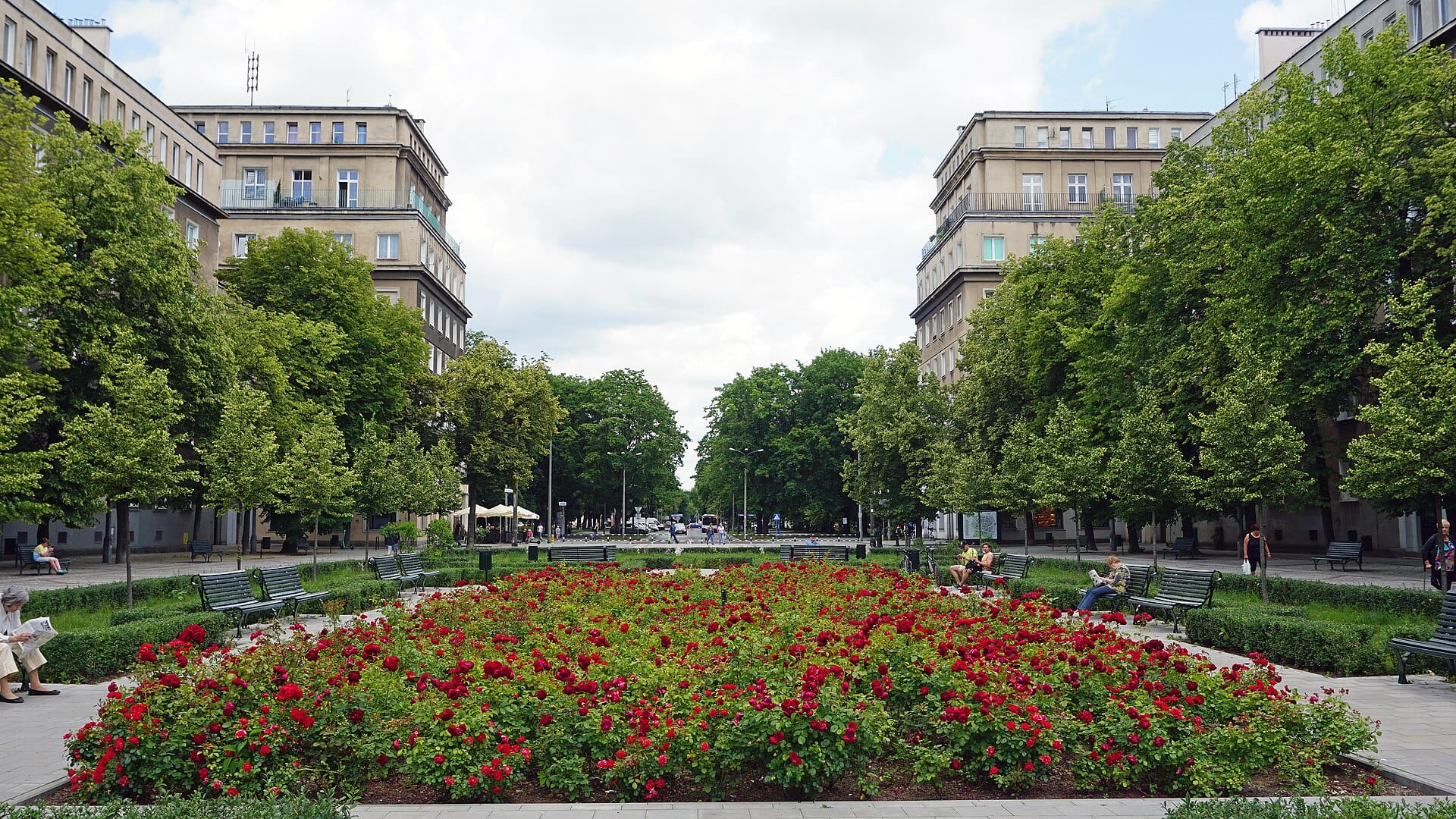
In the morning, the district moves to a working-city rhythm. Residents queue at bakeries and kiosks near the tram stops, children walk to school along the wide pavements of Aleja Róż (Avenue of Roses), and the low sun hits the stone facades of the central blocks in a way that makes the architectural ambition suddenly legible. The planners modelled the aesthetic on Italian Renaissance arcades filtered through Soviet monumentalism, and you see that most clearly at ground level in early light, before the tourist coaches arrive.
By midday the district takes on a quieter, residential tempo. Locals sit in the large parks and squares between the housing blocks, where mature trees now soften the original severity of the plan. Nowa Huta was designed with unusually generous green space for a workers' district: the park areas between avenue alignments are some of the largest urban green corridors in Kraków, and on weekday afternoons they are used almost entirely by local families rather than visitors.
After dark, the streets around the main avenues are adequately lit and generally calm. The neighbourhood now has a reputation no more concerning than central Kraków, though some of the outer residential blocks away from the main axes are quieter and less frequented at night. Stick to the core grid around Plac Centralny and Aleja Solidarności for evening walks and you will feel perfectly comfortable.
ℹ️ Good to know
Nowa Huta remains a residential neighbourhood, and most buildings are occupied apartment blocks with living tenants. Treat the streets and communal spaces with the same respect you would in any urban neighbourhood.
What to See and Do
The core attraction is the urban fabric itself. Walking the avenues from Plac Centralny outward gives you the full theatrical effect of the socialist realist plan: the regulated building heights, the repetition of decorative motifs across blocks, the way each avenue terminates in a vista rather than an intersection. It was designed to be experienced on foot, and it still works that way.
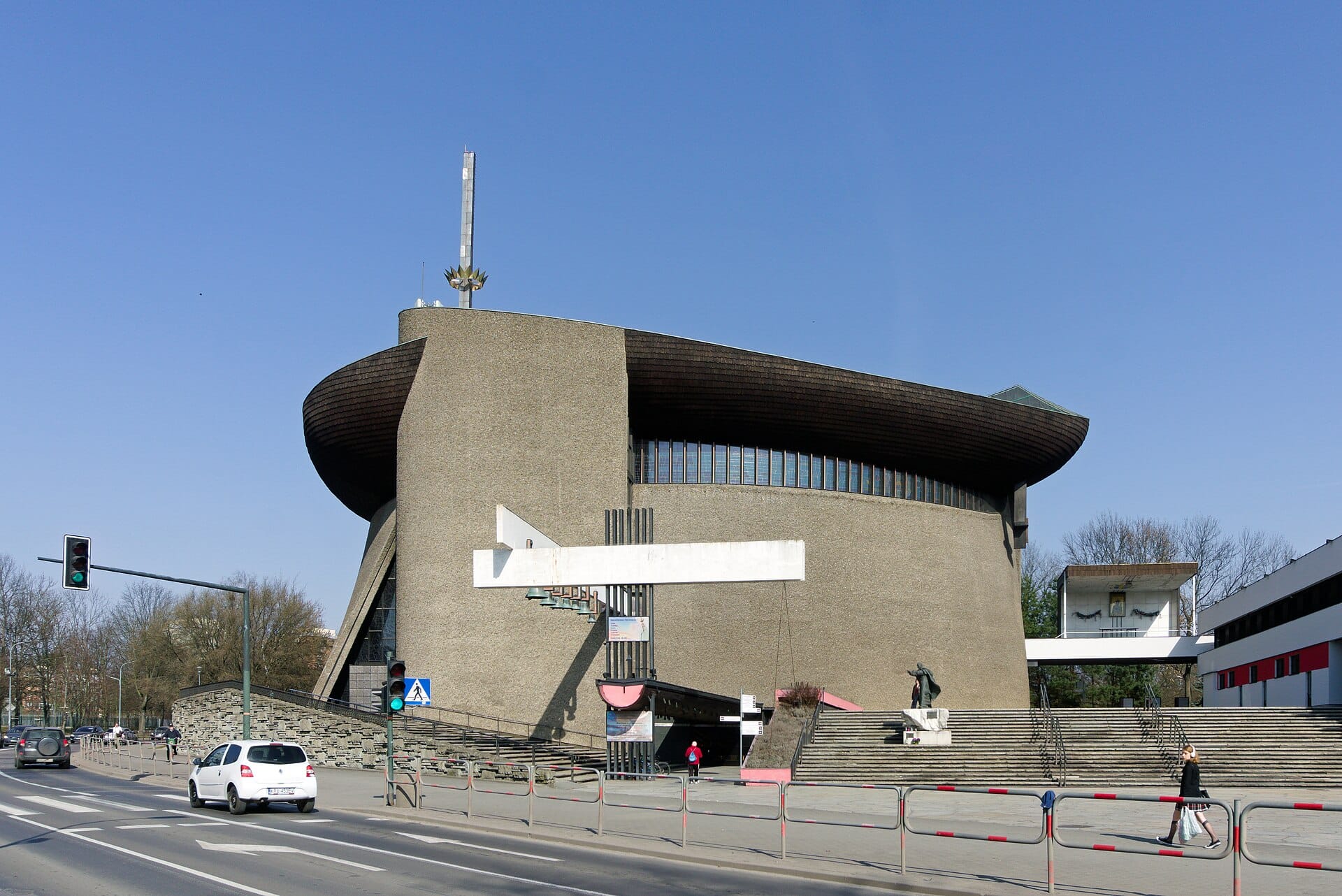
The most striking single building in the district is the Arka Pana (Lord's Ark) Church, officially listed as the Lord's Ark Church in Nowa Huta. Built between 1967 and 1977 after a decades-long struggle by residents against the communist authorities who had deliberately omitted churches from the original plan, it has the form of an upturned hull clad in thousands of pebbles collected by parishioners. The interior is dense with symbolism. This building is the clearest physical marker of how the district's residents eventually resisted the ideology imposed on them.
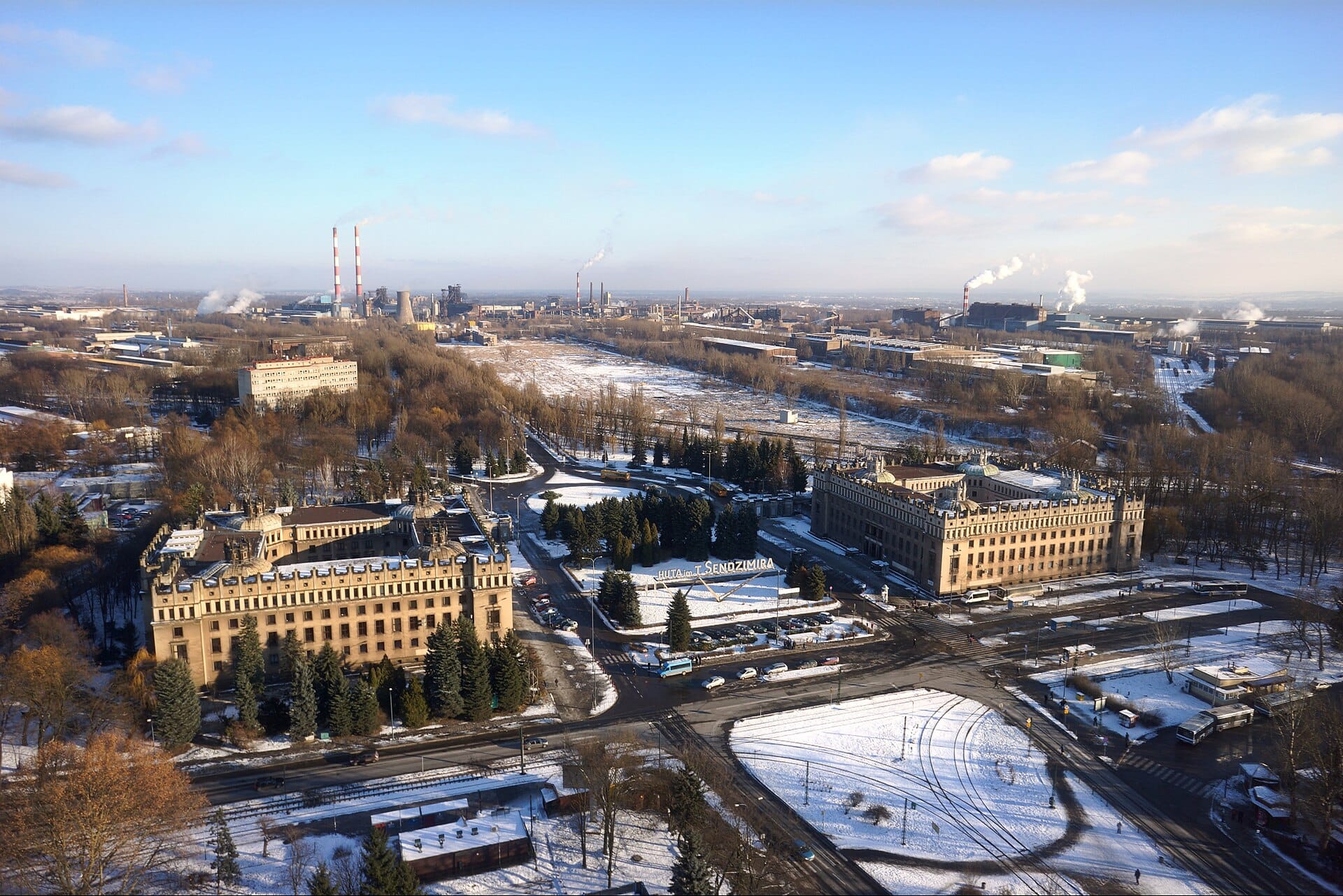
The Tadeusz Sendzimir Steelworks (formerly the Vladimir Lenin Steelworks) opened in 1956 and once employed over 30,000 workers. The plant is still operational and is not publicly accessible as a general visitor attraction, but the gate complex and surrounding infrastructure form a significant part of the district's eastern landscape. Guided industrial heritage tours sometimes include access to the steelworks perimeter and visitor facilities: check with local tour operators for current options.
Plac Centralny im. R. Reagana: the architectural heart of the district, worth photographing at different times of day
Lord's Ark Church (Arka Pana): extraordinary post-war religious architecture with a powerful resistance history
Nowa Huta Museum (branch of the Historical Museum of Kraków): documents the district's founding, the steelworks, and the Solidarity movement's roots here
Aleja Różana and the surrounding park network: the best introduction to the district's green-space planning
The steelworks gate and surrounding streetscape: a reminder of the industrial scale the entire district was built to serve
Nowa Huta open-air cinema and cultural events: seasonal programming that serves local residents year-round
For context before you visit, the Kraków Nowa Huta communist tour guide covers the key sites and the broader political history. Many visitors combine Nowa Huta with a morning at Schindler's Factory Museum in Podgórze to build a fuller picture of Kraków's 20th-century layers.
💡 Local tip
The Nowa Huta Museum branch at Osiedla Słoneczne 16 is the single most efficient introduction to the district's history. Spend an hour there before walking the streets and everything you see outside will make more sense. Check current opening hours before visiting, as they change seasonally.
Eating and Drinking
Nowa Huta's food scene is strongly local. You will not find the polished café strips of Kazimierz or the tourist-facing restaurant rows of the Old Town. What you will find is a working-class Polish food culture that has not been adjusted for visitor expectations: bar mleczny (milk bars) serving traditional Polish dishes at very low prices, local bakeries open from early morning, and neighbourhood restaurants where the menu is unlikely to be available in English.
The bar mleczny format is worth understanding before you arrive. These are subsidised self-service canteens, a direct legacy of communist-era food policy, serving dishes like żurek (sour rye soup), pierogi, gołąbki (stuffed cabbage rolls), and kotlet schabowy (breaded pork cutlet) at prices that feel implausible by western European standards. Pointing at dishes and watching what locals take is the simplest navigation method. Nowa Huta has several of these still operating near the main residential blocks.
Around Plac Centralny and the main avenues, there are cafés and small bars that cater to a mixed local and visitor crowd. Some have leaned into the retro-communist aesthetic with deliberate irony, offering Soviet-era themed cocktails alongside Polish beer. The prices are reasonable by Kraków standards and well below what you would pay in the Old Town. The craft beer and specialty coffee trends that transformed Kazimierz have made limited inroads here, but a few places near the museum have adapted to the growing visitor flow.
For a broader sense of what to eat across Kraków before you arrive, our Kraków food guide covers traditional dishes, price ranges, and where to find them across the city's neighborhoods.
Getting There and Around
Tram is the standard way to reach Nowa Huta from central Kraków. The journey from Dworzec Główny Tunel (the stop beneath the main railway station) takes roughly 20 to 30 minutes depending on traffic and the specific line. Several tram lines connect the city centre to Nowa Huta, with Plac Centralny im. R. Reagana as the key stop. Services run frequently during daytime hours.
Tickets are purchased from machines at tram stops or via the Kraków public transport app. The same ticket covers trams and buses across the city. Single-journey and time-based tickets are available. All prices should be verified with the MPK Kraków operator before visiting, as fares change periodically.
Within the district, the most practical way to move around is on foot for the central area around Plac Centralny and the main avenues, and by tram or bus for reaching the Lord's Ark Church or the steelworks gate, which sit further from the central hub. The distances between sites are workable but not trivial: the district covers 65 square kilometres and the major landmarks are separated by 15 to 20 minute walks even within the central zone.
Ride-hailing apps (Uber and Bolt are commonly used in Kraków) can supplement tram access, particularly for evening visits or for connecting multiple sites across the district efficiently. For a full overview of public transport options across Kraków, see the getting around Kraków guide.
💡 Local tip
Combine a Nowa Huta visit with a morning in Podgórze to avoid backtracking. Both districts are east or south-east of the centre and can be linked by tram with a short transfer, giving you a coherent day focused on Kraków's 20th-century history.
Where to Stay
Nowa Huta is not a primary base for most Kraków visitors and accommodation options are limited compared with the Old Town or Kazimierz. The district has a small number of guesthouses and apartments, typically at lower prices than equivalent options in the historic centre. Staying here makes sense for travelers with a specific interest in the district's architecture and history, or for those visiting on a tight budget who do not mind the 25-minute tram commute to the Old Town.
For most visitors, the Old Town or Kazimierz remain the more practical bases, with better access to the main concentration of Kraków's attractions and nightlife. The where to stay in Kraków guide covers all the main neighbourhoods with specific recommendations by traveler type and budget.
Is Nowa Huta Worth Visiting?
Nowa Huta divides travelers predictably. Those who come expecting a conventional tourist district with polished restaurants and curated heritage trails will find it underwhelming. Those who come to understand what it is, a complete city built to an ideological programme and later used by residents as a base for resistance to the government that built it, will find it one of the most coherent and thought-provoking urban environments in Poland.
The district is not rough or unsafe, and the tram ride from the centre is straightforward. The main drawback is the time investment: doing it properly takes most of a day, and the sites are spread enough that casual drop-ins feel incomplete. It rewards preparation, which means reading something about its history before you arrive, not after.
⚠️ What to skip
Nowa Huta can feel disorientating without a map or basic preparation. The repeating architectural elements and wide avenues make navigation harder than in more organic city districts. Download an offline map or use a GPS app before exploring beyond Plac Centralny.
If you are planning a broader Kraków itinerary, the 3-day Kraków itinerary suggests how to slot Nowa Huta into a structured visit alongside the Old Town, Kazimierz, and Podgórze.
TL;DR
Nowa Huta is one of the best-preserved examples of socialist realist urban planning in Europe, built from 1949 as a model workers' city around a giant steelworks 8 km east of central Kraków.
Key sites include Plac Centralny im. R. Reagana, the Nowa Huta Museum, and the Lord's Ark Church, a monument to the residents' decades-long resistance to the communist authorities who banned churches from the original plan.
The tram from central Kraków takes around 20-30 minutes and makes the district easy to reach as a day trip.
The food scene is local-facing, with traditional bar mleczny canteens offering cheap Polish staples, and the neighbourhood has none of the tourist-facing polish of the Old Town.
Best suited to travelers with an interest in 20th-century history, architecture, or Cold War urban planning; less rewarding for visitors seeking conventional sightseeing or a polished food and nightlife scene.
Two days in Kraków is enough time to cover the Royal Capital's greatest hits without rushing. This itinerary covers the Old Town, Wawel Hill, Kazimierz, and Podgórze in a logical, walkable order, with honest guidance on day trips, booking pitfalls, and what actually fits into a weekend.
Three days is the sweet spot for Kraków. Long enough to cover the Royal Castle, the Jewish Quarter, and a serious day trip without rushing, short enough that you won't run out of things to do. This itinerary breaks it down day by day, with honest advice on costs, timing, and what to skip.
Auschwitz-Birkenau is 65-70 km from Kraków and one of the most significant historical sites in the world. This guide covers every practical detail: how to book mandatory timed entry, how to get there by train, bus, or organized tour, what to expect at both sites, and how to plan your day without stress.
Kraków punches well above its weight as a museum city. This guide covers the finest collections in the Old Town, Kazimierz, Podgórze, Wawel Hill, and beyond, with practical advice on free days, booking ahead, and how to sequence your visits.
Kraków rewards visitors year-round, but timing makes a real difference to your experience. This guide breaks down every season, from spring's mild sightseeing windows to December's Christmas markets, so you can match your trip to your priorities.
Kraków sits at the centre of one of Central Europe's richest day-trip networks. Within two hours you can descend into a UNESCO salt mine, walk the grounds of the world's most significant Holocaust memorial, or stand in the shadow of the Tatra Mountains. This guide covers the best excursions, with honest advice on timing and logistics.
Kraków rewards budget travellers more than almost any other European city. From a medieval market square and riverside walks to free museum days and a communist-era district, here's how to fill your itinerary without opening your wallet.
Kraków's tram and bus network is affordable, frequent and covers every major district. This guide covers MPK Kraków tickets, airport transfers, ride-hailing fares, night services and the common mistakes that catch visitors out.
Kraków ranks among the safest major cities in Europe, with a crime index of around 24.9 and a U.S. State Department Level 1 travel advisory. This guide covers the real risks tourists face, from pickpockets on trams to nightlife scams, plus practical advice on safe neighborhoods, solo travel, and getting around after dark.
The Kraków Christmas Market on Rynek Główny is one of Central Europe's most atmospheric seasonal events, running from late November into the New Year across multiple locations. This guide covers exact dates, opening hours, what to buy and eat, how to get there, and how to avoid the most common mistakes first-time visitors make.
Kraków rewards curiosity beyond its famous squares and castles. This guide uncovers the city's lesser-known museums, quiet districts, ancient earthworks, and local markets that most visitors walk straight past.
Kraków holds one of Europe's most significant concentrations of Jewish heritage, from the medieval synagogues of Kazimierz to the haunting remains of the Podgórze Ghetto. This guide covers every major site, the best order to visit them, seasonal considerations, and the historical context that makes these places meaningful.
Kraków has one of Central Europe's most energetic nightlife scenes, spanning cellar clubs in the Old Town to craft-cocktail bars in Kazimierz. This guide covers where to go, when to arrive, what to pay, and what to skip.
Nowa Huta is unlike anywhere else in Poland. Built from scratch in 1949 as a model socialist workers' city, this eastern district of Kraków preserves Soviet-era architecture, monumental avenues, and a steelworks that once employed 40,000 people. This guide covers what to see, how to get there, and how to make the most of your visit.
Kraków remains one of Europe's best-value city breaks, but knowing where to spend and where to skip makes the difference. This guide breaks down real daily costs, the best free attractions, cheap eating options, and smart strategies to stretch every złoty.
Steven Spielberg's Schindler's List was filmed almost entirely in Kraków, Poland, using real streets, courtyards, and the actual factory where Oskar Schindler saved over 1,000 Jewish workers. This guide breaks down every major filming location, separates film myth from historical fact, and tells you exactly how to visit each site.
Kraków rewards shoppers who go beyond the obvious. This guide covers the city's best markets, streets, and specialty shops — from amber at the Cloth Hall to vintage finds in Kazimierz — with practical details on prices, hours, and what to avoid.
Three main transport options connect Kraków and Prague: direct and semi-direct trains, intercity buses, and low-cost flights on selected days. This guide breaks down journey times, realistic costs, booking logistics, and which option actually suits your trip.
Kraków's Old Town (Stare Miasto) is one of Europe's most walkable historic centres, compact enough to cover on foot in a half-day without a guide. This route takes you along the Royal Route from the Barbican through Rynek Główny to Wawel Castle, with practical timing, entry fee breakdowns, and clear advice on what to skip.
Kraków is one of Central Europe's most rewarding cities for families. From a fire-breathing dragon and underground salt mines to cheap milk bars and a largely car-free Old Town, this guide covers everything parents need to plan a memorable trip to Kraków, Poland with children in tow.
Zakopane sits about 105 km south of Kraków in the Tatra Mountains and makes one of the best day trips from the city. This guide covers every transport option, realistic costs, what to do once you arrive, and the seasonal factors that can make or break the trip.
Kraków is Poland's most historically rich city, home to a UNESCO-listed Old Town, royal castle, Jewish quarter, and some of Europe's most important WWII memorial sites. This guide covers the best things to do in Kraków across every interest and budget, with practical detail on tickets, timing, and logistics.
Wawel Hill is the historical heart of Kraków, Poland, home to the Royal Castle and the Wawel Cathedral — two separate sites with separate tickets, hours, and experiences. This guide covers everything you need to plan a smart, well-timed visit, from ticket prices and booking logistics to what's worth your time inside.
Kraków is one of Central Europe's great food cities, with a cuisine built on centuries of Polish tradition. This guide covers the essential dishes to try, where to find the real thing, and how to eat well without paying tourist-trap prices.
Choosing where to stay in Kraków shapes your entire trip. This guide breaks down every major neighborhood by price, vibe, and proximity to sights, so you can pick the right base without second-guessing yourself.
The Wieliczka Salt Mine is one of Poland's most visited attractions, sitting just 14 km from central Kraków. This guide covers everything you need to know before you go: which route to choose, how to book tickets, what the underground visit actually involves, and the practical details most guides skip.