Lord's Ark Church (Arka Pana): Nowa Huta's Defiant Stone Cathedral
The Church of Our Lady Queen of Poland, known as the Lord's Ark Church or Arka Pana, stands as one of Krakow's most compelling Cold War stories in architectural form. Built between 1967 and 1977 in the heart of a district designed without God, it remains an active parish and a remarkable monument to resistance. Entry is free.
Quick Facts
- Location
- ul. Obrońców Krzyża 1, Bieńczyce, Nowa Huta, Krakow
- Getting There
- Tram lines 4, 10, or 22 to Bieńczyce stop, then a short walk
- Time Needed
- 30–60 minutes
- Cost
- Free admission; voluntary donations welcome
- Best for
- Architecture, Cold War history, religious heritage, photography
- Official website
- www.arkapana.pl
What Is the Lord's Ark Church?
The Lord's Ark Church, officially named Kościół Matki Bożej Królowej Polski (Church of Our Lady Queen of Poland), sits in the Bieńczyce district of Nowa Huta, the vast planned workers' city that communist authorities bolted onto Krakow's eastern edge from the late 1940s onward. It was the first church ever built in Nowa Huta, and that fact carries enormous weight: the district was deliberately designed without places of worship, a calculated statement by the regime that the new socialist city had no need for religion.
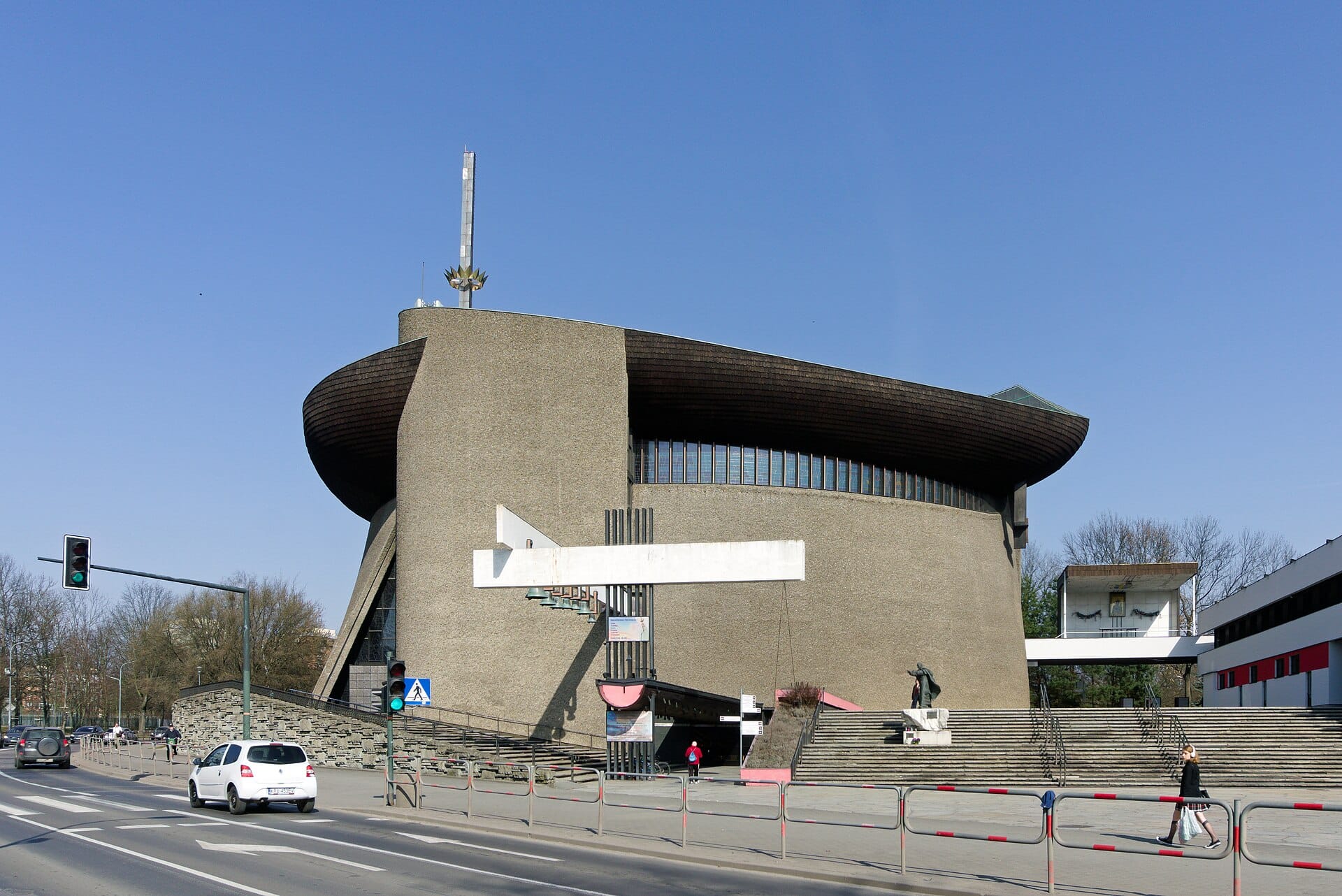
Constructed between 1967 and 1977 to designs by architect Wojciech Pietrzyk, the building took a decade to complete, partly because its existence was contested at every stage by the communist authorities. The congregation that eventually gathered around it had fought for over twenty years simply for the right to build. What emerged from that struggle is a structure unlike almost anything else in Poland: a ship-shaped, reinforced concrete hull clad entirely in roughly two million individual stones and cobblestones, each one hand-placed by parishioners and supporters.
ℹ️ Good to know
Visiting hours are generally Mon–Sat 07:00–19:00 and Sunday 07:00–20:00; some sources note access may vary during Mass or religious holidays. Confirm times at the parish (arkapana.pl) before travelling.
The Architecture: A Ship Built from Two Million Stones
The exterior of the Lord's Ark Church is the first thing that stops visitors in their tracks. The building's massed, curving silhouette from the front elevation suggests the hull of a vessel rising from the ground, though up close it reads more as an organic, almost geological form. The stones covering the surface range from river-worn pebbles to rough cobblestones, and the texture changes noticeably depending on the light. On overcast mornings the facade appears grey and monolithic. In late afternoon sun, warm tones and shadows shift across the irregular surface in ways that make it almost seem to move.
The roof structure carries a large golden cross and a statue of Christ, visible from the tram stop and from across the surrounding streets. The overall form is unapologetically bold for a religious building of its era: this is not a modest structure designed to avoid attention. Its visual aggression was, in part, the point.
Inside, the scale shifts. The nave is broad and relatively low, and the main source of drama is the central crucifix, standing approximately eight metres high and sculpted by Bronisław Chromy, one of Krakow's most prolific post-war sculptors. The figure is expressive without being theatrical, and in the quiet of a weekday morning it commands the space effectively. Natural light enters through stained glass, casting colored patches across the concrete floor depending on the hour.
Tickets & tours
Live prices and dates from our booking partner. If you book, we may earn a commission at no extra cost to you.
Guided tour of Krakow's Nowa Huta district
From 94 €Instant confirmationFree cancellationKrakow's Market Square with St. Mary's Basilica and Rynek Underground
From 46 €Instant confirmationFree cancellationSkip-the-line ticket to the Undergrounds of St. Adalbert's Church
From 2 €Instant confirmationFree cancellationWawel Hill and Old Town Guided Tour with St.Mary's Church Entrance
From 62 €Instant confirmationFree cancellation
Historical Context: Religion vs. the Socialist State
To understand why this church exists and why it matters, you need a basic picture of what Nowa Huta was built to be. Starting in 1949, the communist government constructed a model workers' city from scratch, intended as a showcase of socialist planning and a calculated counterweight to Krakow's strongly Catholic, intellectual identity. The city layout included schools, theatres, sports facilities, and apartment blocks, but no churches. For full context on the district's design and ideology, the Nowa Huta Central Square is the best starting point for any visit.
Local residents began petitioning for a church almost immediately after the district was founded. The authorities repeatedly denied them. When a cross erected on a proposed building site was forcibly removed by the state in 1960, it triggered serious civil unrest. The conflict continued for years, drawing in the Catholic Church hierarchy and eventually Karol Wojtyla, the Archbishop of Krakow, who celebrated open-air Christmas Masses on the contested plot throughout the 1960s and personally fought for construction permission. Wojtyla would later become Pope John Paul II.
Permission was finally granted in 1967, and the foundation stone was laid that same year. The congregation did not wait for contractors: residents carried stones and materials to the site themselves, a collective act of labor that became the building's defining physical characteristic. When the church was finally consecrated in 1977, it was dedicated by Cardinal Wojtyla, just one year before his election as Pope.
💡 Local tip
For a fuller picture of Nowa Huta's communist heritage, combine this visit with a stop at the Nowa Huta steelworks or join a guided communist-era tour of the district. The church makes most sense when seen alongside its ideological context.
Inside the Church: What to Look For
Beyond the crucifix by Bronisław Chromy, the interior contains several details worth seeking out. The tabernacle is reported to contain a fragment of lunar rock, a gift associated with Pope Paul VI, who reportedly received moon samples from the Apollo missions and distributed fragments to Catholic institutions worldwide. Whether visitors can see it up close depends on access arrangements at the time of visiting, but it is one of those details that makes an already unusual church singular.
The baptismal area and side chapels are quieter spaces where the stonework motifs of the exterior reappear in smaller decorative elements. The overall interior palette is restrained: concrete, stone, and natural wood rather than the ornate gilding common in Krakow's older churches. This restraint suits the building's history. It does not look like a place that was given anything easily.
As an active parish church, Masses are held regularly throughout the week. Visitors should avoid arriving during services if their interest is architectural rather than devotional. The atmosphere during a weekday mid-morning visit is calm, with perhaps a handful of locals present for prayer. The church is marked as disabled-friendly by Krakow tourism sources.
How the Experience Changes by Time of Day
Early mornings, particularly on weekdays, offer the most contemplative visit. The exterior stonework catches low-angle light well, and the surrounding streets are quiet enough that the building's scale registers properly without the distraction of foot traffic. This is the best window for exterior photography: the rough stone texture reads sharply in raking morning light, and the cross atop the structure catches the sky cleanly.
Midday visits on weekends can coincide with major Masses, which draw substantial local congregations. If you arrive during a service, you will either need to wait outside or participate respectfully. Sunday afternoons, according to some sources, have restricted visiting windows, so this is the time slot most likely to result in a partial or failed visit.
Late afternoons in summer bring warm golden light across the western-facing stone facade, which is visually rewarding but can also mean higher visitor numbers, particularly if coach tours are running Nowa Huta itineraries. The church is rarely crowded by Old Town standards, but it is not unknown either.
Getting There and Practical Notes
From central Krakow, tram lines 4, 10, or 22 reach the Bieńczyce stop in Nowa Huta, from which the church is a short walk. The journey takes roughly 25–35 minutes from the Old Town, depending on your boarding point. Multiple bus lines also serve the Nowa Huta area. Tram travel is the more straightforward option for first-time visitors.
The church at ul. Obrońców Krzyża 1 is best visited as part of a broader Nowa Huta half-day. A logical route combines the Central Square with the Lord's Ark Church, ending at the steelworks area if time allows. The Nowa Huta communist tour guide covers the full district routing in detail.
Dress modestly for entry, as the building is an active place of worship. Covered shoulders and knees are the standard expectation at Catholic churches in Poland. Photography is generally permitted inside, but be attentive to whether services are in progress. There is no charge for entry, though donation boxes are present.
Is It Worth the Trip?
The Lord's Ark Church is not a detour for everyone. It sits far from the Old Town, the interior lacks the visual density of Krakow's medieval churches, and visitors who come purely for aesthetic spectacle may find the experience underwhelming compared with St. Mary's Basilica or the churches along the Royal Road. The architecture is striking but demanding: it requires engagement with its context to make full sense.
For travelers with an interest in Cold War history, political resistance, or the relationship between architecture and ideology, this is one of the most substantive sites in Krakow. The building is a physical record of a community's twenty-year fight against the state, and that history is written into every stone on its surface. That is not something you encounter in many churches, anywhere.
Those planning a longer stay in the city can fit this into a 3-day Krakow itinerary without difficulty, dedicating one morning to Nowa Huta in its entirety.
Insider Tips
- The best exterior photography angle is from the street directly in front of the main facade, slightly to the left of center, in morning light. The stones catch texture most dramatically at low sun angles.
- If you want to understand the interior's proportions properly, walk to the rear of the nave rather than stopping at the entrance. The crucifix by Bronisław Chromy reads very differently from fifty meters than it does from the door.
- The church is rarely included in standard Krakow day-tour itineraries, meaning even in high summer you are unlikely to share the space with a crowd. Go on a weekday morning for the quietest visit.
- Check Mass times on the parish website (arkapana.pl) before visiting. Sunday visiting restrictions in the afternoon are referenced by multiple sources, and arriving without checking risks a wasted journey.
- The surrounding streets of Bieńczyce are representative of Nowa Huta's residential planning: wide, tree-lined, and geometrically ordered. Walking a few blocks in any direction gives useful context for how the church sits within the district's urban logic.
Who Is Lord's Ark Church (Arka Pana) For?
- Travelers interested in Cold War history and communist-era Poland
- Architecture enthusiasts drawn to 20th-century religious buildings
- Anyone tracing the story of Pope John Paul II and his roots in Krakow
- Visitors who want to see a part of Krakow that most tourists skip entirely
- Photographers looking for texturally distinctive exterior subjects
Nearby Attractions
Other things to see while in Nowa Huta:
- Nowa Huta Central Square (Plac Centralny)
Plac Centralny im. Ronalda Reagana is the monumental heart of Nowa Huta, Kraków's planned socialist-realist district. Built between 1949 and 1956 as the centerpiece of a model workers' city, the square offers a striking architectural time capsule, free to visit, and best understood as part of a longer exploration of one of Europe's most intact examples of Stalinist urban planning.
- Nowa Huta Steelworks
The Tadeusz Sendzimir Steelworks, formerly the Lenin Steelworks, is one of Europe's most striking monuments to communist industrial ambition. Sprawling across a large area of eastern Kraków, it still operates today under ArcelorMittal Poland and can be visited on organised guided tours, usually focused on administrative buildings, shelters, and industrial heritage rather than active production areas.
Planning a trip? Discover personalized activities with the Nomado app.