St Mary's Basilica Kraków: What to See, When to Go, and How to Visit
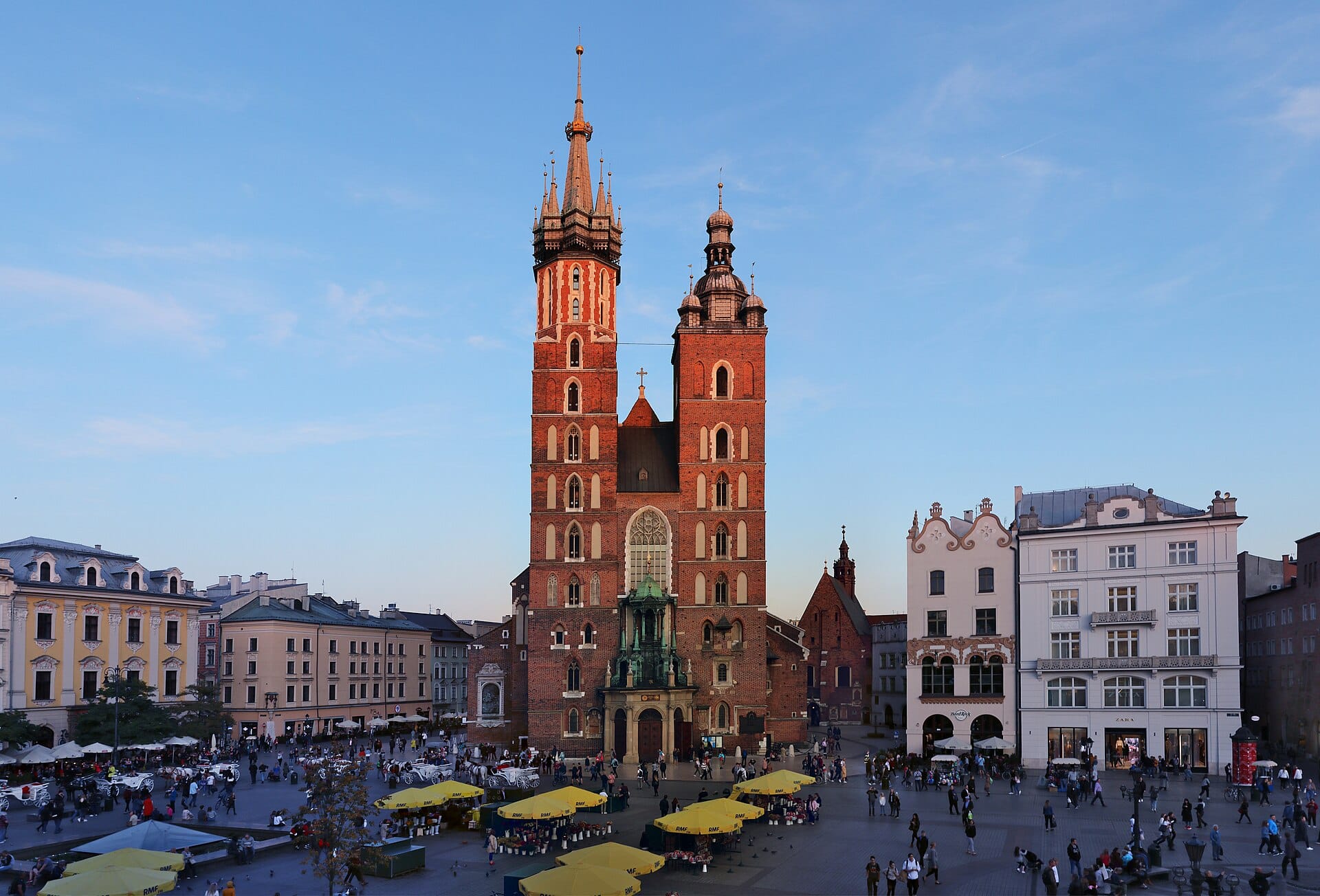
Standing at the north-eastern corner of Kraków's Main Market Square, with foundations dating to the 13th century and its present Gothic form completed in the 14th century, St Mary's Basilica is the city's most recognizable landmark. Its twin asymmetric towers, cobalt-blue interior, and the world's largest Gothic altarpiece make it far more than a photo backdrop.
Quick Facts
- Location
- Plac Mariacki 5, 31-042 Kraków (north-east corner of Rynek Główny)
- Getting There
- Nearest tram/bus stop: Poczta Główna (approx. 5-min walk); 15–20-min walk from Kraków Główny railway station
- Time Needed
- 45–90 minutes for the interior; add 30 minutes if visiting the tower
- Cost
- Interior: 20 PLN regular / 10 PLN reduced. Bugle Tower: 20 PLN regular / 15 PLN reduced; tickets are sold in person on the day
- Best for
- Architecture, medieval art, history, photography from the tower
- Official website
- mariacki.com/en
What St Mary's Basilica Actually Is
St Mary's Basilica (officially the Archipresbyteral Church of the Assumption of the Blessed Virgin Mary, or Kościół Mariacki in Polish) anchors the north-eastern corner of Rynek Główny, Kraków's Main Market Square. Its foundations date to the early 13th century, and the brick Gothic structure visitors see today was built through the 14th century. At roughly 80 metres, the taller of its two asymmetric towers is a prominent feature of the Old Town skyline. The basilica forms part of the Historic Centre of Kraków, inscribed as a UNESCO World Heritage Site in 1978.
Most people know it from photographs: two unequal towers rising above the roofline of the square, the spire of the taller one crowned with a gilded crown and surrounded by turrets. What those photographs don't show is the interior, which is one of the most visually intense Gothic spaces in Central Europe. The colour scheme alone, deep cobalt blues and gold leaf running the length of the nave, tends to stop visitors in the doorway.
💡 Local tip
The tourist entrance to the basilica is on the side facing Mariacki Square (Plac Mariacki), not the main portal facing Rynek Główny, which is reserved for worshippers. Look for the visitor service point just inside the side door.
The Hejnał: Kraków's Hourly Trumpet Call
Every hour, a trumpeter appears at the window of the taller tower and plays the hejnał, a short bugle call that breaks off mid-phrase. The interruption is deliberate: it commemorates a medieval trumpeter who, according to tradition, was shot through the throat while sounding an alarm during a Mongol attack in the 13th century. Whether the story is entirely historical or partly legend is debated, but the ritual itself is not: it has been performed continuously for centuries and is broadcast live on Polish national radio around noon.
If you're in the square when the hour strikes, stop. Look up. You'll hear the call from four sides as the trumpeter rotates to face each direction. It takes about 90 seconds and is one of those rare moments in a tourist city where a centuries-old civic ritual is still happening in real time, not as a re-enactment.
Tickets & tours
Live prices and dates from our booking partner. If you book, we may earn a commission at no extra cost to you.
Krakow Old Town Short Walking Tour with St. Mary's Basilica Entrance
From 23 €Instant confirmationFree cancellationKrakow's Market Square with St. Mary's Basilica and Rynek Underground
From 46 €Instant confirmationFree cancellationWawel Hill and Old Town Guided Tour with St.Mary's Church Entrance
From 62 €Instant confirmationFree cancellationWawel Castle, St. Mary's Church and Rynek Underground Guided Tour
From 85 €Instant confirmationFree cancellation
Inside the Basilica: The Altarpiece and the Interior
The high altar is the reason the interior admission fee exists and, for most visitors, it justifies itself quickly. The polyptych carved by Veit Stoss (Wit Stwosz in Polish) between 1477 and 1489 is considered the largest Gothic altarpiece in the world. It measures roughly 13 metres high and 11 metres wide when open. The central scene depicts the Dormition of the Virgin Mary, with figures carved in limewood at slightly larger than life scale. The craftsmanship is detailed to the point of distraction: fabric folds, individual facial expressions, layered spatial depth. It was commissioned by the city of Kraków, not by the church, which is part of why it has always been treated as a civic treasure as much as a religious one.
The altarpiece is opened Monday through Saturday at 11:50 a.m. and on Sundays and public holidays from 2:10 p.m. If you time your visit to arrive just before opening, you'll watch the panels swing out, which is a slow, deliberate process that draws attention to the scale of the piece. Arriving even five minutes after opening means the crowd has already formed and you'll be working around other visitors' cameras.
Beyond the altarpiece, the interior rewards slow looking. The polychrome decoration covering walls and vaulted ceilings was largely added in the late 19th century, designed by the Polish painter Jan Matejko and executed partly by Stanisław Wyspiański, whose work also includes the stained glass windows in the chancel. The blues are particularly saturated, almost electric under certain light conditions, and the effect of the entire space under those colours is unusually vivid.
ℹ️ Good to know
The basilica is an active place of worship. Masses are held throughout the day, and the tourist section (presbytery area) is closed during services. Check the schedule at mariacki.com before planning your visit.
The Tower: Worth the Climb?
The taller tower opens to visitors from May, Tuesday through Saturday from 10:00 a.m. to 5:30 p.m., and on Sundays from 1:00 p.m. Entry is from Floriańska Street, tickets are sold only on the day at the visitor service point, and groups are limited to a maximum of 15 per entry slot, which run every 30 minutes. Children under 8 are not admitted. The climb is steep and the staircase is narrow, so factor in the physical demands before committing.
The view from the top is excellent, looking directly down onto the full expanse of Rynek Główny with the Cloth Hall running through its centre, the rooflines of the Old Town spreading outward, and on clear days, Wawel Hill to the south. Morning visits offer the softest light for photography. The tower may close in bad weather, so check conditions before purchasing tickets.
For a broader perspective on the Old Town's layout, the tower view pairs well with a walk along Planty Park, the green belt encircling the medieval core, which gives ground-level context for how the city is structured around the historic centre.
When to Visit and How the Experience Changes by Hour
The tourist section opens at 11:30 a.m. on weekdays and Saturdays, and at 2:00 p.m. on Sundays. Arriving at opening time on a weekday morning gives you the best chance of seeing the interior without navigating large tour groups. By early afternoon in peak summer months (July and August), the space can feel crowded, and the narrow tourist route through the presbytery means queues form naturally around the altarpiece.
Late afternoon visits, from around 4:30 p.m. onward, tend to be quieter as group tours have dispersed. The light through the chancel windows shifts noticeably in the afternoon and catches the gold detailing on the altarpiece differently than at midday. If you're interested in the interior as a visual experience rather than just a checklist item, this window is worth prioritising.
Winter visits deserve a mention. Outside of peak season, the square and the basilica are far less crowded, and the church's stone exterior and gilded crown look striking against grey winter sky. Kraków's Christmas Market sets up directly in Rynek Główny from late November, and the basilica towers form the backdrop to the entire market, which changes the experience of the square completely.
Practical Walkthrough: What to Expect on Arrival
The main portal on Rynek Główny is for worshippers. Tourist entry is through the side door on Plac Mariacki (the smaller square immediately to the north-east). The visitor service point is at Plac Mariacki 7; buy your ticket there in person on the day of your visit. The standard basilica admission ticket is 20 PLN, with a 10 PLN reduced ticket for eligible visitors. The service closes 15 minutes before the end of visiting hours, so don't arrive at 5:50 p.m. expecting to get in.
Dress modestly. As an active Catholic church, bare shoulders and very short clothing are not appropriate. Most visitors wear ordinary tourist clothing without issue, but vest tops and shorts that are very short may draw attention from staff. A light layer in a bag solves the problem without any planning.
Photography inside is generally permitted without flash in the tourist areas. The altarpiece is the obvious focal point, but the ceiling vaulting, the stained glass in the apse, and the carved stone details of the side chapels reward closer attention and are less photographed. The tourist route is defined and fairly linear; you won't get lost.
⚠️ What to skip
All ticket prices and opening hours listed here were accurate at the time of writing but are subject to change, particularly around religious holidays. Verify current details at mariacki.com/en/ before your visit.
Is It Worth It?
The exterior can be appreciated for free from the square at any hour, and spending time there is worthwhile regardless. The interior is where the admission makes sense, specifically for the Veit Stoss altarpiece. If Gothic religious art and medieval craftsmanship interest you, this is one of Europe's major late-Gothic woodcarving ensembles and worth the 20 PLN admission without hesitation. If you're primarily a city and café traveller with little interest in ecclesiastical interiors, you might find the restricted tourist zone feels brief for the entry cost, and the Kraków Underground Museum beneath Rynek Główny might compete more directly for your time and interest.
Visitors who find large crowds stressful should be prepared for peak summer afternoons. Those with mobility limitations should note that step-free access details are not clearly published; contact the basilica directly before visiting. The tower, in particular, is not suitable for anyone with difficulty climbing steep, narrow stairs. A visit to St Mary's pairs naturally with the rest of the Old Town: the Cloth Hall (Sukiennice) is directly across the square, and the Kraków Barbican is a 10-minute walk north along Floriańska Street.
Insider Tips
- To see the altarpiece opened rather than already open, arrive at the visitor entrance by 11:40 a.m. on weekdays. The panels swing out at 11:50 a.m. and watching the reveal gives you a sense of the altarpiece's true scale that arriving afterward doesn't provide.
- Tower tickets sell out during peak summer months, especially on weekends. Go early in the morning when the service point opens to secure your preferred time slot, as they are sold only on the day.
- The hejnał trumpet call is broadcast live on Polish Radio One (Polskie Radio Jedynka) every day at noon. If you're not in the square, you can still hear it, but the experience of being directly below the tower window when the trumpeter appears is qualitatively different.
- The south side of Rynek Główny (the side with restaurant terraces) gives you the best unobstructed view of both towers together for photography. Early morning, before the market stalls and tourist crowds fill the square, is the clearest window for exterior shots.
- If you're visiting Kraków over several days, consider attending a Sunday mass rather than the tourist visiting slot. The basilica opens to all worshippers and the full nave is accessible, giving you a completely different spatial experience of the building than the restricted tourist route.
Who Is St Mary's Basilica For?
- Architecture and Gothic art enthusiasts who want to see the Veit Stoss altarpiece in person
- First-time visitors to Kraków building an orientation around Rynek Główny
- Photographers looking for elevated views of the Old Town from the tower
- History travellers interested in medieval Polish civic and religious culture
- Winter travellers visiting the Christmas market, for whom the basilica provides essential context for the square
Nearby Attractions
Other things to see while in Kraków Old Town (Stare Miasto):
- Cloth Hall (Sukiennice)
Standing at the centre of Rynek Główny since the Middle Ages, Kraków's Cloth Hall is part market, part museum, and part architectural monument. The ground-floor arcade sells amber, linen, and crafts; upstairs, the National Museum's Gallery of Polish Art fills Renaissance rooms with 19th-century masterpieces.
- Collegium Maius
Collegium Maius is the oldest surviving building of the Jagiellonian University, founded in 1364. Housing a museum of rare globes, scientific instruments, and royal regalia beneath a serene Gothic arcade, it offers one of Kraków's most quietly impressive indoor experiences.
- Czartoryski Museum
The Czartoryski Museum holds one of Poland's oldest and most important art collections, anchored by Leonardo da Vinci's Lady with an Ermine. Housed in a historic Old Town complex near the Florian Gate, it combines fine art, antiquities, and decorative arts across several interconnected buildings.
- Florian Gate & City Walls
St. Florian's Gate is the sole surviving medieval gate of the eight that once pierced Kraków's city walls. Standing about 33 metres tall at the northern tip of the Old Town, it anchors the Royal Route that once led from the city entrance down to Wawel Castle. Walking through is free; climbing the wall gallery costs a small fee and pairs naturally with the adjacent Barbican.
Planning a trip? Discover personalized activities with the Nomado app.