Planty Park (Planty Krakowskie): Kraków's Green Ring Explained
Planty Krakowskie is a 4-kilometre ring of public gardens encircling Kraków's Old Town, built on the site of the city's demolished medieval walls and moat between 1822 and 1830. Free to enter at any hour, it serves as both a quiet green corridor and a practical route connecting every major landmark in the city centre.
Quick Facts
- Location
- Encircling Stare Miasto (Old Town), Kraków, Poland. Common address: Planty, 31-041 Kraków.
- Getting There
- Multiple tram and bus stops around the Old Town perimeter (ul. Starowiślna, ul. Franciszkańska, near Wawel). All within a short walk of any park entrance.
- Time Needed
- 30–45 minutes for a casual stroll around the full ring; 15–20 minutes for a partial walk between two landmarks.
- Cost
- Free. No ticket, no entry gate, open 24 hours year-round.
- Best for
- Morning walks, joggers, families with pushchairs, travellers linking Old Town sights on foot.
- Official website
- www.zzm.krakow.pl
What Is Planty Park and Why It Exists
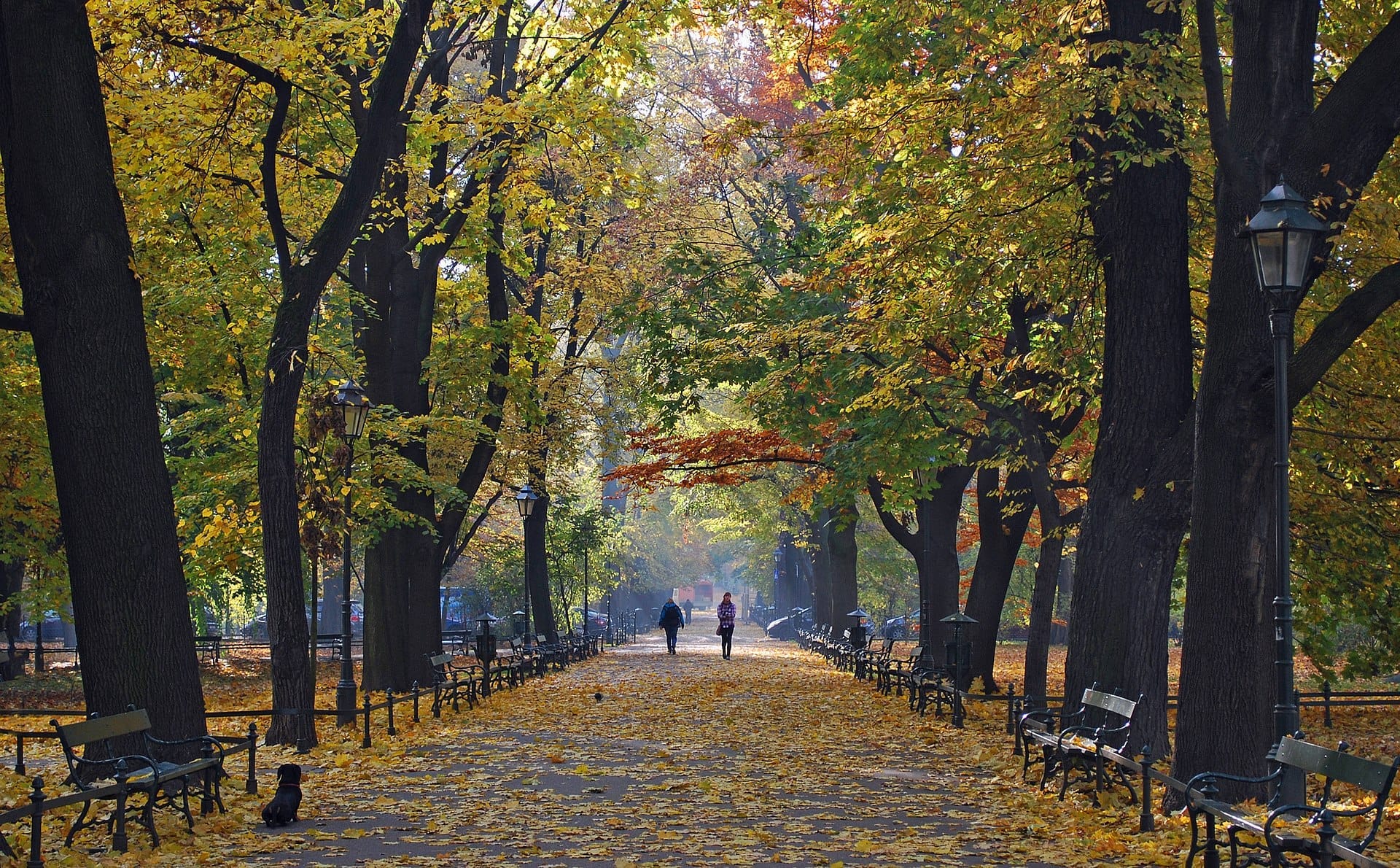
Planty Krakowskie is not a single park but a continuous chain of smaller gardens forming a green ring around Kraków's medieval Old Town. The total circuit runs roughly 4 kilometres and covers approximately 21 hectares (about 52 acres), making it one of the city's most prominent central green spaces rather than its largest park. It sits on the precise footprint of the medieval fortifications: the walls, towers, and water-filled moat that once protected Stare Miasto were demolished in the early 19th century, and the strip of land left behind was converted into public gardens between 1822 and 1830.
That origin explains a great deal about how the park feels today. It is long and narrow rather than deep and wide, shaped more like a green frame than a park you wander into. You are never far from the city around it. On one side, the Old Town's church towers and historic facades press close; on the other, trams run along the ring roads just beyond the treeline. The layout is practical by design, built to give residents of a dense medieval city access to green space and fresh air in a place that had none before.
ℹ️ Good to know
The park is divided into named sections as you walk the ring, each with its own character and monuments. You do not need to complete the full loop to enjoy it. Most visitors pick a segment based on where they are already headed.
Walking the Ring: What You Actually See
The path surfaces are largely level and paved, with benches placed frequently along the route. Trees here are mature, in many cases over a century old, and the canopy in summer creates a clear sense of shade and separation from the surrounding traffic. In late spring, when the chestnut trees flower along several sections, the air carries a faint sweetness that mixes with the smell of damp grass from overnight watering. In autumn, the same paths are carpeted in yellow and brown leaves that crunch underfoot.
Monuments and fountains appear regularly throughout the ring. You will pass stone figures, decorative urns, and small lawns edged in seasonal planting. The gardening is maintained by the Municipal Greenery Authority (Zarząd Zieleni Miejskiej w Krakowie), and the formal beds are kept tidily. None of this is wilderness; Planty is an urban garden in the classic 19th-century European tradition, somewhere between a promenade and a park.
The section near the Kraków Barbican and the Florian Gate is one of the busiest stretches, where the park widens slightly and benches fill up with tourists consulting maps and locals eating lunch. The southern reaches toward Wawel Hill are generally quieter, with longer sight lines through the trees toward the castle walls.
Tickets & tours
Live prices and dates from our booking partner. If you book, we may earn a commission at no extra cost to you.
Entrance ticket for the Legends of Krakow robotic show
From 9 €Instant confirmationFree cancellationWieliczka Salt Mine guided tour with hotel pickup from Krakow
From 58 €Instant confirmationFree cancellationWieliczka salt mine guided tour from Krakow
From 60 €Instant confirmationFree cancellationAuschwitz-Birkenau Spanish Guided Tour with Hotel Pick-Up
From 44 €Instant confirmation
How the Park Changes Through the Day
Early mornings before 8 a.m. are when Planty shows a different face. Joggers have claimed the paths before the tour groups arrive, and older residents sit on benches with newspapers. The light at this hour comes low and filtered through the canopy, throwing long shadows across the grass. If you want to photograph the park without other tourists in frame, this window is narrow but reliable.
By mid-morning, the ring becomes a practical corridor for people crossing the centre on foot. Office workers cut through it, delivery cyclists use it as a shortcut, and the first tour groups appear near the northern sections. Around midday in summer, the shaded benches are occupied almost continuously. Children from nearby schools sometimes use the lawns for supervised outdoor time.
Evenings bring a calmer rhythm again. The paths stay lit at night, and in summer especially, couples and small groups sit on benches well past sunset. The atmosphere is relaxed rather than lively. There is no nightlife here, no bars or kiosks open late; Planty at night is simply a quiet route home or an open-air place to sit and talk.
💡 Local tip
For the most pleasant walking conditions, aim for weekday mornings in May, June, or September. Weekend afternoons in July and August can feel crowded along the northern sections near the Barbican.
Historical and Cultural Context
The decision to demolish Kraków's medieval walls and replace them with a public garden was shaped by early 19th-century urban planning ideas spreading across European cities. Vienna's Ringstrasse followed a similar logic, though on a grander scale. In Kraków's case, the transformation happened during the period when the city was part of the Austrian Partition of Poland, under Habsburg administrative control. The creation of a green public space was partly a civic improvement project and partly an expression of a modernising city identity.
Only a small section of the original fortifications was deliberately preserved: the Barbican and the Florian Gate remain standing today, sitting at the northern edge of the ring as reminders of what once extended all the way around. Walking the full circuit of Planty gives you a physical sense of the scale of those demolished walls. For deeper context on the Old Town's medieval layers, the Kraków Underground Museum beneath Rynek Główny excavates that history literally, with preserved street foundations and market stalls visible several metres below the square.
Practical Details for Visitors
Entry is free and there are no gates or opening times. The park is accessible around the clock every day of the year. There is no single entrance: you cross into Planty from any of the surrounding streets simply by stepping off the pavement onto the park path. This makes it very easy to incorporate into a walking day around the Old Town without planning it specifically.
Accessibility is good. The main paths are level and wide enough for wheelchairs and pushchairs throughout most of the ring. Public toilets with disabled access (including lifts) are available at Szczepański Square and at the corner of ul. Franciszkańska and ul. Straszewskiego, both adjacent to the park. Dogs are common here, usually on leads, and the park is a popular route for dog walkers at dawn and dusk.
Because the park encircles the entire Old Town, it also works as a navigation tool. Nearly every major attraction in Stare Miasto sits just inside the ring: Rynek Główny (Main Market Square), St. Mary's Basilica, the Collegium Maius, and Wawel Castle are all within a few minutes' walk of the park's inner edge. Using Planty as your outer boundary makes it nearly impossible to get lost in the Old Town.
💡 Local tip
Photography tip: The sections framing the Florian Gate work well in early morning light. For a view of Wawel Castle rising above the treeline, position yourself on the southern segment of the ring near ul. Straszewskiego.
Weather and Seasonal Experience
Kraków has a temperate continental climate with cold winters and warm summers. In winter (December through February), Planty still draws visitors, but the atmosphere changes sharply. Bare trees reduce the sense of enclosure, paths can be icy after overnight frost, and the park feels exposed in a way it does not in summer. The flower beds are dormant, but the formal structure of the garden becomes more visible without leaf cover. Snow, when it falls, settles on the lawns and monuments and makes the ring quietly picturesque.
Spring is when Planty recovers quickly. Crocuses appear in the formal beds in March, and by May the park is fully green. This coincides with one of the best periods to visit Kraków overall, when temperatures are mild and crowds are lighter than in July and August. Summer brings full shade under the mature canopy, which makes Planty a welcome relief on hot days. Afternoon thunderstorms occur occasionally in June and July; if one catches you on the ring, the tree cover offers partial shelter, but the park has no indoor refuge.
Planty as Part of a Broader Day in the Old Town
Most visitors encounter Planty repeatedly without specifically planning to, because it flanks every approach to the Old Town from the surrounding tram stops and car parks. A structured way to use it deliberately is to begin a morning walk at the Barbican, follow the ring clockwise to the Wawel end, and then cut into the Old Town to reach the Main Market Square. This gives you both the park and most of the major exterior landmarks in a single loop. Pair it with a visit to the Wawel Castle or the Collegium Maius for a full morning.
Planty also fits naturally into a broader Kraków walking tour of the centre. Because it is free and always open, it requires no planning, no ticket queuing, and no set schedule. Treat it as connective tissue between paid attractions rather than a destination in itself.
Who should skip it: if your time in Kraków is very short (a single afternoon), Planty is not where you need to spend it. The park rewards a relaxed pace and is best enjoyed when you are not rushing between sights. Travellers focused entirely on indoor museums or specific cultural experiences will find Planty more useful as a walking route than as a place to stop.
Insider Tips
- The park's western section near ul. Franciszkańska is consistently quieter than the northern stretch near the Barbican, yet it runs alongside some of the Old Town's most interesting church facades. Walk this section slowly and look up.
- Joggers who run the full 4-kilometre circuit early in the morning complete one of the best free runs in any European city centre. The path is nearly flat and the tree cover makes it comfortable even in summer heat.
- Several of the benches in the shadier sections have become informal gathering spots for elderly locals in the late morning. Sitting nearby for ten minutes gives you a more local sense of the city than most paid attractions.
- The formal flower beds are replanted seasonally by the Municipal Greenery Authority. The spring planting, usually in place by late April, is when the colour contrast against the old stone is most striking.
- Public toilet facilities adjacent to the park at Szczepański Square are cleaner and less busy than the ones inside the Main Market Square. Worth knowing if you are spending a full morning in the area.
Who Is Planty Park For?
- Walkers and joggers wanting a flat, green circuit through the centre of a historic city
- Families with pushchairs or young children who need an accessible outdoor space close to the Old Town
- Photographers looking for early-morning shots of medieval architecture framed by mature trees
- Travellers on a tight budget who want to spend meaningful time outdoors without any cost
- Anyone using the Old Town's major attractions as a day itinerary and needing a logical connecting route
Nearby Attractions
Other things to see while in Kraków Old Town (Stare Miasto):
- Cloth Hall (Sukiennice)
Standing at the centre of Rynek Główny since the Middle Ages, Kraków's Cloth Hall is part market, part museum, and part architectural monument. The ground-floor arcade sells amber, linen, and crafts; upstairs, the National Museum's Gallery of Polish Art fills Renaissance rooms with 19th-century masterpieces.
- Collegium Maius
Collegium Maius is the oldest surviving building of the Jagiellonian University, founded in 1364. Housing a museum of rare globes, scientific instruments, and royal regalia beneath a serene Gothic arcade, it offers one of Kraków's most quietly impressive indoor experiences.
- Czartoryski Museum
The Czartoryski Museum holds one of Poland's oldest and most important art collections, anchored by Leonardo da Vinci's Lady with an Ermine. Housed in a historic Old Town complex near the Florian Gate, it combines fine art, antiquities, and decorative arts across several interconnected buildings.
- Florian Gate & City Walls
St. Florian's Gate is the sole surviving medieval gate of the eight that once pierced Kraków's city walls. Standing about 33 metres tall at the northern tip of the Old Town, it anchors the Royal Route that once led from the city entrance down to Wawel Castle. Walking through is free; climbing the wall gallery costs a small fee and pairs naturally with the adjacent Barbican.
Planning a trip? Discover personalized activities with the Nomado app.