Rynek Główny: The Heart of Kraków's Old Town
Rynek Główny, Kraków's Main Market Square, is one of the largest medieval town squares in Europe, measuring roughly 200 m × 200 m and dating to the city's 1257 charter. Free to enter at any hour, it anchors the Royal Capital City of Kraków's UNESCO-listed historic centre and delivers something different at every time of day.
Quick Facts
- Location
- Rynek Główny, 31-042 Kraków, District I Stare Miasto (Old Town)
- Getting There
- 10–15 min walk from Kraków Główny railway station via ul. Floriańska or ul. Szewska; tram and bus stops on surrounding streets
- Time Needed
- 1–3 hours for the square itself; allow a full day if visiting underground museums and towers
- Cost
- Free to enter the open square; individual attractions (Town Hall Tower, underground museum) charge separate fees
- Best for
- First-time visitors, architecture lovers, history seekers, evening strollers
- Official website
- krakow.travel/en/55-krakow-rynek-glowny
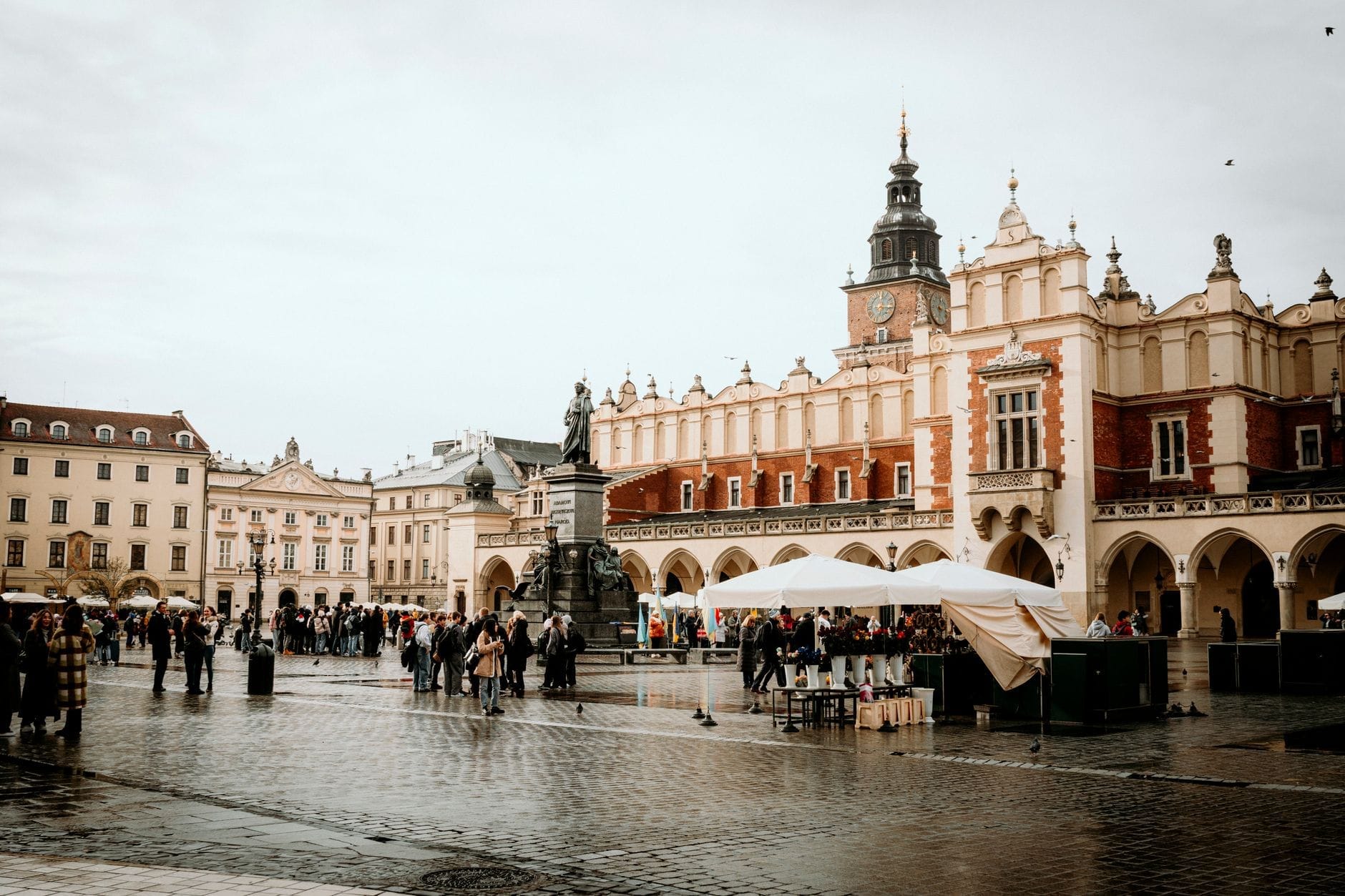
What Rynek Główny Actually Is
Rynek Główny is the central public square of Kraków's Old Town and, by most measurements, one of the largest medieval market squares in Europe. The plaza runs approximately 200 metres on each side, covering roughly 3.79 hectares of level, stone-paved ground. It was laid out in 1257 when Kraków received its city charter under Magdeburg Law, and the name Rynek, derived from the German Ring, appeared in records around 1300. The current official Polish name, Rynek Główny, was formally adopted in 1882 during a city-wide street unification.
The square sits at the physical and civic centre of Kraków's Old Town, which is part of the UNESCO World Heritage Site inscribed in 1978. Everything else in the historic core radiates outward from here: the Royal Road runs north through Floriańska Gate, Wawel Hill rises to the south, and the ring of the Planty park encircles the whole medieval centre. Understanding this geometry helps you orient yourself from the moment you step onto the square.
ℹ️ Good to know
The square itself is open 24 hours a day, every day of the year, with no admission charge. Ticket costs apply only to specific indoor attractions on or beneath the square, including the Town Hall Tower and the Rynek Underground Museum.
How the Square Changes Through the Day
Early morning, roughly 7 to 9 a.m., is when Rynek Główny reveals a version of itself most visitors never see. The flower stalls in front of the Cloth Hall are being set up, pigeons outnumber tourists, and the pale morning light catches the Gothic stonework of St. Mary's Basilica at an angle that makes the asymmetric towers look almost theatrical. The sounds are functional: the rumble of a delivery vehicle on the cobbles, the clatter of café chairs being arranged, a tram rounding the corner of Sienna Street.
By mid-morning the square fills steadily. The famous trumpet signal, the Hejnał Mariacki, sounds from the taller tower of St. Mary's Basilica on the hour, every hour, cutting off abruptly mid-phrase in memory of a medieval trumpeter reportedly shot by an arrow. By noon the square is at full daytime capacity: horse-drawn carriages wait at the edges, tour groups cluster around the Neptune Fountain and the Adam Mickiewicz monument, and the café terraces that ring the square's perimeter are occupied right to their outer rows.
Evenings bring a different crowd and a different atmosphere. Once the sun drops behind the roofline of the tenement houses (kamienice), the golden lantern light across the facades makes the square feel considerably more intimate than it does in the middle of the afternoon. Street musicians set up near the Cloth Hall. In winter, a Christmas market occupies the centre of the square, and the smell of mulled wine and smoked cheese drifts across the paving stones from wooden stalls.
💡 Local tip
For photography, arrive just after sunrise or in the 30 minutes before sunset. The low angle of light throws the relief carvings on the Cloth Hall into sharp contrast, and the square is at its least crowded.
Tickets & tours
Live prices and dates from our booking partner. If you book, we may earn a commission at no extra cost to you.
Wawel Castle, Cathedral and Rynek Underground guided tour with lunch
From 67 €Instant confirmationFree cancellationKrakow's Market Square with St. Mary's Basilica and Rynek Underground
From 46 €Instant confirmationFree cancellationWawel Castle, St. Mary's Church and Rynek Underground Guided Tour
From 85 €Instant confirmationFree cancellationKrakow Rynek Underground Museum guided tour
From 23 €Instant confirmationFree cancellation
The Architecture You Are Actually Looking At
The dominant structure in the centre of the square is the Sukiennice, the Cloth Hall, a long Renaissance trading hall rebuilt after a fire in the 16th century. Its arcaded ground floor still houses market stalls selling amber, linen, and carved wooden souvenirs. The upper floor is occupied by the Gallery of 19th-century Polish Art, a branch of the National Museum in Kraków. The combination of active commerce at street level and a serious art collection overhead is characteristic of how Kraków layers different centuries of use into single buildings.
The St. Mary's Basilica anchors the northeast corner of the square. Its two towers are deliberately unequal in height, a feature that has generated centuries of local legend. The interior contains an extraordinary late-Gothic altarpiece by Veit Stoss, completed around 1489, which is considered one of the finest examples of Gothic woodcarving in Europe. Entry to the basilica requires a separate ticket during visiting hours.
On the south side of the Cloth Hall stands the isolated stump of the Town Hall Tower, all that remains of the medieval town hall demolished in 1820. At 70 metres high, it is climbable when open and provides one of the few elevated views directly over the square. The ascent involves narrow spiral stairs, so it is not suitable for visitors with mobility difficulties. Check current opening hours and prices locally before visiting.
Beneath the square itself lies the Rynek Underground Museum, operated by the Kraków Historical Museum. The museum occupies excavated medieval trade routes and market infrastructure discovered during renovation works in the 2000s. Exhibits use multimedia installations alongside original archaeological layers to trace the square's history from its 13th-century origins. Tickets sell out in peak season; booking in advance is strongly recommended.
Getting There and Moving Around
Kraków has no metro system. The closest you get to rapid transit is the tram network, with several lines stopping on streets bordering the Old Town. From Kraków Główny railway station, the square is a straightforward 10 to 15 minute walk southwest along ul. Floriańska or ul. Szewska. Both streets are pedestrianised or low-traffic and easy to navigate without a map after the first visit.
Private vehicles cannot enter most of the Old Town's central streets, which makes the square strongly pedestrian-focused. For visitors arriving from the Kazimierz quarter or from Podgórze, a 20 to 25 minute walk north along the Vistula riverbank and then up through the Old Town is a practical route that also passes Wawel Hill.
The square's paved surface is largely level and the official tourism description classifies it as accessible for wheelchair users and visitors with mobility aids. Cobblestones appear on some surrounding streets, so a route via the main pedestrian thoroughfares is easier for wheeled mobility equipment.
What to Realistically Expect on Arrival
The square is large by any central-European urban standard. Unlike many European central squares that feel intimate once you are inside them, Rynek Główny reads as open space even when it is crowded. Standing at the Adam Mickiewicz monument and looking toward St. Mary's Basilica, there are at least 150 metres of open paving between you and the church facade. This scale is both the square's main visual effect and the reason it can absorb large visitor numbers without feeling claustrophobic during most of the day.
Flower sellers operate from fixed positions in front of the Cloth Hall. Horse-drawn carriages park along the edges and offer rides; prices are set by drivers rather than a central tariff, so agree on the fare before getting in. Street performers, portrait sketchers, and occasional outdoor exhibitions occupy different parts of the square depending on the season and any events in progress.
⚠️ What to skip
During major public holidays, the Kraków Christmas Market, and city festivals, the square can become difficult to move through in the late afternoon. If you are visiting during these periods, the morning hours between 8 and 10 a.m. offer far more comfortable conditions.
Restaurants and cafés along the tenement house arcades that line the square's perimeter charge significantly more than similar venues two streets away. If budget matters, use the square for walking and looking, then eat in Kazimierz or on the streets just outside the Planty ring.
Context: Why This Square Matters
Kraków served as the capital of the Polish Kingdom for centuries and Rynek Główny functioned as the economic and political centre of that capital. Royal processions, public announcements, markets, and executions all took place here. Unlike Warsaw, which was almost entirely destroyed during World War II and subsequently rebuilt, Kraków's historic core survived the war largely intact, which means what you are seeing is not a reconstruction. The Gothic cellars below the Cloth Hall, the 13th-century street layout, the 14th and 15th-century church towers: these are the original structures.
This intact survival is what gives Rynek Główny its particular texture. It is not a theme park version of a medieval square. The stone is worn in the right places, the facades have been repaired many times over centuries, and the city has continued to function here without interruption. For visitors who want to understand Kraków before exploring its other districts, spending time here first provides the spatial and historical reference point from which everything else makes more sense. The Kraków walking tour routes typically begin here for exactly that reason.
Visitors with a particular interest in the medieval layers of the city may also want to combine a visit to the square with the nearby Rynek Underground Museum and a walk up to Wawel Castle, which together provide a coherent picture of how Kraków developed from its 13th-century charter to the Renaissance period.
Who Should Consider Skipping It
If your primary interest is local everyday life rather than historical architecture and tourism infrastructure, the square in high season can feel distant from that goal. The perimeter restaurants cater heavily to international visitors, the souvenir stalls in the Cloth Hall sell largely the same items as those in every Polish tourist town, and the sheer volume of organised tours passing through can make sustained quiet observation difficult between 10 a.m. and 6 p.m.
Travellers who want to see Kraków beyond its most-visited points are better served by spending their afternoon time elsewhere and using the square only in the early morning or evening. The lesser-known corners of Kraków offer a very different experience from what the Main Square provides at its busiest.
Insider Tips
- The Hejnał Mariacki trumpet signal plays from the taller tower of St. Mary's Basilica every hour. For the clearest listen with the least crowd noise, position yourself on the north side of the Cloth Hall just before the hour, away from the main tourist clusters near the Mickiewicz monument.
- The flower stalls in front of the Cloth Hall are run by the same families that have held permits for generations. Prices are fixed and reasonable by Kraków standards; buying flowers here is one of the few transactions on the square that has not been tuned entirely for tourist margins.
- The Rynek Underground Museum sells out its entry slots well in advance during summer and Christmas market season. Book online through the Kraków Historical Museum's official ticketing system before you arrive in the city, not the morning you want to visit.
- Several of the tenement houses (kamienice) around the square contain accessible courtyards reached through ground-floor archways. These internal courtyards, some with Gothic or Renaissance architectural details, are overlooked by most visitors moving quickly through the square.
- In winter, particularly January and February, the square is dramatically quieter than in summer and the architecture reads more clearly without the café terraces and market stalls filling the foreground. Temperatures can drop well below freezing, but the Gothic stonework covered in snow or frost is worth the cold.
Who Is Rynek Główny (Main Market Square) For?
- First-time visitors to Kraków who need a spatial and historical orientation point for the whole city
- Architecture and urban history enthusiasts interested in medieval European city planning
- Evening walkers and those staying in the Old Town who want to experience the square at different times of day
- Travellers combining the square with nearby museum visits, including the Cloth Hall gallery and the underground archaeological museum
- Winter travellers visiting during the Kraków Christmas Market, when the square hosts one of Poland's largest seasonal markets
Nearby Attractions
Other things to see while in Kraków Old Town (Stare Miasto):
- Cloth Hall (Sukiennice)
Standing at the centre of Rynek Główny since the Middle Ages, Kraków's Cloth Hall is part market, part museum, and part architectural monument. The ground-floor arcade sells amber, linen, and crafts; upstairs, the National Museum's Gallery of Polish Art fills Renaissance rooms with 19th-century masterpieces.
- Collegium Maius
Collegium Maius is the oldest surviving building of the Jagiellonian University, founded in 1364. Housing a museum of rare globes, scientific instruments, and royal regalia beneath a serene Gothic arcade, it offers one of Kraków's most quietly impressive indoor experiences.
- Czartoryski Museum
The Czartoryski Museum holds one of Poland's oldest and most important art collections, anchored by Leonardo da Vinci's Lady with an Ermine. Housed in a historic Old Town complex near the Florian Gate, it combines fine art, antiquities, and decorative arts across several interconnected buildings.
- Florian Gate & City Walls
St. Florian's Gate is the sole surviving medieval gate of the eight that once pierced Kraków's city walls. Standing about 33 metres tall at the northern tip of the Old Town, it anchors the Royal Route that once led from the city entrance down to Wawel Castle. Walking through is free; climbing the wall gallery costs a small fee and pairs naturally with the adjacent Barbican.
Planning a trip? Discover personalized activities with the Nomado app.