Collegium Maius: Inside Poland's Oldest University Building
Collegium Maius is the oldest surviving building of the Jagiellonian University, founded in 1364. Housing a museum of rare globes, scientific instruments, and royal regalia beneath a serene Gothic arcade, it offers one of Kraków's most quietly impressive indoor experiences.
Quick Facts
- Location
- ul. Jagiellońska 15, Old Town (Stare Miasto), Kraków
- Getting There
- Trams 2, 13, 18, 69 and multiple bus lines to the Old Town / ul. Jagiellońska area
- Time Needed
- 45–90 minutes (courtyard free; guided tour adds depth)
- Cost
- Courtyard free; museum from 17 PLN self-guided, 26–31 PLN with guide (children under 7 free). Verify current prices at official site.
- Best for
- History lovers, architecture admirers, and travelers curious about medieval academic life
- Official website
- maius.uj.edu.pl
What Is Collegium Maius?
Collegium Maius, the Great College, is the oldest surviving building of the Jagiellonian University and one of the most significant medieval academic structures in Central Europe. The university itself was founded in 1364 by King Casimir III the Great, making it one of the oldest universities in the world still in operation. The brick-Gothic complex visitors see today was largely built during the 15th century, and its interior has been preserved with unusual care. Since 1964 it has functioned formally as the Jagiellonian University Museum, housing instruments, manuscripts, memorabilia, and artworks that trace the institution's six centuries of scholarship.
Collegium Maius sits at the corner of ul. Jagiellońska and ul. św. Anny, just a few minutes' walk from Kraków's Main Market Square. It is, in physical terms, a compact building. What makes it worth your time is not scale but concentration: the courtyard arcade, the treasury rooms, and the collection of early scientific instruments are each remarkable on their own terms.
💡 Local tip
The courtyard is free to enter and open daily 09:00–18:00. If you are short on time, walk through the gate on ul. Jagiellońska and spend ten minutes in the arcade. It costs nothing and delivers a beautiful experience.
The Courtyard: The Heart of the Building
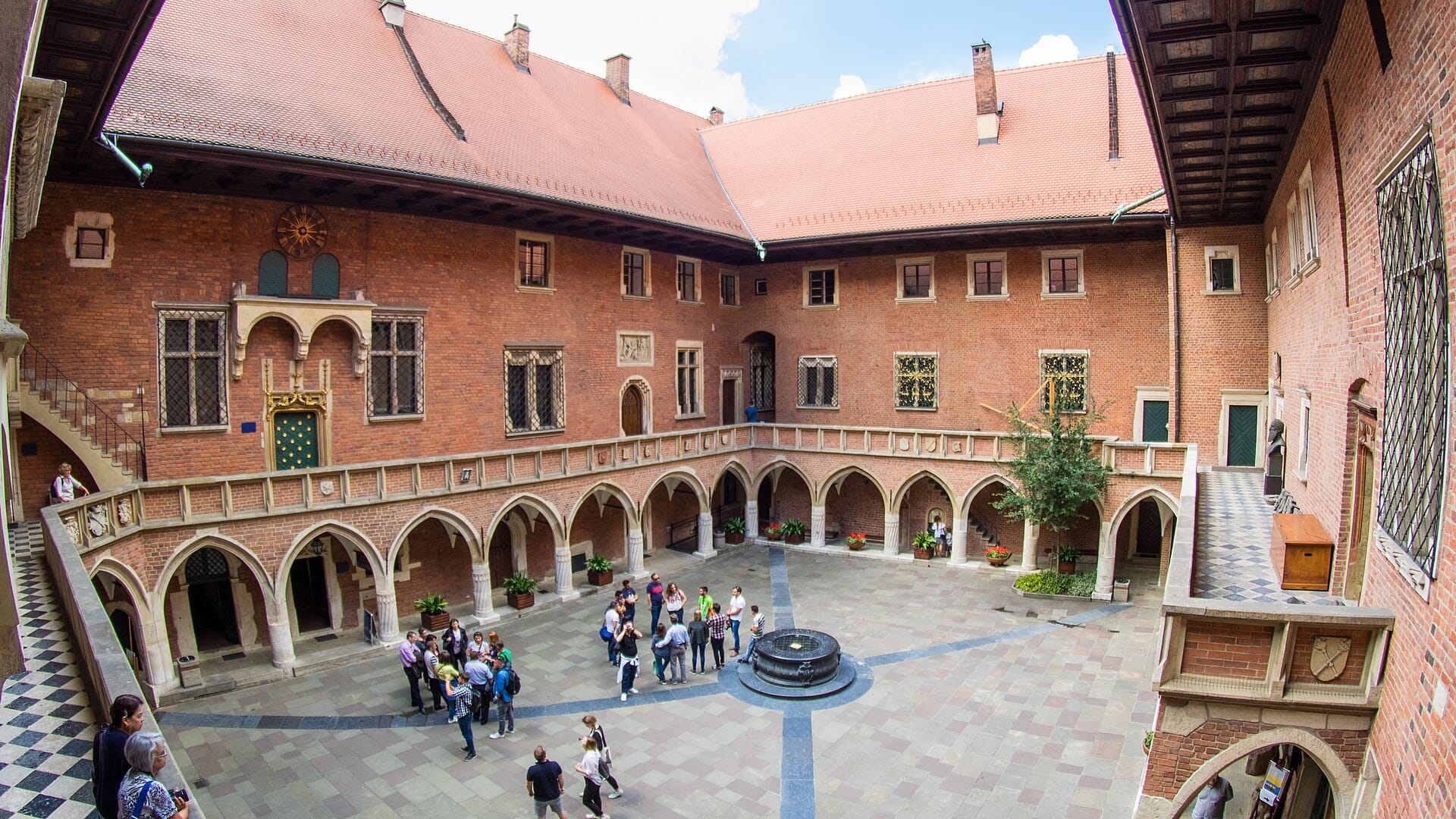
Step through the arched entrance gate from ul. Jagiellońska and the city noise drops away almost immediately. The inner courtyard is surrounded by a two-level Gothic arcade, its stone columns worn smooth and slightly uneven underfoot. The stonework is pale and cool to the touch even on warm days. A well sits at the centre of the yard, and the whole space has a cloister-like quality: quiet, slightly enclosed, with diffuse light filtering through the arcade in the morning and direct afternoon sun warming the upper walls.
In the early morning, before tour groups arrive, the courtyard can feel almost private. The smell is faint stone and cool air, with occasional coffee drifting in from the street. By midday in summer the space fills with small guided groups speaking Polish, German, English, and Italian. Even then it rarely feels overwhelming, simply because the architecture naturally absorbs the crowd into its alcoves and corridors. Late afternoon light hits the upper arcade well and makes for the most photogenic window if you are carrying a camera.
At 11:00, 13:00, and 15:00 each day, a small mechanical clock on the building's facade comes to life: figures of historical scholars and university patrons emerge on a rotating procession. It is a brief spectacle, easy to miss if you do not check the timing, but worth planning around if you are already in the courtyard.
💡 Local tip
The automated clock display runs at 11:00, 13:00, and 15:00. Check the facade clock when you arrive and plan your courtyard visit around one of these moments.
Tickets & tours
Live prices and dates from our booking partner. If you book, we may earn a commission at no extra cost to you.
Entrance ticket for the Legends of Krakow robotic show
From 9 €Instant confirmationFree cancellationWieliczka Salt Mine guided tour with hotel pickup from Krakow
From 58 €Instant confirmationFree cancellationWieliczka salt mine guided tour from Krakow
From 60 €Instant confirmationFree cancellationAuschwitz-Birkenau Spanish Guided Tour with Hotel Pick-Up
From 44 €Instant confirmation
The Museum: What the Collection Actually Contains
The interior of Collegium Maius holds one of the more specific and rare museum collections in Kraków. The emphasis is not on paintings or decorative arts but on the intellectual life of the university across centuries. The most distinctive items are the early scientific instruments: a pair of armillary spheres and, most significantly, the Jagiellonian Globe from around 1510, one of the earliest globes in existence to show the American continent, marked on it as a new unknown land. These objects are not reproductions.
Other rooms display royal regalia and gifts connected to the university's founding patrons, including objects associated with King Władysław II Jagiełło and Queen Jadwiga. There are also academic robes, seals, and furniture from the original professors' meeting hall, the Stuba Communis, where faculty gathered for centuries. The rooms themselves, with their vaulted ceilings and original tiled floors, are part of the experience. You are walking through spaces that have been in continuous use since the 1400s.
The museum is physically inside a 15th-century Gothic building, which means stairs, uneven stone floors, and narrow passages are part of the visit. Visitors with significant mobility limitations should contact the museum directly before visiting, as adapted access to all rooms cannot be guaranteed. This is not an ideal stop for travelers who need fully step-free access throughout. For a broader overview of what Kraków's museum landscape offers, the best museums in Kraków guide covers the full range of options.
⚠️ What to skip
Interior visits require advance booking in peak season. Guided tour slots fill quickly, particularly on weekday mornings. Check availability at maius.uj.edu.pl before you arrive.
Tickets, Tours, and How to Visit
There are three distinct ways to visit. The first is simply entering the courtyard for free, daily between 09:00 and 18:00. This gives you access to the arcade, the well, and the exterior clock. No booking required.
The second option is the self-guided museum visit, which costs 17 PLN for adults and 10 PLN for students, with children under 7 admitted free. This allows entry to the permanent collection rooms at your own pace, without a guide.
The third, and most recommended for anyone seriously interested in the history, is a guided tour. Standard guided tours cost 26 PLN for adults and 14 PLN for students. A fuller tour that includes additional rooms costs 31 PLN for adults and 25 PLN for students. Guides provide the context that makes the scientific instruments and royal objects legible rather than simply old. Without explanation, the significance of the Jagiellonian Globe is easy to miss. All prices should be verified at maius.uj.edu.pl before your visit, as they are subject to change.
Museum opening hours for the main exhibition currently run Monday to Friday 10:00–17:00 (last entry 16:30), with self-guided visits on Saturdays 10:00–15:00 and free self-guided entry on Wednesdays 13:30–17:00. The museum is typically closed on Sundays. Guided and self-guided slots fall within these windows on open days. These hours are not guaranteed and can vary seasonally, so check the official site before planning your day around this visit.
Getting There and Fitting It Into Your Day
Collegium Maius is on ul. Jagiellońska 15, in the heart of Kraków's Old Town. The walk from Rynek Główny (the Main Market Square) takes under five minutes heading west. Trams 2, 13, 18, and 69 serve the wider Old Town area, along with several bus routes including 124, 152, 304, 424, 502, 601, 618, and 902. Kraków has no metro system, so tram and foot are the standard ways to move around the centre.
Collegium Maius pairs naturally with other sites in the immediate area. St. Mary's Basilica is a short walk east on the Main Square, and the Czartoryski Museum, which holds Leonardo da Vinci's Lady with an Ermine, is just a few hundred metres north on ul. św. Jana. A half-day itinerary covering all three is entirely realistic.
If you are planning a fuller day in the Old Town, the Kraków walking tour guide maps out a logical sequence of sights that includes Collegium Maius without backtracking.
Photography and Practical Notes
The courtyard is the primary photographic subject, and the light conditions change significantly through the day. Morning light (before 10:00) is soft and diffuse, hitting the upper arcade evenly and avoiding the harsh contrast shadows that appear at midday. The afternoon, from around 14:00 onward, brings direct sunlight into the south-facing arcade, which creates warm tones on the stone but also strong shadows. Overcast days actually work well here: the pale stone reads clearly without glare.
Inside the museum, photography restrictions vary by room. Flash photography is generally discouraged or prohibited near the scientific instruments and fragile manuscripts. Wide-angle lenses are useful in the vaulted rooms. The staircase connecting levels offers a useful architectural detail shot.
In terms of what to wear: the interior is cool year-round given the thick stone walls, so a light layer is useful even in summer. In winter, the courtyard is exposed and cold; morning visits in January or February require a coat. The floors throughout are original stone or historic tile, uneven in places, so comfortable shoes with a flat sole are a practical choice.
ℹ️ Good to know
Collegium Maius is not the right stop for travelers who want a high-energy, richly illustrated experience. The collection is quiet and specialized. If you are primarily interested in World War II history or Jewish heritage in Kraków, your time is better spent at Schindler's Factory or in Kazimierz.
Insider Tips
- Book a guided tour slot in advance via the official museum website, especially from April through September. Walk-in guided availability is limited and popular time slots go early.
- The courtyard clock runs at 11:00, 13:00, and 15:00. Position yourself on the far side of the courtyard, opposite the facade clock, for the clearest view without craning around other visitors.
- Visit the courtyard first thing in the morning before your museum slot. The acoustic quality of the empty arcade is worth experiencing on its own, and you can take photographs without other visitors in frame.
- Ask your guide specifically about the Jagiellonian Globe if they do not bring it up early. It is the single most historically significant object in the collection, and some guided routes move past it quickly.
- The Stuba Communis, the original professors' common room with its original furniture and vaulted ceiling intact, is included only in the fuller guided tour tier. If this kind of architectural authenticity matters to you, book the higher-tier option.
Who Is Collegium Maius For?
- Travelers with a serious interest in the history of science or medieval European universities
- Architecture enthusiasts drawn to well-preserved Gothic collegiate buildings
- Visitors who want a calm, uncrowded experience away from the Main Square crowds
- Anyone combining Collegium Maius with a broader Old Town walking itinerary
- Families with older children (12+) interested in history; younger children may find the collection harder to engage with
Nearby Attractions
Other things to see while in Kraków Old Town (Stare Miasto):
- Cloth Hall (Sukiennice)
Standing at the centre of Rynek Główny since the Middle Ages, Kraków's Cloth Hall is part market, part museum, and part architectural monument. The ground-floor arcade sells amber, linen, and crafts; upstairs, the National Museum's Gallery of Polish Art fills Renaissance rooms with 19th-century masterpieces.
- Czartoryski Museum
The Czartoryski Museum holds one of Poland's oldest and most important art collections, anchored by Leonardo da Vinci's Lady with an Ermine. Housed in a historic Old Town complex near the Florian Gate, it combines fine art, antiquities, and decorative arts across several interconnected buildings.
- Florian Gate & City Walls
St. Florian's Gate is the sole surviving medieval gate of the eight that once pierced Kraków's city walls. Standing about 33 metres tall at the northern tip of the Old Town, it anchors the Royal Route that once led from the city entrance down to Wawel Castle. Walking through is free; climbing the wall gallery costs a small fee and pairs naturally with the adjacent Barbican.
- Kraków Barbican
The Kraków Barbican is a late-15th-century Gothic fortified outwork standing at the northern entrance to the Old Town, and one of the most complete medieval defensive structures remaining in Central Europe. Built around 1498–1499 to shield St. Florian's Gate from Ottoman-era threats, it now operates as a branch of the Museum of Krakow. Open Tuesday through Sunday, it rewards visitors with thick brick walls, rooftop turrets, and an atmosphere that the surrounding city streets simply cannot replicate.
Planning a trip? Discover personalized activities with the Nomado app.