Kraków Barbican: The Medieval Fortress That Guarded the Royal City
The Kraków Barbican is a late-15th-century Gothic fortified outwork standing at the northern entrance to the Old Town, and one of the most complete medieval defensive structures remaining in Central Europe. Built around 1498–1499 to shield St. Florian's Gate from Ottoman-era threats, it now operates as a branch of the Museum of Krakow. Open Tuesday through Sunday, it rewards visitors with thick brick walls, rooftop turrets, and an atmosphere that the surrounding city streets simply cannot replicate.
Quick Facts
- Location
- ul. Basztowa, Kraków Old Town, at the northern end of Floriańska Street
- Getting There
- Basztowa and Dworzec Główny tram/bus stops, served by multiple lines toward the Old Town
- Time Needed
- 30–60 minutes
- Cost
- Approx. 22 PLN regular / 16 PLN concessions (verify current prices at muzeumkrakowa.pl)
- Best for
- History enthusiasts, architecture lovers, photography, and families with older children
- Official website
- muzeumkrakowa.pl/en/branches/barbican
What the Kraków Barbican Actually Is
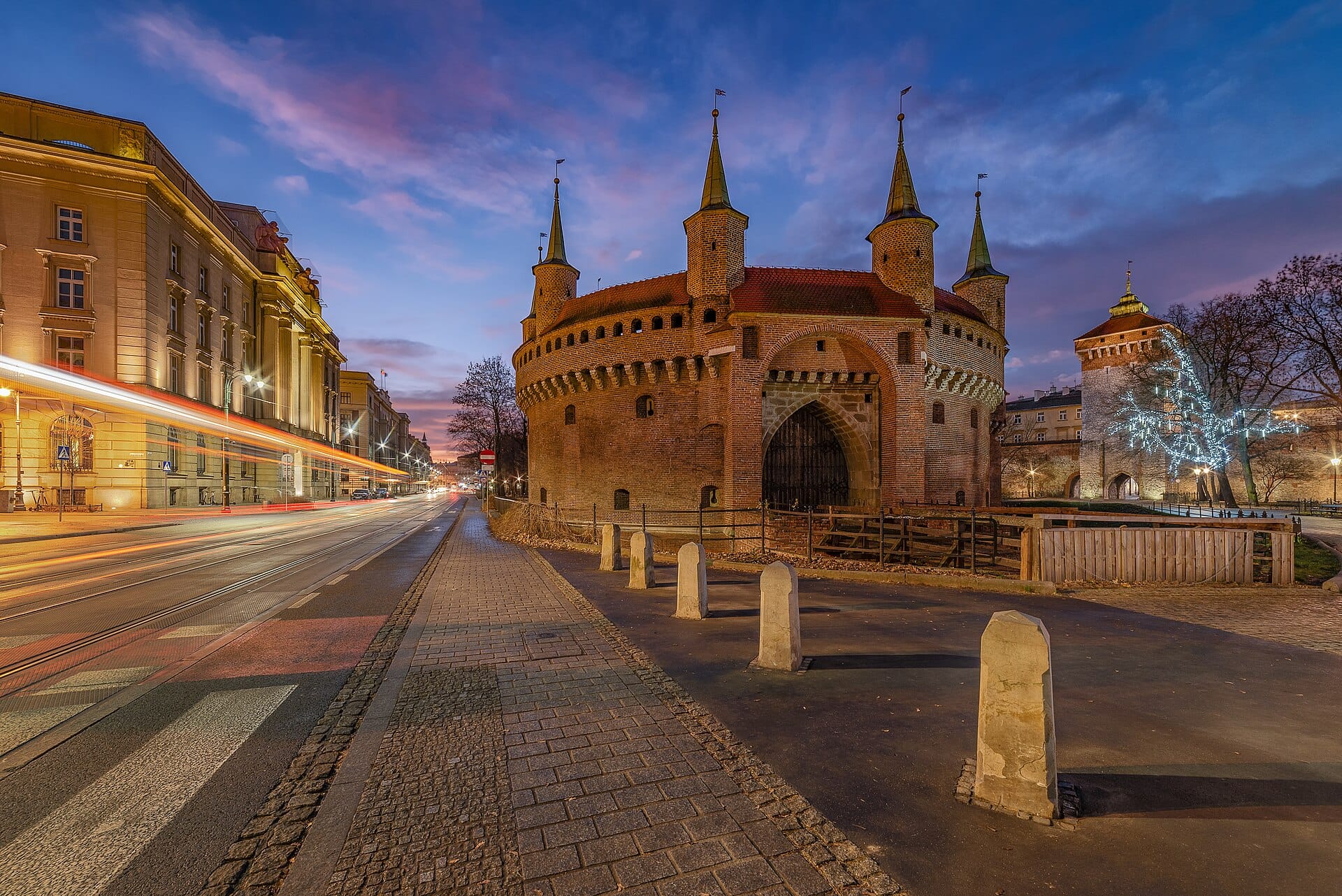
The Kraków Barbican (Polish: Barbakan w Krakowie) is a circular Gothic fortress built around 1498–1499 as the outermost defensive shield for St. Florian's Gate and, by extension, the entire northern flank of the walled medieval city. It stands on Basztowa Street where Planty Park now rings the Old Town, and its brick walls measure roughly 3 metres thick. The structure itself is approximately 25 metres in diameter, reinforced with multiple turrets, and was originally surrounded by a moat.
Fortifications of this type, called barbicans or roundels, were built across Central Europe in the late 15th century partly in response to the advancing Ottoman Empire and partly because gunpowder warfare demanded thicker, more complex perimeter defenses than simple curtain walls could provide. Kraków's Barbican is one of only a handful of such structures to survive in Europe, and arguably the best preserved. That alone makes it worth pausing for, even if you only view it from the outside.
The Barbican is now a branch of the Museum of Krakow and functions as both an exhibition space and an open-air event venue. It sits directly along any walking tour of the Old Town, so most visitors encounter it naturally in the course of the day.
ℹ️ Good to know
The Barbican is open Tuesday through Sunday only. Typical hours are 10:00–16:00, but confirm on the Museum of Krakow website before visiting, as schedules can shift.
The Approach: Florian Gate and the Neck of the Fortress
Arriving from Rynek Główny along Floriańska Street, you pass under St. Florian's Gate before you reach the Barbican. These two structures were once connected by a covered neck passage, now gone, which meant an attacker who broke through the outer gate would be trapped in an enclosed corridor under fire from above. Standing in the space between the two today, you can still read the geometry of that trap in the stonework and in the gap where the neck once ran.
The Florian Gate itself is part of the same ticketed site and can be accessed on the same admission. The two together form a coherent tour of Kraków's northern defensive system and take under an hour to see properly.
Mornings between 9:00 and 11:00, before coach groups arrive, the exterior of the Barbican is at its quietest. The brick takes on a warm ochre tone in early light, and the Planty Park trees around it frame the structure in a way that makes it easy to photograph without crowds cutting through the frame. By midday in summer, tour groups cluster around the gate passage, and the sound of city traffic on Basztowa Street competes with the commentary.
Tickets & tours
Live prices and dates from our booking partner. If you book, we may earn a commission at no extra cost to you.
Entrance ticket for the Legends of Krakow robotic show
From 9 €Instant confirmationFree cancellationWieliczka Salt Mine guided tour with hotel pickup from Krakow
From 58 €Instant confirmationFree cancellationWieliczka salt mine guided tour from Krakow
From 60 €Instant confirmationFree cancellationKrakow: Jewish ghetto and Schindler's Factory entrance ticket and guided tour
From 30 €Instant confirmationFree cancellation
Inside the Walls: What You Actually See
Entry to the interior is through a low, vaulted passageway that opens into a circular courtyard. The scale is more intimate than the exterior suggests. The walls rise steeply on all sides, lined with seven semi-circular turrets that once housed crossbowmen and later gunports. Look up and you will see narrow slit windows and the original defensive gallery that runs along the inner wall. The stonework is rough and dense, with a smell of old mortar and cool air that persists even on hot summer days.
The interior is used for temporary exhibitions related to Kraków's history, and displays of period weaponry and armour are common during the main season. Quality and depth of these exhibitions vary year to year. The courtyard itself hosts open-air events in summer, including jousting demonstrations and medieval craft displays, which add a theatrical dimension that some visitors enjoy and others find a bit staged. If you want a quieter, more contemplative visit, avoid weekends in July and August.
💡 Local tip
Photography tip: The interior courtyard is shaded for most of the morning, which creates even, diffuse light ideal for architectural photography. By early afternoon, direct sun creates harsh contrasts on the curved walls. Come before noon if you want clean shots of the stonework.
Historical Context: Why This Fortress Was Built Here
Kraków in the late 15th century was one of the most significant cities in Central Europe, the royal capital of the Kingdom of Poland and a major hub of trade between Western Europe and the East. The Ottoman advance into Hungary following the fall of Constantinople in 1453 placed Kraków within plausible reach of military threat, and the city's defenses needed upgrading from medieval curtain walls to structures capable of withstanding artillery and organised siege tactics.
The Barbican was completed around 1499, relatively late compared to similar roundels built elsewhere in the region. It was never actually tested in combat, which is partly why it survived. By the 18th century, when military technology had advanced far beyond what such walls could resist, the city began demolishing large sections of its fortifications. The Barbican was preserved largely through the advocacy of civic and cultural organizations in the early 19th century, and the surrounding moat was eventually converted into the green ring of Planty Park, which still encircles the Old Town today.
That green buffer, Planty Park, is one of the best-maintained urban parks in Poland and worth a slow circuit on foot. It puts the Barbican into geographic context: you can see where the walls once stood and understand the full perimeter of the medieval city.
Practical Walkthrough: Tickets, Timing, and Getting There
The Barbican is a branch of the Museum of Krakow. The Barbican is a branch of the Museum of Krakow. Ticket prices published by the Museum of Krakow list 22 PLN for a regular adult ticket and 16 PLN for concessions, with family tickets also available. A combined ticket covering the Barbican and the adjacent section of defensive walls is the standard offering. Prices can change, so check the official Museum of Krakow website for current rates before visiting. Tickets can generally be purchased at the gate.
Getting there requires no special planning. The Barbican is roughly a 10-minute walk north from Rynek Główny along Floriańska Street. Tram and bus stops at Basztowa and Dworzec Główny serve multiple lines connecting to the Old Town and wider city. Kraków's main railway station, Kraków Główny, is within comfortable walking distance, making it easy to visit the Barbican as a first stop after arriving in the city.
⚠️ What to skip
Accessibility: The Barbican is a medieval structure with stairs and uneven stone surfaces throughout. Step-free access inside cannot be guaranteed. Visitors with mobility requirements should contact the Museum of Krakow directly before planning a visit.
Wear comfortable shoes with grip. The courtyard floor and interior ramps are uneven, and in wet weather the stone can be slippery. There is no café or seating inside the structure, but Planty Park immediately outside has benches and food carts in season.
How the Experience Changes by Season
April and May offer the Barbican at its least crowded, with spring greenery in Planty Park framing the walls. Temperatures in May are generally mild, making the outdoor courtyard comfortable for an extended visit. This is also when the Museum of Krakow opens the seasonal exhibitions, so the interior displays are at their freshest.
June through August brings the heaviest tourist traffic, particularly on weekends. The courtyard events and medieval demonstrations are concentrated in this period, which makes for an energetic but noisier visit. If you are visiting Kraków in summer, the Barbican is best seen early in the morning when the Old Town is still waking up and coach groups have not yet assembled outside the gate.
September and early October offer the clearest light of the year and significantly smaller crowds. The air is cooler, the Planty trees begin to turn, and the stone of the Barbican takes on a deeper colour in the lower autumn sun. This is the best month combination if you have flexibility, both for the Barbican and for Kraków generally. The attraction closes at the end of October, so do not plan a winter visit expecting access to the interior.
For broader guidance on planning around Kraków's seasons, the best time to visit Kraków guide covers the full year in detail.
Who Will Not Enjoy This
If you are visiting Kraków with very limited time and must choose between major sites, the Barbican is not in the same category as Wawel Castle or the Cloth Hall. The interior, while atmospheric, is compact, and the exhibitions, when present, are modest in scope. Travellers focused primarily on art collections, Jewish heritage sites in Kazimierz, or the World War II history of Podgórze will find their time better used elsewhere.
Very young children may find the visit too static unless a medieval demonstration happens to be running. The lack of interactive elements inside the walls means attention spans of under-eights are likely to run out quickly.
Visitors with a deep interest in military architecture will find the Barbican rewarding but may want to pair it with a full circuit of the remaining city walls and then continue to Wawel Castle for a more complete picture of Kraków's defensive history across centuries.
Insider Tips
- Buy a combined ticket covering the Barbican and the adjacent city wall section. The wall walk takes only 15 extra minutes and gives you a continuous overhead view of the fortification line that neither structure provides alone.
- The Barbican courtyard is used as an open-air venue for summer events, including medieval fairs and concerts. Check the Museum of Krakow event calendar before your visit. Arriving on an event day transforms the atmosphere entirely, for better or worse depending on your preference.
- The exterior is fully visible from Planty Park at no cost, and the north-facing angle from the park gives the best full-profile view of the turrets. If budget is tight, this is a reasonable alternative to paying for interior access.
- The passage between the Barbican and St. Florian's Gate is where portrait artists and street painters set up daily in season. The light in late afternoon falls directly into this corridor, making it one of the better spontaneous photography spots in the Old Town.
- If you are combining the Barbican with a full Old Town walk, start here first when legs are fresh. The street noise and foot traffic increase significantly toward Rynek Główny as the morning progresses, so moving from north to south makes for a progressively more engaging arrival into the square.
Who Is Kraków Barbican For?
- History and military architecture enthusiasts who want physical contact with medieval fortifications, not just museum displays
- Photographers working in the early morning looking for clean architectural lines before crowds arrive
- First-time visitors to Kraków who want a geographic anchor for understanding the Old Town's former boundaries
- Travellers combining the site with a walk along Planty Park and continuing to Rynek Główny
- Families with older children (10+) visiting during summer when medieval demonstrations are scheduled
Nearby Attractions
Other things to see while in Kraków Old Town (Stare Miasto):
- Cloth Hall (Sukiennice)
Standing at the centre of Rynek Główny since the Middle Ages, Kraków's Cloth Hall is part market, part museum, and part architectural monument. The ground-floor arcade sells amber, linen, and crafts; upstairs, the National Museum's Gallery of Polish Art fills Renaissance rooms with 19th-century masterpieces.
- Collegium Maius
Collegium Maius is the oldest surviving building of the Jagiellonian University, founded in 1364. Housing a museum of rare globes, scientific instruments, and royal regalia beneath a serene Gothic arcade, it offers one of Kraków's most quietly impressive indoor experiences.
- Czartoryski Museum
The Czartoryski Museum holds one of Poland's oldest and most important art collections, anchored by Leonardo da Vinci's Lady with an Ermine. Housed in a historic Old Town complex near the Florian Gate, it combines fine art, antiquities, and decorative arts across several interconnected buildings.
- Florian Gate & City Walls
St. Florian's Gate is the sole surviving medieval gate of the eight that once pierced Kraków's city walls. Standing about 33 metres tall at the northern tip of the Old Town, it anchors the Royal Route that once led from the city entrance down to Wawel Castle. Walking through is free; climbing the wall gallery costs a small fee and pairs naturally with the adjacent Barbican.
Planning a trip? Discover personalized activities with the Nomado app.