Wawel Royal Castle: Kraków's Royal Heart on the Hill
Wawel Royal Castle is Poland's most significant royal residence, perched on a limestone outcrop above the Vistula River. From its Renaissance arcaded courtyard to its treasury of crown jewels and Leonardo da Vinci's Lady with an Ermine, the castle holds centuries of Polish history within a single hilltop complex. Entry to the hill and courtyard is free; exhibitions require timed tickets.
Quick Facts
- Location
- Wawel 5, 31-001 Kraków — southern edge of the Old Town, 10-minute walk from the Main Market Square
- Getting There
- Tram stop Wawel (foot of the hill) or Stradom (5-min walk); buses also serve Stradom and Jubilat stops
- Time Needed
- 2–4 hours for the hill and selected exhibitions; a full day if visiting multiple collections
- Cost
- Wawel Hill and arcaded courtyard: free. Ticketed exhibitions: priced per collection in PLN — check the official site for current rates
- Best for
- History enthusiasts, architecture lovers, first-time visitors to Kraków
- Official website
- wawel.krakow.pl/en/what-to-see
What Wawel Royal Castle Actually Is
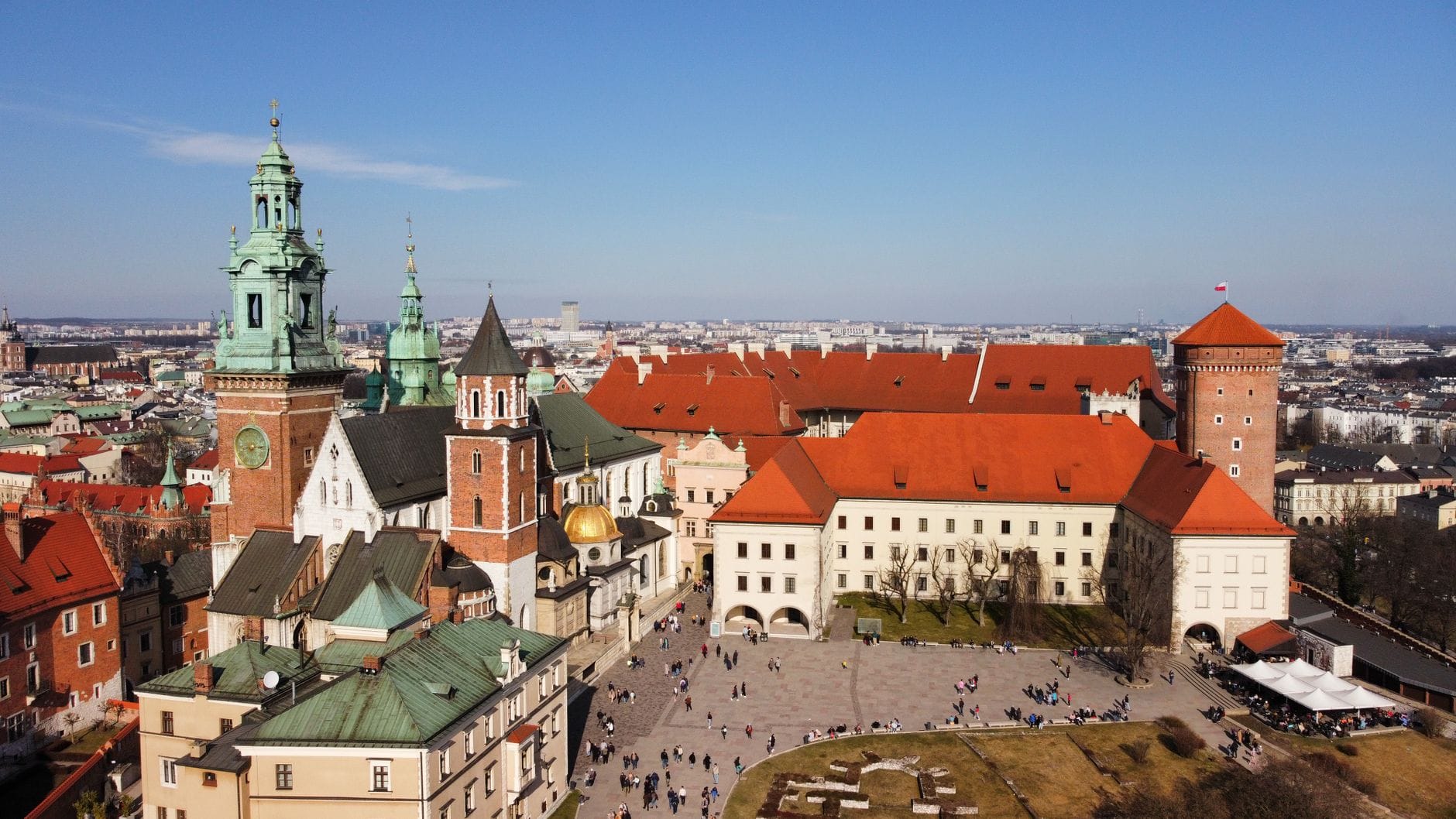
Wawel Royal Castle, known in Polish as Zamek Królewski na Wawelu, is not a single building but a walled complex of royal apartments, a Gothic cathedral, state rooms, a treasury, and archaeological remains — all crowded onto a compact limestone hill 228 metres above sea level at the southern end of Kraków's Old Town.
The castle served as the residence of Polish kings for centuries before the royal court moved to Warsaw in 1596. Even after that shift in political gravity, Wawel remained the ceremonial heart of the Polish state: coronations and royal funerals continued here long after the court had left. That layered importance explains why the complex feels simultaneously lived-in and monumental.
The limestone hill itself has been inhabited since at least the early medieval period. The current castle took shape primarily in the 14th century and was substantially rebuilt in the Renaissance style during the reign of King Sigismund I the Old in the first half of the 16th century. The three-storey arcaded courtyard that defines the castle's visual identity today is a product of that Italian-influenced transformation. Wawel is part of the Historic Centre of Kraków, inscribed on the UNESCO World Heritage List in 1978 among the very first cohort of twelve sites.
💡 Local tip
Timed tickets for the interior exhibitions sell out on busy days, especially in summer. Book through the official site (wawel.krakow.pl) in advance rather than queuing at the box office on arrival.
The Approach: Getting Up the Hill
Most visitors approach from the north, walking down Grodzka Street from the Main Market Square and then following the road as it curves left toward the main Dragon's Den gate. The approach through Planty Park from the west is quieter and often less crowded, particularly in the morning.
The hill is accessed via a sloping road rather than stairs at the main entrance, which makes it navigable with a pushchair or wheelchair, though the surface is uneven cobblestone in places. In summer, the castle also opens an additional entrance from Kanonicza Street via the Austrian Gate, which gives a slightly different angle of approach and tends to attract fewer people.
The walk from the tram stop at Wawel to the castle gate takes around five minutes. Stradom stop is a similar distance. If you are staying in Kazimierz, the walk north along the Vistula riverbank is pleasant and takes about fifteen minutes on flat ground before you begin the ascent.
⚠️ What to skip
Flat-soled shoes with grip are strongly recommended. The courtyard and hill paths are cobbled limestone, which becomes slippery after rain.
Tickets & tours
Live prices and dates from our booking partner. If you book, we may earn a commission at no extra cost to you.
The Arcaded Courtyard and the Castle Exterior
Entry to Wawel Hill and the arcaded Renaissance courtyard is free and open from 06:00 until dusk. This matters more than it might sound: in the early morning, particularly on weekdays outside July and August, you can walk the courtyard almost alone. The stone arcade wraps three sides of the inner yard in two tiers of graceful arches, the stonework worn to a warm honey tone. The proportions are lighter than you might expect from a royal fortress — closer to a Florentine palazzo than a northern European defensive keep.
By mid-morning on a summer weekend, the courtyard fills with school groups and tour parties. The acoustics amplify conversation, and the space that felt contemplative at 08:00 becomes crowded by 10:30. If the exhibitions themselves are your main interest, arriving when the ticket offices open (exhibitions usually start around 09:00 Tuesday through Sunday) lets you move through the state rooms before group tours arrive in force. Monday hours are reduced, with a shorter free-admission programme (roughly 10:00–16:00, varying by season and exhibition).
From the castle ramparts and terraces, the views south over the Vistula River and toward the Podgórze district are among the best elevated views in Kraków. The light is best in the afternoon, when the sun falls on the river rather than into your eyes.
The Exhibitions Inside
The castle operates as the Wawel Royal Castle National Art Collection, with several distinct ticketed exhibitions. Each requires a separate timed-entry ticket, and daily visitor numbers per exhibition are capped. This keeps the interiors from becoming overwhelmed, but it also means popular collections like the State Rooms and the Royal Private Apartments can sell out entirely on high-season weekends.
The State Rooms contain the most impressive display of the castle's original furnishings and decorative arts, including a series of Flemish tapestries commissioned by King Sigismund II Augustus in the 16th century. Around 130 of the original Wawel tapestries survive, and a rotating selection is on display. The coffered ceilings in the main audience halls are remarkable: in one room, the ceiling was originally fitted with carved wooden heads representing human faces — an unusual decorative device of which a number of originals remain.
The Crown Treasury and Armoury houses coronation regalia, including Szczerbiec, the ceremonial sword used at Polish royal coronations from the 13th century onward. The collection of medieval armor and weaponry is genuinely significant. For visitors making a broader tour of Kraków's art collections, the Czartoryski Museum nearby holds Leonardo da Vinci's Lady with an Ermine, which was historically associated with the Wawel collections — worth noting as a related stop.
The Lost Wawel exhibition, located in the former royal kitchen buildings below the main palace, covers the archaeological remains of the earliest structures on the hill, including a pre-Romanesque rotunda from the 10th or 11th century. It is less crowded than the State Rooms and worth including if you have time.
Wawel Cathedral: The Building Next Door
The Wawel Cathedral stands within the same hilltop complex but is administered separately. Entry to the main nave is free; climbing the Sigismund Tower to see the enormous bronze Sigismund Bell and entering the royal crypts below the cathedral require a separate ticket. The crypts contain the tombs of Polish kings, national heroes including Tadeusz Kościuszko, and more recent figures such as President Lech Kaczyński and his wife, who died in the Smolensk air disaster of 2010. The cathedral is an active place of Catholic worship — expect to observe services from a distance if you visit on Sunday mornings.
The Sigismund Bell, cast in 1520, is one of the largest historic bells in Poland. Ringing it by hand requires significant effort; it is only rung manually on major state and religious occasions. On normal visits, you can see and touch the bell from the tower platform.
Seasonal and Weather Considerations
Wawel Hill is exposed. In winter — December through February — temperatures in Kraków regularly sit around or below 0°C, and the hilltop catches wind that the city streets below do not. The castle exterior and courtyard can be snow-covered, which is visually striking but makes the limestone surfaces more treacherous underfoot. Winter is also low season for tourists, so exhibition tickets are far easier to obtain, and the state rooms feel properly contemplative rather than processional.
Summer weekends, particularly July and August, bring the highest crowds. The castle is not air-conditioned, and the State Rooms can become warm by early afternoon. Visiting in May, early June, or September gives you better weather balance — mild temperatures, longer daylight hours, and manageable visitor numbers. For a broader look at timing your visit to Kraków, the best time to visit Kraków guide covers seasonal trade-offs across the city.
Photography inside the ticketed exhibitions is subject to restrictions that vary by room and may change. The arcaded courtyard, exterior ramparts, and cathedral exterior can all be photographed freely. The best light for the courtyard falls in the morning when the sun is low and to the east.
Who Should Skip This (or Manage Expectations)
Visitors expecting a single sweeping palace interior will find the reality more fragmented: Wawel is a complex of buildings requiring multiple tickets for different sections, with timed-entry constraints and separate queues. If you have limited time and are choosing between Wawel and one other attraction, prioritize based on your interests — the State Rooms and Treasury for royal history, the Cathedral for religious and national history, the courtyard alone if you simply want the architecture without buying tickets.
Visitors primarily interested in WWII history may find more focused content at Schindler's Factory Museum in Podgórze, or on a day trip to Auschwitz-Birkenau. Wawel's significance is medieval and early modern rather than 20th century.
Children who are not interested in royal regalia or tapestries may engage more with the Dragon's Den (Smocza Jama) — a natural cave system at the foot of Wawel Hill with a fire-breathing dragon sculpture at its exit above the Vistula. It is separately ticketed and takes about 20 minutes to walk through. It works well as an add-on to a Wawel visit for families.
Insider Tips
- The courtyard and hill open at 06:00 — arriving before 09:00 on a summer morning gives you the Renaissance arcade almost to yourself before tour groups and ticket offices arrive simultaneously.
- Tickets for the most popular exhibitions (State Rooms, Royal Private Apartments) cap daily visitor numbers. On summer weekends, book via the official site at least two to three days in advance — walk-up tickets may be unavailable by mid-morning.
- The Lost Wawel archaeological exhibition in the former kitchens is consistently less crowded than the main palace exhibitions and covers the oldest layers of the hill's history, including pre-Romanesque remains. It is worth adding to any visit.
- The Austrian Gate entrance from Kanonicza Street, open during summer at specified hours, is used by fewer visitors than the main northern gate and places you immediately adjacent to the cathedral rather than at the courtyard — useful if Wawel Cathedral is your primary destination.
- Monday is reduced-hours day for exhibitions (typically 10:00–16:00), but the courtyard and hill remain free and open. For a free, unhurried visit focused on the exterior and architecture, Monday mornings are often the quietest of the week.
Who Is Wawel Royal Castle For?
- First-time visitors to Kraków who want to understand the city's political and cultural history in a single site
- Architecture enthusiasts interested in Renaissance courtyard design and its Italian influences in Central Europe
- History readers with knowledge of the Polish-Lithuanian Commonwealth, royal dynasties, or the medieval Kingdom of Poland
- Families combining the castle with a visit to the Dragon's Den cave at the hill's base
- Photographers working in the early morning when the courtyard light is soft and crowds are absent
Nearby Attractions
Other things to see while in Wawel Hill:
- Dragon's Den (Smocza Jama)
Carved into the limestone bedrock of Wawel Hill over 25 million years ago, the Dragon's Den (Smocza Jama) is one of Kraków's oldest and most atmospheric stops. A short underground walk through three chambers ends at the Vistula riverbank, where a fire-breathing bronze dragon greets you. It is low-cost, quick, and interesting for what it is.
- Vistula Riverbank (Bulwary Wiślane)
The Vistulan Boulevards stretch along both banks of the Vistula River beneath Wawel Hill, offering Kraków's most popular free outdoor space. Built between 1907 and 1913 as flood-protection embankments, they now serve as a walking, cycling, and socialising hub with views of one of Poland's most iconic skylines.
- Wawel Cathedral
The Archcathedral Basilica of Saint Stanislaus and Saint Wenceslaus, known as Wawel Cathedral, is the coronation and burial church of Polish kings. Standing on Wawel Hill in its present Gothic form since 1364, it combines Gothic architecture, Renaissance chapels, and baroque interiors into one of the most historically charged buildings in Central Europe.
Planning a trip? Discover personalized activities with the Nomado app.