St. Florian's Gate & City Walls: Kraków's Last Medieval Gateway
St. Florian's Gate is the sole surviving medieval gate of the eight that once pierced Kraków's city walls. Standing about 33 metres tall at the northern tip of the Old Town, it anchors the Royal Route that once led from the city entrance down to Wawel Castle. Walking through is free; climbing the wall gallery costs a small fee and pairs naturally with the adjacent Barbican.
Quick Facts
- Location
- Brama Floriańska, junction of Floriańska and Pijarska streets, Kraków Old Town
- Getting There
- Tram/bus stops Stary Kleparz and Teatr Słowackiego, approx. 5 min walk; Kraków Główny train station approx. 10–15 min walk
- Time Needed
- 15–20 min to pass through and photograph; 45–60 min to include the wall walk and Barbican
- Cost
- Walking through the archway is free. Upper gallery and wall walk require a combined ticket with the Barbican (sold at the Barbican ticket office, PLN prices vary — check mhk.pl)
- Best for
- History enthusiasts, architecture photography, medieval fortification fans, first-time visitors to Kraków
- Official website
- www.mhk.pl
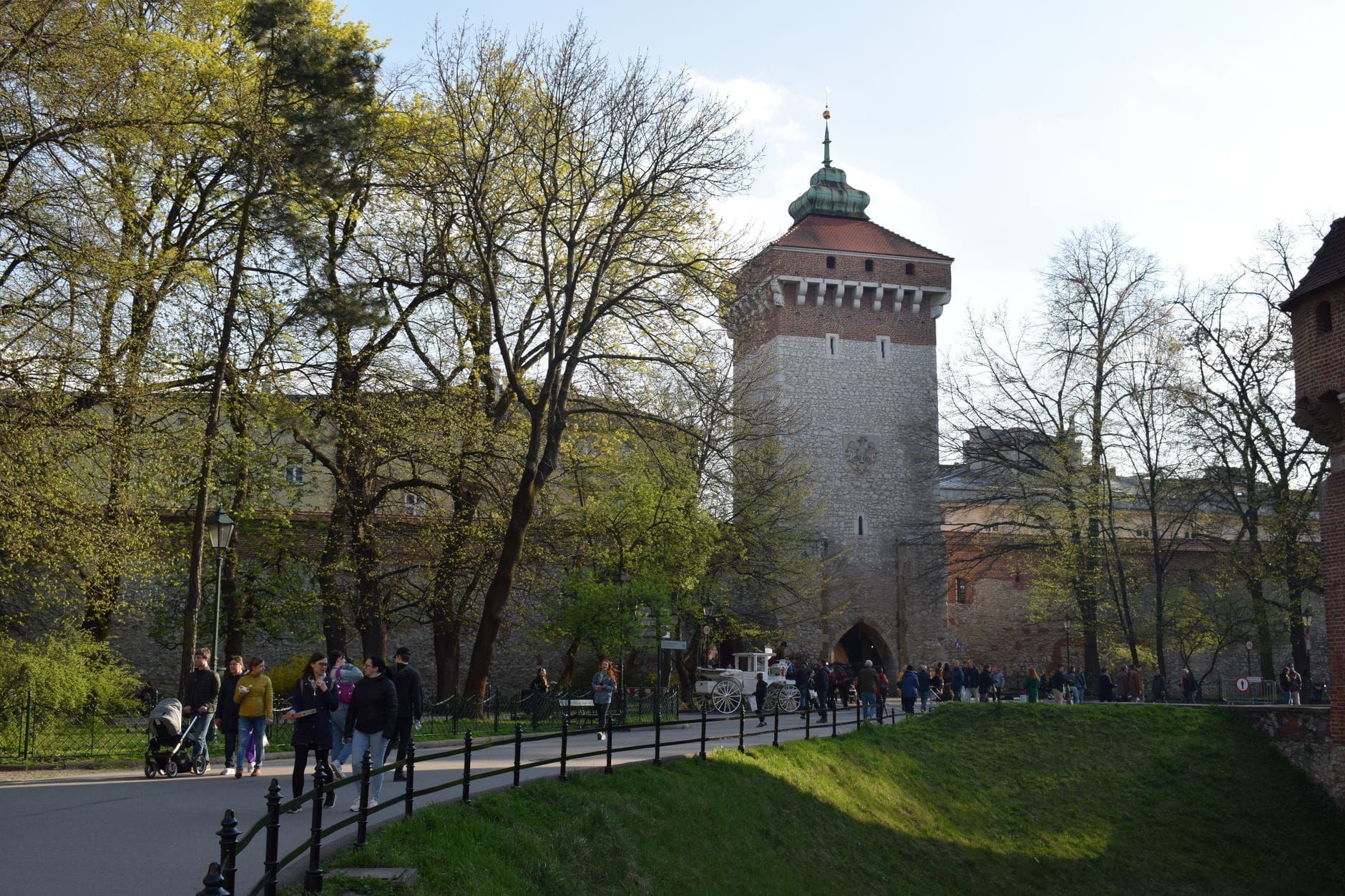
What You're Actually Looking At
St. Florian's Gate, known in Polish as Brama Floriańska, is a Gothic tower that has stood at the northern edge of Kraków's Old Town since the 14th century. It is the only one of the original eight medieval city gates still standing, which makes it singular rather than merely old. The tower rises approximately 33 metres and is capped by a distinctive Renaissance parapet added during later renovations — a detail that rewards a slow upward look rather than a quick photograph and a walk-on.
The gate sits at the top of Floriańska Street, one of Kraków's most direct pedestrian axes. When you walk north from Rynek Główny toward the gate, the street narrows slightly and the tower frames itself at the end like a stage backdrop. From this angle, particularly in morning light when the stone is warm and the crowds are thin, the gate earns its place on every postcard.
The gate was part of a wider fortification system whose construction began after Duke Leszek the Black granted permission to build Kraków's city walls in 1285, with the gate first mentioned in documents dating to 1307. What visitors see today is the culmination of centuries of reinforcement and repair, not a single-period structure. To understand the full defensive layout, including the moat that once surrounded these walls, the nearby Krakow Barbican provides the clearest surviving illustration of that outer perimeter.
💡 Local tip
Tickets to walk the upper gallery and defensive walls are sold at the Barbican ticket office, not at the gate itself. If you arrive at the gate expecting to buy a ticket on the spot, you will need to walk back roughly 100 metres. The wall walk and Barbican are covered by a single combined ticket.
The Royal Route: Context That Changes How You See It
St. Florian's Gate was not simply a defensive structure. It was the formal entrance to the Royal Capital — the first thing ambassadors, monarchs, and victorious armies passed through when entering Kraków. This was the start of the Royal Route, the ceremonial procession that ran south along Floriańska Street, across Rynek Główny, and down through the Old Town to Wawel Castle on the hill above the Vistula.
Standing at the gate and looking south, you are looking directly down that same axis. Wawel Castle sits at the far end of this processional corridor, invisible from the gate but present in the logic of the city's layout. The straight line connecting them is one of the oldest planned urban sequences in Central Europe, and it still functions today as the main pedestrian spine of the Old Town.
This historical weight is easy to overlook when the street is full of people eating ice cream and posing for photographs. But the Royal Route is worth knowing about before you arrive, because it reframes a pleasant walk into something with seven centuries of accumulated significance.
Tickets & tours
Live prices and dates from our booking partner. If you book, we may earn a commission at no extra cost to you.
Entrance ticket for the Legends of Krakow robotic show
From 9 €Instant confirmationFree cancellationWieliczka Salt Mine guided tour with hotel pickup from Krakow
From 58 €Instant confirmationFree cancellationWieliczka salt mine guided tour from Krakow
From 60 €Instant confirmationFree cancellationAuschwitz-Birkenau Spanish Guided Tour with Hotel Pick-Up
From 44 €Instant confirmation
Visiting at Different Times of Day
Early morning, roughly 7:30 to 9:00, is when the gate is at its most photogenic and least crowded. The archway is oriented roughly northwest–southeast, so morning light from the east catches the eastern face of the tower and creates strong contrast against the stone. The passage under the gate is also quiet enough at this hour that you can stop and look up at the barrel-vaulted ceiling, the worn sandstone blocks, and the iron-hinged remnants of the original gate structure without being shuffled along by foot traffic.
By mid-morning, particularly in summer, tour groups begin flowing through in both directions. The archway is wide enough to accommodate this without feeling dangerous, but the acoustic shift is noticeable: the low murmur of city noise becomes a layered echo of rolling suitcases, multiple languages, and the occasional school group. This is still a perfectly good time to visit; it just requires more patience for photography.
Evening visits, after 18:00, offer a different character. The interior of the gate closes at the end of the operating day, but the archway remains open as part of the public street. At dusk, when the stonework is lit artificially and the crowd has thinned to couples and late walkers, the gate feels more intimate. The smell of pretzels and roasting nuts from nearby street vendors drifts through the passage. It is a good moment to stand at the northern face, look out toward the Barbican and the Planty park beyond, and appreciate the spatial logic of the old defensive line.
The Wall Walk: What You Get for the Ticket
The combined ticket covering the Barbican and defensive walls opens access to the surviving stretch of walls that runs east and west from the gate. This wall walk is shorter than visitors sometimes expect — it covers the preserved section between the gate and two flanking towers, the Joiners' Tower and the Carpenters' Tower — but the views from the gallery level are useful for understanding how the fortification worked. You look down onto Planty Park, which replaced the filled-in moat in the early 19th century, and you can see exactly how the walls would have presented themselves to anyone approaching from outside.
The wall walk is open seasonally, typically April through October, daily from approximately 10:30 to 18:00. It closes entirely in winter. This is worth noting if you are planning a winter visit to Kraków — the archway itself is accessible year-round, but the interior experience is only available in the warmer months.
The stairways inside the walls are steep and uneven in places, with worn stone edges and low clearance at certain points. The walk is not suitable for wheelchairs or pushchairs. Physically, it is not demanding for anyone reasonably mobile, but closed-toe shoes with grip are more sensible than sandals, particularly after rain when the stone surface becomes slippery.
⚠️ What to skip
The tower and wall walk are not wheelchair-accessible. Street-level passage through the archway is accessible on foot and is free at all times, but anyone unable to manage steep internal staircases should plan accordingly and skip the combined ticket.
Photography: Where to Stand and When
The classic composition is from the south — standing on Floriańska Street with the gate at the end of the frame. For this shot, a 35mm or 50mm equivalent focal length captures the proportional relationship between the street, the flanking buildings, and the tower without distorting the perspective. A slightly elevated position, such as standing on the base of one of the street-side planters, gives you a clear foreground and reduces the problem of heads in the lower third.
For the northern facade, step through the gate and turn around. The outer face is more ornate, with the remnants of fortified elements and a different texture of stonework. From this side, the Barbican is visible in the middle distance, which makes for a layered architectural composition. The northern approach is also where you find the outdoor art market that lines the walls in summer — small paintings, prints, and crafts propped against the stone. It adds colour and human scale, and it is also a legitimate place to buy a souvenir if you prefer something produced by a local artist over mass-printed merchandise.
Fitting the Gate Into Your Wider Visit
St. Florian's Gate works well as the starting or ending point of a walk through the Old Town. Begin here, walk south down Floriańska Street to Rynek Główny, then continue toward Wawel Hill. This is essentially the Royal Route in reverse, and it covers the most historically dense corridor in the city in about 30 to 45 minutes of walking, not counting stops.
If you are working through a broader itinerary, the gate pairs logically with the Barbican to the north and the nearby Planty Park, the green ring that encircles the Old Town on the site of the former moat. A loop through Planty from the gate back to Wawel takes roughly an hour and gives a good sense of the Old Town's overall footprint. For a structured overview of how to sequence these sights, the Kraków walking tour guide covers the full route with practical timing.
Visitors with limited time should note that the gate itself, as a street-level experience, takes fifteen minutes at most. The combined wall walk and Barbican visit is worth budgeting an hour for, including queuing time in peak season. Neither experience is particularly crowded relative to, say, the interiors of major city museums, so it rarely requires advance booking. Tickets are sold on the day at the Barbican ticket office.
People who might not find the gate rewarding: if your primary interests are indoor museum experiences, contemporary culture, or Kraków's Jewish heritage, the gate is pleasant to pass through but is unlikely to hold your attention for long. It is architecture and historical context rather than exhibition or narrative. Travellers focused on Kazimierz or Podgórze, for example, will find more to engage with in those districts and can reasonably give the gate a five-minute pause rather than a dedicated visit.
Insider Tips
- The outdoor art market on the northern face of the walls, running along the outer wall toward the Barbican, operates in summer and sells original prints and paintings by local artists — more interesting than most souvenir shops and worth a browse even if you are not buying.
- Buy your combined ticket at the Barbican, not at the gate. There is no ticket window at the gate itself, and arriving expecting one will send you back up the street.
- For the cleanest photograph of the gate from Floriańska Street, arrive before 9:00 in summer. After that, the pedestrian traffic makes it very difficult to shoot a clear foreground without waiting for gaps between groups.
- The wall walk closes entirely from November through March. If you are visiting outside the summer season, the archway is still open and free, but do not factor the interior experience into your plans.
- The stone floor inside the archway and on the wall walk becomes slippery after rain. Wear shoes with grip if there has been recent rainfall.
Who Is Florian Gate & City Walls For?
- First-time visitors to Kraków wanting to orient themselves at the start of the Royal Route
- Architecture and medieval fortification enthusiasts who appreciate the rarity of a complete Gothic city gate
- Photographers looking for a framed street composition with genuine historical depth
- Travellers combining the Old Town loop with a visit to the Barbican and Planty Park
- Anyone planning a free walking introduction to Kraków's Old Town without a set itinerary
Nearby Attractions
Other things to see while in Kraków Old Town (Stare Miasto):
- Cloth Hall (Sukiennice)
Standing at the centre of Rynek Główny since the Middle Ages, Kraków's Cloth Hall is part market, part museum, and part architectural monument. The ground-floor arcade sells amber, linen, and crafts; upstairs, the National Museum's Gallery of Polish Art fills Renaissance rooms with 19th-century masterpieces.
- Collegium Maius
Collegium Maius is the oldest surviving building of the Jagiellonian University, founded in 1364. Housing a museum of rare globes, scientific instruments, and royal regalia beneath a serene Gothic arcade, it offers one of Kraków's most quietly impressive indoor experiences.
- Czartoryski Museum
The Czartoryski Museum holds one of Poland's oldest and most important art collections, anchored by Leonardo da Vinci's Lady with an Ermine. Housed in a historic Old Town complex near the Florian Gate, it combines fine art, antiquities, and decorative arts across several interconnected buildings.
- Kraków Barbican
The Kraków Barbican is a late-15th-century Gothic fortified outwork standing at the northern entrance to the Old Town, and one of the most complete medieval defensive structures remaining in Central Europe. Built around 1498–1499 to shield St. Florian's Gate from Ottoman-era threats, it now operates as a branch of the Museum of Krakow. Open Tuesday through Sunday, it rewards visitors with thick brick walls, rooftop turrets, and an atmosphere that the surrounding city streets simply cannot replicate.
Planning a trip? Discover personalized activities with the Nomado app.