Nowa Huta Central Square (Plac Centralny): Kraków's Socialist-Realist Utopia in Stone
Plac Centralny im. Ronalda Reagana is the monumental heart of Nowa Huta, Kraków's planned socialist-realist district. Built between 1949 and 1956 as the centerpiece of a model workers' city, the square offers a striking architectural time capsule, free to visit, and best understood as part of a longer exploration of one of Europe's most intact examples of Stalinist urban planning.
Quick Facts
- Location
- Nowa Huta district, eastern Kraków. Plac Centralny im. R. Reagana
- Getting There
- Trams from central Kraków to Plac Centralny im. R. Reagana; line 4 is a common daytime option, but check current MPK routes
- Time Needed
- 30–60 minutes for the square; 2–3 hours to explore Nowa Huta properly
- Cost
- Free (public square; no ticket required)
- Best for
- Architecture enthusiasts, Cold War history, urban photography, off-the-beaten-path sightseeing
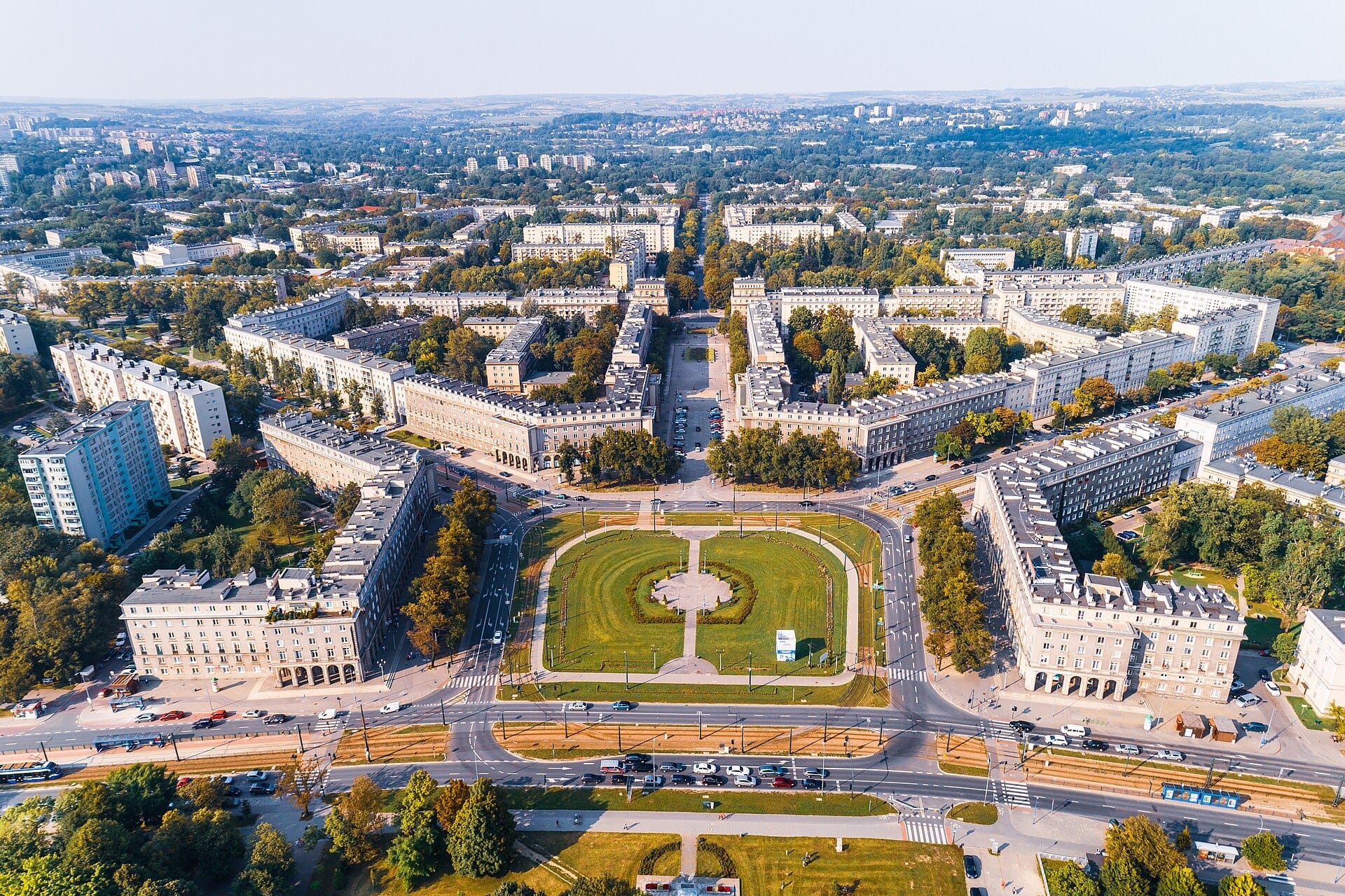
What Is Nowa Huta Central Square?
Plac Centralny im. Ronalda Reagana, known in English as Nowa Huta Central Square, is the urban core of one of the most ambitious and controversial city-planning projects in postwar Europe. Built between 1949 and 1956 as part of the socialist-realist district of Nowa Huta, the square was conceived as the ceremonial heart of a brand-new workers' city on the eastern edge of Kraków. Unlike most European plazas that evolved over centuries, Plac Centralny was drawn from scratch on a drafting table and built to communicate state power through stone, symmetry, and scale.
The square is an open, public space with no admission fee and no set opening hours. It is neither a museum nor a park in the conventional sense, but rather an urban monument you walk through. That distinction matters when planning your visit: come to observe, to photograph, and to think about what the architecture was designed to make people feel, rather than to tick off exhibits.
In 2004, in a pointed act of political symbolism, the square was renamed after Ronald Reagan, the American president widely credited in Poland with moral support for the Solidarity movement that helped bring down communist rule. The original name, Plac Centralny, is still used colloquially by most locals.
The Architecture: What You Are Actually Looking At
The square sits at the convergence point of five wide avenues, designed in the socialist-realist style that Soviet urban planners exported across Eastern Europe in the late 1940s and early 1950s. The governing aesthetic borrows heavily from classical European architecture, specifically Italian Renaissance and Baroque, while stripping it of religious or royal connotations and repackaging it as a symbol of the working class. The result is grand, slightly severe, and unmistakably deliberate.
The surrounding apartment blocks are four to six stories tall, built in pale stone and terracotta, with arched ground-floor arcades, decorative cornices, and uniform window rhythms. Stand at the center of the square and rotate slowly: every sightline terminates in a building facade, each one carefully composed to reinforce the impression of an ordered, prosperous, self-contained world. Nothing was left to chance. Even the street widths were calculated to allow military parades to pass with visual effect.
💡 Local tip
For the strongest architectural overview, walk to the center of the square and look down each of the five radiating avenues. The perspective lines are intentional: Nowa Huta's planners studied Haussmann's Paris and Soviet Moscow before laying out this grid.
The scale is easy to underestimate from photographs. In person, the arcaded walkways feel substantial and the proportions of the facades communicate authority in a way that is hard to articulate but immediately felt. This is architecture as ideology, and it still works on the senses even when you know the politics behind it.
Tickets & tours
Live prices and dates from our booking partner. If you book, we may earn a commission at no extra cost to you.
Guided tour of Krakow's Nowa Huta district
From 94 €Instant confirmationFree cancellationKrakow: Plaszow concentration camp guided tour
From 20 €Instant confirmationFree cancellationEntrance ticket for the Legends of Krakow robotic show
From 9 €Instant confirmationFree cancellationWieliczka Salt Mine guided tour with hotel pickup from Krakow
From 58 €Instant confirmationFree cancellation
Historical Context: A City Built to Change Kraków
Nowa Huta was not just a housing project. It was a political instrument. The postwar communist government in Poland viewed Kraków with suspicion: the city was too Catholic, too intellectual, too tied to the prewar bourgeoisie. The solution was to build a new, ideologically correct city right next to it, populated by workers recruited from rural Poland, and anchor it to a massive steelworks. You can still visit those original Nowa Huta steelworks today on guided tours.
Construction on Plac Centralny and the surrounding district began in 1949. The chief architects, Tadeusz Ptaszycki and a team working under state direction, produced a master plan that covered thousands of apartments, schools, cultural centers, and green spaces, all organized around this central square. By the mid-1950s, the district had a population of tens of thousands and its own urban logic, entirely separate from old Kraków.
The irony the communist planners never anticipated: Nowa Huta became one of the most active centers of resistance to communist rule in Poland. Its workers were among the earliest and most committed supporters of the Solidarity trade union movement in the 1980s. The renaming of the square after Reagan in 2004 is the endpoint of that arc, a deliberate symbolic reversal carved into the geography of the city.
The Experience at Different Times of Day
In the early morning, Plac Centralny has a quality that feels almost theatrical in its emptiness. The arcades echo with footsteps, and the pale facades catch early light at a low angle that emphasizes every carved detail. This is the best hour for photography. The avenues are quiet, trams run infrequently, and you can walk the full circumference of the square without competing with other visitors.
By midday, local life fills the space. Residents cut through on their way to the market, elderly men sit on benches reading newspapers, and the small cafes under the arcades open their shutters. The square functions as a neighborhood hub, not a tourist attraction staged for outside consumption. That ordinariness is itself part of what makes it interesting: people still live inside this planned utopia, and it works, on a domestic scale, in ways its designers probably never prioritized.
On overcast days, which are common in Kraków from October through March, the grey stone and the heavy cornice lines can feel oppressive in a way that is historically appropriate. Summer afternoons bring a warmer atmosphere: children on bicycles, the smell of linden trees along the avenues, and a softening of the architecture's harder edges. Both moods are worth experiencing if you have the time.
ℹ️ Good to know
Nowa Huta is approximately 8 km east of Kraków's Old Town. Allow about 30–35 minutes on the tram from the city center. Tram services change over time; line 4 is a common daytime option to Plac Centralny im. R. Reagana, but check current MPK Kraków routes before setting out.
How to Structure Your Visit
The square itself takes 20 to 30 minutes to walk at a considered pace. But arriving and leaving immediately means missing the surrounding streets, which extend the socialist-realist urban fabric for several blocks in every direction. The residential alleyways behind the main facades, lined with small gardens and painted courtyards, reveal the domestic scale at which the architects also worked. For a structured introduction to the whole district, the Nowa Huta communist tour guide covers the key stops in sequence.
Muzeum Krakowa operates a related exhibition, Central Square in Search of the Centre, which provides archival photographs, original planning documents, and contextual exhibits. Check their website for current opening hours before visiting, as these vary by season and are subject to change.
If you have half a day, combine the square with a walk along Aleja Róż (Avenue of Roses), a formal promenade that stretches south from the square and still contains the original flower beds and benches from the 1950s. The Lord's Ark Church, built by residents who fought the communist government for permission to construct a place of worship in a district deliberately designed without one, is also within walking distance and adds a layer of human resistance to the architectural story.
💡 Local tip
Wear comfortable walking shoes. The square and surrounding streets are paved with uneven stone slabs and cobblestones. There are no formal amenities on the square itself, but cafes and small shops operate under the arcades along the perimeter.
Photography Tips and Practical Notes
The geometry of Plac Centralny rewards wide-angle lenses. The symmetrical avenue perspectives are most effective when shot from low height at the center of the square, using the tram lines in the pavement as leading lines. Morning and late afternoon light, arriving at low angles, gives the terracotta facades the most texture and warmth. Midday in summer tends to flatten the detail under direct overhead light.
The square is fully open to the sky, which means weather matters considerably. In heavy rain, the arcades provide shelter and create interesting reflections on the wet stone, but the overall experience is significantly reduced. Snow, by contrast, transforms the space: the white ground against the pale stone and the quiet of a winter morning makes for some of the most striking photographs possible in Kraków.
For visitors on a tight schedule who want to combine Nowa Huta with the Old Town in a single day, this is manageable but requires planning. A focused 2-day Kraków itinerary can help allocate time effectively between the two very different parts of the city.
Is It Worth the Trip from the Old Town?
This depends entirely on what you want from Kraków. If your interest is medieval architecture, the Jewish quarter, or sites like Wawel Castle, Nowa Huta asks you to shift register completely. The two parts of the city represent opposite ends of European history, separated by about a kilometre of distance and a thousand years of time. Many visitors find that contrast to be the most intellectually compelling thing about Kraków as a whole.
The square itself is not overhyped in the way some urban attractions are. It looks like what it is: a serious piece of urban design from a specific political moment, preserved largely intact. There are no street performers, no souvenir kiosks at the center, and no staging for tourism. You are simply standing in a neighborhood where people live, built according to an ideology that no longer exists.
Visitors who find the 20th century less interesting than the medieval period, or who have limited time in Kraków, may reasonably prioritize other sites. The tram journey takes about 30 minutes each way, which is a real commitment on a short trip. But for anyone curious about how cities encode politics into stone, or how ordinary people inhabited an extraordinary ideological project, Plac Centralny is worth the detour.
Insider Tips
- Go on a weekday morning for the cleanest photographs. Weekend afternoons bring local families and occasional events that can crowd the central area, though even this is quieter than most tourist sites in Kraków's Old Town.
- The arcades around the square perimeter have small, inexpensive cafes that are almost entirely frequented by locals. Prices are noticeably lower than in the city center, and the coffee is good.
- Look up at the carved decorative panels on the upper facades of the apartment blocks around the square. They depict idealized workers, farmers, and soldiers, the figurative vocabulary of socialist realism, and they are detailed enough to reward close attention.
- The square was named after Ronald Reagan in 2004 in recognition of US support for the Solidarity movement, but locals still predominantly call it Plac Centralny. Using that name with tram drivers or locals will get you further than the official Reagan-era version.
- If you visit in winter, check whether the Muzeum Krakowa exhibition on the square is open. It provides archival materials and historical context that significantly deepens what you see outside, and the building itself is worth entering.
Who Is Nowa Huta Central Square (Plac Centralny) For?
- Architecture and urban design enthusiasts interested in socialist-realist planning
- Cold War and 20th-century European history travelers
- Photographers looking for strong geometric compositions and untouristy streetscapes
- Travelers combining Kraków with Auschwitz-Birkenau who want broader context on postwar Poland
- Anyone who has already covered the Old Town and wants to see a radically different face of the same city
Nearby Attractions
Other things to see while in Nowa Huta:
- Lord's Ark Church (Arka Pana)
The Church of Our Lady Queen of Poland, known as the Lord's Ark Church or Arka Pana, stands as one of Krakow's most compelling Cold War stories in architectural form. Built between 1967 and 1977 in the heart of a district designed without God, it remains an active parish and a remarkable monument to resistance. Entry is free.
- Nowa Huta Steelworks
The Tadeusz Sendzimir Steelworks, formerly the Lenin Steelworks, is one of Europe's most striking monuments to communist industrial ambition. Sprawling across a large area of eastern Kraków, it still operates today under ArcelorMittal Poland and can be visited on organised guided tours, usually focused on administrative buildings, shelters, and industrial heritage rather than active production areas.
Planning a trip? Discover personalized activities with the Nomado app.