Nowa Huta Steelworks: Inside Kraków's Soviet-Era Industrial Colossus
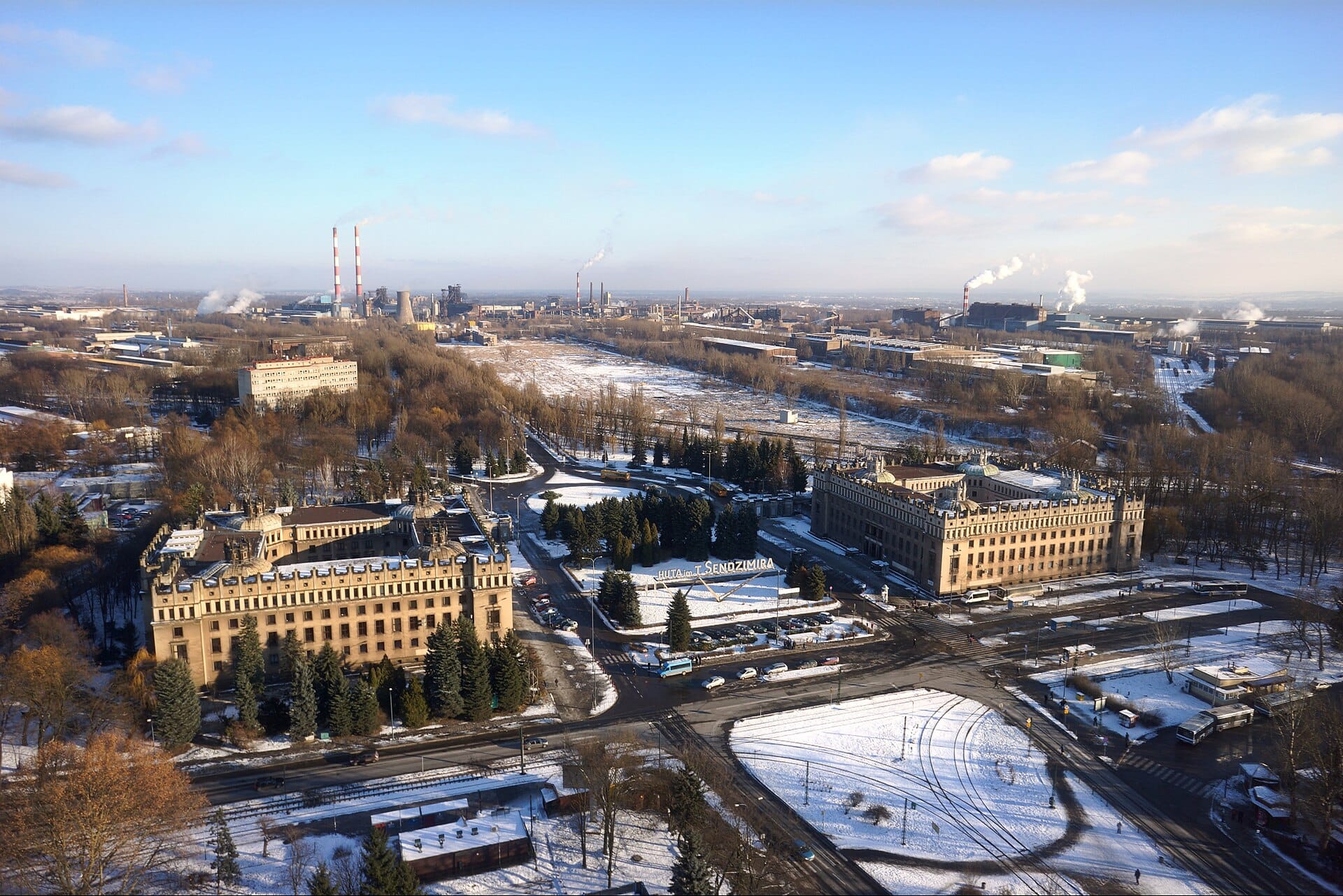
The Tadeusz Sendzimir Steelworks, formerly the Lenin Steelworks, is one of Europe's most striking monuments to communist industrial ambition. Sprawling across a large area of eastern Kraków, it still operates today under ArcelorMittal Poland and can be visited on organised guided tours, usually focused on administrative buildings, shelters, and industrial heritage rather than active production areas.
Quick Facts
- Location
- Ujastek 1, 31-752 Kraków (Nowa Huta district)
- Getting There
- Tram from central Kraków toward Nowa Huta; alight near Plac Centralny, then follow signs toward the steelworks gates
- Time Needed
- Allow time for a guided tour of the administrative buildings and Cold War bunkers
- Cost
- Varies by tour operator; no walk-in admission. Check your chosen NGO or specialist tour provider for current PLN prices
- Best for
- Cold War history enthusiasts, industrial architecture fans, and travellers interested in 20th-century heritage
- Official website
- poland.arcelormittal.com
What the Nowa Huta Steelworks Actually Is
The Tadeusz Sendzimir Steelworks is not a museum. It is a functioning heavy-industry plant, owned by ArcelorMittal Poland, that happens to carry one of the most charged political histories of any factory in Central Europe. Commonly called the Nowa Huta Steelworks, the complex covers a large area on the eastern edge of Kraków and was for decades the physical embodiment of communist Poland's industrial ideology.
At its peak, the plant employed tens of thousands of workers, and today production is scaled back significantly. The communist-era administrative buildings and underground Cold War bunkers beneath the site are accessible to visitors through specialist guided tours.
⚠️ What to skip
There are no walk-in visiting hours. Entry is typically restricted to escorted groups through prior arrangement with approved tour operators or local NGOs.
History: From Lenin's Steel Dream to ArcelorMittal
Construction of the steelworks began as a centrepiece of the communist government's Six-Year Plan, designed to transform Poland's economy along Soviet lines. The plant's first steel was tapped in 1954. It was christened the Lenin Steelworks, and the name was intended as a statement of ideological alignment as much as industrial purpose.
The choice of Kraków as the location was also political. The city was historically Catholic, aristocratic, and intellectually conservative. Party planners believed flooding the area with tens of thousands of workers from rural Poland would dilute that identity and create a reliable socialist constituency. The gamble backfired spectacularly: the steelworks workers became some of the most active supporters of the Solidarity trade union movement in the 1980s, and the plant's labour force played a direct role in pressuring the communist government toward democratic reforms.
After communism's collapse, the steelworks was renamed in honour of Tadeusz Sendzimir, a Polish-American metallurgist and inventor whose engineering innovations had nothing to do with Soviet ideology — a pointed act of historical correction. The plant passed through several ownership phases before becoming part of ArcelorMittal's Polish operations.
To understand the steelworks in its full urban context, it helps to read about the district built around it. Our Nowa Huta communist tour guide covers the planned avenues, Soviet-era architecture, and the cultural sites that together tell the district's story.
Tickets & tours
Live prices and dates from our booking partner. If you book, we may earn a commission at no extra cost to you.
What You See on a Guided Tour
Tours of the steelworks typically concentrate on two areas: the administrative buildings from the Stalinist construction era, and the Cold War civil defence bunkers located beneath the complex. The administrative centre at Ujastek 1 is a striking example of Socialist Realist architecture — wide corridors, heavy ornamentation, and the kind of institutional gravitas that was designed to communicate permanence and authority.
The bunkers are the atmospheric highlight for most visitors. Built during the height of Cold War tensions, they were intended to shelter key personnel and documents in the event of a nuclear or conventional attack. Walking through them, the air carries the particular coolness and slight dampness of deep underground spaces. Metal blast doors, Soviet-era signage, and equipment frozen in time give the spaces an uneasy, preserved-in-amber quality that no reconstruction could replicate.
Because the plant is still operational, tour routes do not pass through active production areas in the same way industrial tours at decommissioned sites might. What you gain instead is the contrast: the heavy industrial smell of a working steelworks drifting across an administrative campus designed to look more like a civic building than a factory. The scale is disorienting in the best way. Even seen from the outside, the chimneys, cooling towers, and vast shed roofs communicate a scope that photographs do not fully capture.
💡 Local tip
Book your tour well in advance, particularly for weekend dates. Local NGOs running access to the bunker tours have limited group sizes and slots fill quickly during summer and autumn.
How to Get There and What to Expect on Arrival
From central Kraków, tram services run east through the city toward Nowa Huta. The journey from the Old Town takes roughly 30 to 40 minutes depending on traffic signals and stops. Alight near Plac Centralny, the vast circular square at the heart of Nowa Huta's planned city grid, and from there the steelworks gates are reachable on foot or by continuing on local transport.
The area around Plac Centralny is worth arriving early to explore before your tour. The square itself — formally called Nowa Huta Central Square — is a lesson in Stalinist urban planning: wide radiating avenues, uniform building heights, and long ceremonial perspectives intended to signal state power at an urban scale. It takes about 20 minutes to walk its perimeter properly.
On arrival at the steelworks, expect a security check and ID verification. Your tour operator will typically advise what documentation to bring. The plant is an active industrial site, so there are real safety protocols at the gate. Wear closed-toe shoes regardless of the season — sandals are not appropriate here, and some tour operators will refuse entry to visitors wearing them. The bunker sections involve stairs and low-clearance areas; the tour is not well-suited to visitors with significant mobility limitations.
Time of Day and Seasonal Considerations
Tour availability depends entirely on your chosen operator rather than on the site itself, so the classic 'visit at dawn for empty photos' logic does not apply here. Most bunker and administrative tours run during daylight hours on weekdays and selected weekends. The exterior of the steelworks, visible from public roads, reads differently depending on light conditions: on overcast winter days, the grey steel structures and perpetual haze of industrial steam create a stark visual, while summer light softens the drama somewhat.
If you are planning a broader day in Nowa Huta, pairing the steelworks tour with a visit to the Lord's Ark Church makes for a coherent half-day. The church was built by Nowa Huta residents in open defiance of communist authorities who refused to grant planning permission — its story is the human-scale counterpart to the steelworks' ideological ambition.
Winter visits to the bunkers carry an additional atmospheric reward: the temperature contrast between the surface and the underground spaces is more pronounced, and the exterior industrial landscape in snow or frost is particularly photogenic. Rain does not significantly affect the tour since most of it takes place indoors or underground, but check with your operator about surface conditions at the plant during icy periods.
Photography Notes and Practical Considerations
Photography is generally permitted in the bunker and administrative building tours, but always confirm the rules with your specific operator before arrival. In the bunkers, a wide-angle lens and a camera capable of performing in low artificial light will serve you far better than a smartphone. The tunnels and blast-door corridors are narrow and poorly lit by design, which makes them compelling to photograph but technically demanding.
From public roads, the exterior of the steelworks is freely visible and photographable. The best vantage points for conveying the plant's scale are from the approach roads on the northern and eastern sides, where the full spread of the complex becomes apparent against the skyline.
ℹ️ Good to know
The steelworks appears on some Cold War and industrial heritage itineraries in Kraków. If this type of history interests you, combining it with a visit to the Schindler's Factory Museum in Podgórze gives a broader picture of the city's 20th-century industrial and political legacy.
For a connected perspective on Kraków's wartime and post-war industrial history, the Schindler's Factory Museum in Podgórze provides essential context on the period immediately preceding the steelworks era.
Who Should Skip This Attraction
Visitors looking for a polished, self-guided museum experience will find the steelworks frustrating. There are no audio guides, no permanent interpretation panels open to the public, and no café at the end of the tour. The experience demands active engagement with a guide and curiosity about industrial history and Cold War politics. If neither of those topics holds your interest, your time in Kraków is better directed elsewhere.
Families travelling with young children will likely find the logistics — security checks, restricted routes, stairs, underground spaces — more hassle than the content rewards. For family-oriented Kraków experiences, the Kraków with kids guide suggests more accessible alternatives.
Insider Tips
- Book through a local NGO rather than a large aggregator platform if possible — guides connected to community organisations often have richer personal or family ties to the steelworks history and give significantly more nuanced tours.
- The administrative buildings contain original Stalinist-era fittings, light fixtures, and floor tiles that survive largely intact. Slow down in the corridors and look at the details rather than focusing only on the bunker finale.
- Combine your steelworks visit with a walk around Plac Centralny before the tour, not after. You will read the square's architecture more clearly once you understand the ideological logic behind the steelworks it was designed to serve.
- If your tour includes upper floors of the administrative building, the view across the plant gives a useful sense of the steelworks' scale. On very clear days, guides may point out distant southern landmarks, but visibility varies sharply with weather and industrial haze.
- Dress in layers regardless of season. The bunkers maintain a constant low temperature year-round, and the contrast with summer surface heat can be surprisingly sharp.
Who Is Nowa Huta Steelworks For?
- Cold War and 20th-century history enthusiasts who want to move beyond surface-level narrative
- Architecture researchers and urban planners interested in Socialist Realist industrial design
- Dark tourism travellers building an itinerary around Kraków's more difficult histories
- Photographers looking for industrial scale and authentic period details rather than reconstructed heritage
- Visitors on a second or third trip to Kraków who have already covered the major Old Town landmarks
Nearby Attractions
Other things to see while in Nowa Huta:
- Lord's Ark Church (Arka Pana)
The Church of Our Lady Queen of Poland, known as the Lord's Ark Church or Arka Pana, stands as one of Krakow's most compelling Cold War stories in architectural form. Built between 1967 and 1977 in the heart of a district designed without God, it remains an active parish and a remarkable monument to resistance. Entry is free.
- Nowa Huta Central Square (Plac Centralny)
Plac Centralny im. Ronalda Reagana is the monumental heart of Nowa Huta, Kraków's planned socialist-realist district. Built between 1949 and 1956 as the centerpiece of a model workers' city, the square offers a striking architectural time capsule, free to visit, and best understood as part of a longer exploration of one of Europe's most intact examples of Stalinist urban planning.
Planning a trip? Discover personalized activities with the Nomado app.