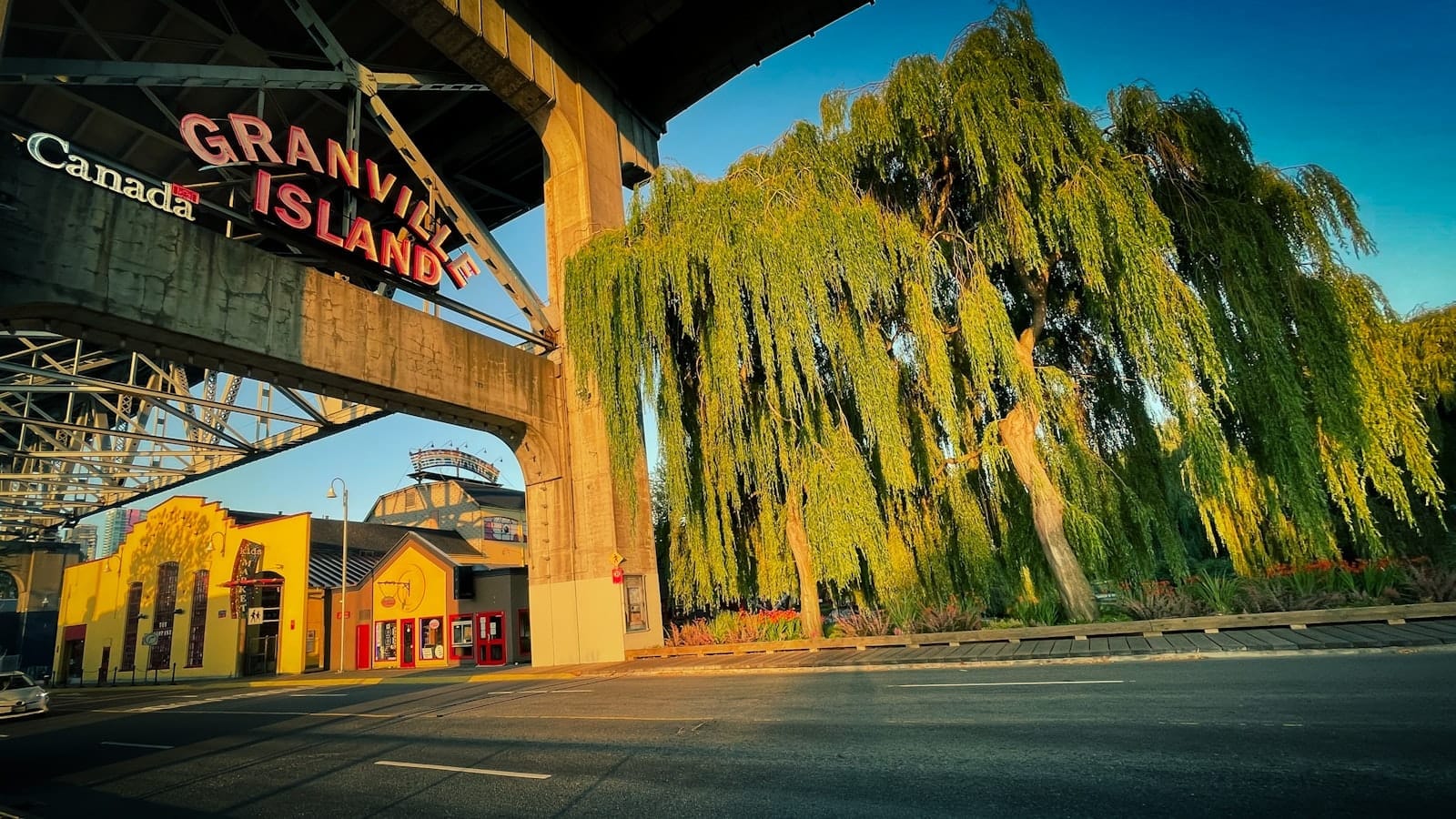
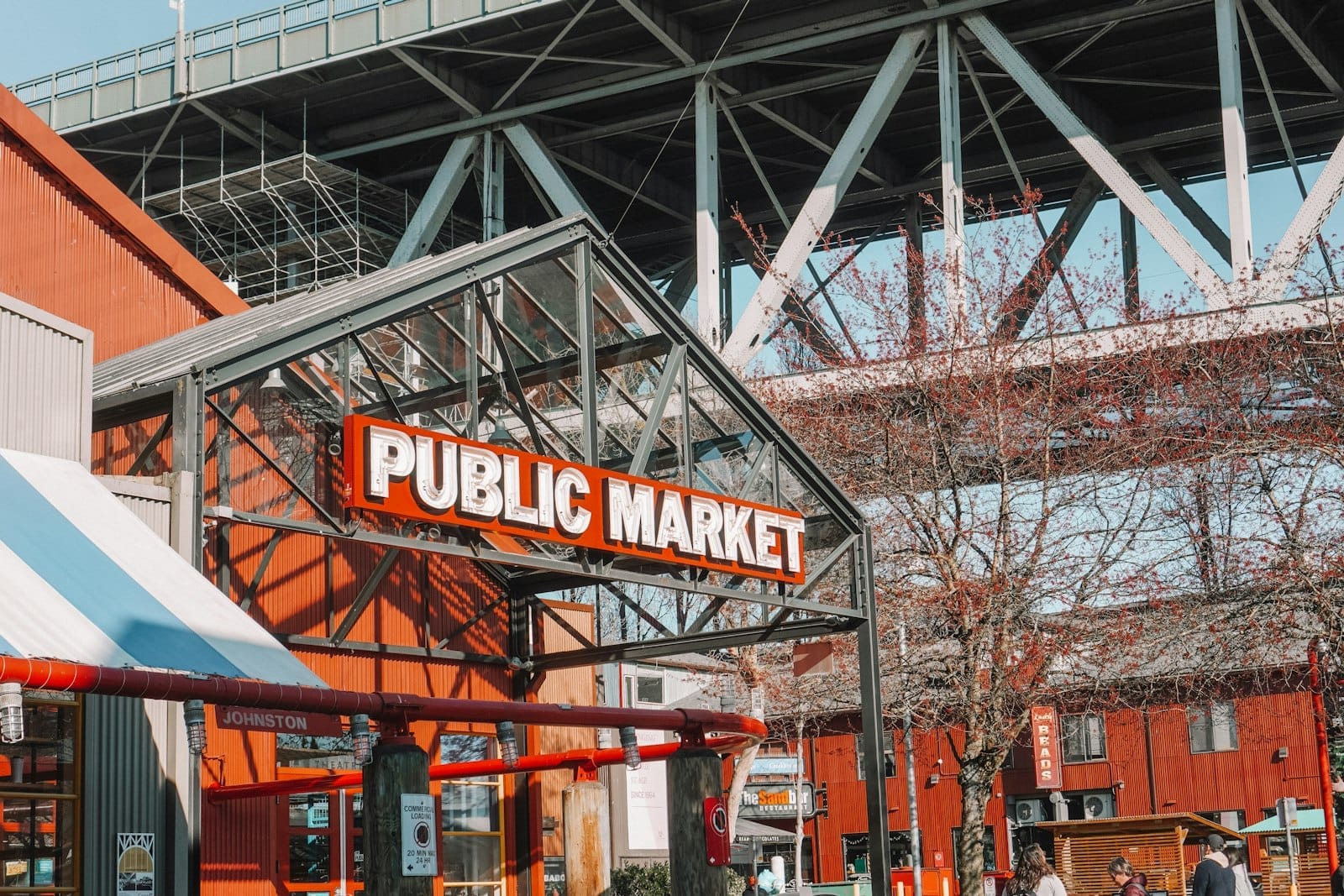
Granville Island is a compact peninsula tucked beneath the Granville Street Bridge on the south shore of False Creek, combining a world-class public market, working artists' studios, craft breweries, performing arts theatres, and a marina in a space you can walk end to end in twenty minutes. Once an industrial manufacturing site, it has been carefully redeveloped by Canada Mortgage and Housing Corporation into a distinctive cultural and commercial destination.
Granville Island sits beneath the concrete arches of the Granville Street Bridge, a former industrial peninsula that has become Vancouver's most layered destination: part food market, part arts district, part working waterfront. It draws enormous crowds and earns them, because beneath the tourist surface there is a genuinely functioning creative community that gives the place its texture.
Orientation
Granville Island occupies a small peninsula on the south shore of False Creek, directly across the water from downtown Vancouver and Yaletown. It sits within the broader Fairview neighbourhood, with Kitsilano immediately to the west and the Fairview area to the east. Despite the name, it is not truly an island: a narrow land connection along Anderson Street links it to the mainland streets of Fir Street and West 2nd Avenue.
The simplest way to orient yourself is to picture the Granville Street Bridge above you as you enter. The Public Market sits on the north side of the peninsula closest to the water. Cartwright Street runs along the southern edge, where you will find the Kids Market, artists' studios, and several theatres. The Net Loft, a collection of specialty retailers, faces the market across a small courtyard. The marina and Granville Island Hotel occupy the western tip. The internal road network is compact, making the island far easier to navigate on foot than by car.
The False Creek waterfront runs along the northern edge, connecting Granville Island to the broader Stanley Park Seawall network to the west and toward Science World to the east. This seawall path is how most cyclists and walkers arrive, and it gives the island its sense of being embedded in the city's waterfront fabric rather than separate from it.
Character & Atmosphere
Arrive at the Public Market before 9am on a weekday and Granville Island belongs to a different crowd entirely: fishmongers arranging their cases, bakers pulling trays, and vendors setting out produce while the seagulls work the marina. The smell of fresh bread and roasted coffee cuts through the salt air off False Creek. At this hour, the covered market interior is dim and purposeful, and it feels closer to a working market than a tourist attraction.
By mid-morning on weekends, that changes quickly. The market fills to capacity, the outdoor courtyard fills with people eating takeaway chowder and watching the Aquabus ferry bob across from the Yaletown dock, and the pedestrian lanes between buildings get genuinely tight. Weekend afternoons in summer are the peak of peak, with visitors competing for the same parking spots, the same market stalls, and the same outdoor tables. If you have flexibility, a Tuesday or Wednesday morning visit will show you a noticeably calmer version of the same place.
What keeps Granville Island from feeling like a pure tourist zone is the working fabric beneath it. Potters fire kilns in studios on Cartwright Street. The Arts Club Theatre Company, one of Canada's largest regional theatre companies, runs productions year-round in its Granville Island stage. Emily Carr University of Art and Design was historically based here before moving its main campus, but working artists remain, renting studio space and running open workshops. On a slow afternoon, the quieter south side of the island near the community centre and the back studios has a creative, low-key atmosphere that most visitors never reach.
💡 Local tip
The crowd dynamic shifts dramatically by day of week and time. For the market without the crush, aim for a weekday morning. For the full experience with street performers, outdoor food stalls, and ferry traffic at its most photogenic, come on a Saturday between 10am and noon and accept that it will be busy.
What to See & Do
The Granville Island Public Market is the anchor of any visit. The large indoor market covers an impressive floor space under a corrugated metal roof, housing dozens of independent vendors selling fresh seafood, BC cheeses, charcuterie, specialty produce, baked goods, prepared foods, and a broad range of ready-to-eat items. Unlike many so-called public markets in North American cities, the majority of vendors here sell food rather than crafts or souvenirs, which keeps it grounded. The prepared food counters are the practical choice for lunch: grab a fresh salmon chowder or a house-made crepe and find a spot near the water-facing windows.
Beyond the market, the Net Loft building directly across the courtyard holds a mix of independent specialty retailers covering everything from handmade paper goods and nautical charts to imported textiles and local jewellery. It is a better option for browsing if you are looking for gifts that are not mass-produced. Cartwright Street runs the length of the southern side of the island and is worth walking in full: studio glass-blowers work in view of visitors, independent galleries show local artists, and the Carousel Theatre occupies a converted industrial space at the eastern end.
Granville Island Brewing has been operating on the island since 1984, one of Canada's early craft breweries. The taproom on Cartwright Street is a functional, unpretentious space to sample their core range. The brewery no longer produces all of its beer on-site, but the taproom remains a consistent stop for visitors wanting a pint in a spot that predates the broader craft beer wave by decades.
Granville Island Public Market: indoor market with fresh seafood, produce, baked goods, and prepared food
Net Loft: independent specialty retailers across the courtyard from the market
Granville Island Brewing Taproom: one of Canada's oldest craft breweries, open for pints and tasting
Cartwright Street studios: working potters, glass artists, and open galleries
Arts Club Theatre Company: year-round professional theatre productions
Carousel Theatre: performing arts for children and families
False Creek Seawall: cycling and walking route along the water's edge
Marina and boatyard: working waterfront with sailboats and other small boats
The seawall path along Granville Island's northern edge is part of the larger connected waterfront network. Walking west takes you toward Kitsilano Beach in about 25 minutes on foot. Walking east from the island eventually connects, via the south shore of False Creek, to the walkways near Science World. For a longer outing, the Vancouver Seawall guide covers the full route and its connections in detail.
Eating & Drinking
The Public Market is the most practical and arguably the best option for eating on Granville Island, particularly at lunch. The prepared food counters cover considerable range: fresh chowder and grilled salmon represent the local seafood standard, but you will also find crepes, curry, fresh pasta, and a range of baked goods from multiple independent bakeries. Prices are mid-range by Vancouver standards, and the quality at most stalls is genuinely high. The outdoor courtyard and market-facing windows are the spots to aim for when the weather cooperates.
The Dockside Restaurant at the Granville Island Hotel occupies one of the better waterfront positions on the island, with views across False Creek toward Yaletown. The menu leans toward Pacific Northwest cuisine with a focus on local seafood and BC wines. It is the most formal dining option on the island and works better for a longer lunch or dinner than as a quick stop.
For coffee, several independent cafes operate within and around the market building. The market itself has a few dedicated coffee vendors among the food stalls, and the small courtyard area gets afternoon sun in summer, making it a reasonable place to sit. The brewery taproom on Cartwright Street serves food alongside its beers and tends to be slightly quieter than the market area on busy weekend afternoons.
ℹ️ Good to know
Granville Island is not a neighbourhood with dozens of restaurant options spread across multiple blocks. Almost all dining is concentrated within or immediately adjacent to the market and the hotel. If you are looking for a broader restaurant scene, the streets just south of the Granville Bridge in the Fairview area, and further west along West 4th Avenue in Kitsilano, offer far more variety.
For a broader picture of where and what to eat across Vancouver, the what to eat in Vancouver guide covers the city's food culture well beyond what Granville Island alone can offer.
Getting There & Around
Granville Island has no SkyTrain station. The most scenic and often fastest option from downtown is the mini-ferry. Both Aquabus and False Creek Ferries operate regular crossings between downtown Vancouver and Granville Island, with departures from docks near the foot of Hornby Street and Davie Street on the north shore of False Creek. Crossing time is roughly five minutes and the ferries run daily, with extended hours in summer. Fares are modest (verify current pricing before you go) and the ride itself, low across the water with the city behind you and the bridge above, is worth doing for its own sake.
By bus, the number 50 False Creek route connects downtown Vancouver with a stop at West 2nd Avenue and Anderson Street, which is essentially at the entrance to the island. Several other routes stop at the Granville Street and West Broadway interchange, about a 10-minute walk south through the Fairview neighbourhood. For full transit route planning across Vancouver, the getting around Vancouver guide covers all TransLink options in detail.
Cycling is practical and pleasant. The False Creek Seawall path connects directly to the island's perimeter, and the internal streets are low-speed and one-way. Bike parking is available near the market entrance. Walking from Yaletown takes approximately 15 minutes; walking from Kitsilano takes longer heading east.
Driving is possible but actively discouraged by the island's layout. The single access road is one-way, pay parking operates during set hours throughout the day, and the lot fills completely by mid-morning on weekends. If you arrive by car in summer and the lot is full, you will be re-entering a slow circulation loop with limited alternatives. The ferry, the bus, and the seawall path are all meaningfully better options.
⚠️ What to skip
Do not plan to drive to Granville Island on a weekend morning in summer. The parking situation is genuinely constrained: the lot is small, demand is high, and there is no useful overflow. The ferry from downtown takes five minutes, costs less than parking, and drops you at the market door.
Where to Stay
The Granville Island Hotel is the only hotel directly on the island. It occupies the western tip of the peninsula with rooms facing the marina and False Creek. The location is unusual: quiet by Vancouver standards at night, genuinely walkable to the market in the morning, and with ferry access that makes downtown reachable in minutes. It is not a large or flashy property, but the waterfront position is hard to replicate.
For travelers who want to stay near Granville Island without paying hotel prices, the surrounding Fairview and Kitsilano neighbourhoods have a reasonable supply of shorter-term rental apartments. Downtown Vancouver and Yaletown, both accessible by ferry in under 10 minutes, offer the widest range of hotel options. The where to stay in Vancouver guide maps out the full accommodation landscape across the city's neighbourhoods.
Staying on Granville Island itself suits a specific type of traveler: someone who values the market being a 3-minute walk from the room, who wants a quieter base than downtown, and who is comfortable with the island's limited late-night options. For visitors who want proximity to nightlife, dining variety, and the SkyTrain network, downtown or Yaletown will serve them better.
Practical Considerations
Granville Island is family-friendly in a genuine, structural way. The Kids Market is a dedicated indoor market for children with toys, games, and activity-based retail. The Carousel Theatre programs specifically for younger audiences. The market itself has wide aisles and plenty of outdoor space, and the seawall path is flat and pram-friendly. For a city waterfront destination with children, it consistently delivers.
The island is almost entirely accessible by paved paths and flat internal roads, which makes it manageable for visitors with mobility considerations. The market interior is level and covered, which matters in Vancouver's rainy seasons from October through March. Rain is not a reason to skip Granville Island: the indoor market is the main event, and the covered courtyard area stays functional through most weather.
Granville Island is generally a busy, well-staffed commercial and cultural district during operating hours. It functions as a busy, well-staffed commercial and cultural district throughout operating hours. As with any high-traffic tourist area, standard awareness of your belongings applies. For broader context on moving around Vancouver safely, the Vancouver safety guide covers the city's neighbourhoods and transit in useful detail.
💡 Local tip
The Public Market is open daily, but individual vendor hours vary and some stalls may not operate every day. If you have a specific vendor in mind, check ahead. The market building itself generally opens from 9am and the energy is best before noon.
TL;DR
Granville Island is best experienced on a weekday morning: the Public Market is at its most functional, the crowds are manageable, and the working-studio side of the island is accessible.
The ferry from downtown is the correct way to arrive: faster than driving, cheaper than parking, and a genuinely enjoyable crossing of False Creek.
The food offer is strong but concentrated almost entirely within the market and the hotel restaurant. Do not expect a broad neighbourhood dining scene.
Weekend afternoons in summer are the highest-traffic point of the week. The experience is still worthwhile but requires patience with crowds and limited seating.
Best suited to: food-focused travelers, families with children, arts and craft shoppers, and anyone connecting a Granville Island visit to a longer seawall walk toward Kitsilano or Yaletown.
Three days is enough time to cover Vancouver's best neighbourhoods, waterfront parks, and mountain views without feeling rushed. This itinerary organizes the city logically by geography, cuts out the tourist traps, and works whether you're on foot, SkyTrain, or a borrowed bike.
Vancouver's art scene spans a former provincial courthouse turned major museum, an intimate Haida gallery downtown, a world-class anthropology collection at UBC, and a full gallery district along South Granville. This guide covers the best art galleries in Vancouver for every interest and budget.
Vancouver has over 18 kilometres of oceanfront beaches, from lively urban strands with mountain backdrops to tidal flats perfect for families. This guide covers every beach worth your time, with clear notes on what to expect at each one.
Vancouver's museum scene spans world-class Indigenous art collections, civic history, space science, maritime heritage, and forensic curiosities. These are the best museums in Vancouver, organized by theme and neighbourhood, with practical tips for each.
Vancouver's temperate oceanic climate means it's visitable year-round, but each season offers a completely different experience. This guide breaks down weather, crowds, hotel prices, and key events by season so you can pick the right time for your trip.
Vancouver is one of the most visually dramatic cities in the world, where a downtown skyline meets ocean inlets and snow-capped peaks. This guide covers the best viewpoints across the city, from free hilltop parks and seawall walks to mountaintop gondolas and elevated observation decks.
Vancouver's garden scene ranges from a world-class 55-acre botanical garden to an authentic Japanese tea garden and a tropical conservatory open year-round. This guide covers every significant plant-focused attraction in the city, with notes on the best seasons to visit each.
Vancouver sits at the gateway to some of the most dramatic scenery in North America. Whether you head north toward Whistler, west to Vancouver Island, or east into the Fraser Valley, these are the best day trips from Vancouver, with realistic travel times, transport options, and what to prioritise once you arrive.
Vancouver is one of Canada's most expensive cities, but a remarkable number of its best experiences cost nothing. These 22 free activities cover Stanley Park, beaches, North Shore hikes, waterfront walks, and neighbourhood explorations across the city.
Vancouver's transit network is one of the best in North America, but navigating zones, passes, and peak hours takes some planning. This guide covers every mode of transport, from the Canada Line SkyTrain to cycling the seawall, with current fares and practical tips on when to skip the car entirely.
Vancouver sits at the edge of one of the most dramatic hiking landscapes in North America. These are the best trails near the city, from steep North Shore climbs to peaceful forest walks, chosen for scenery, accessibility, and what makes each one worth the effort.
Vancouver delivers a compelling luxury travel proposition: world-class 5-star hotels steps from the waterfront, a dining scene that punches well above its size, and wilderness experiences that no other major city can match. This guide covers where to stay, when to book, what to spend, and how to get the most out of high-end Vancouver.
Vancouver packs an extraordinary range of experiences into a compact, walkable city on Canada's Pacific coast. This guide covers the best things to do in Vancouver BC, from iconic outdoor adventures to neighbourhood deep-dives, with practical assessments, current pricing context, and logistics to help you make the most of your time.
Vancouver hosts one of Canada's largest Lunar New Year celebrations, anchored by a 1.3 km parade through historic Chinatown and a full 15-day festival season. This guide covers the parade route, top events across Metro Vancouver, transport logistics, and what first-timers often get wrong.
Vancouver sets a high bar for romantic travel. Mountains meet ocean, world-class restaurants sit steps from forested trails, and the city shifts beautifully with every season. This guide covers the best things to do in Vancouver BC for couples, from free waterfront walks to splurge-worthy experiences worth every dollar.
December transforms Vancouver into one of Canada's most festive winter cities, with major light displays, Christmas markets, and ice skating — all against a backdrop of mild, rainy Pacific weather. This guide covers everything you need to plan a December visit, from the best seasonal events to practical logistics.
Summer is Vancouver's best season by most measures: dry weather, long daylight hours stretching past 9 pm, and a calendar packed with outdoor events. This guide covers what to do each month, how much it costs, where crowds get bad, and what the city actually feels like when temperatures hit their annual peak.
Getting from Vancouver to Vancouver Island is straightforward once you know which route to take, when to book, and what to expect on the water. This guide covers every BC Ferries route, current fare ranges, reservation rules, and practical tips for making the most of a day trip or longer stay.
Vancouver's after-dark scene spans gritty dance clubs on the Granville Strip, polished cocktail lounges in Yaletown, independent craft beer bars on Main Street, and live music in Gastown. This guide breaks down where to go, what to expect, and how to avoid a bad night out.
Vancouver has a reputation for being pricey, and on accommodations and dining, that reputation is earned. But a huge share of what makes the city worth visiting costs nothing at all. This guide breaks down real daily costs, the best free attractions, affordable food strategies, and how to get around without spending a fortune.
Vancouver is one of Canada's most visited cities, and for good reason. But visitors increasingly ask: is Vancouver safe? This guide uses recent crime data, neighborhood-by-neighborhood context, and practical tips so you can explore with confidence.
The Vancouver Seawall is the world's longest uninterrupted waterfront path, stretching about 22 km along the waterfront from Coal Harbour to Kitsilano Beach, with some sources including extensions out to roughly 28–30 km. This guide covers every section of the route, cycling rules, seasonal conditions, rental options, and the best spots to stop along the way.
Vancouver's shopping scene spans luxury boutiques on Alberni Street, 330-store malls reachable by SkyTrain, a working public market on a former industrial island, and independent-label strips on Main Street and Commercial Drive. This guide breaks down every major option by neighbourhood, budget, and transit access so you can shop smarter.
Vancouver is one of the most approachable solo travel destinations in North America. From the Stanley Park Seawall to Granville Island's food stalls, this guide covers everything you need to plan a confident, well-timed solo trip to British Columbia's Pacific coast city.
The trip from Vancouver to Calgary covers roughly 970 km and can be done by plane, car, or bus. Each option has real trade-offs. This guide breaks down the costs, logistics, and seasonal considerations so you can choose the route that actually works for your trip.
The Vancouver to Seattle corridor is one of the most-traveled cross-border routes in North America. Whether you're driving I-5, riding the Amtrak Cascades train, or taking a budget coach, this guide breaks down travel times, costs, border logistics, and the smartest ways to avoid delays.
Everything you need to plan the Vancouver to Whistler drive via Highway 99, including key stops along the Sea to Sky corridor, shuttle alternatives, winter driving laws, and the best times to make the trip. Whether you're heading up for ski season or a summer adventure, this guide covers it all.
Vancouver's temperate oceanic climate means mild, rainy winters and warm, relatively dry summers — but the details matter for trip planning. This guide breaks down Vancouver weather month by month, covering temperatures, precipitation, crowd levels, and what to pack for every season.
From Stanley Park playgrounds to Science World and the Granville Island Kids Market, Vancouver delivers serious family value across every budget and season. Practical logistics, clear assessments, and the specific details parents actually need.
Vancouver's food scene is one of the most diverse in North America, shaped by Pacific seafood, deep Asian culinary traditions, and a thriving modern restaurant culture. This guide breaks down what to eat, where to eat it, and what to skip across the city's best food neighborhoods.
Choosing where to stay in Vancouver shapes your entire trip. This guide covers every major neighbourhood, realistic price ranges, seasonal timing, and clear trade-offs so you can match your accommodation to how you actually plan to spend your days.