Science World Vancouver: Inside the Geodesic Dome on False Creek
Science World, operated by the ASTC Science World Society at 1455 Quebec Street, is Vancouver's hands-on science centre housed inside a 47-metre-high geodesic dome that has been a fixture of the city's skyline since Expo 86. From interactive exhibits and live science demonstrations to an OMNIMAX theatre, it draws curious minds of all ages and rewards visitors who arrive with a plan.
Quick Facts
- Location
- 1455 Quebec Street, Vancouver, BC V6A 3Z7 (Main Street–Science World Station)
- Getting There
- SkyTrain Expo Line to Main Street–Science World Station, then a short walk
- Time Needed
- 2.5–4 hours for exhibits; add 45 min for an OMNIMAX film
- Cost
- Adults $37.50 CAD, Seniors/Youth $30.50, Children (3–12) $25.50, Under 3 free, Indigenous Peoples free
- Best for
- Families with children, curious adults, rainy-day visitors
- Official website
- www.scienceworld.ca
About Science World
Science World is a public science centre, not a natural history museum or a conventional gallery. The distinction matters. There are very few static displays where you read a label and move on. Instead, the building is filled with hands-on exhibits designed to be touched, activated, climbed on, or tested. The permanent galleries cover topics from the physics of everyday objects to the biology of the human body, and the programming includes live science demonstrations that run on a schedule throughout the day.
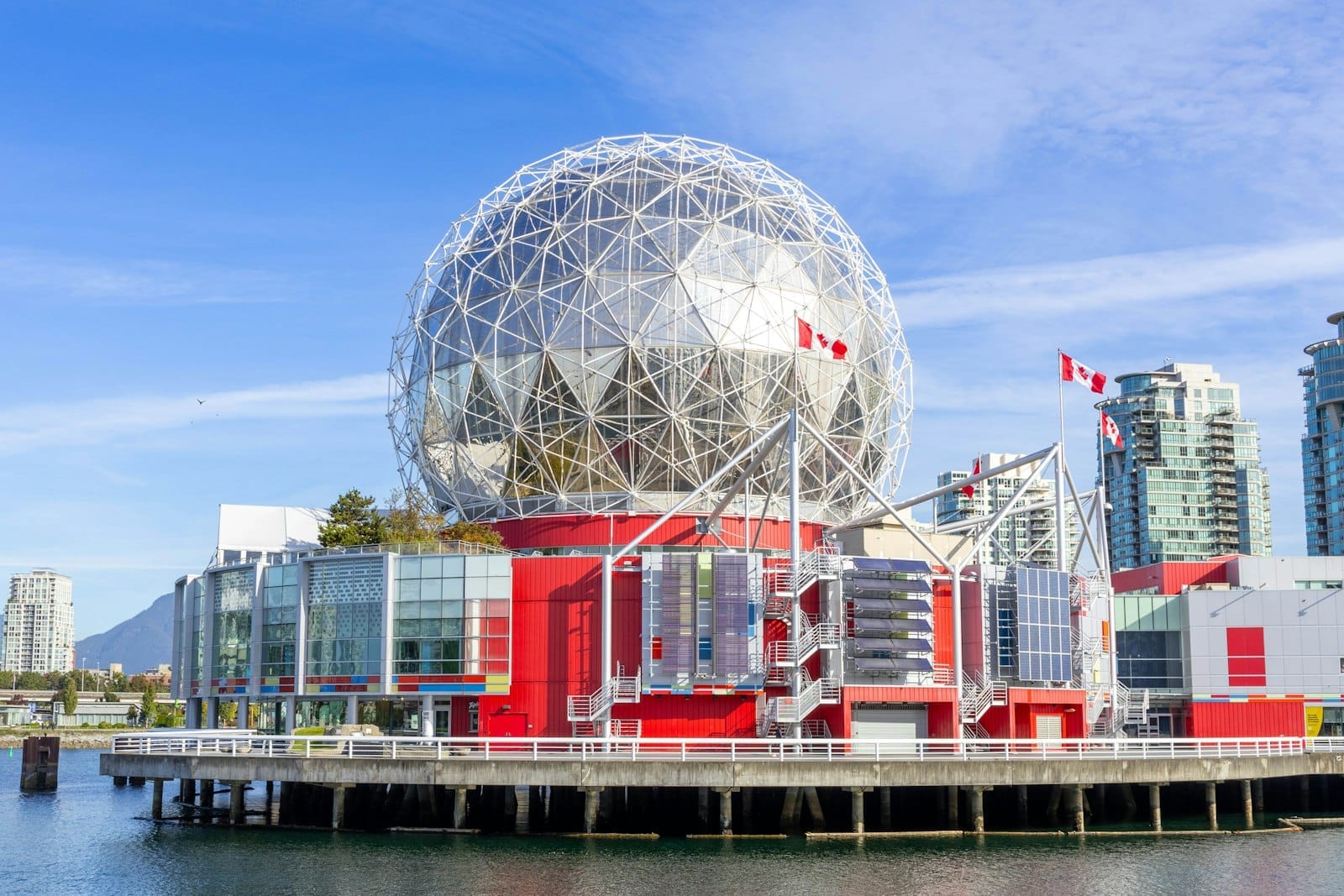
The building itself is the most recognizable structure in the exhibit. The geodesic dome, 47 metres high and clad in triangular panels that catch and scatter light depending on the weather and hour, was originally constructed as the Expo Centre for Expo 86. After the world's fair ended, the City of Vancouver handed the structure over, and the science centre opened formally on May 6, 1989. It has since become one of those rare buildings that most Vancouverites can identify from a distance but many have never entered.
💡 Local tip
Members get early entry at 9:30am on select days, typically 30 minutes before the public doors open at 10:00am. If you plan to visit more than once in a year, membership pricing is worth calculating against the per-visit gate rate.
The Building and the Approach
Arriving by SkyTrain on the Expo Line is genuinely the most convenient approach. The Main Street–Science World Station sits almost directly in front of the building, and the walk from the platform to the entrance takes under five minutes. As you come down from the elevated station, the dome appears in the near distance across the water's edge of False Creek, its steel lattice reflecting whatever the sky is doing: grey and muted on overcast mornings, sharp and almost metallic in afternoon sun, and lit at night in a way that makes it visible from across the creek.
The surrounding area places Science World at the boundary between Mount Pleasant and the Main Street corridor to the south and the False Creek waterfront to the north. Outside the main entrance, a small paved plaza faces the water. On warm days, this plaza gets lively with visitors eating lunch or waiting for the rest of their group. It is not a particularly large outdoor space, but the view across to Yaletown and the creek is a reasonable preview of Vancouver's relationship with its waterways.
The entrance lobby is where you will find ticketing, a gift shop focused on science-themed merchandise and educational toys, and the queue for the OMNIMAX Theatre. Collect a schedule of the day's live demonstrations at the front desk when you arrive, since these run at fixed times and are genuinely worth planning around.
Tickets & tours
Hand-picked options from our booking partner. Prices are indicative; availability and final rates are confirmed when you complete your booking.
Grouse Mountain and Capilano Suspension Bridge Park tour
From 252 €Instant confirmationFree cancellationVancouver Art Gallery Tickets
From 19 €Instant confirmationFree cancellationVancouver Stanley Park cycling tour
From 56 €Instant confirmationFree cancellationWhistler, Shannon Falls and Sky Gondola tour from Vancouver
From 135 €Instant confirmationFree cancellation
Inside: What the Exhibits Are Like
The permanent galleries are spread across multiple levels inside the dome, organized loosely around themes: matter, the natural world, technology, and the human body. In practice, the space does not feel rigidly divided, and visitors tend to circulate based on what catches their attention. The sound environment is consistently high, particularly in areas designed for younger children, where noise is essentially built into the experience. If you are sensitive to that, it is worth being aware before you arrive.
The exhibits that tend to generate the most engagement are the ones with immediate physical feedback: structures you build and test, surfaces that respond to movement, experiments where the result is unpredictable. Some sections are clearly calibrated toward children in the 5 to 12 age range, but a subset of the exhibits, particularly those dealing with light, sound, and perception, are interesting regardless of age. The live science demonstrations, which take place in a small theatre-style space within the building, tend to be the most consistently well-executed programming on offer.
ℹ️ Good to know
Pick up a printed schedule of live demonstrations at the front desk when you arrive. These shows run at fixed times and cover topics like chemical reactions, physics principles, and biological curiosities. They are free with admission and usually last 15 to 20 minutes.
The OMNIMAX Theatre occupies a significant portion of the dome's interior and shows films on a tilted, dome-format screen. Tickets for the OMNIMAX are separate from general admission, or bundled at a reduced rate. The films rotate on a schedule and tend to focus on natural history, space, and earth science topics. The format, with the screen wrapping overhead and to the sides, is more immersive than a standard cinema, though individual reactions to the dome-ceiling projection vary.
When to Visit and How Crowds Behave
Science World opens daily at 10:00am and generally closes between 5:00pm and 9:00pm depending on the day and season, with seasonal hour variations that should be confirmed on the official website before your visit. The building is at its busiest on weekend mornings and during school holidays, particularly from late December through early January and during spring break. On those days, the lobby queues and the most popular exhibit sections can feel genuinely congested. A Tuesday or Wednesday morning in the shoulder season is a materially different experience than a Saturday in July.
Vancouver's rainy season runs from October through March, and Science World benefits directly from this. On days when rain makes outdoor options like the Stanley Park Seawall or the area beaches impractical, indoor attractions absorb the overflow. If you are visiting in winter and flexibility allows, aim for a weekday opening-hour arrival to avoid the worst of the weather-driven crowds.
Mid-morning on a weekday is the most comfortable window: the building has opened, the first wave of school groups has settled into their programming, and the midday rush of general visitors has not yet arrived. By early afternoon, particularly on weekends, the noise levels and density in the main exhibit halls peak. If you are visiting with younger children who tire quickly, an opening-hour start lets you see the most interactive sections before fatigue sets in.
Practical Details Worth Knowing
Admission pricing as of the most recent published rates: Adults (19 and over) pay $37.50 CAD. Seniors (65 and over) and Youth (13 to 18) pay $30.50. Children aged 3 to 12 pay $25.50. Children 2 and under enter free. Indigenous Peoples enter free. Members enter free, with the early 9:30am access benefit. OMNIMAX tickets are priced separately and can be purchased at the box office or online.
⚠️ What to skip
Admission prices, seasonal hours, and OMNIMAX schedules are subject to change. Verify current details at scienceworld.ca before your visit, especially during holiday periods when hours may extend or programming may shift.
Getting there by SkyTrain is straightforward. The Expo Line stops at Main Street–Science World Station, which is served by trains running between Waterfront Station in downtown Vancouver and the eastern terminus in Coquitlam. From downtown Waterfront Station, the journey takes roughly eight to ten minutes. If you are coming from the airport on the Canada Line, transfer at Commercial–Broadway Station to the Expo Line and continue west to Main Street–Science World.
Parking is available in the area but limited, and street parking along Quebec Street and the surrounding blocks can be competitive on busy days. The SkyTrain option removes this friction entirely. For visitors combining Science World with a walk along the waterfront, the False Creek Ferries operates small passenger boats connecting the Science World dock with Granville Island and other False Creek stops, which makes for a more scenic approach or departure than the train.
The building has a cafeteria-style food service area inside. The food on offer is functional rather than notable, the kind of reliable fare that makes sense when visiting with children who need a meal mid-visit. There are also additional dining options within a short walk toward Main Street or along the False Creek waterfront path.
Photography and Sensory Notes
The dome exterior photographs well from across False Creek, particularly from the Yaletown waterfront side or from a False Creek Ferry in transit. The triangular panel geometry creates a strong geometric subject that works at most light levels. Inside, the lighting in exhibit areas is functional rather than atmospheric, and smartphone cameras handle it adequately. The OMNIMAX interior is dark during screenings and not a photography environment.
If you are combining Science World with other attractions in the area, the waterfront path connects eastward toward the Yaletown seawall and westward toward Granville Island via ferry. The combination of Science World in the morning and Granville Island in the afternoon makes for a full and manageable day, particularly with children.
Visitors who are sensitive to crowded, noisy environments should plan their visit with timing in mind. The building's acoustic design reflects its dome architecture, and sound carries differently than in a rectangular space. Early weekday mornings are genuinely quieter. The outdoor plaza provides a reset point if you need a few minutes away from the activity inside.
Who Should Think Twice
Science World is primarily designed and programmed for families and school groups. Adult visitors without children who are expecting a rigorous science museum with deep content, extensive academic context, or research-level programming are likely to find the experience lighter than anticipated. The exhibits prioritize engagement and discovery over detailed explanation, which is appropriate for the intended audience but may not satisfy someone looking for the depth of a natural history museum or a specialized science institution.
At $37.50 per adult, the admission cost is also on the higher end for Vancouver attractions. If budget is a significant constraint, the experience needs to be weighed against that price point, particularly for adult-only groups. Families with children in the 5 to 12 range tend to get the most obvious value from the visit.
Insider Tips
- Check the live demonstration schedule before you commit to a time slot. Some of the science shows run only two or three times per day, and the first showing often draws a smaller crowd than the midday one.
- The False Creek Ferries dock near the Science World entrance. Taking the ferry across to Granville Island instead of retracing your steps to the SkyTrain adds almost no cost and provides a genuinely different perspective of the False Creek basin.
- If you are visiting with a child who is likely to be overwhelmed by the main exhibit hall at peak times, start on the upper levels first. The density of visitors tends to be lower there, and you can work your way down to the busier ground-floor sections once the morning rush has thinned.
- Booking OMNIMAX tickets online in advance is worth doing on busy weekends. The theatre fills for popular films, and walk-up availability at the box office is not guaranteed during school holidays.
- The outdoor plaza facing False Creek is an underused lunch spot. If the weather holds, bringing food from one of the nearby Main Street cafes and eating outside before or after your visit is a reasonable alternative to the in-house cafeteria.
Who Is Science World For?
- Families with children aged 5 to 12 who want interactive, hands-on programming
- Visitors dealing with a rainy Vancouver day looking for a full half-day indoor option
- Travelers who want to combine a cultural attraction with a False Creek waterfront walk
- School-age groups and educational visits with structured programming needs
- Anyone who wants to see the interior of Vancouver's most distinctive architectural landmark
Nearby Attractions
Other things to see while in Mount Pleasant & Main Street:
- Bloedel Conservatory
Perched at the highest point in Vancouver inside Queen Elizabeth Park, the Bloedel Conservatory is a triodetic-domed greenhouse sheltering over 500 plant species and more than 100 free-flying exotic birds year-round. It rewards visitors with warmth, color, and birdsong regardless of what the weather is doing outside.
- Playland Amusement Park
Playland at the PNE is Vancouver's beloved seasonal amusement park, operating at Hastings Park in its current Playland form since the late 1950s. With dozens of rides ranging from toddler-friendly carousels to serious thrill machines, it draws families and ride enthusiasts from across the Lower Mainland every summer.
- Queen Elizabeth Park
Perched atop Little Mountain, the highest point in the City of Vancouver, Queen Elizabeth Park combines manicured gardens, open lawns, and former quarry pits transformed into stunning sunken gardens. Entry to the park is free, and the panoramic views of the downtown skyline backed by the North Shore mountains are among the most photographed in the city.