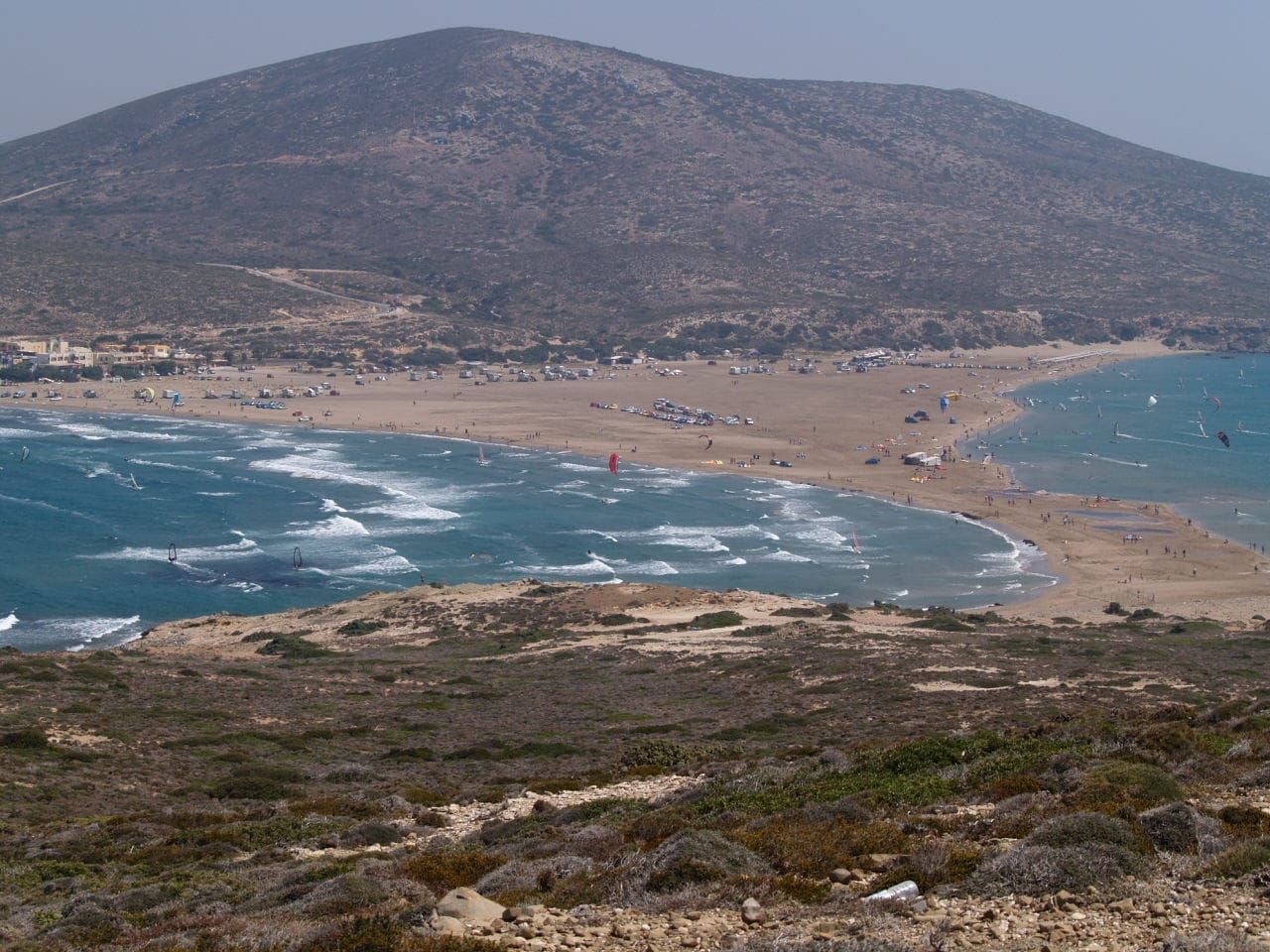
Prasonisi is Rhodes at its most elemental: a sandy tombolo at the island's southernmost point where the Aegean and Mediterranean meet, drawing windsurfers, kitesurfers, and anyone who wants to escape the package-holiday crowds. It shifts from peninsula to near-island depending on the season, and that seasonal transformation is part of what makes it unlike anywhere else on Rhodes.
Prasonisi is Rhodes stripped back to its essentials: a remote cape at the island's southern tip where two seas collide across a narrow strip of sand. One side churns with Aegean waves; the other stays calm enough for children to wade. The result is one of the Mediterranean's most unusual beach settings, and a destination that rewards the effort it takes to reach it.
Orientation
Prasonisi occupies the absolute southernmost point of Rhodes, at coordinates 35°52'57"N, 27°45'40"E. It is not a town or a resort strip in any conventional sense. Rather, it is a cape and a tombolo: a narrow sandy isthmus connecting the main island to a rocky headland. In summer, when water levels are lower, you can walk across that isthmus on dry sand. In winter and early spring, the isthmus often submerges, turning the cape into a genuine island.
The nearest settlement of any size is Kattavia village, a few kilometres north, which functions as the gateway to Prasonisi. From Kattavia, a winding road descends to the cape's small cluster of facilities: a handful of motels, a couple of tavernas, equipment rental outfits, and a small shop. That is essentially it. Rhodes Town lies roughly 92 kilometres to the north, a drive of around 90 minutes on roads that grow more rural the further south you travel. Lindos, the island's other major landmark, sits about 40 kilometres to the north along the east coast.
The geography is the defining fact of Prasonisi. The isthmus divides two bodies of water: the Aegean Sea to the east and the Mediterranean Sea to the west. These two seas have distinctly different characters at this point. The Aegean side faces northeast, catching the strong Meltemi winds that blow down from the Aegean basin in summer, generating consistent waves. The Mediterranean side, sheltered from those same winds, stays comparatively calm. This dual character is what drew the windsurfing and kitesurfing community here, and it is why Prasonisi appears on Rhodes windsurfing and kitesurfing guides as one of the island's premier locations for the sport.
Character & Atmosphere
Prasonisi does not do crowds in the same way that Faliraki or even Lindos does. The infrastructure simply would not support it. What it does do is a particular kind of elemental experience: wide open sky, constant wind, the sound of waves on one side and relative quiet on the other, and a lighthouse standing at the very tip of the headland as if marking the edge of something.
Arrive early in the morning and the cape has an almost severe quality. The light is flat and the wind is already building from the northeast, rippling the surface of the Aegean side into rows of white-capped chop. The beach is largely empty at this hour except for a few windsurfers rigging their equipment, the sound of Velcro and the clatter of booms carrying across the sand. The Mediterranean side is glassy and still by comparison, the water colour shifting from pale turquoise near the shore to deep blue beyond the shallows.
By midday in July and August, the scene changes dramatically. The wind peaks, the Aegean side fills with sails, and the Mediterranean shore gathers families, couples, and casual swimmers who have driven down specifically for its calm waters. The small cluster of facilities at the base of the tombolo gets busy, and the dirt car park fills with hire cars and campervans. This is as crowded as Prasonisi ever gets, and even then it feels open and unmanicured compared to the resort beaches further north.
Late afternoon is arguably the best time to be here. The light turns golden and raking across the sand from the west, the windsurfers thin out, and the headland itself comes into its own as a place to walk. The Prasonisi Lighthouse, sitting at the southern tip, is visible from the beach and makes a clear focal point. As the sun drops, the two seas take on different colours: the Aegean darker and more agitated, the Mediterranean softening toward orange. In the shoulder months of May, June, September, and October, this late-afternoon atmosphere extends across most of the day, with far fewer visitors and the wind often dropping enough for the cape to feel genuinely peaceful.
ℹ️ Good to know
Prasonisi's name translates from Greek as 'green island'. The headland itself is rocky and covered in low scrub vegetation, which takes on a noticeably greener appearance in spring before the summer dry heat sets in.
What to See & Do
Windsurfing and kitesurfing are the primary draws, and the setup here is genuinely good by any European standard. The Aegean side delivers consistent force-4 to force-6 winds during the Meltemi season (roughly June through September, peaking in July and August), with wave conditions that attract experienced riders. The Mediterranean side, with its flat water and steady breeze, functions as a learning ground, with several rental and lesson operations based at the beach. If you want context on where Prasonisi fits into the island's water sports picture, the Rhodes windsurfing and kitesurfing guide covers equipment hire, skill levels, and seasonal conditions in detail.
Swimming is very much dependent on which side of the isthmus you choose. The Mediterranean side is the obvious choice for families, non-surfers, and anyone who simply wants to swim in calm, clear water. The Aegean side, while not off-limits, should be treated with respect: the waves and wind create genuine rip currents near the tombolo, and the conditions that make it excellent for surfing make it actively hazardous for casual swimming.
Walking the headland is underrated. From the base of the tombolo, you can cross onto the cape when conditions allow (easier in summer) and walk out to the lighthouse at the southern tip. The path is rough and the vegetation is low scrub, but the views back along both coastlines are remarkable, and the sense of being at the very end of Rhodes is striking. The lighthouse itself is a working aid to navigation and not open to visitors, but the walk to reach it takes around 20 to 30 minutes and passes through genuinely wild landscape.
Windsurfing and kitesurfing on the Aegean side (intermediate to advanced conditions)
Beginner and learning sessions on the Mediterranean side (flat water, consistent breeze)
Swimming and snorkelling on the Mediterranean shore
Walking to the Prasonisi Lighthouse at the southern tip of the headland
Photography of the two-sea meeting point from the tombolo
Exploring Kattavia village and the surrounding agricultural landscape on the drive in
⚠️ What to skip
Do not attempt to swim on the Aegean side near the tombolo if there is any significant wind. The currents created by two converging sea systems can be powerful and unpredictable, and there is no lifeguard presence at Prasonisi.
Eating & Drinking
Expectations need to be calibrated accordingly: Prasonisi is not a food destination. The eating options consist of a small number of tavernas and snack bars clustered at the base of the cape, near the parking area. These places serve the practical needs of a beach crowd: grilled meats, Greek salads, fresh fish on occasion, sandwiches, coffee, and cold drinks. The quality is generally adequate and the atmosphere is informal.
Pricing at Prasonisi is not dramatically different from elsewhere on the island's more remote beaches. A sit-down lunch of a salad, some grilled fish, and drinks for two will typically cost somewhere between 25 and 45 euros depending on what you order. The tavernas here do not compete on sophistication; they compete on location and convenience.
Anyone who wants a proper meal before or after visiting Prasonisi would do well to stop in Kattavia village on the way. The village has its own small tavernas that serve straightforward Greek food in a setting that sees fewer tourists than the beach. Alternatively, if you are making Prasonisi part of a longer loop around the southern coast, Lindos to the north has a full range of dining options. The where to eat in Rhodes guide covers the island's food scene from the Old Town to the southern villages.
💡 Local tip
Bring your own supplies if you are planning a full day. A cooler with food and drinks is standard practice among those who know Prasonisi well, especially if you are spending the whole day on the water and do not want to break to find a table at the busiest midday period.
Getting There & Around
Prasonisi is 92 kilometres from Rhodes Town, and the most practical way to reach it is by hire car. The drive takes approximately 90 minutes from the city centre under normal traffic conditions, following the main road south through the island's interior toward Kattavia. The road south of Kattavia to the cape itself is narrower and winds through scrubby terrain, so drive carefully, particularly if you are not accustomed to Greek rural roads. Rental cars are available from Rhodes Town and from the airport.
Public bus service to Prasonisi is very limited. The KTEL bus network covers the island, but Prasonisi sits at the end of a long route and services are infrequent, particularly outside peak season. Check current schedules directly with KTEL before planning to rely on buses. For most visitors, a hire car makes the most sense, and the Rhodes car hire guide covers the practicalities of renting on the island, including what to watch for in the fine print.
Taxis from Rhodes Town to Prasonisi are available but expensive over a 90-kilometre distance; expect to negotiate a return fare if you want the driver to wait. Organised day trips occasionally include Prasonisi as part of a southern Rhodes circuit, though these are less common than tours focused on Lindos or the Old Town. If you are combining Prasonisi with a broader itinerary, the 7-day Rhodes itinerary suggests how to fit the southern cape into a full week on the island.
Once at Prasonisi, everything is walkable. The parking area, beach facilities, and the base of the tombolo are all within a few minutes of each other. Getting onto the headland itself requires walking across the sandy isthmus, which takes around 5 minutes when dry. For context on how Prasonisi compares to other southern Rhodes destinations, the Prasonisi Beach attraction page has specific details on conditions and access.
Where to Stay
Accommodation at Prasonisi is minimal by design. There are a small number of motel-style rooms and basic guesthouses in and around the cape, used almost entirely by windsurfers and kitesurfers who want to be on the water from dawn. These are functional places: clean, simple, with little in the way of amenities beyond a bed and a shower. If you are a dedicated water sports enthusiast and want to maximise time on the water, staying here makes sense. For everyone else, it is a long way from anywhere.
Most visitors to Prasonisi treat it as a day trip from a base further north. Lindos, about 40 kilometres away, has a wide range of accommodation from small family-run rooms to boutique hotels, and positions you well for exploring the eastern coast. Rhodes Town, 92 kilometres north, gives you access to the full breadth of the island. The where to stay in Rhodes guide breaks down all the main areas by traveller type, including families, couples, and budget travellers.
For those drawn to the southern part of the island more broadly, the area around Pefkos and Lardos offers a middle ground: relaxed, moderately developed, and within reasonable driving distance of Prasonisi without the full commitment of staying at the cape itself.
Practical Considerations
Prasonisi is remote by Rhodes standards, and that remoteness has practical implications. Mobile signal can be patchy at the cape itself. There is no pharmacy, no bank, and no petrol station between Kattavia and the beach. Fill up the car before heading south from any of the larger villages along the route.
The best months to visit are May, June, September, and October if you want calm conditions and fewer people. July and August bring peak Meltemi winds, which is ideal if you are a windsurfer but can make a beach day unpleasant for everyone else: the wind blows sand, the waves are rough, and the Mediterranean side, while calmer, is not immune to the general sense of being battered. In winter, the tombolo often floods, the facilities close, and the road becomes less hospitable. Visiting between November and March is possible but offers little reward.
Prasonisi sits within the broader context of southern Rhodes, which contains several other worthwhile stops. Tsambika Beach to the north is one of the island's finest stretches of sand and makes a strong pairing on a longer southern loop. The best beaches in Rhodes guide puts Prasonisi in context alongside the island's other coastal highlights, which helps in planning a route that makes the most of the drive.
TL;DR
Prasonisi is at the southern tip of Rhodes, 92 km from Rhodes Town: plan for a 90-minute drive each way and treat it as a dedicated day trip or a water sports base.
The cape divides two seas: the Aegean side delivers strong winds and waves for experienced windsurfers, while the Mediterranean side offers calm, clear water for swimming and beginners.
Infrastructure is minimal: a few tavernas, basic rooms, and equipment hire operations. Bring supplies if you plan a full day.
July and August are peak windsurfing season, but the Meltemi winds make it rough for casual beach days. May, June, September, and October give the best balance of conditions and crowd levels.
A hire car is essentially essential. Public bus service is infrequent, and there is no practical alternative for most visitors.
Anthony Quinn Bay is one of the most photographed coves on the Greek island of Rhodes, but most visitors know only half the story. Here is the full history of how a Hollywood film, a failed land deal, and emerald-clear water turned a small pebble cove into one of Greece's most recognisable spots.
Rhodes has over 220 km of coastline stretching from rocky northern coves to sweeping southern sandbanks. This guide covers the best beaches in Rhodes, from the iconic bay below the Acropolis of Lindos to the wild windsurfing isthmus at Prasonisi.
Rhodes rewards visitors year-round, but timing your trip correctly means the difference between a peaceful escape and a sweaty queue. This guide breaks down every season honestly, with temperature ranges, crowd levels, pricing patterns, and clear recommendations for different travel styles.
One of the Seven Wonders of the Ancient World, the Colossus of Rhodes was a 33-metre bronze statue that stood near Mandraki Harbour around 280 BCE. Nothing physical survives, but the story, the site, and the surrounding attractions make this one of Rhodes' most fascinating stops. Here is everything you need to know.
Rhodes is an excellent base for exploring the wider Dodecanese and the island's own interior. From the spectacularly beautiful island of Symi to the ancient Acropolis of Lindos and the lush Valley of the Butterflies, these are the day trips that reward the effort of leaving your sunbed.
Rhodes is a large island covering over 1,400 km², and getting around it requires some planning. This guide covers every transport option available, from public buses and taxis to car hire and scooters, with real fares, route logistics, and honest advice on what actually works.
Rhodes is one of Greece's most complete travel destinations, combining a UNESCO-listed medieval city, diverse beaches, and layers of ancient history. But peak-season crowds and tourist-trap pricing are real concerns. Here's everything you need to know before booking.
For over two centuries, the Knights of Rhodes — formally the Order of the Knights of St. John — transformed a Greek island into the most formidable Christian stronghold in the eastern Mediterranean. This guide covers their origins, military achievements, the fall of the city, and exactly what survives today for you to explore.
Rhodes delivers genuine luxury across the full spectrum: UNESCO-listed medieval hotels, clifftop adults-only resorts, Michelin-quality dining, and private boat charters to deserted coves. This guide covers where to stay, eat, and spend your money wisely on the Greek island that consistently punches above its weight.
Everything you need to know about arriving at Rhodes International Airport 'Diagoras' (RHO). From bus routes and taxi fares to pre-booked private transfers, this guide covers all your options for reaching Rhodes Town and the rest of the island quickly and without stress.
Rhodes sits at the perfect crossroads of the Aegean for exploring by sea. This guide covers the best boat trips available, from full-day Symi cruises and Lindos sea excursions to catamaran sailings and snorkelling stops at stunning coastal bays.
Renting a car in Rhodes unlocks the island's best beaches, hilltop villages, and ancient ruins that buses simply can't reach. This guide covers licensing requirements, realistic pricing, parking rules, seasonal booking strategy, and what to watch out for on local roads.
Rhodes rewards those on a budget with an extraordinary range of free experiences. From wandering ancient and medieval streets to swimming in turquoise bays, here are 20 genuinely free ways to get the most from the island.
Rhodes rewards those who look past the headline sites. From a frescoed Byzantine monastery in the pine-covered interior to a crowd-free medieval castle with sea views, these are the places that show you a different side of the island.
Rhodes rewards couples with an exceptional mix of dramatic scenery, ancient history, and unhurried beaches. Whether you are planning a honeymoon, anniversary, or simply a getaway together, this guide covers the most romantic experiences the island offers.
October is one of the smartest months to visit Rhodes, Greece. The summer heat breaks, the crowds thin out dramatically, and the sea stays warm enough for swimming well into the month. This guide covers weather, prices, what's open, and how to make the most of the island in autumn.
Rhodes in summer is spectacular and intense in equal measure. This guide covers everything from scorching July temperatures and peak-season crowds to the quieter southern beaches and the best strategies for enjoying Greece's largest Dodecanese island without the misery.
Three days in Rhodes is enough to cover the medieval Old Town, the Acropolis of Lindos, ancient Kamiros, and a handful of excellent beaches — if you plan it right. This itinerary sequences the island's highlights by geography, not just popularity, so you spend less time driving and more time exploring.
A week in Rhodes is enough to cover its UNESCO medieval core, the clifftop drama of Lindos, a ferry to Symi, and some of the Aegean's best beaches without ever feeling rushed. This day-by-day itinerary is built around realistic travel times, crowd patterns, and practical logistics so you can spend less time planning and more time actually enjoying the island.
Rhodes Medieval Old Town is one of Europe's most intact medieval cities, a UNESCO World Heritage Site enclosed by 4 km of walls and layered with 700 years of history. This guide covers everything from the Palace of the Grand Masters to the Ottoman quarter, with practical entry info, crowd patterns, and honest recommendations.
Rhodes after dark covers a wider range than most visitors expect. Whether you want high-energy clubs on Orfanidou Street, open-air beach parties near Kallithea, or a quiet glass of wine inside the medieval walls, this guide covers every scene with practical details on venues, timing, and what to avoid.
Rhodes Old Town is one of Europe's most intact medieval cities and a UNESCO World Heritage site. This self-guided walking tour covers the essential route, every major landmark, honest crowd warnings, and practical details so you can explore at your own pace without wasting a step.
Rhodes is one of Greece's most rewarding destinations, and it doesn't have to drain your wallet. This guide breaks down realistic daily budgets, the best free and low-cost attractions, smart transport choices, and the seasonal timing that cuts costs by nearly half.
Rhodes is one of the most photogenic islands in the Mediterranean, stacking medieval architecture, turquoise bays, and ancient ruins into a remarkably compact space. This guide covers the 20 best photography locations on the island, from iconic landmarks to lesser-known viewpoints.
Choosing between Greek islands is harder than it looks. This guide breaks down how Rhodes compares to Santorini, Crete, Kos, and Mykonos across beaches, history, cost, and crowd levels — so you can book with confidence.
Rhodes is one of Greece's top destinations for windsurfing and kitesurfing, driven by reliable Meltemi winds and a string of well-organized schools on the northwest coast. This guide covers every spot, lesson price, seasonal window, and insider tip you need to plan your trip.
Rhodes punches well above its weight for family travel. Whether your kids are after slides and splash pools, wildlife encounters, or exploring real medieval castles, the island delivers. This guide covers the best family-friendly activities across beaches, nature, history, and pure entertainment.
Rhodes is one of Greece's most layered destinations, where a UNESCO-listed medieval city sits minutes from clear Aegean water. This guide covers the best things to do in Rhodes across history, beaches, food, and day trips, with honest takes on what's worth your time and what isn't.
Rhodes has a distinct culinary identity rooted in chickpeas, wild greens, handmade pasta, and cumin-heavy stews. This guide covers the essential local dishes, seasonal specialities, what to drink, and where to find the food worth seeking out.
Rhodes has one of the strongest food cultures in Greece, built on fresh Aegean seafood, sun-ripened local produce, and centuries of Mediterranean culinary tradition. This guide covers where to eat across the island, from the medieval alleyways of the Old Town to the clifftop village of Lindos, with honest assessments, realistic prices, and practical booking advice.
Choosing where to stay in Rhodes shapes your entire trip. This guide breaks down every major area honestly, from UNESCO-listed Old Town to family-friendly Pefkos, with specific hotel recommendations and seasonal tips to help you book with confidence.