Tsambika Beach: Rhodes' Golden Arc and Its Monastery Above
Tsambika Beach stretches nearly a kilometre along Rhodes' east coast, offering fine golden sand, shallow turquoise water, and full beach facilities. Above it, a 240-metre hilltop monastery adds a layer of cultural weight that most Aegean beaches simply don't have.
Quick Facts
- Location
- East coast of Rhodes, ~25–30 km south of Rhodes Town, between Kolymbia and Archangelos
- Getting There
- By car via National Road 95 (free parking on site); KTEL bus routes also serve the area
- Time Needed
- 2–4 hours for the beach; add 1 hour if you climb to the monastery
- Cost
- Free beach access; sunbed and umbrella hire charged separately
- Best for
- Families, photographers, couples, pilgrimage visitors
What Makes Tsambika Beach Stand Out
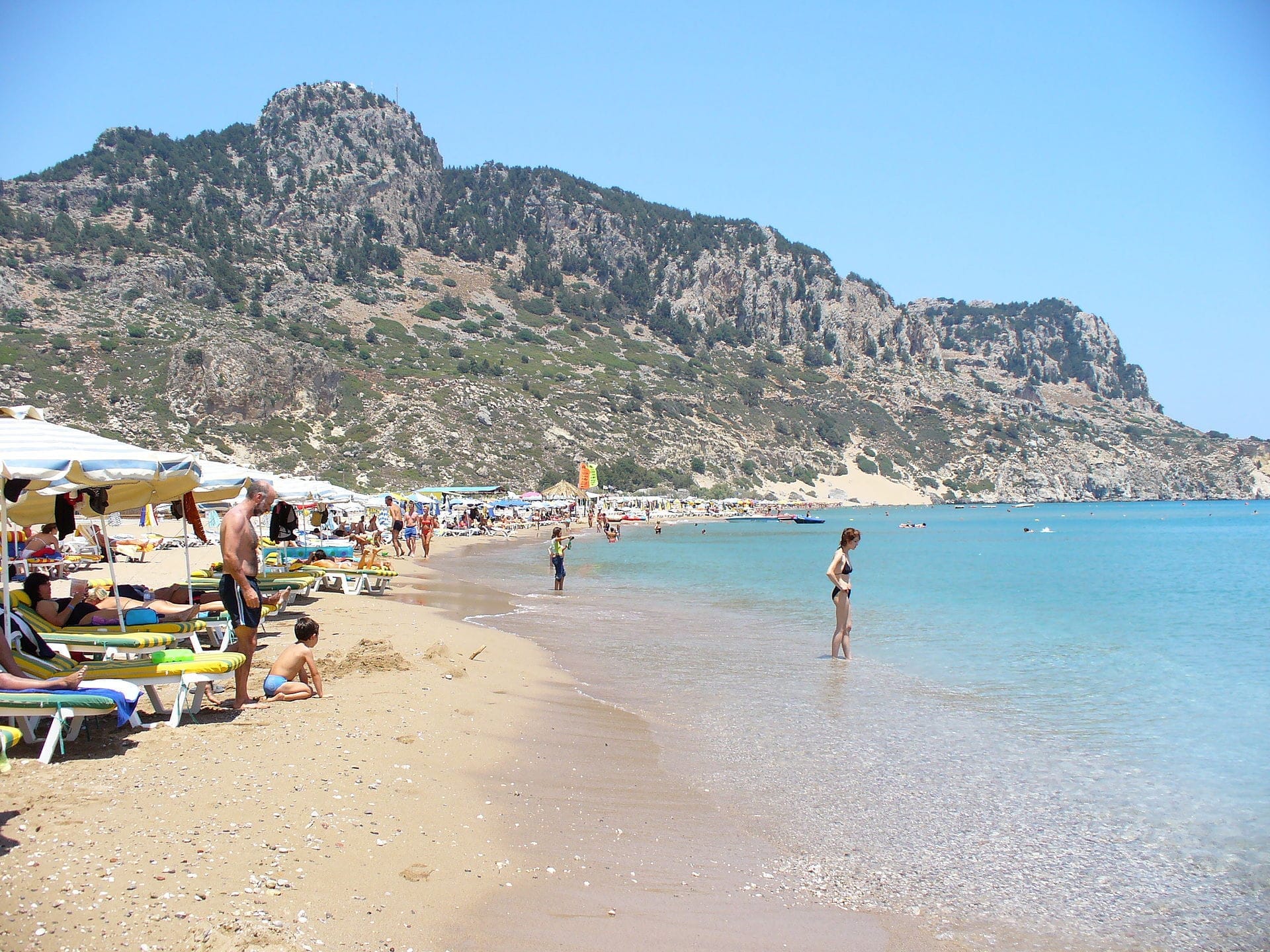
Tsambika Beach sits on a wide, gently curving bay on Rhodes' east coast, roughly 25 kilometres south of the capital. The sand is the kind that travel photographers specifically come to find: pale gold, fine-grained, and mostly free of the coarse grit or pebbles that frustrate visitors at lesser-known coves. The bay runs somewhere between 800 metres and 1.5 kilometres depending on the tide, giving it enough space that even in August it rarely feels oppressively packed at the northern end.
The water here earns its reputation. The seabed slopes so gently that children and nervous swimmers can wade out 20 or 30 metres in water no deeper than their chest. The colour transitions in layers, from pale turquoise at the shallows to a deeper blue-green toward the centre of the bay, which makes it genuinely photogenic from above.
💡 Local tip
Arrive before 9:30 am in July or August if you want to claim a sunbed in a good position. By mid-morning the prime spots fill quickly and late arrivals often end up near the water sports area.
The Monastery on the Hill: Why It Changes the Experience
What separates Tsambika from a dozen other fine beaches on Rhodes is what sits directly above it. The Tsambika Monastery, dedicated to the Virgin Mary, crowns a 240-metre rocky summit that rises almost vertically from the coastal road. The climb is accessible via a stepped path, but it is steep, exposed to the sun, and should not be taken lightly in the midday heat of summer. Wear shoes, not sandals, and carry water.
The monastery is considered the most important pilgrimage site on Rhodes. For centuries, women seeking to conceive have made the climb as an act of devotion, and children born following such pilgrimages are traditionally given the name Tsambikos (for boys) or Tsambika (for girls). You will still see this name throughout Rhodes, which gives you a sense of how deeply the tradition runs.
The views from the summit are the best argument for the effort. The beach below looks almost impossibly blue from that height, the bay curving cleanly against the forested hills. On clear days, which is most days from May through October, you can see across to the Turkish coastline. If the monastery itself is open when you arrive, the interior is modest but atmospheric, with the expected icons and votive offerings.
The monastery climb pairs naturally with a visit to Tsambika Monastery, though many visitors choose to simply admire it from the beach below and save the energy for swimming.
Tickets & tours
Hand-picked options from our booking partner. Prices are indicative; availability and final rates are confirmed when you complete your booking.
Sunset catamaran cruise with dinner in Rhodes
From 70 €Instant confirmationFree cancellation3-Hour All Inclusive Sun and Sea Swimming Cruise in Rhodes
From 55 €Instant confirmationFree cancellationRhodes Sunset Cruise with Greek BBQ and Unlimited Drinks
From 65 €Instant confirmationFree cancellationPalace of the Grand Master Ticket and Audio Tour by App
From 30 €Instant confirmation
How the Beach Changes Through the Day
Early morning at Tsambika, before the beach operators arrive to set out the sunbeds, is a genuinely different experience. The light from the east catches the water at a low angle, the sea is glassy calm, and the only sounds are distant waves and the occasional engine from a fishing boat passing the headland. This is the hour for serious photographers or anyone who wants to swim in peace.
From around 10 am through to 5 pm in peak season, the organised section fills with sunbeds, parasols, and a moderate volume of noise from the water sports area. Speed boats pull water-skiers; a jet ski or two circles the bay. Families cluster toward the central section where the facilities are closest. It is cheerful rather than chaotic, but it is not a secluded experience during these hours.
Late afternoon, roughly from 5 pm onward, the light softens, the water sports wind down, and the families with young children begin to leave. The beach takes on a quieter character. The southern end of the bay, which is less organised and unofficially accommodates naturist sunbathing, tends to empty last.
ℹ️ Good to know
The southern end of Tsambika Beach is quieter, less organised, and used informally by some naturist visitors. It involves a short walk from the main beach access point.
Facilities and What to Expect
The beach is well-equipped for a full day. Sunbeds and umbrellas are available for hire across the organised section. Shower and bathroom facilities are on site. There are restaurants and bars within easy reach of the sand, along with a mini-market for basics. Water sports rentals operate from a dedicated area and typically include options such as pedalos, kayaks, and motorised equipment.
Parking is free and large enough to absorb reasonable volumes of visitors, though it fills up on peak summer weekends. The access road from National Road 95 is straightforward and clearly signed. KTEL buses connect Rhodes Town to Kolymbia and Archangelos, and Tsambika is served along this east coast route, though a car gives you much more flexibility for timing.
If you are planning a longer east coast day that includes Tsambika, consider combining it with a visit to Seven Springs inland, or continuing south to Lindos for the afternoon.
Photography: Getting the Shot Right
The most compelling image of Tsambika is the aerial-style view from the monastery hilltop, looking down at the arc of gold and blue below. You do not need a drone to get it: the monastery path offers several natural vantage points at different heights, and the summit itself frames the whole bay cleanly. Morning light from the east is ideal for this shot, illuminating the sand directly and picking up the colour gradations in the water.
At beach level, the best light for water photography is mid-morning before the beach fills. The sun angle produces the vivid turquoise that makes Aegean beaches recognisable, without the flat, washed-out quality that arrives at midday. A polarising filter helps cut the surface glare if you are shooting with a camera rather than a phone.
💡 Local tip
For the classic overhead view of Tsambika's bay, climb the monastery path at least partway, even if you do not go to the summit. The view opens up significantly after the first 10 minutes of walking.
Honest Assessment: Who Will Love It and Who Might Not
Tsambika is one of the best beaches on Rhodes in terms of sand and water quality, and it delivers reliably on that promise. Families with children will find it close to ideal: shallow, safe, fully equipped, with enough activities to keep older kids occupied. Couples who visit outside July and August will find it has a genuinely beautiful setting without overwhelming crowds.
If you are comparing beaches on the island, Tsambika stands alongside Lindos Beach as one of the east coast's best. Both have exceptional water quality; Tsambika tends to be less crowded and has the added dimension of the monastery.
That said, visitors seeking solitude or an undeveloped coastal experience will find peak season at Tsambika disappointing. The organised beach section is commercial in the way that most well-known Greek beaches are: sunbed rentals are not optional if you want shade in the prime area, and the water sports noise is a constant backdrop from late morning. It is popular enough that calling it undiscovered would be misleading.
Anyone with mobility difficulties should note that the monastery climb is not accessible in any practical sense. The beach itself, at ground level, is reachable from the car park without significant obstacles, but the full Tsambika experience involving the hilltop view is physically demanding.
For more context on planning around Rhodes' beaches, the best beaches in Rhodes guide covers the full island with honest comparisons.
Insider Tips
- The far northern end of the beach, past the main sunbed area, tends to hold a pocket of calmer water because of the headland. It is a good spot for snorkelling if you bring your own mask.
- If you are driving, stop at the roadside viewpoint on the approach road before turning into the car park. It gives you a clean view across the bay that you cannot get once you are down at sand level.
- The monastery path is best attempted in the cooler part of the morning, before 10 am. After that, the exposed rock radiates significant heat and there is no shade on the upper sections of the climb.
- Beach restaurants at Tsambika tend to be priced for tourists and the quality is average. Pack your own lunch or eat before you arrive if value is a priority.
- Late September is arguably the best time to visit: the water has had all summer to warm up, the crowds have thinned considerably, and the light has a lower, golden quality that makes the beach look its best.
Who Is Tsambika Beach For?
- Families with young children who need calm, shallow water and full beach facilities
- Photographers looking for the combination of golden sand, turquoise water, and an elevated viewpoint
- Travellers on a Rhodes east coast day trip combining beach, monastery, and nearby villages
- Pilgrimage visitors with a connection to the Tsambika Monastery tradition
- Couples visiting in shoulder season, when the beach is quieter and the setting genuinely impressive
Nearby Attractions
Combine your visit with:
- Asklipio Castle
Built in 1479 by the Knights Hospitaller on the edge of a limestone ridge above a quiet village, the Castle of Asklipio is one of Rhodes's least-visited medieval fortresses. Free to enter, open at all hours, and commanding views across the southern coastline, it rewards travellers willing to venture beyond Lindos.
- Kritinia Castle
Perched on a rocky hilltop 131 metres above the western coastline of Rhodes, Kritinia Castle is a medieval fortress built by the Knights of Saint John in 1472. The ruins are freely accessible, the views stretch across the Aegean toward Turkey, and the surrounding silence makes it one of the island's more atmospheric stops for history-minded travellers.
- Monastery of Fountoukli
The Monastery of Fountoukli, officially known as Agios Nikolaos Fountoukli, is a 14th-century Byzantine church tucked into the forested hills of the island's interior. With original frescoes, a distinctive four-conch architectural plan, and almost no crowds, it rewards travelers willing to venture beyond the coastline.
- Profitis Ilias
At 798 metres, Profitis Ilias is the third-highest peak on Rhodes, draped in dense pine and cypress forest. It offers a striking contrast to the island's coastal attractions: cool shade, Italian-era architecture, quiet hiking trails, and a hilltop chapel with wide views across the Aegean.