Lindos Beach (Megali Paralia): The Complete Visitor's Guide
Lindos Beach, officially known as Megali Paralia, stretches along a sheltered bay beneath the towering Acropolis of Lindos on Rhodes' southeast coast. With clear, shallow water and organised facilities from May to October, it draws families, couples, and day-trippers seeking one of the Aegean's most dramatically framed swimming spots. Here is everything you need to plan your visit honestly and well.
Quick Facts
- Location
- Lindos, Rhodes 851 07, Greece (short walk from Lindos village centre)
- Getting There
- Bus from Rhodes Town (~1 hour); taxi or rental car from Rhodes Airport (~50 km, approx. 1 hour)
- Time Needed
- 2–4 hours for the beach alone; pair with the Acropolis for a full day
- Cost
- Free entry; sunbed and umbrella rental approximately €10–15 per set or higher (prices vary, seasonal May–Oct)
- Best for
- Families, couples, history enthusiasts, photographers, cruise day-trippers
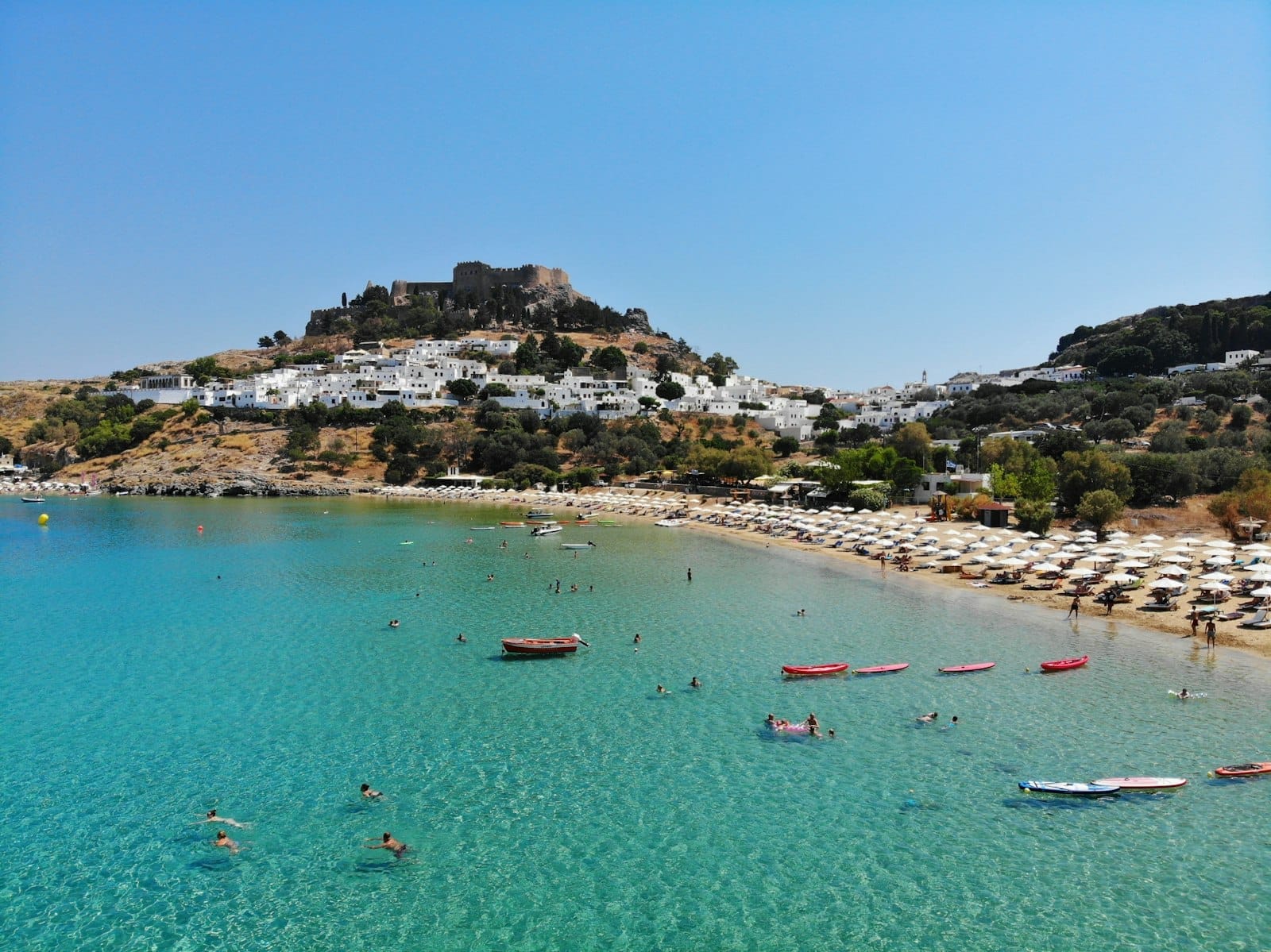
What Lindos Beach Actually Looks Like
Lindos Beach, known in Greek as Megali Paralia (Μεγάλη Παραλία, literally 'big beach'), is a wide arc of pale sand curving around a sheltered natural harbour on the southeast coast of Rhodes. The water is shallow and exceptionally clear, shifting from pale turquoise at the shoreline to a deeper blue toward the centre of the bay. On a calm summer morning, you can see the sand clearly at waist depth.
What separates this beach from the dozens of other sandy bays on Rhodes is the view directly above it. The limestone promontory rising steeply from the southern end of the bay is capped by the Acropolis of Lindos, its ancient columns and medieval walls visible from the waterline. That combination of ancient monument, whitewashed village rooftops, and sea is the defining image of Lindos, and the beach is where you experience it at its most immediate.
The beach is organised across its main stretch with rows of sun loungers and parasols available for hire. A strip of beach bars and snack kiosks operates from roughly May through October. At the southern end, a rocky outcrop separates Megali Paralia from the smaller Pallas Beach, which can be reached on foot with care. The path involves uneven rock surfaces, so those with limited mobility should stay on the main beach, which is considerably more accessible.
💡 Local tip
Arrive before 9:30 AM in July and August if you want a sunbed without waiting. By 10:30 AM the organised section is typically fully occupied, and rows of umbrellas extend almost to the waterline.
How the Beach Changes Throughout the Day
Early morning is when Lindos Beach is at its quietest and most striking. Between 7:00 and 9:00 AM, the light catches the acropolis columns from the east, the water is glassy, and the village above is still largely silent. A handful of locals and early-rising guests from nearby accommodation walk the shoreline. The sand is cool underfoot and the air smells of salt and nothing else.
By mid-morning the beach fills steadily. Cruise ship passengers arrive in significant numbers between 10:00 AM and 2:00 PM, particularly from late June through September. During peak season this is one of the genuinely crowded beaches on Rhodes, with very little unclaimed sand near the water's edge by noon. The sounds shift from wind and low conversation to music from beach bars, children calling out, and the low hum of water sports equipment.
Late afternoon, from around 4:30 PM onward, the cruise groups typically depart and the beach begins to thin out. The sun moves behind the acropolis promontory for the southern end, casting a long shadow across the sand, which actually makes the water look a deeper shade of blue. This is arguably the most enjoyable window for swimming, when the temperature is still warm but the crowds have thinned considerably.
⚠️ What to skip
If you are visiting Rhodes on a cruise with a short port window, be aware that Lindos Beach at midday in summer is extremely busy. Consider arriving first thing or visiting later in the afternoon if your schedule allows flexibility.
Tickets & tours
Hand-picked options from our booking partner. Prices are indicative; availability and final rates are confirmed when you complete your booking.
Lindos Self-Guided Audiovisual Tour with 3D Models
From 9 €Instant confirmationFree cancellationKiotari, Lardos, Lindos High-Speed Boat Trip to Rhodes Town
From 70 €Instant confirmationFree cancellationLindos 3 caves sailboat tour with lunch and drinks
From 110 €Instant confirmationFree cancellationTwo-hour Submarine tour of Lindos and Swim at Navarone's bay
From 0 €Instant confirmationFree cancellation
Historical Context: A Beach Used for Over Three Thousand Years
The harbour at Lindos has been in use since ancient times, with significant settlement by the Dorian Greeks. The Dorian Greeks who settled Lindos recognised the natural bay as one of the finest sheltered anchorages on the eastern Aegean coast, and the settlement that grew on the promontory above became one of the three great ancient city-states of Rhodes, alongside Ialyssos and Kamiros.
The Acropolis of Lindos, whose columns you see from the beach, dates largely to the 4th century BC, though the site was sacred and occupied much earlier. The Temple of Athena Lindia at its summit was a place of significant regional worship, and the harbour below was the economic and strategic engine that made Lindos prosperous. Looking up from the waterline, you are looking at essentially the same skyline sailors would have seen returning to port two and a half millennia ago.
The Knights of St John, who controlled Rhodes from 1309 to 1522, added fortification walls to the acropolis, which is why the silhouette above the beach includes both classical columns and medieval battlements. This layering of eras is part of what makes the setting genuinely unusual rather than merely photogenic.
Practical Walkthrough: Getting There and Getting Set Up
The most straightforward way to reach Lindos Beach from Rhodes Town is by bus. The KTEL bus service runs regular departures from the East Side Bus Station in Rhodes city to Lindos, with the journey taking approximately one hour. The bus drops passengers in Lindos village, from where the beach is a short downhill walk of around five to ten minutes. For full transport options across the island, including car hire considerations, see this guide to getting around Rhodes.
If you are driving, note that private vehicles cannot enter Lindos village itself. Paid parking is available at the entrance to the village, and from there you walk or take one of the donkey rides (a well-established tourist tradition here) down toward the beach area. The walk is manageable but involves cobbled lanes on a slope, so flat, closed-toe shoes are advisable if you plan to combine the beach with a visit to the acropolis.
Sunbeds and umbrellas are available for hire directly on the beach, with prices running approximately €10–15 per set as of recent seasons. This is worth budgeting for in peak summer, as the sun in Lindos is intense and shade is otherwise limited. Several beach bars serve drinks, light food, and ice cream from mid-May through October. Outside these months the beach itself remains accessible but all facilities are closed.
ℹ️ Good to know
Bring reef-safe sunscreen, a reusable water bottle, and water shoes if you plan to explore the rocky section toward Pallas Beach. The main beach has no sharp rocks underfoot, but the connecting path between the two bays is rough limestone.
Photography at Lindos Beach
The best photograph from Lindos Beach is the one most visitors attempt: the acropolis framed above the village rooftops, reflected in still morning water. The light for this is best in the first two hours after sunrise, when the sun is low and to the east. By midday the acropolis is front-lit but the contrast is harsh and the beach foreground is often cluttered with umbrellas. For a full photography perspective on Lindos and the wider island, the Rhodes photography guide covers timing and positioning in detail.
An often-missed angle is from the water itself, looking back toward the village. Even a basic camera or phone held at water level captures the dramatic contrast between the white cubic houses climbing the hillside and the clarity of the sea in the foreground. The southern end of the beach, near the rocky outcrop, provides a slightly elevated vantage point looking north across the full bay.
Honest Assessment: Is Lindos Beach Worth It?
Lindos Beach is worth visiting, but the reason to come here is the setting, not the beach itself. As a swimming beach it is good rather than exceptional: the water is clean and calm, the sand is fine, and the bay is well-sheltered. But Rhodes has other beaches with softer sand, fewer crowds, and more space. What Lindos has that nowhere else on the island can offer is that acropolis rising directly above you. If that context matters to you, this beach justifies the journey from Rhodes Town without question. If you are simply looking for the best swimming beach on the island, the best beaches guide for Rhodes will point you toward alternatives with fewer crowds.
Those who may want to skip Lindos Beach: travellers who strongly dislike crowds in high season, anyone expecting a remote or undiscovered experience, and visitors primarily interested in watersports (facilities here are present but limited compared to the west coast resorts near Ixia). The beach is also not ideal for those with significant mobility difficulties, as the approach through Lindos village involves uneven cobbled ground.
If you are building a day around Lindos, combine the beach with a morning visit to the acropolis before the heat peaks, then descend to the water for the early afternoon. The village itself has several good tavernas for lunch. For a structured approach to spending time here as part of a wider Rhodes trip, the 3-day Rhodes itinerary dedicates a full day to Lindos and covers how to sequence it efficiently.
Insider Tips
- The beach has a narrow strip of free, unorganised sand at the far northern end, away from the sunbed rows. If you bring your own towel and arrive before 10:00 AM, you can claim a spot here without paying for a sunbed.
- In September and early October, Lindos Beach is significantly quieter than August, the water temperature is still warm (around 24–25°C), and the light is softer and more photogenic. This is the best overall window to visit.
- The boat trip from Rhodes Harbour to Lindos is an underused alternative to the bus. It avoids the village parking chaos entirely and gives you an approach to the bay by sea, which shows the acropolis from the angle ancient traders would have seen it.
- Bring snorkelling gear. The waters off the rocky southern end near Pallas Beach have interesting underwater rock formations and occasional fish. The main sandy section is mostly clear and shallow but less interesting below the surface.
- If you are staying in the village overnight rather than day-tripping, visit the beach at dusk after most visitors have left. The acropolis is lit from below after dark and the empty beach in the fading light is a very different, far more peaceful experience.
Who Is Lindos Beach For?
- Families with young children: the shallow, sheltered water and organised facilities make it genuinely easy to manage a beach day here
- Couples combining history and relaxation in a single day without needing to plan two separate stops
- Photographers who want the classic Aegean backdrop of whitewashed village above blue water, especially in morning light
- Cruise passengers with limited time who want one strong, memorable image of Greece packed into a half-day
- Travellers doing a full Lindos day who want to balance a cultural site visit with time in the water
Nearby Attractions
Other things to see while in Lindos:
- Acropolis of Lindos
Perched 116 metres above the Aegean on a sheer limestone cliff, the Acropolis of Lindos layers Dorian, Hellenistic, Byzantine, and medieval history into one dramatic site. This guide covers the full experience: the climb, the ruins, the views, and the practical details that make the difference between a frustrating visit and an unforgettable one.
- Saint Paul's Bay
Saint Paul's Bay, known in Greek as Agios Pavlos, is a near-circular sheltered cove at the foot of the Lindos Acropolis. Its pale turquoise water, clifftop chapel, and striking natural framing make it one of the most recognizable spots on Rhodes, though the experience varies considerably depending on when you arrive.