Acropolis of Lindos: What to Expect Before You Climb
Perched 116 metres above the Aegean on a sheer limestone cliff, the Acropolis of Lindos layers Dorian, Hellenistic, Byzantine, and medieval history into one dramatic site. This guide covers the full experience: the climb, the ruins, the views, and the practical details that make the difference between a frustrating visit and an unforgettable one.
Quick Facts
- Location
- Lindos village, Rhodes Island, Greece (southeast coast, approx. 56 km from Rhodes Town)
- Getting There
- KTEL bus from Rhodes Town to Lindos (approx. 1.5 hrs); taxi or rental car also common. The acropolis is a steep 15-25 min walk or donkey ride from the village centre.
- Time Needed
- 2.5 to 4 hours including the climb, the site, and a descent through the village
- Cost
- €12 per adult (as of 2024). Reductions may apply for EU students and seniors — confirm on-site.
- Best for
- History lovers, photographers, architecture enthusiasts, and anyone chasing a view that earns its difficulty
What Is the Acropolis of Lindos?
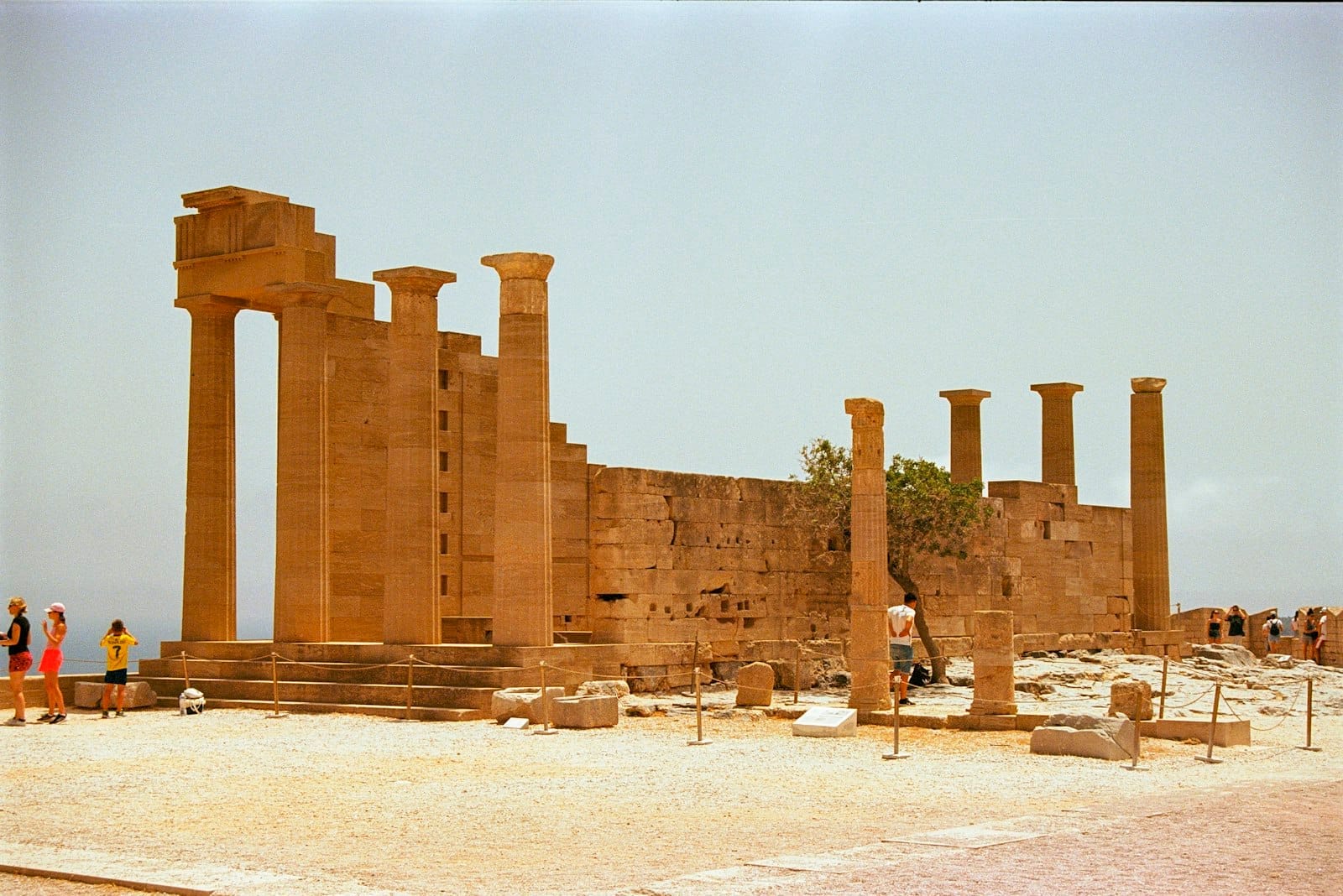
The Acropolis of Lindos is one of the most consequential ancient sites in the Aegean. Founded around the 10th century BC by Dorian settlers, it sits atop a 116-metre vertical cliff on the southeast coast of Rhodes and has been continuously occupied, modified, and fought over for roughly three thousand years. What survives today is a layered palimpsest: a Dorian sanctuary at its core, reshaped into a Hellenistic showpiece, later fortified by the Byzantines, and finally refortified by the Knights of St John in the 14th century.
The site is dominated by the Temple of Athena Lindia. A sanctuary dedicated to Athena existed here as early as the 9th century BC, but the temple visible today dates in its final form to around 300 BC, rebuilt in the Doric order after an earlier structure burned down in 342 BC. The Hellenistic stoa below the temple portico stretches 87 metres and originally featured 42 columns, framing one of the most theatrical architectural approaches in ancient Greece.
ℹ️ Good to know
Arrive before 9am or after 4pm in summer to avoid the worst of the midday crowds. The site is fully exposed — there is no shade on the acropolis plateau itself.
The Climb: What the Path Actually Looks Like
Getting to the acropolis requires some effort, and it is worth being honest about that. From the centre of Lindos village, a cobbled lane leads upward through whitewashed houses before giving way to a zigzagging staircase carved into the rock. The ascent takes between 15 and 25 minutes depending on your pace and the heat. The path is uneven in places, with worn stone steps that can be slippery when wet. Solid footwear is genuinely important here — sandals without grip are a poor choice.
Donkeys are available for hire near the base of the climb for those who cannot or prefer not to walk up. This is a traditional practice in Lindos, though the conditions vary and welfare standards have been a point of public discussion in recent years. If you hire one, the handler will accompany you.
The final approach passes through the medieval gatehouse built by the Knights of St John, then up the Hellenistic Grand Staircase. Even before reaching the temple, the view back toward the village and the twin bays on either side of the promontory is already extraordinary. Plan to pause here.
⚠️ What to skip
The Acropolis of Lindos is not wheelchair accessible. The terrain includes steep stone steps, uneven surfaces, and a Hellenistic staircase without modern handrails across much of the route.
Tickets & tours
Hand-picked options from our booking partner. Prices are indicative; availability and final rates are confirmed when you complete your booking.
Acropolis of Lindos Ticket with Downloadable Audio Tour
From 35 €Instant confirmationAncient Lindos Acropolis admission ticket
From 26 €Instant confirmationLindos 7 springs oasis and Acropolis tour from Rhodes
From 28 €Instant confirmationFree cancellationLindos Self-Guided Audiovisual Tour with 3D Models
From 9 €Instant confirmationFree cancellation
The Site Itself: Layers of Three Thousand Years
Once through the medieval gate and up the Grand Staircase, the site opens into a series of terraced levels. The Knights of St John left behind substantial fortification walls and a Governor's residence, portions of which remain in reasonable condition. Their 14th-century presence here was strategic: Lindos harbour below was among the most sheltered anchorages on the eastern Aegean, and holding the high ground above it mattered.
The Hellenistic stoa is the first major ancient structure you encounter. Originally a colonnaded hall 87 metres long, it served as a monumental forecourt to the temple above. Many of its columns have been partially re-erected through 20th-century restoration work, giving visitors a reasonable sense of the original scale. The Italian archaeological mission that worked here between 1902 and the 1940s oversaw significant excavation and some controversial reconstruction.
The Temple of Athena Lindia occupies the highest terrace. It is a small temple by mainland Greek standards, with a pronaos and cella, but its position is everything. The cliff drops away on three sides. On a clear morning, the island of Symi is visible to the northeast, and the coastline of Turkey shimmers to the east. The temple was an object of pilgrimage in antiquity: Alexander the Great reportedly stopped here before sailing to Persia, and the site attracted offerings from across the Greek world.
The archaeological finds from Lindos are now housed in the Archaeological Museum of Rhodes in Rhodes Town, which is worth visiting before or after your trip to Lindos to understand what once stood on this plateau.
How the Experience Changes by Time of Day
Early morning, before 9am, the acropolis receives a fraction of its midday visitor numbers. The light at this hour is soft and directional, ideal for photography, and the temperature is manageable even in July and August. The village below is quiet, the harbour still. You can stand in front of the Temple of Athena Lindia and hear only wind and gulls.
By 10:30am, tour groups from Rhodes Town begin arriving in earnest. Between roughly 11am and 2pm in peak season (June through August), the staircase and upper terraces become crowded enough to limit movement. The heat on the exposed plateau at midday in summer can reach 35°C or above with no relief. This is the time to be back in the village eating lunch in the shade.
Late afternoon visits, from around 4pm onward, offer a second window of relative calm. The light turns golden by 5pm and the views toward Turkey and Symi take on a different quality. Admission closes before sunset, so check current closing times before planning an evening approach. If you are visiting in May, June, September, or October, the midday heat problem largely disappears and the timing flexibility increases significantly.
For context on the best months to plan around, the guide to the best time to visit Rhodes breaks down weather, crowds, and pricing by season in detail.
Lindos Village: The Attraction Below the Acropolis
The acropolis does not exist in isolation. The village of Lindos directly beneath it is architecturally significant in its own right. The whitewashed cubic houses, many with pebble mosaic courtyards known as chochlakia, were built primarily by wealthy sea captains during the 17th and 18th centuries. Several are now tavernas or small hotels. The lanes connecting them are too narrow for vehicles and trap the smell of jasmine and woodsmoke in the evenings.
Below the village, Lindos Beach curves around a sheltered bay to the north, while the smaller St Paul's Bay (where the apostle reportedly landed in 51 AD) lies to the south beneath the cliff. Both are accessible on foot from the village. The combination of an ancient acropolis, a medieval village, and two swimming beaches makes Lindos one of the most complete day-trip destinations on the island.
For a full picture of the area, the Lindos neighbourhood guide covers beaches, restaurants, accommodation, and how to structure a full day or overnight stay.
Practical Details and Honest Limitations
Admission to the Acropolis of Lindos was €20 per adult as of 2025. Opening hours are subject to seasonal change and are not always published in advance with reliability — the safest approach is to check with your accommodation in Lindos the evening before your visit or confirm via the Greek Ministry of Culture's official site. The site generally follows the broad pattern of Greek archaeological sites: opening mid-morning and closing before sunset, with reduced hours in winter.
Bring water. More than you think you need. There are no kiosks or shade structures on the acropolis itself. A hat and sunscreen are not optional in summer. The exposed limestone plateau reflects and amplifies heat in ways that catch visitors off guard.
Photography is permitted throughout the site. The morning light falls from the east, illuminating the temple facade directly. The afternoon light turns the cliff face and the sea below warm amber. A wide-angle lens is useful for the stoa and the panoramic views; a standard lens handles the temple columns well. For those using phones, the views are hard to capture in a single frame without a panoramic mode.
If you are planning photography across multiple Rhodes sites, the Rhodes photography guide includes timing and location advice for the island's most photogenic spots.
💡 Local tip
Wear footwear with grip, not slip-on sandals. Carry at least one litre of water per person. The descent through the village is steeper than it looks from below and becomes more demanding if your legs are already tired from the site.
Who This Site Is Not For
If you have significant mobility limitations, the Acropolis of Lindos is genuinely inaccessible. The route from the village involves extended staircase sections with no alternative. Visitors with heart conditions or heat sensitivity should be cautious about midday visits in July and August. The site also requires a tolerance for crowds during peak season — if you are the type of traveller who finds crowded ancient sites more stressful than moving, consider visiting Lindos in May or October when visitor numbers drop significantly. Those expecting a site comparable in scale and completeness to the Acropolis of Athens will find Lindos smaller and more ruined, though the setting arguably surpasses it.
Insider Tips
- The small Byzantine church of Agios Ioannis (St John) sits just inside the Knights' fortification wall, often overlooked by visitors rushing toward the temple. It contains faded frescoes and is worth a minute of your time.
- If you visit in summer, buy water in the village before you start climbing. The price of anything sold near the base of the steps is inflated, and there is nothing available once you are on the acropolis itself.
- The chochlakia pebble-mosaic courtyards in the captain's houses below the acropolis are most visible in the morning light. Many are attached to cafes that open for breakfast — a good way to see them without feeling like you are trespassing.
- The view from the acropolis toward St Paul's Bay to the south is less photographed than the north view toward the main beach and village, but arguably more dramatic. Walk to the southern edge of the upper terrace for it.
- If you are driving from Rhodes Town, arrive in Lindos by 8:30am. The village's single approach road becomes congested by mid-morning in summer, and parking is limited to designated areas at the village perimeter.
Who Is Acropolis of Lindos For?
- History and archaeology enthusiasts who want context for ancient Greek religious architecture
- Photographers working in the golden hours of early morning or late afternoon
- Travellers combining a cultural site with swimming — the beaches below are excellent
- Couples looking for a scenic day trip from Rhodes Town that rewards the effort
- Visitors with a serious interest in medieval history, given the Knights' fortifications layered over the ancient structures
Nearby Attractions
Other things to see while in Lindos:
- Lindos Beach
Lindos Beach, officially known as Megali Paralia, stretches along a sheltered bay beneath the towering Acropolis of Lindos on Rhodes' southeast coast. With clear, shallow water and organised facilities from May to October, it draws families, couples, and day-trippers seeking one of the Aegean's most dramatically framed swimming spots. Here is everything you need to plan your visit honestly and well.
- Saint Paul's Bay
Saint Paul's Bay, known in Greek as Agios Pavlos, is a near-circular sheltered cove at the foot of the Lindos Acropolis. Its pale turquoise water, clifftop chapel, and striking natural framing make it one of the most recognizable spots on Rhodes, though the experience varies considerably depending on when you arrive.